A Guinness reversal, a disputed 508 km/h run and a limiter that decided a record: how the Chiron, Tuatara and Venom F5 contest the crown.
The accepted production car speed record is Bugatti's Veyron Super Sport at 431.072 km/h, a two-way average from 2010. Bugatti's Chiron, the SSC Tuatara and the Hennessey Venom F5 have all produced larger claims or aims, but disputes over limiters, verification and two-way averages have kept the crown contested.
In April 2013 the organisation that certifies world records said the fastest production car on Earth was no longer valid. Five days later it said the record had not been disqualified after all, and five days after that it confirmed Bugatti's 431.072 km/h (267.856 mph) run. The argument was about a speed limiter, and it explains why the title of fastest production car has been disputed ever since.
What counts as a production car?
For the purposes of record-keeping, a production car is a vehicle built mainly for retail sale to consumers for personal use on public roads. It must be on sale to the public matching the record car's specification, and it must be street-legal in its intended markets after meeting the test or inspection rules of the United States, the European Union or Japan. It also has to be sold in more than one national market.
The list that tracks these records applies several further filters. It covers road cars built after the Second World War that exceeded 200 km/h (124 mph), with the Benz Velo, the first petrol-driven car, as its only exception. Cars made before 1981 must come from the original manufacturer without changes by tuners or individuals. A modified car can qualify only if the manufacturer's own identification code appears on its VIN: cars built by RUF using Porsche parts carry RUF's code W09 and are eligible, while cars RUF modified under Porsche's code WP0 are not.
How is top speed measured?
The test requires a run in both directions during an independent road test, and the car's top speed is the mean of the two. Running both ways cancels out the help from a tailwind or a gradient. If a limiter was removed for the test but the car is sold with it fitted, the limited speed is the one accepted. In the case of the McLaren F1, the figure used is Car and Driver's estimate of its speed at the rev-limiter.
A rule that mattered a great deal was the production minimum. The list once demanded 25 cars, but the Koenigsegg Agera RS was found ineligible because only 11 cars had engines rated above 865 kW. The 25-car minimum was dropped and replaced by new rules based on suggestions from Koenigsegg's PR manager, Steven Wade.
Nobody owns the stopwatch: there is no agreed test and no body that can verify a claim.
Why do the fastest car claims keep getting disputed?
Because nobody is in charge. No standard method exists for working out top speed, and nobody has the power to verify claims, which makes historical comparisons especially hard.
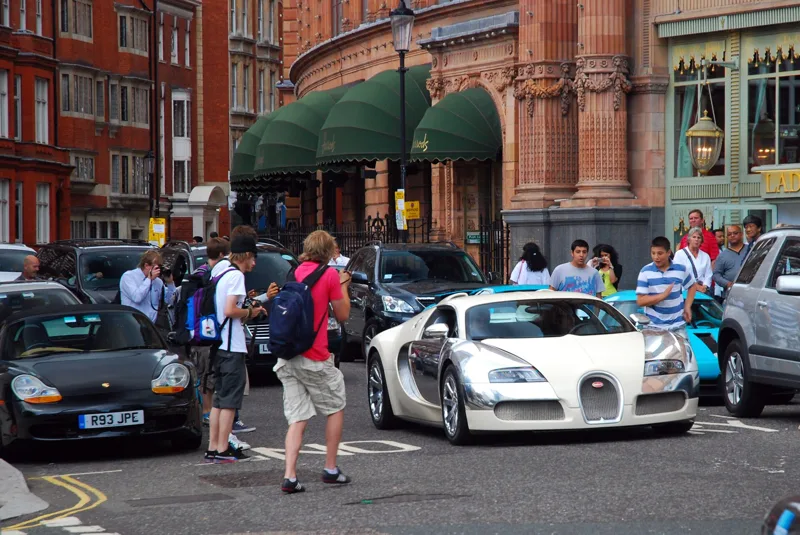
The Veyron story shows how messy that becomes. The Veyron Super Sport set its figure on 4 July 2010: 431.072 km/h (267.856 mph), averaged over two directions. Thirty identical Super Sports were built, five of them named World Record Edition. All 30 had electronic limiters, but on the record cars the limiters were switched off for the attempt and then switched back on, so every car was delivered to customers limited to 415 km/h (257.87 mph). Guinness listed the unlimited 431.072 km/h run as the production car speed record.
Then came the dispute. Hennessey had claimed the record for its Venom GT on the grounds of the limiter issue. According to The Sunday Times in April 2013, Guinness's public relations director Jaime Strang said that deactivating the limiter went against the official guidelines. Guinness then said the record had not been disqualified and was under review, and five days later announced a confirmation. After consulting external experts, it concluded that altering a speed limiter leaves the basic design of the car and its engine untouched. Hennessey's own run was slower than Bugatti's, lacked a two-way average and lacked the minimum 25-car run, so the dispute had run for two weeks by the time it ended.
What did the Bugatti Chiron do for the top speed record?
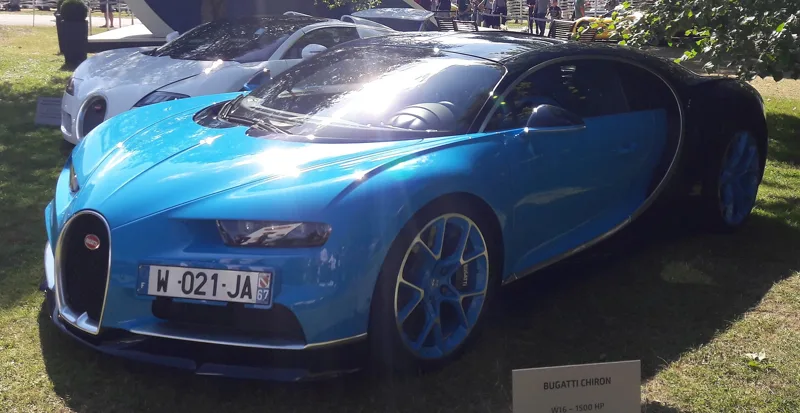
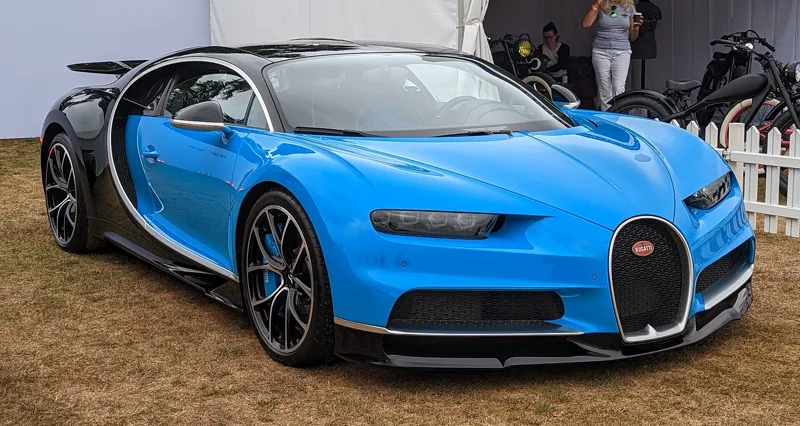
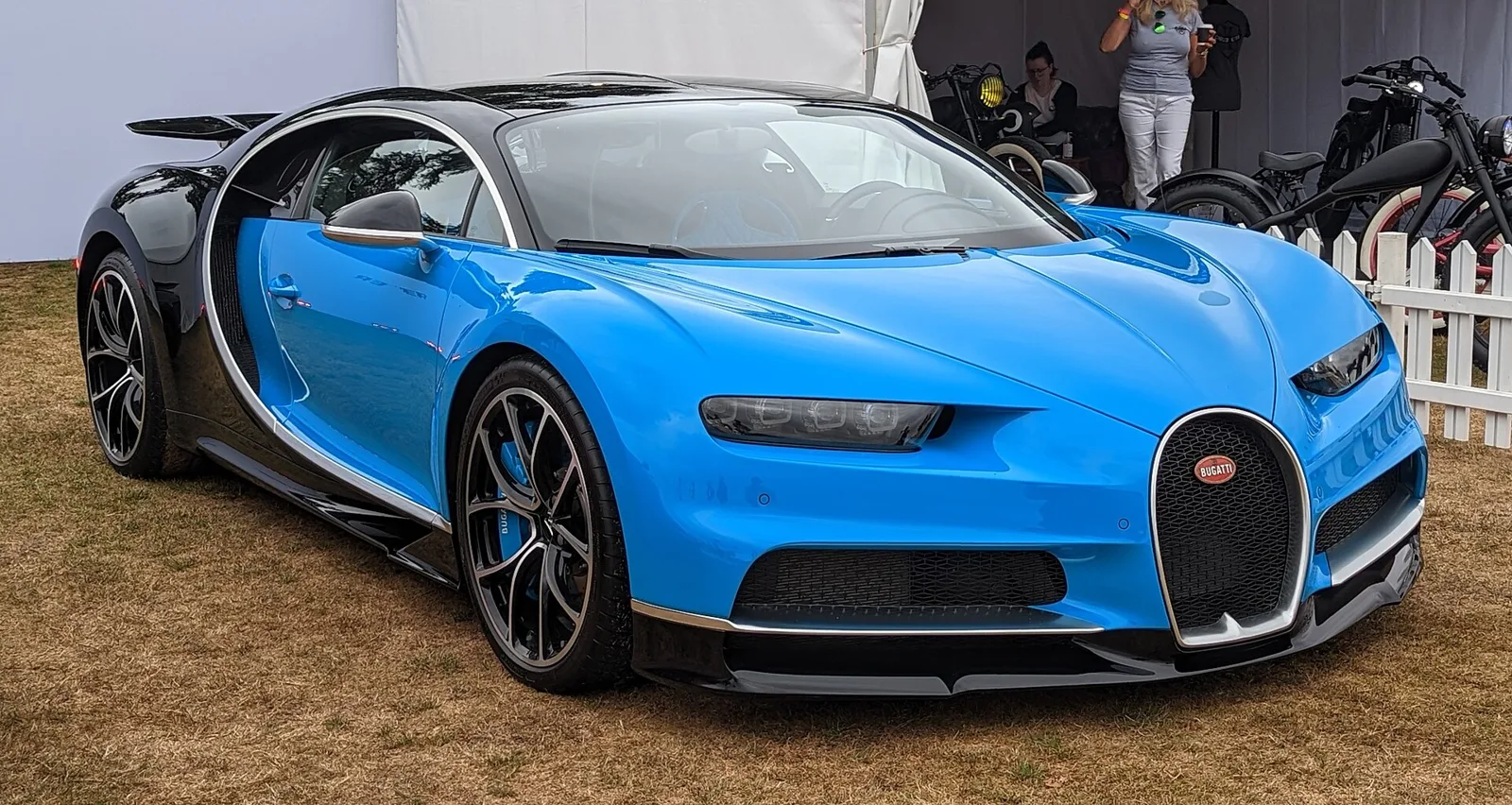
The Bugatti Chiron, which made its debut in Geneva on 1 March 2016, is a mid-engined two-seater that succeeded the Veyron. It is built at Molsheim in France and named after the driver Louis Chiron. The 7,993 cc quad-turbocharged W16 is the main component carried over from the Veyron, but it is heavily updated, rated at 1,103 kW (1,479 hp; 1,500 PS) and peaking at 6,700 rpm, with 1,600 N-m of torque available from 2,000 to 6,000 rpm.
Bugatti claims 0-100 km/h in 2.4 seconds, 0-200 km/h in 6.5 seconds and 0-300 km/h in 13.6 seconds. In a 2017 test, 400 km/h (249 mph) arrived in 32.6 seconds, and it then took 9.4 seconds to bring the car to a halt.
The standard car does not chase top speed. It is limited electronically to 420 km/h (261 mph), or 375 to 380 km/h (233 to 236 mph) without a specific key. The reason given is the tyres: Bugatti concluded that no tyre currently made could cope with the stress at the speed the car can reach. An owner who tested the car independently concluded that it easily attains its limited top speed.
The Super Sport 300+
The car that went after the outright record was the Chiron Super Sport 300+, presented on 8 September 2019 and limited to 30 examples at a net price of 3.5 million euros. Its W16 is the 1,600 PS (1,175 kW; 1,580 hp) unit that the Bugatti Centodieci also uses, paired with a gearbox with longer ratios, and its high-speed bumpers make the car 248.9 mm (9.8 in) longer.
Bugatti says that without the limiter the car could exceed 483 km/h (300 mph), and that a pre-production model reached 490 km/h (304.7 mph) in August 2019. The production cars carry a limiter, though Bugatti set up the cars of owners who wanted to find their limits on the Ehra-Lessien test track. The final 300+ was delivered on 21 July 2022. A related model, the Chiron Super Sport introduced in June 2021, is limited to 440 km/h (273 mph), and Bugatti cannot disable that limiter for prepared runs.
Is the SSC Tuatara the fastest production car?
The answer depends on whom you ask and what you count. The Tuatara is built by SSC North America in a purpose-built facility in Richland, Washington, with production limited to 100 cars. It replaced the Ultimate Aero, and Jason Castriota worked with SSC on the design. The engine began as a 6.9-litre twin-turbo V8, and its capacity was later cut to 5.9 litres so it could rev to 8,800 rpm. SSC said the power rating would be 1,350 hp (1,000 kW), rising to 1,750 hp (1,300 kW) on E85, and promised a top speed above 300 mph (483 km/h).
On 10 October 2020, SSC claimed a disputed record, pending independent confirmation, for the Tuatara. Driven by Oliver Webb on a closed stretch of Nevada State Route 160 near Pahrump, the car was said to have reached 331.15 mph (532.93 km/h) in one direction and 316.11 mph (508.73 km/h) averaged over both. SSC said that topped the Koenigsegg Agera RS mark, set on that same road in 2017, by 46.6 mph (75.0 km/h).
Doubts followed. SSC founder Jerod Shelby said in a video that the run had been spoiled by doubts and that the top speed would need to be run again. On 21 July 2021 SSC released a statement saying the initial attempt had not reached 300 mph (483 km/h).
The verified runs
Later runs were checked by outside equipment. On 17 January 2021 the Tuatara managed 279.7 mph (450.1 km/h) northbound and 286.1 mph (460.4 km/h) southbound, for a mean of 282.9 mph (455.3 km/h) across a 2.3-mile (3.7 km) strip at the Launch and Landing Facility run by Space Florida. The car's owner, Larry Caplin, was at the wheel, and Racelogic, Life Racing, Garmin and IMRA each supplied satellite tracking that backed up the numbers. On 14 May 2022 his car hit 295 mph (475 km/h) in one direction on the same strip, checked by two Racelogic VBOX units and a Life Racing GPS system. In between, in April 2021, the Tuatara was damaged when its trailer flipped over in high winds in Utah.
Where does the Hennessey Venom F5 fit in?
The Hennessey Venom F5 is the contender that has set out to take the crown on paper. Hennessey wants to pass 311 mph (500 km/h) and so take the title of world's fastest production car. The F5 name borrows the top grade of the Fujita tornado scale, which describes winds of 261 to 318 mph (420 to 512 km/h).
The engine is Hennessey's own Fury, a twin-turbo 6.6-litre V8 making as much as 1,817 hp (1,842 PS; 1,355 kW). In April 2025 the company released an Evolution package for an extra $285,000, which lifts output to 2,031 hp (2,059 PS; 1,515 kW) on E85 fuel, and cars with it are claimed to reach 0-200 mph (0-322 km/h) in 10.3 seconds. Power goes to the rear wheels through a seven-speed single-clutch automated manual from CIMA. The chassis and body are almost entirely carbon fibre, and the car reportedly weighs 2,950 lb (1,338 kg) with fluids. Hennessey estimated a drag coefficient of 0.33 for the concept, and claims 0.39 for the production car, which has a smaller fixed spoiler in place of the concept's active aerodynamics.
Production was limited to 24 units. The price in the United States began at US$1.6 million and rose to US$2.1 million for the final 12, and in August 2021 the company said all 24 were sold. A more track-focused Venom F5 Revolution is limited to 36 units, with an approximate price of $2.7 million. On 30 July 2024, John Hennessey drove the Venom F5 to a production-car standing half-mile record of 14.44 seconds at 219 mph (353 km/h) in Florida.
How do the contenders compare?
| Car | Headline figure | Status |
|---|---|---|
| Bugatti Veyron Super Sport | 431.072 km/h two-way average, 4 July 2010 | Guinness record confirmed after review; 30 built, delivered with 415 km/h limiter |
| Bugatti Chiron Super Sport 300+ | 490 km/h, pre-production car, August 2019 | Bugatti's figure; 30 limited cars, 3.5 million euros each |
| SSC Tuatara | 508.73 km/h two-way average claimed, 10 October 2020 | Disputed; SSC later said the attempt did not reach 300 mph; verified two-way average of 455.3 km/h in January 2021 |
| Hennessey Venom F5 | Target in excess of 500 km/h | Hennessey's stated aim; 24 built, 14.44 s half-mile record in 2024 |
What does top speed mean if you buy one?
Very little of it will ever be used on the road. Every Veyron Super Sport was delivered with a limiter, and so was the standard Chiron. The Chiron's base price was 2,400,000 euros, with a 200,000 euro deposit, and buyers had taken the first 200 cars before delivery of the first. Europe and the Middle East received the first three, in March 2017. By January 2022 every Chiron had been sold, and production ended in May 2024 with the Chiron L'Ultime.
The Chiron Super Sport that followed the 300+ sold for 3.2 million euros, and between 70 and 80 were built including the L'Ultime. It closes the book on the W16 engine, and probably on any engine of that layout. The Chiron Profilee, a single car, was sold at auction by RM Sotheby's on 1 February 2023 for 9,792,500 euros after the 500 Chiron slots had all been assigned.
Other buyers get a different bargain. SSC's Tuatara includes a touch screen on the centre console, a camera system in place of mirrors and a speedometer that reads up to 300 mph (483 km/h), and its ride height can change between Sport mode and Track mode. Hennessey says it paid attention to interior space so that tall drivers fit.
Where does the top speed race go next?
The next step belongs to Hennessey, whose stated ambition is to pass 500 km/h in the Venom F5. SSC has said a smaller supercar nicknamed Little Brother is at an early stage of development, aimed at a lower price point than the Tuatara. Bugatti continues to build cars based on the Chiron, though the Chiron production run itself has finished.