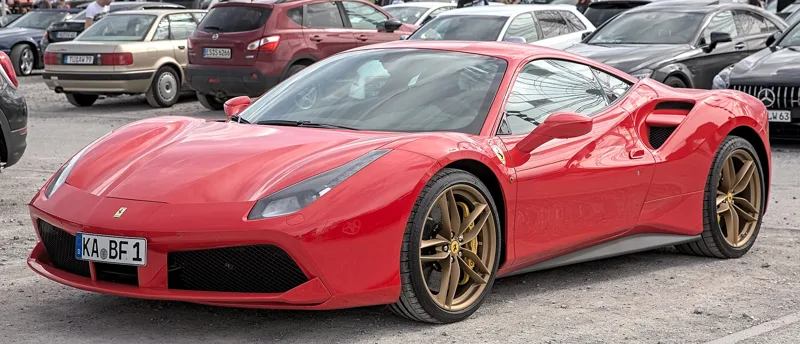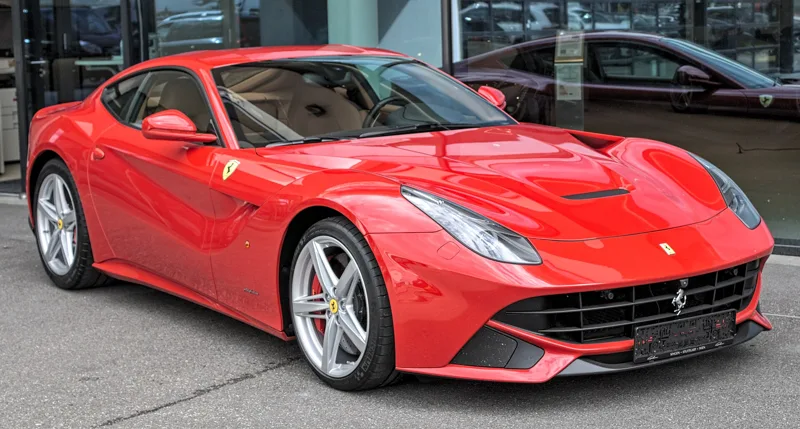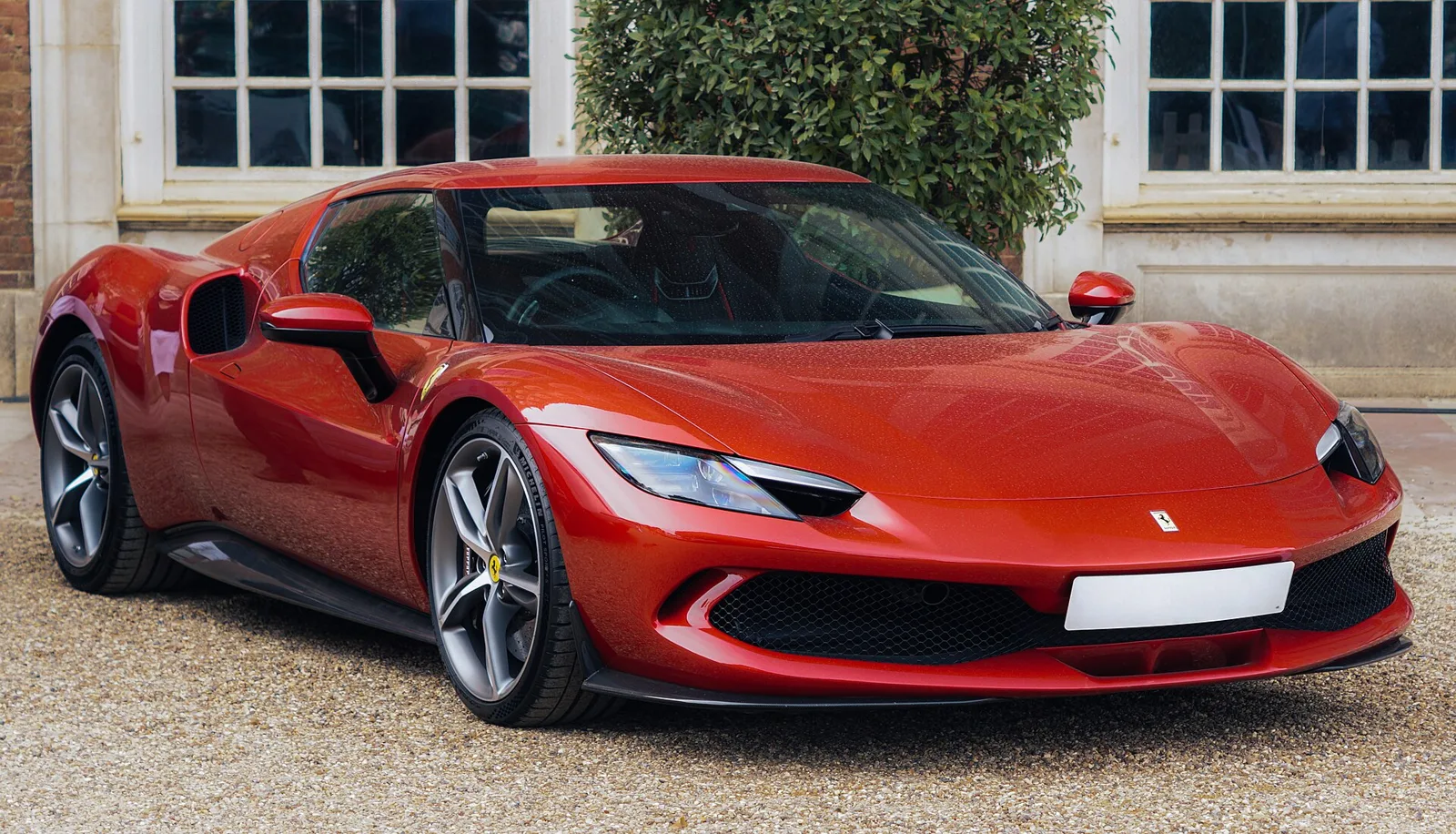
One small hybrid V6, one 1,000 PS plug-in V8 and one elegant 2+2 grand tourer: what each Ferrari does, how far it runs on electricity and who it is aimed at.
The Ferrari 296 is an 830 PS plug-in hybrid with a twin-turbo V6, the SF90 Stradale is a plug-in hybrid with a twin-turbo V8 rated at 1,000 PS, and the Roma is a 620 PS front-engined turbo V8 grand tourer with no hybrid system and a 2+2 cabin.
Ferrari spent decades keeping six-cylinder engines away from the prancing horse badge, then put one in an 830 PS plug-in hybrid and called it a proper Ferrari. That car, the 296, now sits in a line-up beside the 1,000 PS SF90 Stradale and the front-engined Roma, and the three could hardly be more different in character.
Why is the Ferrari 296 such a break with tradition?
The 296 is the first stock Ferrari with six cylinders other than the Dino 206 GT, 246 GT and 246 GTS, cars that Ferrari built but sold under the separate Dino marque. Unveiled on 24 June 2021 and on sale in 2022, it carries the Ferrari name without qualification.
Ferrari's old V12-only policy explains the history: until 1974 the smaller-engined cars were sold as Dino models, kept below the flagship V12 cars. The new name reprises that scheme: 296 means a 2.9-litre engine with six cylinders, and GTB stands for Gran Turismo Berlinetta. Two seats, a coupe GTB and a GTS with a folding hard top: the engine sits behind the cabin and the rear wheels take the power.
A six-cylinder hybrid, a 1,000 PS plug-in V8 and a front-engined turbo grand tourer: three Ferraris, three different answers.
How does the 296 hybrid V6 work?
A twin-turbocharged V6 with its cylinder banks set at 120 degrees drives the rear wheels, and an electric motor sits between the engine and the gearbox. Together they make 830 PS (610 kW; 819 hp), and the car can run on electricity alone for short stretches.
The engine is the F163 BC, displacing 2,992 cc, and it makes 488 kW (654 hp; 663 PS) at 8,000 rpm. The motor adds 123 kW (165 hp; 167 PS) and 315 Nm (232 lb-ft). Combined torque is 740 Nm (546 lb-ft) at 6,250 rpm. Ferrari quotes 0-100 km/h in 2.9 seconds and a top speed of more than 330 km/h (205 mph).
Think of the motor as a second pair of lungs fitted to the crankshaft. At low revs, where a small turbocharged engine is still gathering breath, the motor can fill the gap; at high revs both push together. A battery under the floor stores 7.45 kWh (26.8 MJ), enough for 25 km (16 mi) of electric driving. Ferrari says the electric mode is there for city centres that admit only zero-emission running. Its power-to-weight figure for the 296 is 560 hp/ton.
What makes the SF90 Stradale different?
The SF90 Stradale pairs a 4.0-litre twin-turbo V8 with three electric motors. It takes its name from Ferrari's SF90 Formula One car, with 90 marking the 90th anniversary of Scuderia Ferrari, while Stradale is Italian for made for the road. The V8 alone is rated at 1,000 PS.
The V8 is the F154, an evolution of the engine in the 488 Pista and F8 Tributo. Ferrari widened each bore to 88 mm (3.46 in), taking capacity to 3,990 cc. The heads are narrower, the injectors sit centrally and run at 35 MPa (5,100 psi), and the exhaust manifold is made of inconel. Ferrari also dropped the whole engine 50 mm (2.0 in) in the chassis relative to its other mid-engined V8 cars, to keep the centre of gravity low. Output is 735 kW (1,000 PS; 986 hp) at 7,500 rpm, with 800 N m (590 lb ft) at 6,000 rpm.
The electric side adds 162 kW (220 PS; 217 hp). Two of the three motors drive the front wheels, one each, which gives the car torque vectoring up front. Those same motors also double as the reverse gear, because the new eight-speed dual-clutch gearbox has no reverse of its own. Omitting it helped the new unit shed 10 kg (22 lb) and shrink against the seven-speed it replaces, and Ferrari says shifts are 30% faster at 200 milliseconds.
How does the SF90 Stradale drive on electricity?
A 7.9 kWh lithium-ion battery gives the SF90 Stradale 26 km (16 miles) of electric range. The driver picks one of four modes with the eManettino knob on the steering wheel: eDrive, Hybrid, Performance or Qualify, each trading efficiency against response.
eDrive runs the car on the electric motors only. Hybrid is the default and lets the control logic shut the engine down when conditions suit, then restart it when the driver asks. Performance keeps the engine running to charge the battery and hold the car ready to respond. Qualify uses the whole powertrain at full effort.
Behind those modes sits a layer of software. The control logic works across three areas: the high-voltage systems, the RAC-e torque vectoring, and the MGUK alongside the engine and gearbox. The car also has eSSC, electric Side Slip Control, which manages how torque reaches all four wheels, and eTC, a brake-by-wire system that blends hydraulic braking with the electric motors for regeneration and torque vectoring.
How fast is the SF90 Stradale?
Ferrari states 2.5 seconds from rest to 100 km/h, 6.7 seconds to reach 200 km/h, and a ceiling of 340 km/h (211 mph). The car weighs 1,570 kg (3,461 lb) dry, including 270 kg (595 lb) of electrical equipment, and its chassis combines aluminium with carbon fibre.
On the Fiorano circuit it was, as of 2020, the fastest Ferrari road car, seven tenths of a second quicker than the LaFerrari. That same year it set the quickest lap of the Top Gear test track ever broadcast, 1:11.3.
Aerodynamics matter as much as power here. Ferrari claims 390 kg (860 lb) of downforce at 250 km/h (155 mph), a figure it credits to new aero and thermal findings. The rear wing is in two parts, borrowing the drag reduction idea from Formula One: a fixed element holds the rear light, while moving parts, which Ferrari calls the shut-off Gurney, use electric actuators to blend into the bodywork and maximise downforce. The cab-forward shape makes room for the extra radiators the hybrid system needs. Lead designer Flavio Manzoni described the look as sitting between a spaceship and a race car, and the rear side profile recalls the 1960s 330 P3/4.
What is the Ferrari Roma?
The Roma is a grand tourer with a twin-turbo V8 at the front of the chassis, rear-wheel drive and a 2+2 cabin. It has no hybrid system. Based on the Portofino, it succeeds that car and sits below the F8 in Ferrari's sports car range.
Ferrari introduced it online on 13 November 2019 as a coupe and unveiled it in Rome the following day, at the Stadio dei Marmi. A soft-top Roma Spider followed in March 2023, the first front-engined Ferrari with a fabric roof since the 1969 365 GTS4, a gap of 54 years. Ferrari describes the Spider as the replacement for the Portofino.
The 3.9-litre F154 V8 (3,855 cc) makes 456 kW; 612 hp (620 PS) between 5,750 and 7,500 rpm, and 761 N m (561 lb ft) between 3,000 and 5,750 rpm. Two parallel turbochargers, cooled by water, feed the engine through a pair of air-to-air intercoolers, and a dry sump helps keep oil where it belongs during hard cornering. Power goes through the same eight-speed dual-clutch transmission as the SF90 Stradale, though the Roma keeps a mechanical reverse gear. Ferrari says third gear has 15 percent more longitudinal pull than in the previous seven-speed.
Ferrari engineered the Roma 200 kg (441 lb) lighter than the Portofino whose platform it shares, and says 70 percent of its parts are new. Dry weight is 1,472 kg (3,245 lb), with a 50/50 front-to-rear split. The active rear wing has three positions and manages up to 95 kg (209 lb) of downforce once the car reaches 250 km/h (155 mph). Published figures are 3.4 seconds to 100 km/h, 9.3 seconds to 200 km/h and a top speed above 320 km/h (199 mph).
How do the three cars compare?
| Figure | 296 GTB | SF90 Stradale | Roma |
|---|---|---|---|
| Layout | Rear mid-engine, plug-in hybrid | Mid-engine, plug-in hybrid | Front mid-engine, 2+2, turbo only |
| Engine | 2,992 cc twin-turbo V6 | 3,990 cc twin-turbo V8 | 3,855 cc twin-turbo V8 |
| Output | 830 PS combined | 1,000 PS from the V8 alone | 620 PS |
| 0-100 km/h | 2.9 s | 2.5 s | 3.4 s |
| Top speed | Over 330 km/h | 340 km/h | Over 320 km/h |
| Battery | 7.45 kWh | 7.9 kWh | None |
| Electric range | 25 km | 26 km | None |
Which open-top and track versions exist?
All three cars have been stretched in both directions: roofs that fold away, and packs that strip weight out and add downforce. The 296 GTS has a folding hard top that takes 14 seconds to operate and works at up to 45 km/h (28 mph). Reinforcements make it 70 kg (154 lb) heavier than the GTB, but Ferrari says performance is equal.
The SF90 Spider has a retractable hard top and was the first open-top Ferrari plug-in hybrid. With 735 kW (1,000 PS; 986 hp) it is described as the most powerful non-limited convertible in the world, taking the record from the 812 GTS, and its performance is close to the closed car and on par with the LaFerrari Aperta.
For the track, the 296 Assetto Fiorano adds upgraded suspension, carbon fibre bodywork and a polycarbonate rear window screen. The SF90 equivalent uses Multimatic shocks, carbon parts in the doors and underbody, a titanium exhaust and carbon wheels, saving 30 kg (66 lb). Beyond that sits the SF90 XX Stradale and Spider, road legal but track focused, with 758 kW (1,030 PS; 1,016 hp) in total, with 586 kW (797 PS; 786 hp) from the V8 and 171 kW (233 PS; 230 hp) from the electric motor. Ferrari built 799 XX Stradale and 599 XX Spider cars, and all were pre-allocated to customers.
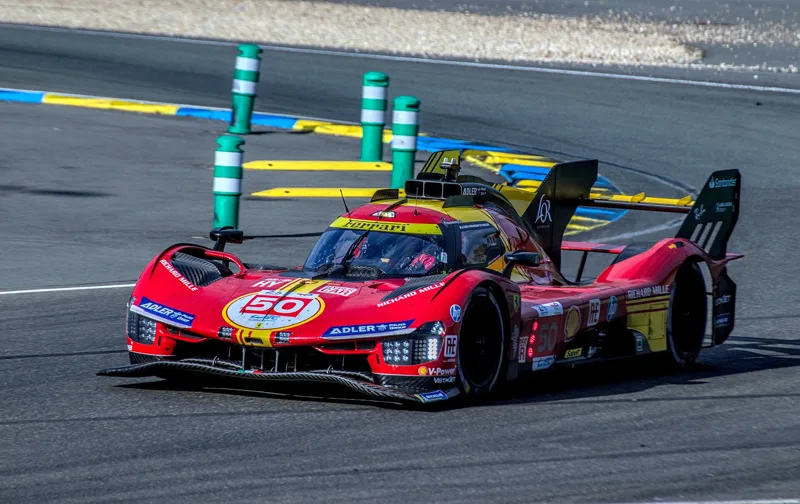
The 296 Speciale, announced in April 2025, lifts the V6 to 515 kW; 690 hp (700 PS) and the hybrid total to 647 kW; 868 hp (880 PS). Dry weight is 1,410 kg (3,109 lb) for the coupe and 1,460 kg (3,219 lb) for the folding hard top, with a claimed 20% more downforce than the base car. A Speciale Piloti was shown at the 2025 24 Hours of Le Mans, its yellow and red livery recalling the 499P that races in the Hypercar class.
What has the 296 done in racing?
The 296 GT3, developed by Oreca and introduced in 2022, replaced the 488 GT3 from 2023 and made its debut at the 2023 24 Hours of Daytona. It has won steadily since, on both road-circuit and endurance calendars.
- 21 May 2023: Frikadelli Racing won the 24 Hours of Nurburgring with 162 laps, setting a new distance record.
- 28 January 2024: Risi Competizione took the GTD PRO class at the 24 Hours of Daytona.
- 2024: In the GT World Challenge Europe Endurance Cup, Alessandro Pier Guidi and Alessio Rovera took the drivers' title in the No.51 car and AF Corse the teams' title.
- 2024: Liam Talbot and Chaz Mostert won GT World Challenge Australia for Arise Racing, only the second Ferrari success in the Australian GT Championship, which dates from 1960, since Allan Simonsen in 2007.
- 16 November 2025: Antonio Fuoco won the FIA GT World Cup in the No.50 car, Ferrari's first win in Macau.
Vista AF Corse added LMGT3 class wins at the 2024 6 Hours of Fuji and the 2024 8 Hours of Bahrain, and Ferrari took LMGT3 at the 2025 6 Hours of Spa-Francorchamps. A one-make 296 Challenge, first spotted testing at Monza in February 2023, made its debut in the 2024 Ferrari Challenge.
Who is the Roma for, and what does it cost?
The Roma was priced from $218,670 in 2020 US dollars. Typical final build-outs ran from $270k to $310k and up. Ferrari estimated that seven in ten buyers would be new to the brand, and pointed the car directly at the territory of the Porsche 911 and Aston Martin.
The design theme is what Ferrari calls understated elegance, a step away from the usual Ferrari road car. The shape was influenced by the 250 GT Lusso and 250 GT 2+2, with flush door handles, slim LED lights and a rear spoiler that sits flat when the car is driven gently. Inside, a 16.0-inch wrap-around screen and the steering wheel come from the SF90 Stradale, there is an 8.4-inch portrait screen in the centre, and a third screen on the passenger side is optional. The Roma won a Red Dot award in 2020, the Auto&Design Magazine award for best production car design that year, and the 2021 Esquire Car Awards title of Best Designed Car. Fuel economy is quoted at 12.4 L/100 km (22.8 mpg-imp; 19 mpg-US) combined.
For a buyer, then, the 296 offers a small hybrid with a short electric range for low-emission zones, the SF90 Stradale offers a 1,000 PS flagship with a 26 km (16 miles) battery, and the Roma offers a turbocharged grand tourer without a hybrid system.
What are the 296 GT3 Evo, GT Modificata and CZ26?
Ferrari's plans for the 296 family run mainly on the track. The 296 GT3 Evo, revealed on 27 June 2025 during the 24 Hours of Spa and aimed at a 2026 debut, has a new gear ratio cascade to favour torque at low and high speeds, improved cooling with two air intakes on the bonnet, and a redesigned rear wing. Its first race outing came at Daytona, in the 2026 24-hour round.
In September 2026 Ferrari unveiled the 296 GT Modificata, a track-only special built from the 296 GT3 Evo race car and released from motorsport rules, with 730 horsepower. At the 2026 Pebble Beach Concours d'Elegance it showed the CZ26, a one-off created through its Special Projects programme for a single client. Ferrari presents it as a full rethink of the SF90 Stradale, with bespoke bodywork drawn by its design studio under Flavio Manzoni. In October 2024, the Tailor Made division also showed a one-off Roma Spider Oro at the Enzo Ferrari Museum in Modena, on display until February 2025.