A Beetle with a hidden driver, a Mustang a court called a prop, a police Dodge that wrecked a record and an ambulance that fought ghosts.
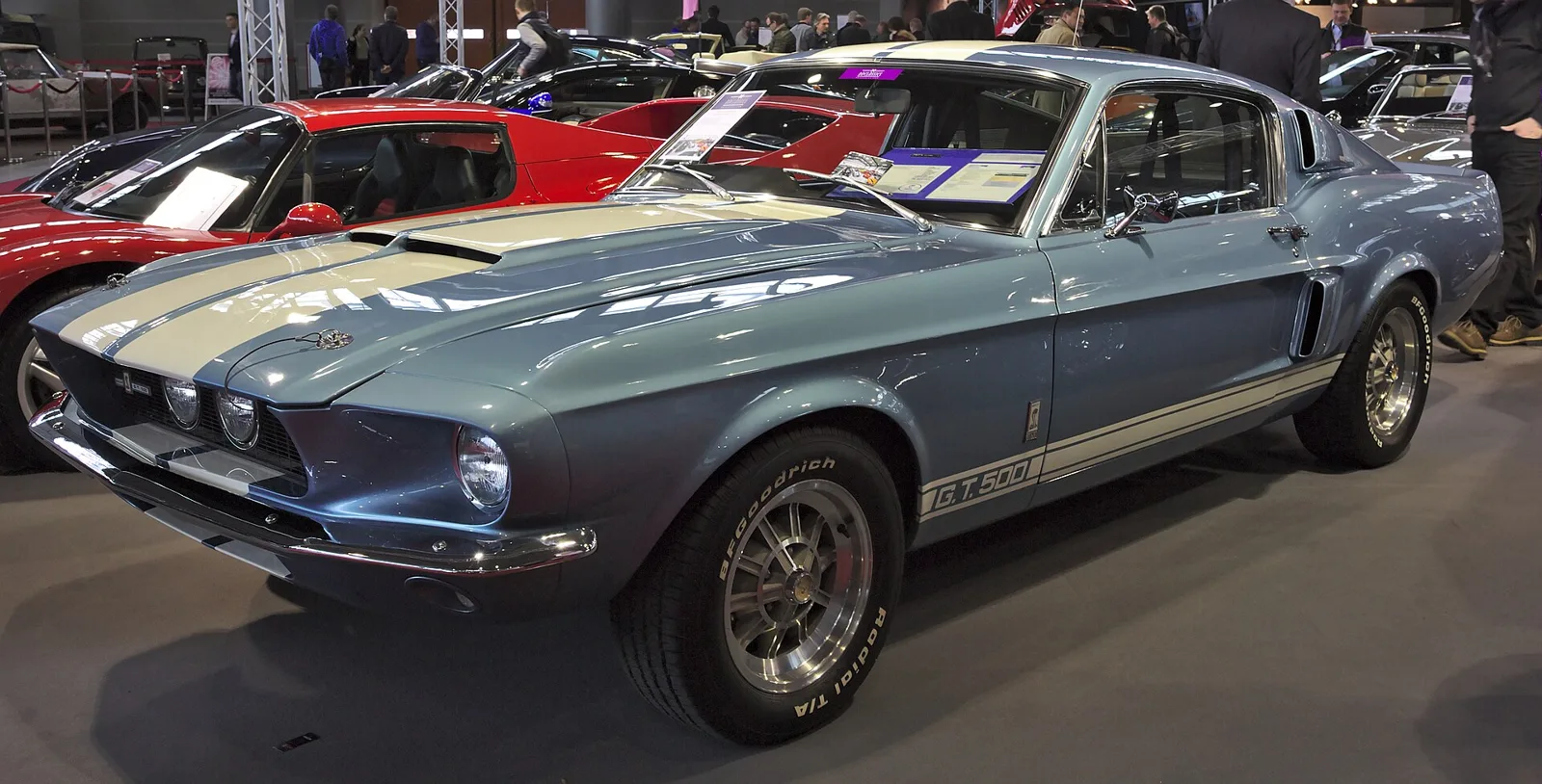
Herbie is a 1963 Volkswagen Beetle, Eleanor a Mustang (1971 in 1974, a 1967 Shelby GT500 in 2000), the Bluesmobile a 1974 Dodge Monaco and the Ectomobile a 1959 Cadillac ambulance conversion. Each became a collectible screen character, though a 2025 US ruling called Eleanor a prop.
In June 2025 a United States appeals court decided that a Ford Mustang called Eleanor is a prop, not a character. The ruling ended years of lawsuits from the widow of the man who made the original film, and it turned on a three-part test: whether a vehicle has human qualities, consistent traits and distinctive features of its own.
Herbie passes that test with ease, since he is a Volkswagen with a mind of his own. The Bluesmobile and the Ectomobile sit somewhere between the two, as machines that audiences treated as members of the cast.
Four film cars at a glance
| Car | Real base vehicle | Film | Notable figure |
|---|---|---|---|
| Herbie | 1963 Volkswagen Beetle | The Love Bug, 1968 | Racing number 53 |
| Eleanor | 1971 Ford Mustang, then a customised 1967 Shelby GT500 | Gone in 60 Seconds, 1974 and 2000 | Two cars used in 1974; 128-foot jump |
| Bluesmobile | 1974 Dodge Monaco | The Blues Brothers, 1980 | 13 cars used |
| Ectomobile (Ecto-1) | 1959 Cadillac Miller-Meteor ambulance conversion | Ghostbusters, 1984 | Bought in the story for $4,800 |
Eleanor, a court said, is a prop and not a character.
Herbie the Love Bug: how a Beetle drove itself
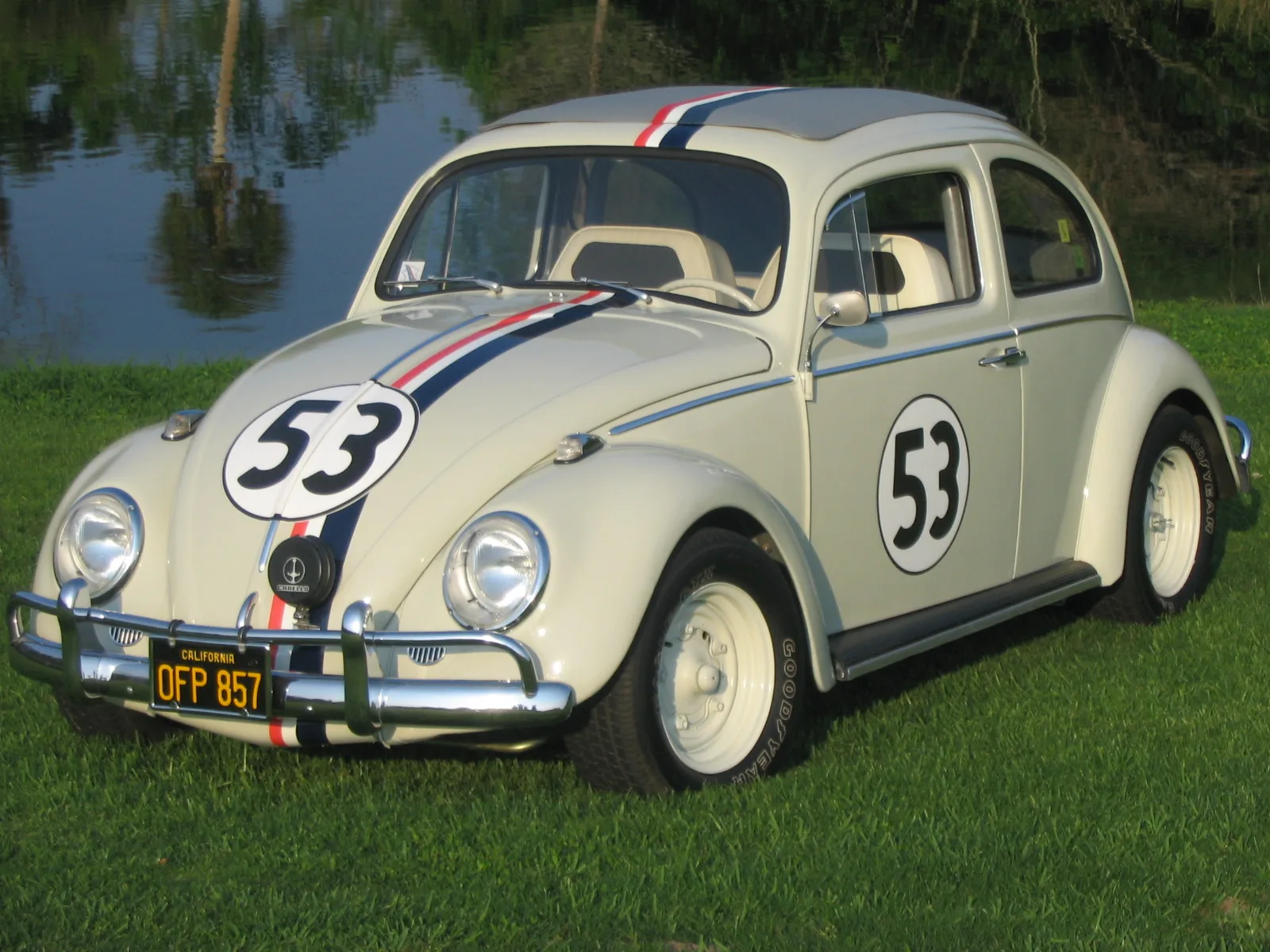
Herbie is a pearl-white 1963 Volkswagen Beetle with red, white and blue stripes from bumper to bumper, a racing number 53 on the front lid, doors and engine cover, and a California plate, yellow on black, reading OFP 857. He first appeared in Disney's The Love Bug in 1968, and has since been the central figure of five cinema films, a 1997 television movie and a short-lived series. In the first film the mechanic Tennessee Steinmetz names the car after an uncle, a middleweight boxer whose nose looked like a Beetle's bonnet.
Making a car drive itself took trickery. Disney fitted a second steering column beneath the front seat so that a driver lying in the back could steer, linked by sprockets and pulleys, with a second set of pedals, clutch cables and a gearshift extension. In The Love Bug the hidden driver sat just low enough to see over the windscreen and stay out of shot. On the next two films, Herbie Rides Again and Herbie Goes to Monte Carlo, Disney added a Carello fog light on the bonnet that concealed a small camera, letting the driver sit lower still.
One car, many small changes
The details changed from film to film. In The Love Bug the stripes were a lighter blue and did not cover the valances, and one racing Herbie carried a Porsche 356 engine and brakes with KONI dampers. Every Herbie lost its Volkswagen badges and wore plain hubcaps, to avoid trademark conflicts. Then the film became a hit, and Volkswagen, in financial trouble and with North American Beetle sales well below earlier decades, insisted that the logos go back on for Herbie Rides Again. The company also placed a Herbie-liveried Beetle in every showroom.
Herbie Goes to Monte Carlo used nine Volkswagens, many recycled for Herbie Goes Bananas, and fitted wide Goodyear racing tyres and a fake silver fuel cap. The car that walks the plank in Bananas was never recovered. It was thrown from the ferry M.N. Coromuel, and lies somewhere between La Paz and Baja California. The 1997 television movie and Herbie: Fully Loaded in 2005, which starred Lindsay Lohan and sent Herbie into NASCAR, both gave him major overhauls.
His reach has outlasted the films. Herbie has appeared in Disney parades and theme-park shows, in two racing video games from Disney Interactive Studios, in a Forza paint job and in liveries for the Grand Theft Auto Online car based on a Beetle, and the Detroit Red Wings defenceman Moritz Seider chose the number 53 after watching the film with his parents.
Eleanor in Gone in 60 Seconds: the Mustang that went to court
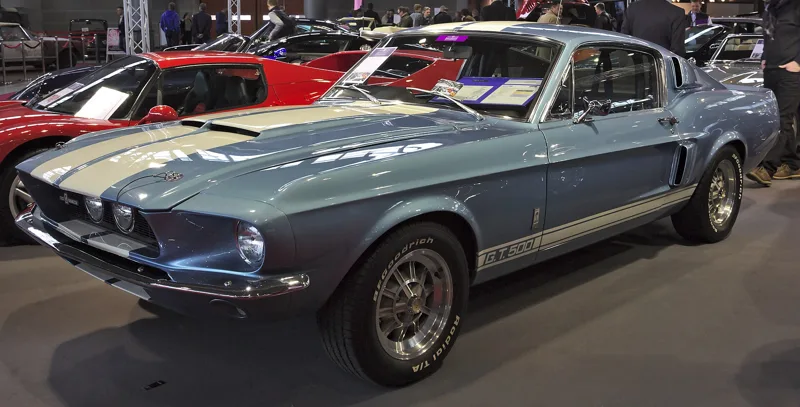
"Eleanor" is a code name. In the original 1974 Gone in 60 Seconds it referred to a 1971 Ford Mustang, and in the 2000 remake it became a customised Shelby GT500. Four Eleanor targets appear in the 1974 story, but only two cars were used, with plates and tyres swapped as needed: one built for stunt driving, one kept for beauty shots.
The two Sportsroof Mustangs were bought in 1971, and neither is proven to be a Mach 1, as is often assumed. The director, H.B. Halicki, took three years to raise the money to film, so each car was updated with 1973 grilles. He blacked out the lower body, taillight panel and bonnet, removed nearly all Mustang badges, and said in a 1974 interview that he painted the cars generic school-bus yellow to save money, rather than Ford's Medium Yellow Gold as claimed.
The stunt car
The stunt car needed 250 hours of work. It received a roll cage in its unibody, a chained-in transmission and a camera rig in the back seat, plus a heavy-duty shoulder harness, deadbolt door locks, bonnet pins, a 24-volt electrical system, a first-aid kit, kill switches, individually locking rear brakes and steel fish plating under the floor. Filming was dangerous. During a freeway sequence the stunt driver leading the traffic went past his mark and clipped the Mustang, which hit a light pole and knocked Halicki unconscious. Filming resumed the following week and the crash went into the film. His first words on waking were "Did we get coverage?" Afterwards he compressed several vertebrae landing the 128-foot jump near the end. The beauty car was undamaged, though Halicki claimed at the premiere that it had been crushed.
The 2000 remake and the lawsuits
In 1995 Halicki's widow, Denice, licensed the film's rights to Disney. The 2000 version, produced by Jerry Bruckheimer, starred Nicolas Cage as Randall "Memphis" Raines, and both films have thieves stealing a long order of cars, 48 in the original and 50 in the remake, for delivery to the Long Beach docks. Eleanor became a Dupont Pepper Grey 1967 Shelby GT500 fastback with a body kit designed by Steve Stanford and built by Chip Foose. Cinema Vehicle Services made eleven or twelve cars, depending on who is counting: three were fully functional and nine were shells, and seven reportedly survived. Between 2007 and 2009 Classic Recreations built licensed reproductions, and as of 2020 Fusion Motor Company held a licence for approved ones.
Denice Halicki spent years claiming she owned the copyright to Eleanor as a character, which unsettled the replica community. A 2004 case against Unique Performance was thrown out when a judge found that only Disney held the copyright to the sequel car. In 2008 the Ninth Circuit ruled in Halicki's favour against Carroll Shelby and Classic Recreations. In 2020 a case against the YouTube builder Chris Steinbacher, who was constructing a Shelby replica over a 2015 Mustang, went her way, and he had to give up the car. Then the tide turned. A 2022 suit brought by Carroll Shelby Licensing led a federal court in California to invalidate her claims, and the judge described the idea of Eleanor as a distinctive character as "an invention of overzealous advocacy". She appealed in 2023, and a judge dismissed her claims in June that year. In June 2025 the Ninth Circuit held Eleanor ineligible for copyright because the car is a prop, and failed all three parts of the Towle test: anthropomorphic qualities, consistent traits and distinctive qualities.
Bluesmobile: how the Blues Brothers car was destroyed
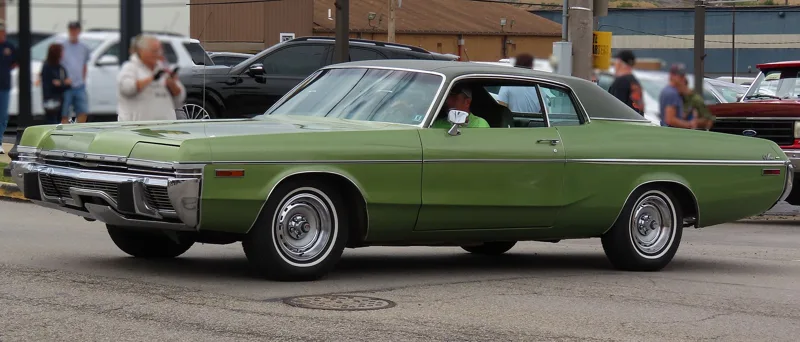
The Bluesmobile is a 1974 Dodge Monaco in the 1980 film The Blues Brothers, presented as a retired Mount Prospect police car that Elwood bought at auction, having swapped his earlier Bluesmobile, a 1968 Cadillac Sixty Special, for a microphone. It carries a 440 Magnum engine and the squad-car package, and an Illinois plate, BDR 529, that nods to a Toronto motorcycle club, the Black Diamond Riders. Dan Aykroyd, who co-wrote the film, picked the 440 Monaco because he thought it the hottest car police used in the 1970s. Elwood proves it by jumping it over the 95th Street Bridge in Chicago, and the car goes on to leap an open drawbridge, flip backwards in mid-air and briefly "fly". Its cigarette lighter, however, does not work.
Making it took 13 cars, all former California Highway Patrol vehicles dressed as Mount Prospect cars, which shared the same black-and-white livery. Some were set up for speed and others for jumps, and one was rigged for months to fall apart on arrival at the Cook County Building. More than 60 old police cars were bought for the chase scenes, with a body shop open 24 hours a day for repairs. At release the film held the world record for the most cars destroyed, until its 1998 sequel took it.
The roof loudspeaker was a copy of a Cold War air-raid siren, a CLM Model 92729DP, from the schoolyard where Aykroyd studied in Ottawa. Director John Landis has said that the section of the final chase beneath the elevated tracks, where the speedometer reads 190 km/h (118 mph), was really filmed at that speed, and he reshot scenes with pedestrians on the pavement to show the film had not been sped up. He calls the Bluesmobile "a magic car", and the extended version shows Elwood parking it in an electric substation, which Aykroyd suggested was where it drew its power.
The sequel Blues Brothers 2000 used a 1990 Ford LTD Crown Victoria, bought in the story for $500, with a 190 hp 351 cubic inch engine and a four-speed automatic. This Bluesmobile acts like a submarine, can be radio controlled and jumps about 300 feet. The film claimed the record for cars destroyed, at 104, with 63 wrecked in the main crash. Filming brought injuries too: the stuntman Bob Minor suffered serious head injuries, and a car rolling onto a crew member led to a leg amputation.
Ectomobile: the Ecto-1 from Ghostbusters
The Ecto-1 started as a 1959 Cadillac Miller-Meteor Sentinel, a limousine-style combination car converted from an ambulance. Its design is credited to Steven Dane, hardware consultant. In the first Ghostbusters, Ray Stantz pays $4,800 (about $14,875 in 2025) for a wreck that needs a long list of repairs. Afterwards it carries the team around New York with a rack built from the ambulance's gurney to hold the proton packs, plus roof-mounted gadgets whose purposes are never explained.
Aykroyd's early scripts gave it interdimensional travel, and the shooting script described a black car with purple and white strobes. The filmmakers switched to white because a black car would be too hard to see in night scenes. Three cars played the vehicle in the films, the third bought after the second died during Ghostbusters II, and a black Miller-Meteor at the start of the first film was leased for that scene only. The name Ectomobile appears only in a song on the soundtrack; the car's licence plate reads Ecto-1.
For Ghostbusters II it was overhauled and renamed Ecto-1a, and by 2021 it had gained a gunner's seat and a remote trap vehicle. Ghostbusters: Afterlife has Trevor, Egon Spengler's grandson, repair an Ecto-1 that had decayed in storage on the family farm in Oklahoma, and Ghostbusters: Frozen Empire gives it a roof-launched air drone with a trap. The 2016 reboot uses a 1984 Cadillac Fleetwood hearse instead. Sony restored the original for the video game, and it sits outside the Ghost Corps building with the 2016 car; the Ecto-1A, left to deteriorate at the Universal back lot, was weathered into one of two aged Ecto-1s for Afterlife and later used for Frozen Empire.
Replicas and toys
A replica built for a Universal Studios stage show sold at the Barrett-Jackson auction in Scottsdale on 22 January 2010 for $80,000, and another by Peter Mosen was bought by George Barris. Toys include a 1/25 Ecto 1A from AMT/Ertl in 1989, a Polar Lights model kit in 2002, Hot Wheels versions in 2010 and 1/18 diecasts in 2010 and 2013.
Why film cars became characters
Each of these cars gained a life beyond its film. Herbie has parks, games and a hockey player's jersey number. The Bluesmobile has die-cast models, the Ecto-1 has restored originals and licensed toys, and Eleanor has licensed reproductions, a museum car and a court ruling on whether any of this makes her a character. That ruling spelled out what a court weighs: human qualities, consistent traits and distinctive features.
Where this goes next
In 2017 a new Herbie series was reported in development at Disney XD, about a child who finds that missing parents had built a talking car. The concept was later developed into a show called Fast Layne without any Herbie references, which leaves his future uncertain. Eleanor reproductions continue under licence, and in the Ghostbusters films the Ecto-1 has kept receiving upgrades, with Frozen Empire in 2024 the latest.