A prototype that overheated in a carnival parade, a Swiss bubble car built in Turin and a French quadricycle you can drive without a car licence: the recurring logic of the smallest cars.
The Fuldamobil was a German three-wheeler built from 1950 to 1969, the Microlino is a Swiss-designed electric bubble car built in Turin since 2022, and the Citroen Ami is a 45 km/h electric quadricycle made in Morocco since 2020. Low cost, small size and licence rules link all three.
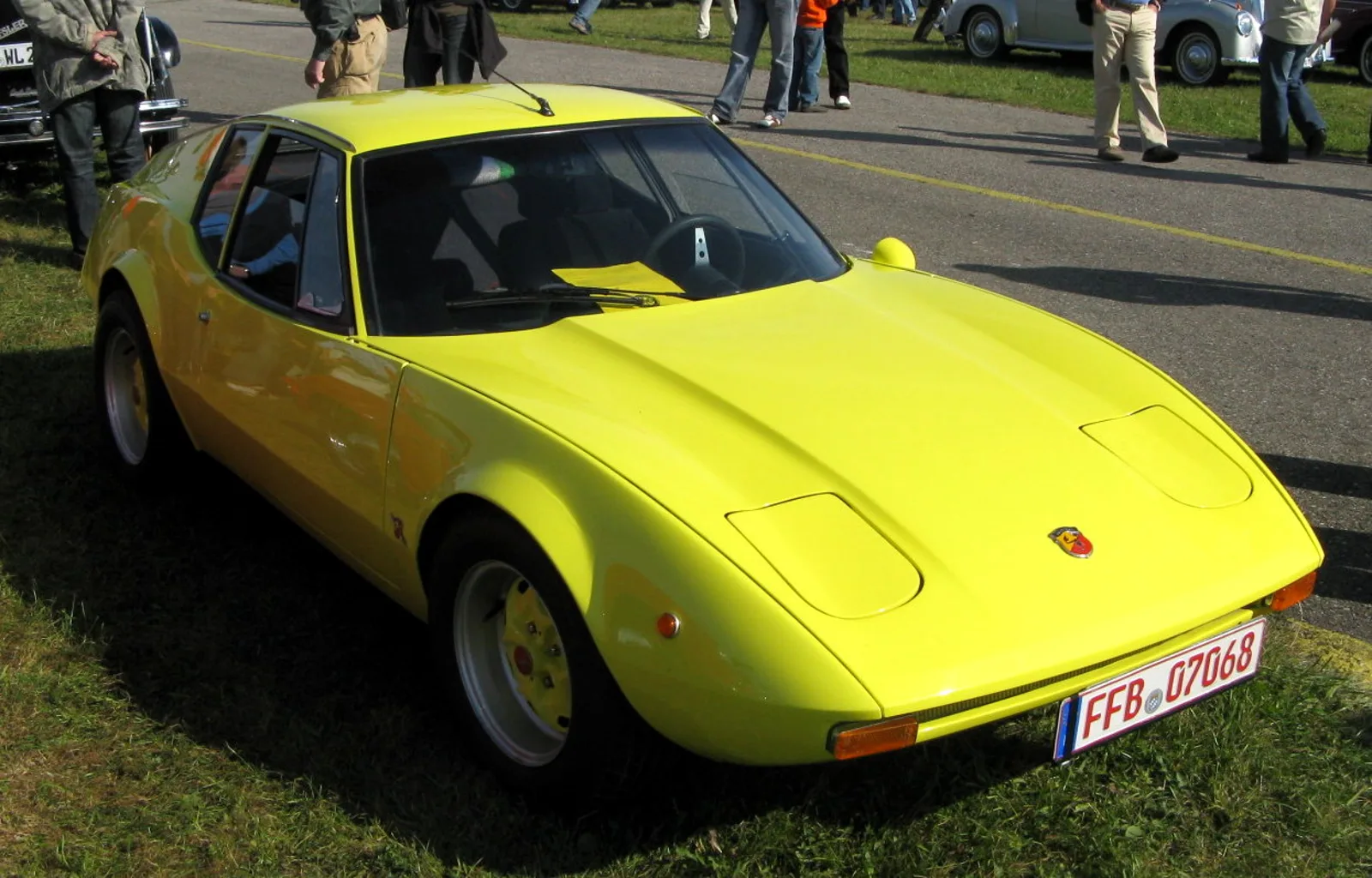
The first Fuldamobil made its public debut at the Rosenmontag carnival parade in Fulda in March 1950, crawling at walking pace behind its air-cooled engine. It overheated and broke down on the route. The press loved it anyway, and a car that had barely survived a parade went on to see licensed construction on four continents.
More than seventy years later, tiny cars are back. The Microlino is a Swiss-designed electric bubble car assembled in Turin, and the Citroen Ami is a battery quadricycle that France lets some people drive without a car licence. Their stories share more than size, and the reasons microcars keep coming back are written into each.
Fuldamobil: how a journalist's sketch became a bubble car
The Fuldamobil was a series of small cars made by Elektromaschinenbau Fulda GmbH of Fulda and Nordwestdeutscher Fahrzeugbau of Wilhelmshaven from 1950 to 1969. Norbert Stevenson, a freelance journalist at the Rhein-Zeitung, drew up the original design with only a single term of mechanical engineering, at the Technische Hochschule in Berlin, behind him. His idea was a very simple three-wheeler for two people with two wheels at the front for stability and a small engine at the rear.
The first attempt, funded by the newspaper's publisher Peter Stein and using a 350cc Horex Columbus engine, collapsed when economic conditions proved unworkable, and the parts were sold. In the summer of 1949 Stevenson found backing from Karl Schmitt, a wealthy engineering graduate and Bosch wholesaler in Fulda, who also ran Elektromaschinenbau Fulda, a firm repairing the emergency power generators then common in Germany.
The Flea prototype
By October 1949 a new chassis was under way, and its front axle had a negative scrub radius. That feature gives a stabilising effect on slippery roads or when brakes act unevenly on either side, and it is now found on most front-wheel-drive cars and about a third of rear-drive ones. The Fuldamobil is credited as the first car in the world to have it.
Everything else was basic. The steel central-tube chassis had swing axles at the front and a swinging arm for the single rear wheel, brakes only on the front wheels and no shock absorbers, so the finished prototype wallowed like a ship at sea. It used a 198cc air-cooled Zundapp motorcycle engine, although a conflicting report in Das Auto gives a 250cc ILO two-stroke. Leibold of Fulda built the black-and-white coupe body in eight days, using caravan techniques: metal sheet nailed to a wooden frame. Nicknamed the Flea, it was scrapped after 3000 km of testing.
Finding a better engine was not easy. Triumph-Werke in Nuremberg gave a disparaging answer, but the chainsaw maker Baker and Polling of Niedernhall agreed to adapt its 200cc fan-cooled engine to nearly 250cc. The Fulda factory added a Hurth three-speed gearbox with reverse and an electric starter. A second prototype with a roadster body appeared around Christmas 1950 and was sold almost immediately.
Type N and Type S
Series production started in February 1951. Between February and June at least 48 cars were built with wooden frames from Alexander Schleicher, mostly covered in plywood and synthetic leather, because sheet steel was scarce in post-war Germany. Buyers disliked the sloping front, and drivers could not reach the windscreen if it misted up. The fix was a rounded nose and a more upright windscreen, a profile the factory called the "Bosom-car", shown at the IAA in Frankfurt in April 1951.
Quality was uneven. Between June 1951 and September 1952 at least 346 cars were built, and later reports describe Baker and Polling engines with pistons striking the heads and, in the worst cases, barrels leaving the crankcase. By May 1952 360cc Fichtel and Sachs engines were being fitted and the bodies were hammered aluminium, which earned the nickname Silver Flea. Licence rules created a new problem, because holders of a class IV licence in Germany could only drive vehicles up to 250cc. In January 1953 Fichtel and Sachs enlarged a 150cc engine to 175cc, announced at the Frankfurt Motor Show that March, and the car gained a front bumper. The Type N ended probably in August 1954, though most references give August 1955.
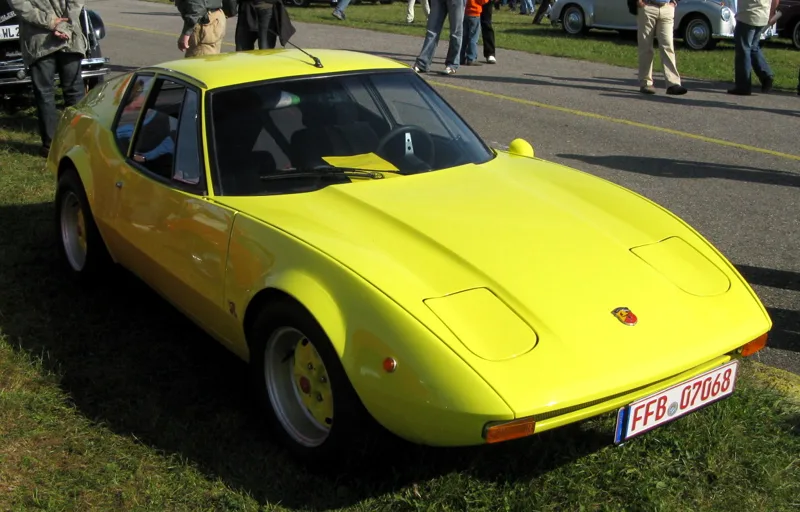
The rounded Type S made its official debut at the IFMA show in Frankfurt in October 1953. Stevenson designed it with the master coachbuilder Wilhelm Lehnebach, who had helped with the first prototype; they built a wood and plaster model in ten days. VDM Metals formed the aluminium body in sections and welded them. The seats folded flat into a sleeping platform for two. Some compared the shape to a tiny Porsche, and others to a Disney pig. The stiffer body amplified engine noise, so the engine and drive train were mounted on rubber and a horizontal pivot, which quietened it at the expense of handling, only partly cured by a panhard rod.
The little car also went far. Werner Ritterbusch, a disabled war veteran, drove one on a round trip of nearly 9,000 km (5,592 mi) from Kassel to Lapland and back. In August 1953 the former racing driver Georg Kremel, a company representative, took one non-stop over the Grossglockner, Plocken and Katschberghohe passes, which included a 2 km climb at 32%.
The 1950 prototype overheated at walking pace in a carnival parade, and the press loved it.
Microlino: the Swiss family's bubble car
The Microlino is a four-wheeled battery-electric bubble car built by Micro since 2022. Micro Mobility Systems showed it at the 86th Geneva Motor Show in 2016, after working on the concept with Zurich's university of applied sciences. Wim, Oliver and Merlin Ouboter, the Swiss family that created the Micro Kickscooter, came up with the concept, and early cars were made in China. Its shape recalls the Isetta bubble cars of the 1950s, with a front-opening door, a sunroof and a trunk.
Microlino history
The company treated the Geneva show car as a public-relations stunt, then received more than 500 reservations within two days. That convinced it to build the car in series. A partnership with the Italian maker Tazzari followed, but Tazzari was sold to the German company Artega, which in 2019 announced a competing model called the Karolino. Micro Mobility Systems sued and won that year. Also in 2019 it began working with the Italian automotive company CECOMP to turn the Microlino 1.0 into the Microlino 2.0, and in 2022 it started series production in its own factory in Turin, which employs about 100 people. The company said approximately 3,700 vehicles were produced in 2024.
Microlino specifications
The car measures 2,519 mm long, 1,473 mm wide and 1,501 mm high, and weighs between 496 and 530 kg depending on configuration. A rear motor delivers 12.5 kW (17 hp) to the rear wheels for a top speed of 90 km/h. Three batteries are offered: 6 kWh for about 91 km, 10.5 kWh for about 177 km and 14 kWh for about 230 km. It charges from a household plug or a Type 2 connector in three to four hours, with no fast charging, and it carries two adults and 230 litres of luggage. Its makers say it has 50% fewer parts than a typical car and a footprint up to 60% lower than a conventional electric vehicle. In Switzerland it is the most registered vehicle in the L7e category.
Variants broaden the range. The Microlino Lite, shown in February 2024, is an L6e quadricycle with a 6 kW motor, a 45 km/h limit and a weight under 425 kg, so it can be driven on a moped licence in several countries, and in some regions at 14 with an AM licence. It comes with a 5.5 kWh battery for about 100 km or a 10.5 kWh one for about 180 km. The Spiaggina, presented in Paris in October 2024, is a limited-edition open-sided convertible, an L7e car with up to 177 km of range and a 90 km/h top speed, inspired by the Fiat 600 Jolly and the Citroen Mehari. It comes in Portofino Blue or Sardinia Sage.
Citroen Ami: an electric quadricycle for the city
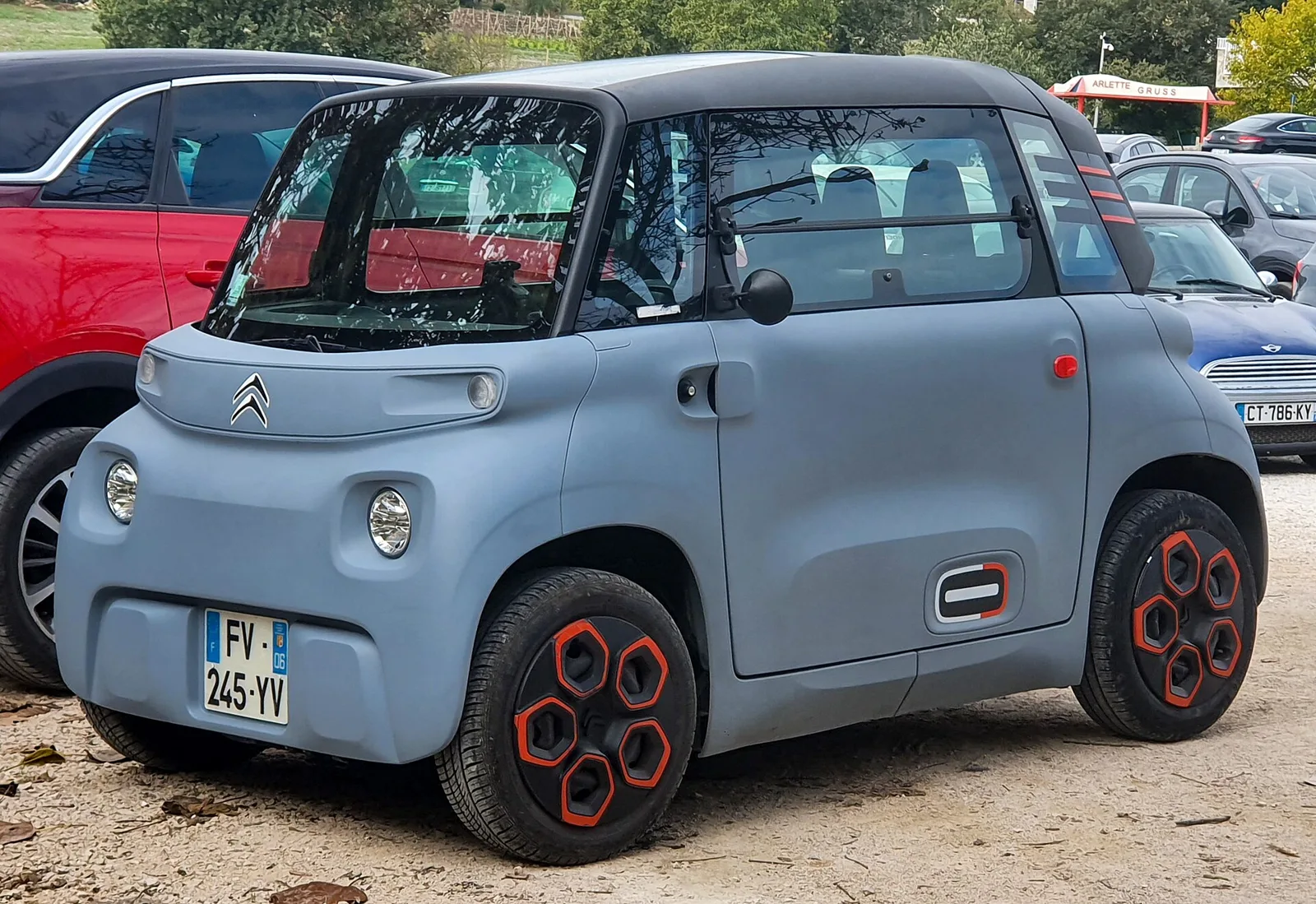
Citroen has sold the Ami, a two-door battery quadricycle, since 2020, and it takes its name from a model built from 1961 to 1978. Pierre Leclercq designed the exterior, and the concept and the production car were developed together by Groupe PSA, now Stellantis, and Altran. The Ami One concept appeared at the Geneva Motor Show in March 2019, the production version in February 2020, and production began in June 2020 at Stellantis' plant in Kenitra, Morocco.
How the Ami saves money
Most of the Ami's design is about cost. The body is symmetrical from left to right and from front to back, apart from the doors and roof, so the same panels fit in several places. The driver's door is hinged at the front and the passenger's at the rear, which lets both use the same part, and the front and rear bumpers are identical. A smartphone supplies the screen and, through a cylindrical Bluetooth speaker, the audio. Interior designer Jean-Arthur Madeleine said the way to make it affordable was to avoid redundancy of technology. A Telegraph journalist likened sitting in it to being inside a Lego brick.
It measures 2.41 m long, 1.39 m wide and 1.52 m high and weighs 485 kg with its battery. A 6 kW motor running at 48 V drives the front wheels. The 5.5 kWh lithium-ion battery charges to 80% in three hours from a household 230 V socket and gives a maximum range of 75 km by the WMTC method. Top speed is limited to 45 km/h. All versions are left-hand drive, even those sold in the right-hand drive UK.
Licences, limited editions and cousins
In France the Ami is a light motor quadricycle that people born before 1988 may drive without a car licence, as may anyone older than 14 with an AM licence. Citroen made 50 My Ami Buggy limited editions in June 2022 and 1,000 of a second-generation Ami Buggy in May 2023, introduced the Ami Pop trim in November 2023 and revealed a facelift at the Paris show in October 2024, when it said some 65,000 Amis had been sold.
Its twins carry other badges. Opel presented the Rocks-e for Germany in August 2021, later renamed Opel Rocks Electric, and it also sells in the Netherlands. The Fiat Topolino is the only one of the three with different front, rear and side design, with a front that resembles the 1957 to 1975 Fiat 500. In May 2024 Italian customs blocked a shipment of 134 Topolinos at Livorno because they carried Italian flag stickers though built in Morocco. Stellantis said it had acted in full compliance with the rules and agreed to remove the stickers.
The three microcars compared
| Car | Era | Power | Where built | Notable limit or feature |
|---|---|---|---|---|
| Fuldamobil | 1950 to 1969 | Petrol, 175cc to 360cc Fichtel and Sachs engines | Fulda and Wilhelmshaven, Germany | Three wheels; first negative scrub radius |
| Microlino | From 2022 | 12.5 kW electric motor, 90 km/h | Turin, Italy | Ranges of 91 km, 177 km or 230 km |
| Citroen Ami | From 2020 | 6 kW electric motor, 45 km/h | Kenitra, Morocco | Symmetrical body; no car licence needed in France for some drivers |
Why microcars keep coming back
The three cars give a pattern. Post-war Germany lacked sheet steel, so the Fuldamobil used plywood and fabric, and its engine size was tied to a driving licence class. Seven decades on, the Ami and Microlino Lite are shaped by licence categories too, with 45 km/h limits that let teenagers and moped holders drive them. Cost cutting drives the design in both eras, from the Ami's shared panels to the Microlino's parts count, and weather protection sets them apart from motorcycles. The Ami and Microlino are sized for short urban trips, with the Ami rated at 75 km and the Microlino at 91 km to 230 km, though the Fuldamobil showed a microcar could go much further, with a round trip to Lapland.
For a buyer or driver, the practical questions are which licence class the car falls under, how it charges and what range suits the daily trip. A 45 km/h car suits town streets, while the heavier Microlino reaches 90 km/h.
Latest moves: the Topolino in the US and new Microlino models
The dated news is short. In July 2026 Fiat began selling the Topolino in the United States, while Micro Mobility Systems has presented the Lite and the Spiaggina as new models since the first Microlino 2.0 reached production in 2022.