A race against the clock that began as arithmetic and passengers, kept one Worcestershire lane alive for over a century and runs today from Kelowna to Tasmania.
Hillclimbing is a race against the clock up a hill. The first known event was at La Turbie in 1897, and Shelsley Walsh in Worcestershire has run since 1905. Its record stands at 22.33 seconds, set in June 2026. Australia has crowned an annual champion since 1947.
When Ernest Instone won the first Shelsley Walsh hill climb on 12 August 1905, he did not win it by being fastest. His 35 hp Daimler climbed in 77.6 seconds, but the result was settled by arithmetic: time in seconds multiplied by horsepower, divided by the total weight of car, driver, passengers and ballast. Spectators were not even told the times. More than a century later the same lane in Worcestershire is where the hill record sits at 22.33 seconds, set in June 2026 at round 10 of the British Hillclimb Championship.
That distance, from a reliability trial with passengers to a pure sprint against the clock, is the story of hillclimbing itself. It runs from a road above Nice in 1897, through a Worcestershire lease that nearly expired, across the Alps and Pikes Peak, and down to the Australian Hillclimb Championship, which has crowned a national champion every year since 1947.
What is hillclimbing, and where did it begin?
Hillclimbing is a branch of motorsport in which each driver competes alone against the clock over an uphill course. There is no wheel-to-wheel racing. Fastest time wins. It is among the oldest forms of motorsport, and the first known event took place at La Turbie, near Nice in France, on 31 January 1897.
Motorcycles climb too, sometimes on steep dirt hills, and the sport is run on four continents. Yet a handful of venues carry its reputation. Shelsley Walsh in Worcestershire is described as the world's oldest continuously staged motorsport event still run on its original course. It is organised by the Midland Automobile Club and is the third oldest motorsport event in the world.
The first Shelsley Walsh winner was decided by a sum, not a stopwatch.
Why Shelsley Walsh suits a hill climb car
The course is shorter than most people expect. It measured 992 yards (907 m) in 1905, and in 1907 it was fixed at 1000 yards (914 m), where it has stayed. What it lacks in length it makes up in severity. The climb gains 328 feet (100 m), an average gradient of 1 in 9.14 (10.9%), and the steepest pitch reaches 1 in 6.24 (16%).
Think of it as the difference between a sprinter and a marathon runner. A circuit car is built to run for hours at a steady pace, and spends its energy managing heat, fuel and tyres. A hill climb car has a single minute at most, so everything is spent on getting weight and power into the right proportion. Porsche understood this in the 1960s. Its racing models had been designed for endurance events lasting up to 24 hours, so for the hills it built lightweight open-top Bergspyder variants. The most extreme, the 909 Bergspyder, weighed only 384kg.
Shelsley rewards that approach more than most. The hill is steep by British standards, so power counts for a great deal, and the gap in times between the strongest cars and the rest is wider than at many other venues. It is also narrow, no more than 12 feet (3.66 m) across in places.
From formula sums to fastest time of the day
The early meetings were closer to a reliability test than a race. A car of 20 hp or more had to be a four-seater and carry passengers, with full touring trim and a full load aboard. Whether a particular machine would reach the top at all was a real question. The handicap calculation produced the winner, which is why Instone's time was a footnote rather than a headline.
Restrictions were dropped from 1913, and specialised racing cars were suddenly eligible. The effect was immediate. On 7 June 1913 Joseph Higginson's Vauxhall 30-98 recorded the best time of the day at 55.2 seconds, more than eight seconds quicker than the 63.4 seconds H. C. Holder had managed two years earlier. Higginson set this on his third run, at a time when only a driver's first run counted. After the First World War, hillclimbing resumed in July 1920 and attention moved quickly to fastest time of the day. Class awards followed: a cyclecar class in 1913, a light car class from 1920 to 1922, and a prize for the fastest amateur member of the organising club.
How the Shelsley Walsh hill climb record fell
| Year | Driver | Time | Detail |
|---|---|---|---|
| 1905 | Ernest Instone | 77.6 s | 35 hp Daimler, winner on formula |
| 1913 | Joseph Higginson | 55.2 s | Vauxhall 30-98, best time of the day |
| 1930 | Hans Stuck | 42.8 s | Austro Daimler, European Championship round |
| 1933 | Whitney Straight | 41.2 s | Maserati, lowered to 40.0 s in 1934 |
| 1935 | Raymond Mays | 39.6 s | 2-litre ERA, first below 40 s |
| 1939 | Raymond Mays | 37.37 s | ERA R4D, last meeting before the war |
| 1992 | Richard Brown | 25.34 s | Stood for nine years |
| 2002 | Graeme Wight Jr | 24.85 s | First under 25 s, 1,000 pounds prize |
| 2008 | Martin Groves | 22.58 s | Second record of the year, after 22.71 s |
| 2021 | Sean Gould | 22.37 s | August meeting |
| 2026 | Will Hall | 22.33 s | Round 10 of the British Hillclimb Championship |
The 1920s produced Shelsley's first star. Basil Davenport broke the hill record four times between 1926 and 1928 in his GN Spider. Count Zborowski, of Chitty Bang Bang fame, drove a Sunbeam in 1921, and Raymond Mays arrived the same decade in a self-tuned Hillman. Two meetings a year became the rule from 1926, one for the club's own members and one open to all.
The 1930s are described as a golden era, and the guest list explains why. The 1930 Open meeting counted towards the first European Hill Climbing Championship, the track was resurfaced with sprayed bitumen, and two Germans came to compete. Hans Stuck took the record down to 42.8 seconds in an Austro Daimler. Rudolf Caracciola, in the Mercedes SSK sports car of the type he had raced to the 1929 RAC Tourist Trophy, set the fastest sports car time but found so large a machine hard going. Both men won their respective hill climbing championships that year.
Not every international visit went smoothly. In 1931 the only two foreign entries were factory Nacional Pescaras. Their drivers, Zanelli and Tort, understood little English, had never seen the hill and arrived late, yet still posted 44.4 and 44.6 seconds. Fastest time went to R.G.J. Nash in a Frazer Nash called The Terror, at 43.3 seconds. In 1932 the Bugatti factory entered a four-wheel-drive car for Jean Bugatti, Ettore's son. He crashed it in practice and drove a borrowed conventional Bugatti instead. The BBC began live radio coverage of the Open events that year, and kept it up through the decade.
Stuck's mark lasted until September 1933, when Mays beat it in a Riley with 42.2 seconds, and then Whitney Straight went to 41.2 seconds in a Maserati. Straight reached 40.0 seconds the following June. In May 1935 Mays became the first to go under that figure, with 39.8 seconds in a 1.5 litre ERA and later 39.6 in a 2-litre car. Stuck returned in June 1936 with a 16-cylinder Auto Union but rain held him to 45.2 seconds. New timing equipment that September measured to a hundredth of a second rather than a tenth. Mays reached 39.09 seconds in June 1937, at the first meeting run over two days, and 37.37 seconds in his ERA R4D at the last meeting before the Second World War.
The post-war years and the sub-30 second barrier
Racing returned in 1947. The 1950s brought a shift from Saturday to Sunday, over the objections of, among others, the Lord's Day Observance Society. Formula One drivers were regulars. Ken Wharton, a four-time British Hill Climb Champion, broke the record on four occasions, and Tony Marsh also competed. Stirling Moss would have made his debut in 1947 but the entry list was full, so he settled for a win in 1948. In June 2021 a memorial plaque to Moss was unveiled at the hill, with his Jaguar XK120 on show.
In 1971 David Hepworth made the first climb under 30 seconds, in his own four-wheel-drive Hepworth FF. Alister Douglas-Osborn then took the record no fewer than eight times between 1976 and 1983, and Richard Brown lowered it to 25.34 seconds in 1992. After that the surface became increasingly uneven, which made smooth runs difficult, and around the turn of the century nobody had cracked 25 seconds.
Scottish driver Graeme Wight Jr finally did it in 2002, with 24.85 seconds, collecting a 1,000 pound prize that had been offered to the first driver below that mark. Three-time reigning champion Martin Groves took two records in 2008, 22.71 seconds in June and 22.58 in August. In August 2021 Sean Gould set 22.37 seconds, with Alex Summers on 22.52 and Wallace Menzies on 22.55 close behind. Nicola Menzies set a new ladies' record of 24.70 seconds the same day. Will Hall's 22.33 seconds in June 2026 is the mark now on the board.
The lease that nearly ended it
For all its fame, the Midland Automobile Club does not own the land. The course is leased from a local landowner, and the original agreement, signed in 1905, ran for the common term of 99 years. That put 2004 on the calendar as a possible final season. The owners refused to sell outright but were willing to grant another 99 years, at a very substantial price.
The club answered by launching the Shelsley Trust with the aim of raising over a million pounds. The target was met, and the new lease was signed in 2005.
Hillclimbing in Europe
Elsewhere in Europe the courses are far longer than Shelsley. Continental events are usually several kilometres, using real hills and mountains, and the FIA European Hill Climb Championship is the most prestigious competition. Britain goes its own way. Cairncastle, the longest British hillclimb, is 1.65 mi (2.66 km), and most courses are really uphill sprints that take the fastest drivers under a minute. For that reason cars and drivers do not generally move between the British and continental championships.
Germany had a long tradition and, until the 1970s, some manufacturers entered factory teams. Hans Stuck dominated the 1930s, earning the nickname King of the Mountains, and the Grand Prix cars he drove were sometimes fitted with twin rear tyres, as on a lorry, for traction. Today two German states no longer allow hillclimb racing, mostly for environmental reasons, and the famous Freiburg-Schauinsland event in the Black Forest is no longer a competition. At its fourth running, on 5 August 1928, Heusser's Bugatti was fastest car at 74.009 km/h and Stegmann's DKW the quickest motorcycle at 69.6 km/h.
Stuck's 1938 run at Feleac in Romania shows the scale of continental courses: a 600 bhp (450 kW) Auto Union over a 7 km (4.3 mi) gravel road in 2 minutes 56 seconds. The road has since been widened for heavy traffic and is considered unsuitable for racing. In Italy the championship includes some of the longest and most demanding climbs, such as Trento-Bondone, and Mauro Nesti won over 20 championships between Italy and Europe. France's Jimmy Mieusset won four straight titles from 1971 to 1974, and Portugal's Falperra has run since 1927.
Switzerland offers an unusual case. Motor racing was banned there after the 1955 Le Mans disaster, but the prohibition does not cover events where drivers compete only indirectly via the clock. Hillclimbs, rallies and slaloms therefore flourish. Ludovico Scarfiotti clinched the 1965 European title there, at Ollon-Villars.
Pikes Peak, Mexico and the rest of the world
The best known American event is the Pikes Peak International Hill Climb, whose winners include Bobby Unser and rally champions Walter Rohrl, Stig Blomqvist, Ari Vatanen and Sebastien Loeb. The Appalachian HillClimb Series, run by the Sports Car Club of America in North Carolina, Virginia and Kentucky, has limited driver openings and quick sellouts. In Canada the Knox Mountain Hillclimb in Kelowna, British Columbia, uses a 3.5 km (2.2 mi) paved road that climbs 245 m (804 ft), with off-camber corners beside cliffs.
Mexico has the San Pedro Martir Hill Climb, founded by Pedro Vargas on 30 September 2017 on the road to the National Astronomical Observatory in Baja California. As of 2024 it is regarded as the world's longest, and the overall ascent record of 14 minutes 58 seconds belongs to the late Carlin Dunne on a Honda CRF 450 motorcycle.
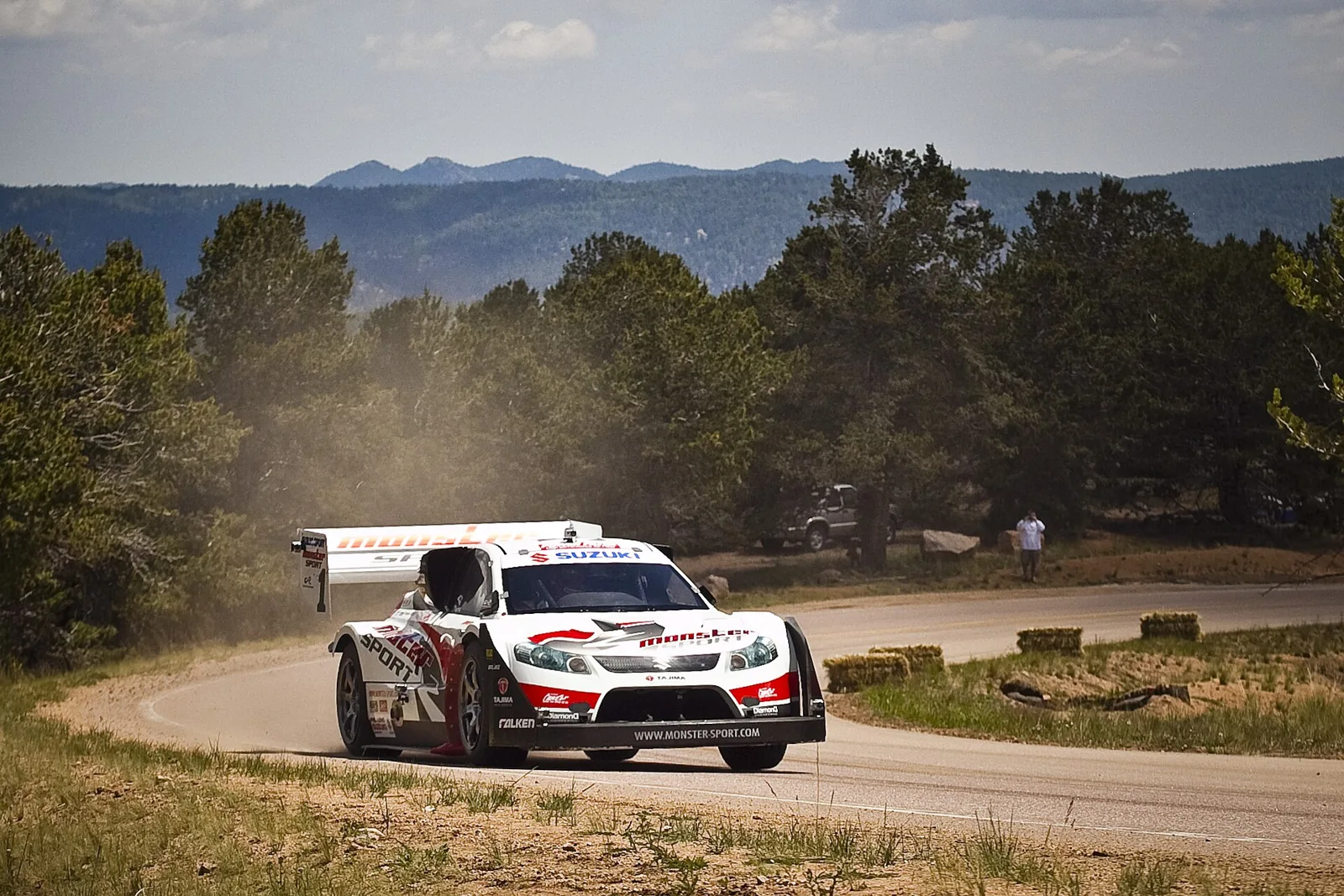
New Zealand's Race to the Sky ran every Easter from 1998 to 2007 near Queenstown. It covered 15 km (9.3 mi) and 137 corners, rising from 460 m to 1,500 m. Nobuhiro Tajima won it eight times in a custom Suzuki Escudo. In South Africa the Simola Hillclimb at Knysna, founded in 2009, runs up a 1.9 km (1.2 mi) course. Its 2018 winning average speed was 192.524 km/h (119.629 mph).
The Australian Hillclimb Championship
An Australian Hillclimb Championship was first staged in 1938 and has been run every year since 1947. Traditionally the title goes to the driver with the fastest time at a single meeting. The exceptions are 1958, when two meetings were combined, and 1972 to 1975, when a multi-round points series was used. Motorsport Australia, formerly the Confederation of Australian Motor Sport, has sanctioned the event since 1954. Before that the Australian Automobile Association did, and two events held national championship status in 1949. Since 2020 the title has been the Motorsport Australia Hill Climb Championship.
In 2022 Dean Tighe won the title 58 years after his father Ivan, making them the first father and son to hold it.
The sport in Australia dates to the early 1900s and was strongest in Melbourne, at Templestowe, Heidelberg and Rob Roy. Templestowe, now in the Domain Wetlands, had a section called the wall at a ratio of 1:2.5, thought to be the steepest bitumen surface in the country. The road was never open to ordinary traffic. Rob Roy, at Christmas Hills, still hosts rounds of the Victorian championships.
Queensland's Mount Cotton circuit was built by the MG Car Club of Queensland, which was established in 1954. Its first event was on 18 February 1968. The 946 metres of tarmac host the state championship, the club's six-round series and inter-club contests, and the Australian championship has been held there on at least nine occasions. Tasmania's Poatina is the longest, a temporarily closed road with 580 m (1,900 ft) of climb in 10.6 km (6.6 mi) up Mount Blackwood. Its first event, in February 2014, covered 7.2 km (4.5 mi), and the course was lengthened for 2015. South Australia has the permanent venue Collingrove, plus temporary courses at Mount Alma Mile, Willunga and Legend Of The Lakes. Eden Valley, at 3.7 km (2.3 mi), is its longest.
What it means for a driver
A hill climb car is a purpose-built tool, and entry at the established events is often capped. Simola limits its Classic Car Friday to 65 entries and its King of the Hill Challenge to 84. Appalachian events sell out quickly. At Mount Tarrengower in Victoria, held on the third weekend of October, only classic machinery is now accepted, after a serious accident in the 1970s. Stacey Heaney, the current champion there on a 1971 Yamaha XS650, is the only woman to win the climb.
What is the future of hillclimbing at Shelsley and elsewhere?
Shelsley Walsh's immediate future is secure: the lease signed in 2005 runs a further 99 years. The record has fallen several times in the 21st century, most recently in June 2026, and the hill is still a round of the British Hillclimb Championship. Elsewhere the picture is mixed. German restrictions have closed some venues to competition, while newer events such as Poatina, begun in 2014, and San Pedro Martir, begun in 2017, have joined the calendar.