Servicing pays, new cars barely do. Franchise laws, Tesla's galleries, Volvo's direct-sales plan and the rise of the monthly car subscription.
Most of a US dealership's profit is made in the workshop, with used cars adding a share and new cars very little. Franchise laws shield dealers from direct sales, which is why Tesla uses online-only galleries, Volvo plans to sell direct and subscriptions offer a monthly alternative to buying.
The new car in the showroom window is the part of a dealership's business that earns it the least. In the United States, dealership profits come mainly from servicing, some from used cars and only a little from new ones.
That fact is why dealers lobby for the franchise rules that protect them. It also frames the story of Tesla, which refused the dealership model, and of the monthly subscriptions now offered by carmakers and dealerships alike.
How do car dealerships make money?
A dealership sells new or used cars at retail under a contract with a carmaker, and it also sells spare parts and maintenance. Across the United States the money comes mainly from servicing, with used cars adding some and new cars very little. The workshop, more than the showroom, carries the business.
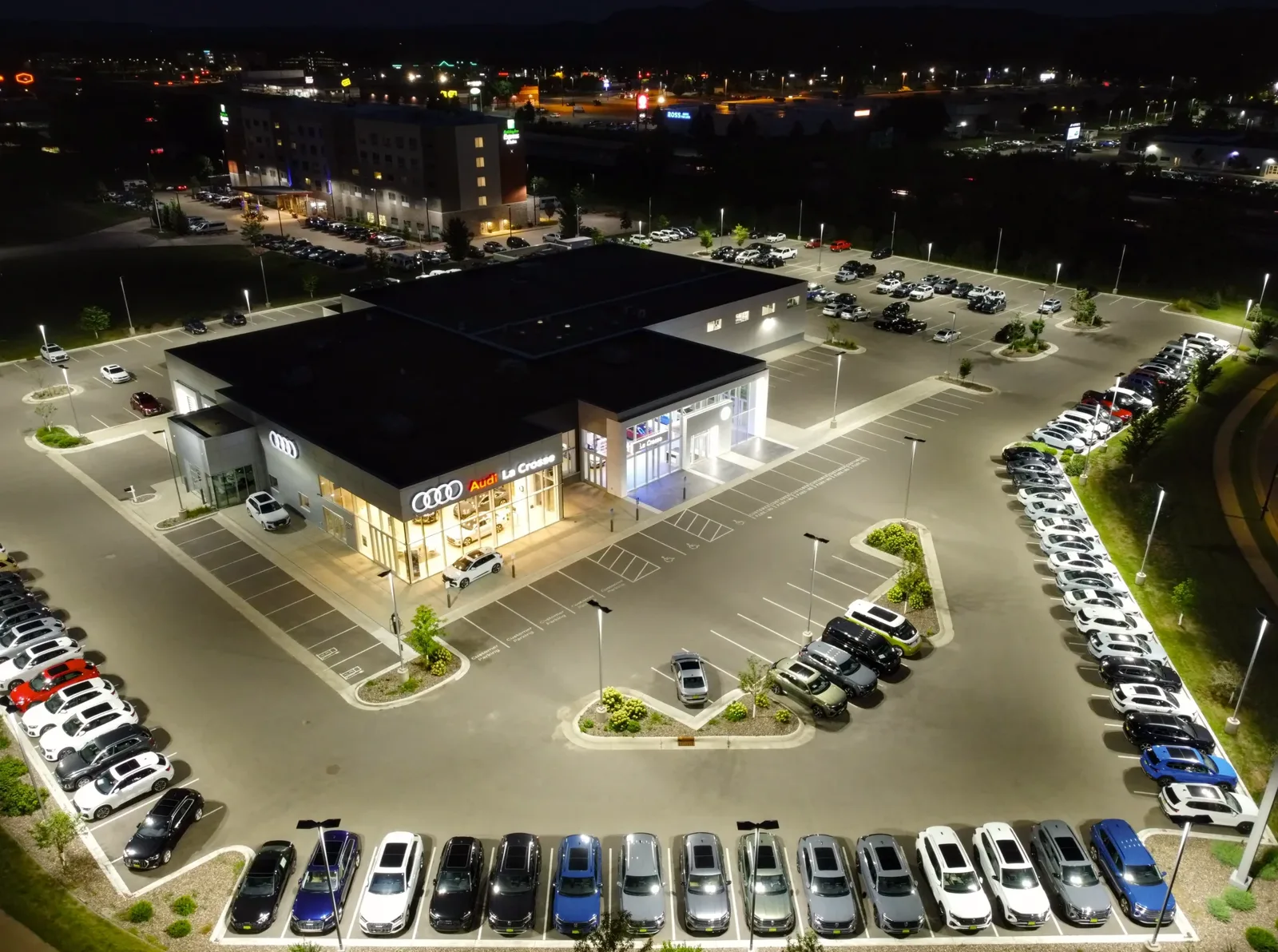
The buildings tell the same story. A typical site has a showroom, a mechanical service department, body repair facilities and space to store new and used stock, which is why so many sit outside town centres, often on their fringes. Many modern dealerships now belong to corporate chains with hundreds of locations, a change from single-owner firms such as Collier Motors in North Carolina.
Warranty work shows how the economics can bend. Many state laws dictate the exact terms on which manufacturers repay dealers for warranty repairs, and those terms can give dealers a reason to push up what customers pay for repairs.
Manufacturers have also changed what they want from the showroom. Most have shifted their franchised retailers towards branding and technology, with a required standard look for new or refurbished premises and product experts to guide customers. Audi has tried a high-tech showroom where buyers configure and experience cars on digital screens at 1:1 scale. Mercedes-Benz has opened city centre brand stores in markets that permit them.
In the United States the profit is in the workshop first, the used-car lot second and the new-car showroom a distant third.
What is a car dealership franchise?
It is a contract in which the dealer, the franchisee, sells and services a manufacturer's cars while the manufacturer, the franchisor, supplies them. In theory both sides gain: the dealer gets a well-made, attractive product to sell, and the carmaker gets someone else to carry the downstream costs and to use local relationships to sell more.
Think of it as a tenant who fits out a shop for a landlord's brand. Once the money is spent, the balance of power shifts. Economic theory says the franchisor can behave opportunistically after the dealer has sunk costs into buildings and a local reputation, for example by demanding low selling prices or paying little for service work. The dealer can do the same in reverse: with a local monopoly it can give poor service, overcharge customers and hand the inflated costs to the manufacturer.
Why can't most carmakers sell direct in the United States?
Because the law stops them. Franchise laws in most American states require new cars to be sold only through licensed, bonded and independently owned dealerships, which limits direct sales by an automaker to consumers. By 2010 all 50 states and the District of Columbia had such rules, and by 2009 most also restricted new dealerships from opening to compete with existing ones.
The protections run deeper than that. The laws commonly work in the dealer's favour in these ways:
- All states place severe limits on a manufacturer ending a franchise.
- Most prohibit quantity forcing, where a maker obliges dealers to buy cars they never ordered.
- Most restrict a maker from treating dealers differently, such as offering better terms to large or better-rated ones.
- Most require a maker to buy back inventory and special equipment when a dealership closes, and sometimes to pay the rent on its premises.
- New licences can be geographically restricted, so that where a company already has a dealer, no one else can open.
That last rule has an odd consequence. Dealerships have become in effect hereditary, with families running them in an area since the licence was first issued, and a franchise can usually be withdrawn only for illegal activity.
Economists call all of this rent-seeking. Multiple studies show that the protections raise what consumers pay and limit what manufacturers earn, and research finds retail car prices are higher than they would otherwise be. Consumer campaigns for reform have been met with heavy lobbying by franchise holders. Historically, dealers have also contributed a good deal of state and local sales tax.
Where did the car dealership come from?
Early cars did not go through dealers at all. Automakers sold them directly or through mail order, department stores and travelling representatives. Sears first tried a gasoline-engined high-wheeler in its mail-order catalogue in 1908 and sold the Allstate through its stores and catalogue from 1951.
The first dealership dedicated to cars, not horse-drawn carriages, opened in 1889, when Fred Koller started in Reading, Pennsylvania, selling cars built in Cleveland, Ohio. William L. Hughson became the first Ford dealer in San Francisco in January 1903, the same year Rachel Krouse opened the Krouse Motor Car Company in Philadelphia and became the first American woman to work as a car dealer.
How the number of US dealerships fell
| Year | US car dealerships |
|---|---|
| 1927 | 53,125 (the peak) |
| 1960 | 33,658 |
| 1980 | 23,379 |
| 2001 | 22,007 |
Can you buy a car direct from the manufacturer?
In much of the United States, only in limited ways. Tesla rejected the dealership model, arguing that dealers did not properly explain what its cars offer over combustion-engined ones. Franchise laws in many states bar direct sales, so Tesla runs city centre galleries where prospective buyers can look at cars that can be ordered only online. The idea was inspired by Apple Stores.
New entrants like Tesla have faced constant legal pressure and have either been forced out or forced to work around the franchise model. Tesla's approach was the first of its kind, and it has given the company advantages of its own.
Europe took a different route. From 1985 to 2006, manufacturers there were allowed to sign contracts that limited what dealers could sell, tying supply to a small number of dealers under strict franchise agreements. In 2006 the European Commission decided it was anti-competitive to stop dealers carrying more than one brand. European manufacturers are increasingly moving towards selling directly to customers. Volvo has announced plans to sell all of its vehicles that way by 2030.
Multibrand dealers occupy the middle ground, selling cars from different independent makers, and some specialise in electric vehicles.
Behind every dealership sits a logistics chain. Auto transport moves vehicles from the factory to the showroom, both internationally and domestically. It was largely a commercial activity run by manufacturers, dealers and brokers, and the internet has helped this niche expand to reach ordinary consumers.
Are dealerships ready for electric cars?
A 2023 survey by the Sierra Club found that two-thirds of US dealerships had no electric or hybrid vehicles for sale. Supply chain difficulties are one reason. Another is cost, since dealers must invest heavily in training staff and in the facilities required to retail and look after electric vehicles.
Car subscription vs buying: what is the difference?
A vehicle subscription is a service in which customers hand over a regular fee in return for the use of one or more vehicles. Unlike buying, the subscription service keeps ownership of the car. Industry commentators treat it as an alternative to owning or leasing.
Leases also involve recurring payments, but many subscriptions are more flexible about minimum term and about swapping between vehicles. Rental differs in purpose: most subscriptions give full-time possession and are meant to replace the customer's main car, whereas rental means procuring a vehicle for particular dates or trips.
Edmunds.com observes a wide variety in what is on offer. Most services charge a flat fee, typically monthly, with no haggling, and customers usually sign up through an app. Insurance, servicing and roadside help can be rolled into the fee. Some services cap mileage and others do not. Terms vary too: Book by Cadillac has no minimum term, while Care by Volvo began with a minimum of two years. Carousel, Porsche Passport and Book by Cadillac let subscribers swap between types of vehicle, some without limit and others within a cap.
Who sells car subscriptions?
Several kinds of company, each with its own motive. Manufacturers offering or announcing subscriptions include Ford, Lexus, BMW, Mercedes-Benz, Hyundai, Cadillac, Volvo and Porsche, and each has stated its objectives. Volvo wants convenience in a single package of access, insurance, maintenance and support. Cadillac wants to grow the number of its drivers, especially those new to the brand. Porsche describes Passport as a way to serve customers with highly varied lives. Ford says Canvas grows its driver base while controlling how many used vehicles reach auction.
Dealerships are the second group, and they usually bundle several brands they already stock. Flow Automotive Companies was the first dealership to offer a subscription, launching Drive Flow in Winston-Salem in 2016. Park Place Select in Dallas is another example. The third group is start-ups and corporate-backed ventures, from Switzerland's Carvolution, launched in 2018 with a 50 million CHF investment and said to hold around 80% of that market, to Elmo, a British service offering electric vehicles only.
In Australia, Carbar, HelloCars and Carly all launched in early 2019. Carbar and HelloCars, both registered motor dealers in Victoria and New South Wales, own and run their subscription cars, while Carly uses peer-to-peer vehicles offered in partnership with a sister company. Loopit, launched in August 2019, sells software that lets manufacturers, dealerships and rental companies run their own subscription product, and it reported a 52% rise in enquiries from dealerships during the COVID-19 shutdown.
Elsewhere the same model has spread quickly. Revv Cars of Gurgaon launched a monthly multi-brand programme called Switch across 15 cities in India in 2017, and Myles Automotive Technologies, based in Delhi, followed in 2018. Cluno began in Germany in October 2017, Driveto Klub launched in the Czech Republic in October 2018, and Invygo started the Middle East's first car subscription app in March 2019. Observers file these services under several labels: the sharing economy, the subscription economy, transportation-as-a-service and mobility-as-a-service.
The idea is younger than it looks. A dealership in Honolulu, run by Rima Braden of Autosource, offered a flexible short-term programme called Flexlease in 2010, rebranded Carousel in 2013. Flexdrive and Clutch Technologies followed in 2014, and 2017 brought launches from Cadillac, Porsche, Volvo and Ford's Canvas.
Where this goes next
Manufacturers are leaning towards direct contact with buyers. Volvo has announced that it will sell all vehicles directly by 2030, European carmakers are increasingly shifting to direct sales, and Mercedes-Benz and Tesla already run city centre stores where the law lets them.
For subscriptions, the early programmes concentrated on one or two cities, yet there is evidence that makers will in time widen their reach. Care by Volvo was available across the country from launch, and Book by Cadillac has grown beyond its first market of New York City. Dealerships, meanwhile, are being asked to invest in the training and equipment that electric vehicles demand.