Fuel stored at more than 2,000 bar, injectors fired by computer and up to five injections per stroke: how the common rail made diesels quieter and cleaner.
Common rail injection keeps diesel fuel at pressures typically above 2,000 bar in a shared rail, and the engine computer fires each injector electrically, several times per stroke if needed. That made diesels quieter and cleaner. Denso and Hino sold the first mass-production system in 1995, and Alfa Romeo the first passenger car in 1997.
Fuel enters a modern diesel cylinder at pressures that typically exceed 2,000 bar (29,000 psi), delivered from a shared reservoir that never stops being pressurised. The idea is far older than the passenger car. Vickers used a mechanical version in submarine engines in 1916, and the first mass-production vehicle with the modern, electronically controlled kind did not reach buyers until 1995. Today it sits behind nearly every diesel that is not a commercial vehicle.
How does a diesel engine burn its fuel?
A diesel has no spark plugs. Air alone, or air mixed with recirculated exhaust gas, is drawn in and squeezed during the compression stroke until it is hot enough to ignite the atomised fuel sprayed in. That is why engineers call it a compression-ignition engine, and why it carries the name of Rudolf Diesel.
Power is controlled differently from a petrol engine. Rather than throttling the intake air, a diesel varies the quantity of fuel injected, so the air-fuel ratio is usually high. Its very high expansion ratio and inherently lean burn give it the highest thermal efficiency of any practical engine, with low-speed marine diesels reaching effective efficiencies of up to 55%. Diesel's third prototype, tested in February 1897, reached 26.2% from 13.1 kW.
How the fuel gets in has always been the difficult part. Diesel's early engine used air-blast injection, an idea he adopted from George Brayton's patent of 1872 while raising the air pressure sharply. The pre-combustion chamber, invented by Prosper l'Orange in 1919, made engines small enough for cars feasible. MAN presented the first direct-injected truck diesel in 1924, and Bosch introduced higher-pressure injection pumps in 1927. Mass-produced diesel cars such as the Mercedes-Benz OM 138 followed in the late 1930s. Since the 1970s energy crisis, demand for efficiency has led most major carmakers to offer diesels, and according to Konrad Reif, writing in 2012, they made up about half of new registrations across the EU. In the US, tougher emissions control means diesels are largely confined to larger on- and off-road vehicles.
The rail turns injection into a stored-pressure event: the pump keeps the pressure, and the computer decides when to spend it.
What was wrong with older diesel injection?
Before common rail, diesels mostly used unit injectors or a distributor or inline pump. These measured fuel precisely and timed it accurately, but they shared three weaknesses.
First, they were driven by a cam, so the injection pressure rose and fell with engine speed. The highest pressure was available only at the highest revs, and it dropped as the engine slowed. Because each injection came from a single pumping event with no accumulator, the effect was strong and troublesome. Second, they could manage only a limited number of injection events in each combustion cycle. Multiple injections were possible but difficult and costly. Third, in a typical distributor or inline system, injection started at a predetermined pressure known as pop pressure. The injectors in the cylinder head were "dumb": a spring preload on the plunger decided when they opened and closed.
How does common rail injection work?
A common rail system separates making pressure from using it. A high-pressure pump fills and maintains a reservoir of fuel at up to, and above, 2,000 bar (200 MPa). The name comes from the rail itself, a single pressure accumulator from which every injector is fed. Think of a water tower: the pump can labour at its own pace to keep the tank full, and every tap draws on the same stored pressure.
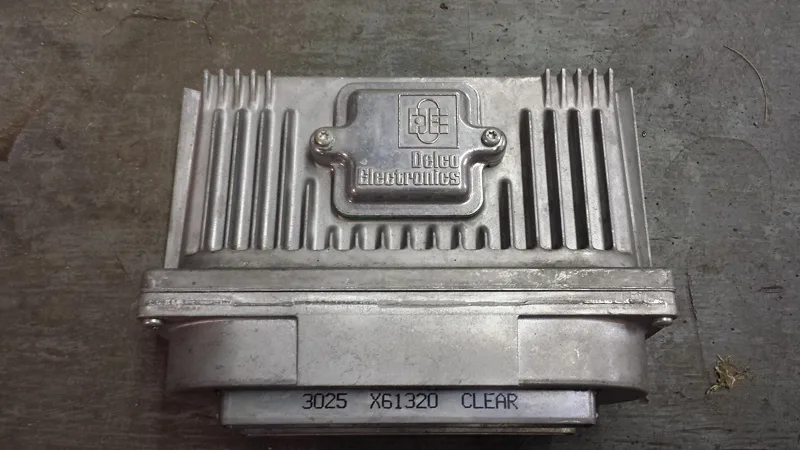
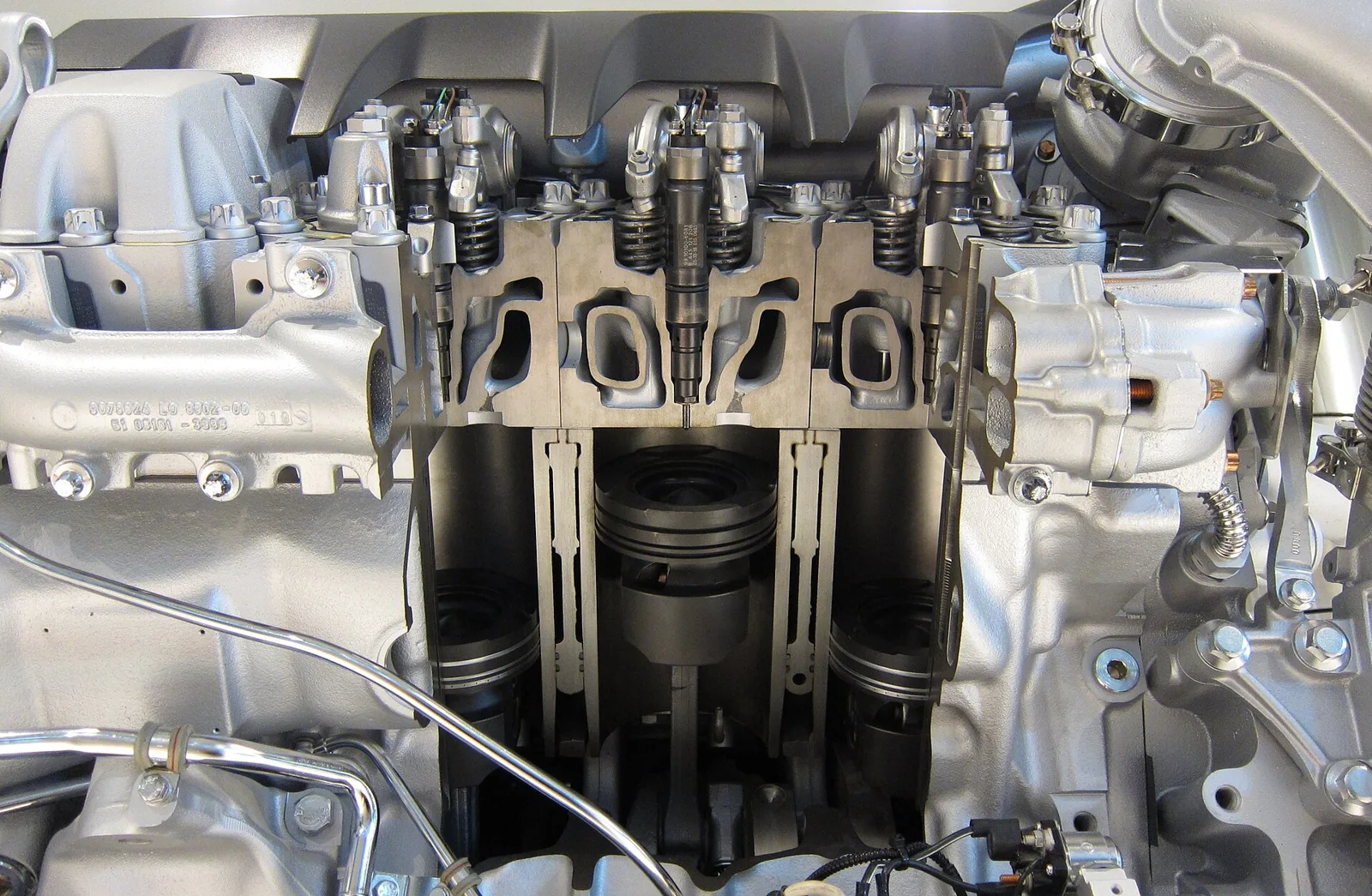
That arrangement simplifies the pump's job, since it only needs to hold a target pressure, whether it is controlled mechanically or electronically. The injectors are normally commanded by the engine control unit. Fire an injector electrically and a hydraulic valve, built from a nozzle and a plunger, lifts so that fuel sprays into the cylinder at just the pressure wanted. In practice a solenoid-operated needle valve opens and closes the nozzle, and an accumulator relief valve returns excess fuel to the tank.
The stored pressure has a pleasant consequence. Because the energy sits in the rail and the injector is opened electrically, the pressure at the start and end of an injection is very close to rail pressure. Engineers describe the resulting injection as having a square rate, and provided the accumulator, pump and pipework are the right size, each of several injections in one cycle can share the same pressure and rate. The older cam-driven systems could not do that.
Pressure is the other half of the benefit. High-pressure injection splits the fuel into a larger number of smaller droplets, so each drop exposes far more surface for its size. The droplets vaporise more readily from their surfaces, so atmospheric oxygen combines with the fuel more efficiently and combustion is more complete.
| Feature | Cam-driven unit or inline systems | Common rail |
|---|---|---|
| Source of injection pressure | A single pumping event, driven by a cam | A stored reservoir in the rail |
| Pressure versus engine speed | Proportional to engine speed | Held near a target, whatever the revs |
| Injection events per cycle | Limited; more difficult and costly | Several, with the same pressure and rate |
| Injector control | Spring preload sets pop pressure | Solenoid or piezo valves commanded by the ECU |
| Typical pressure | Rises and falls with the pumping event | Over 2,000 bar; up to 2,500 bar in third generation |
Why are common rail diesels quieter?
Valves worked by solenoids or piezo crystals let the computer dictate exactly when and how much fuel goes in, while the extra pressure the rail provides breaks the spray into a finer mist. A diesel's clatter comes from the explosiveness of the main injection, and the computer can reduce it with a pilot injection, a small amount of diesel injected just before the main event. The pilot lowers the explosiveness and vibration of combustion. The same control lets the computer tailor the injection to the quality of the fuel in the tank, to a cold start and to similar circumstances. The most advanced systems fit up to five injections into a single stroke.
Depending on the weather, a common rail engine needs a very short warm-up or none, and it is quieter and cleaner than the older systems. Piezoelectric injectors, for extra precision, mark the third generation. Quoted pressures differ between accounts: one gives up to 2,500 bar (250 MPa; 36,000 psi), another up to 300 MPa, or 44,000 psi.
Who got there first?
The mechanical version came long before the electronic one. In 1916 Vickers pioneered it in G-class submarine engines, where four plunger pumps held a constant pressure of 3,000 pounds per square inch (210 bar) and valves in the injector lines shut off individual cylinders. Doxford Engines ran a common rail on its opposed-piston marine diesels from 1921 until 1980, storing fuel in accumulator bottles at around 600 bar. The Cooper-Bessemer GN-8 of about 1942 is an example of a hydraulically operated version, known as a modified common rail.
The first car-oriented prototype came from the Swiss engineer Robert Huber in the late 1960s. Dr Marco Ganser, working at Zurich's Swiss Federal Institute of Technology, carried it forward and later led Ganser-Hydromag AG. The first common-rail diesel in a road vehicle was the MN 106 from East German VEB IFA Motorenwerke Nordhausen, fitted to a single IFA W50 in 1985. Funding ran out and the project was cancelled before mass production.
Success in volume came in Japan in 1995, with the Hino Ranger truck. Its ECD-U2 system was the work of Denso's Dr Shohei Itoh and Masahiko Miyaki, and the company itself says this was the first commercial high-pressure rail.
The electronic systems that went into cars were worked up during the 1990s by Magneti Marelli, together with Elasis and the Fiat research centre in Bari, and the physicist Mario Ricco at Fiat Group did further work. Fiat's finances were weak, so Robert Bosch GmbH bought the design to refine it and put it into volume production. The 1997 Alfa Romeo 156 with the 2.4-litre JTD engine became the first passenger car to use it, and Mercedes-Benz followed with the W202 later that year. Pickups were next in 2001, when GMC's Sierra HD and the Chevrolet Silverado HD received the 6.6-litre Duramax LB7 V8. Dodge and Cummins launched rail engines in 2003, and Ford's 6.4L Powerstroke arrived in 2008.
Where does common rail sit among injection systems?
Injection comes in two broad families. In direct injection the fuel goes straight into each cylinder's main combustion chamber, so only air is drawn in on the intake stroke. It can be done with a conventional helix-controlled pump, with unit injectors or with a common rail, and the rail is the most common choice in modern automotive engines.
Indirect-injection diesels work differently. They have a second chamber, a pre-chamber, connected to the main one, and the fuel is sprayed into that first. Combustion starts there and spreads to the main chamber.
What do the badges mean, and who builds the hardware?
The system suits every kind of diesel road car, whether a small Fiat Panda or an executive Audi A8. Four companies dominate supply: Bosch, Delphi Technologies, Denso and Siemens VDO, the last now part of Continental AG.
Carmakers sell their versions under their own names. Volkswagen Group calls its diesels TDI, Daimler uses CDI, the PSA group HDi, Renault and Dacia dCi, Fiat Group JTD or MultiJet, and Hyundai and Kia CRDi. Mitsubishi uses Di-D, Mazda Skyactiv-D, Toyota D-4D and Suzuki DDiS.
The name alone does not guarantee a common rail. More recent TDI models use common rail, in contrast with the earlier unit-injector TDI engines. Saab's 2.2 turbo diesel was called TiD, the same label it used on common rail engines, but it did not have a common rail.
What this means for buyers and drivers
For anyone shopping for a diesel, the practical outcome is a quieter, cleaner engine that fires up with little warm-up. A common rail diesel's pilot injection takes the edge off the traditional clatter, and the flexibility of electronic multi-injection lets the computer adapt to fuel quality and cold starts.
Because the technology is so widespread, the badge on the bootlid tells you more about the maker than about the injection system, and the age of the engine tells you more than the badge. A Volkswagen Group diesel with a TDI badge could have the earlier unit injectors or the later common rail, and one marketed with a Saab TiD badge might lack a rail altogether. It pays to check the engine itself.
Where this goes next
Common rail is no longer a diesel-only story. The same architecture underpins gasoline direct injection on petrol engines. Through the 20th century most petrol engines relied on a carburettor or on indirect injection, but direct injection has been spreading since the turn of the century.
Within the diesel world, third-generation systems already use piezoelectric injectors for greater precision.