A 4:1 final drive, a direct top gear and a cruising overdrive each give something up. Here is how to read the numbers and what they cost.
A gear ratio is the speed relationship between two meshing gears, found by dividing their tooth counts or radii. In a car, low ratios multiply torque for acceleration and high ratios cut engine speed for cruising. The final drive adds one fixed reduction, and overdrive adds a taller gear for economy.
A petrol engine in a normal car turns somewhere between about 600 and 7000 rpm, yet the wheels it has to drive turn between 0 and about 1800 rpm. No single fixed connection between the two could work at every speed, and the whole business of gearing exists to bridge that gap.
How do gear ratios work?
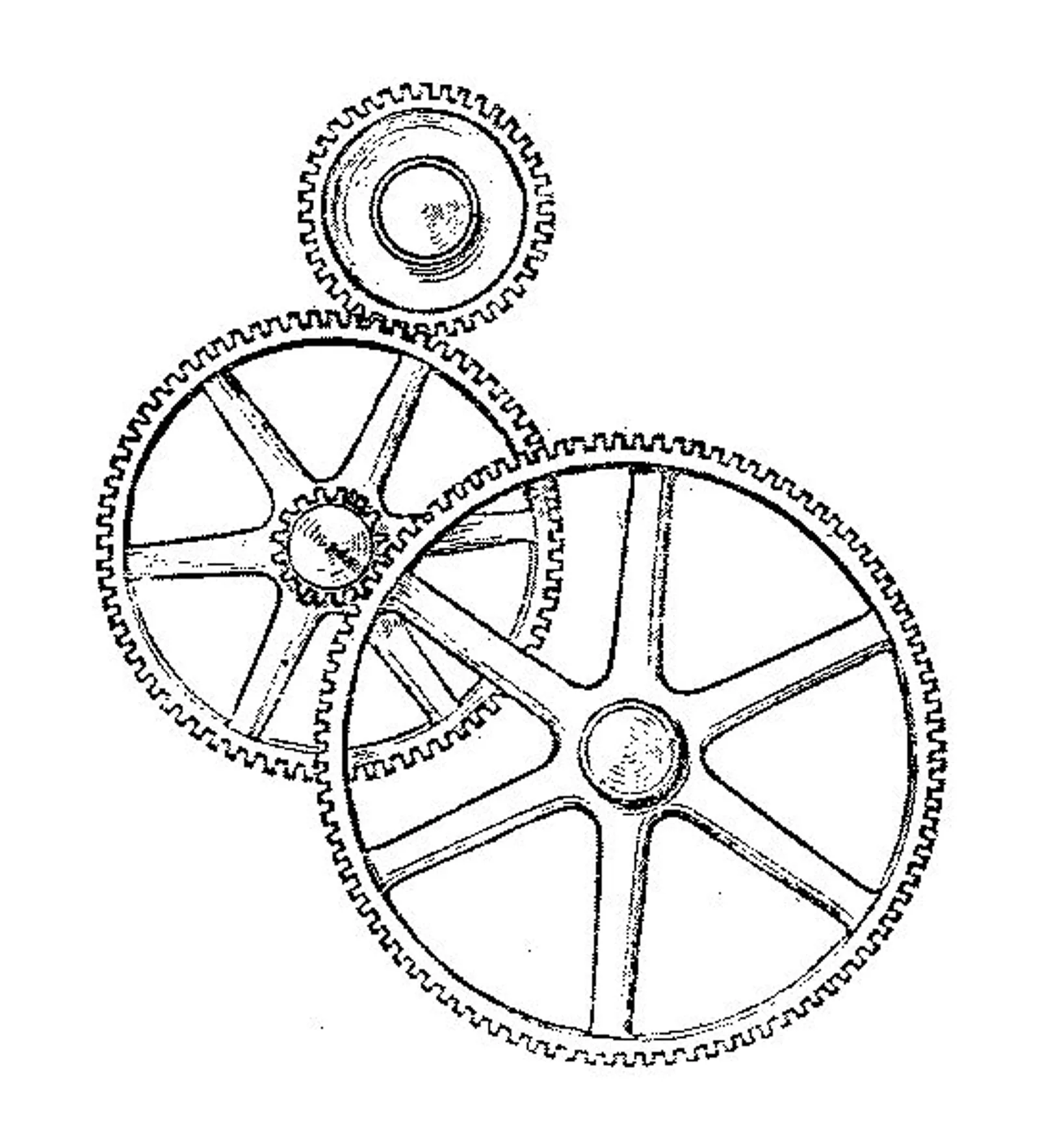
Two gears meshed together share the same tooth size, so the bigger one simply has more teeth. The speed ratio comes from comparing them: the number of teeth on one divided by the number on the other, or equivalently the ratio of their radii. Take a small gear of 1 in (25 mm) pitch radius driving a larger one of 2 in (51 mm), and the ratio is 2, written 2:1. A turns twice as fast as B, and for every full turn of A, B makes half a turn.
The same relationship governs torque, but in the opposite sense. In an ideal gear train with rigid gears and no loss at the teeth, the torque ratio equals the gear ratio. Whatever you gain in turning force you give up in rotational speed, which is why a low gear that slows the output feels strong, and a tall gear that speeds it up feels relaxed but weak. Chain and belt drives are worked out the same way, which is why bicycle gearing is described with the same numbers.
Gearing is also an old idea. The idea runs back through the Antikythera mechanism of Greece and China's south-pointing chariot, and the involute tooth, the shape that gives a constant speed ratio, became the standard design that let gear sets mesh smoothly.
A car needs one gearing to reach its maximum speed and another to reach maximum fuel efficiency at a lower speed.
Why do cars have so many gears?
An internal combustion engine produces different torque and power at different speeds, so it needs several ratios to stay in its power band. That is how a car manages good power, good fuel efficiency and smooth running at once. More ratios also give enough acceleration to leave the line and enough velocity to cruise safely at modern highway speeds.
The transmission, or gearbox, is the device that does the job: a gear set that changes the speed, the direction of rotation, or the multiplication or reduction of torque. Louis Renault, the founder of Renault, is credited with inventing it, and Carl Benz had anticipated the idea. In 1886 Benz used sprockets and chains running to an auxiliary shaft, with a clutch, to give a second, low gear on his belt-driven Patent-Motorwagen Nr. 2, the first practical car.
A transmission can have one fixed ratio, several discrete ratios or a continuously variable range. Most current passenger cars with petrol or diesel engines have between 4 and 10 forward ratios plus one reverse. Take the ZF 8HP: it has 8 forward gears, and two of those are overdrive ratios below 1:1.
What does the final drive ratio do?
Behind the gearbox, a second set of gears sits in the rear axle of a conventional rear-wheel-drive car. This is the final drive, and it is a fixed ratio. Splitting the job in two meant the propeller shaft could turn faster and carry less torque. Power is rpm multiplied by torque, so a shaft spinning quickly can move the same power at lower torque, which means it can be lighter and weaker.
For many years the top gear of a gearbox was 1:1, called direct drive, because that arrangement needs no gear to transmit power and therefore wastes less of it. Early cars had straight-cut gears that were poorly finished, noisy and inefficient, so avoiding them in the most-used gear was worth the trouble. The final drive then did the rest of the reduction. Ratios of 4:1 were common, so the wheels turned at a quarter of the engine's rate.
The useful side effect was flexibility. In that era, models with different wheel sizes could be accommodated simply by changing the final drive ratio. That is why the final drive ratio is the usual answer to the question of how to change a diff ratio: it was the cheap, fixed lever for tuning a car to its wheels.
When front-wheel drive arrived, the gearbox and final drive merged into one unit called a transaxle. With no propeller shaft between them, the idea of direct drive stopped making sense in the old way, though the phrase survives. Higher gears with ratios beyond 1:1 are still called overdrive gears.
What do first gear, top gear and cruising gear each trade away?
The key to reading a ratio table is knowing that every gear is a compromise between pulling and speed. A low gear multiplies torque at the wheels and cuts road speed. A high gear does the reverse. Between them the box has to cover everything from rolling away from a standstill to holding a legal limit on a motorway.
A car's top speed is limited by air resistance, and the aerodynamic drag grows with the square of speed, while rolling resistance rises roughly in line with it. Engine power climbs with rpm to a peak and then falls away, and the peak sits somewhat below the redline. At top speed the engine is running at its power peak and drag exactly equals that maximum power. Only a single ratio achieves this: the one that pairs that engine speed with that road speed.
Slow down even slightly and the picture changes. The drag falls considerably, so the engine needs to produce far less power, but the wheels have hardly changed their rotation rate. Without a different, taller ratio the engine is left turning faster than it needs to. The consequences are the ones the textbooks list: more power lost to internal friction, more fuel burned just to keep the engine turning, more wear on every revolution, and more noise, since engine sound is strongly tied to rpm.
The upshot is that one gearing gives the maximum speed and a different one gives the best economy at a lower speed. At any cruising speed several ratios can balance engine power against air resistance, and the most economical of them is the one with the lowest engine speed.
Where did overdrive come from?
For a long time the answer was a second small gearbox. In the early days, fast cars had their final drive chosen for maximum speed. Building a cruising gear into the main gearbox was possible, yet it was generally simpler to bolt a separate two-speed overdrive unit onto the back of an existing box, with its own shift lever. It could be tuned for different vehicles and offered as an easily installed option.
The problem grew as cars got faster. In the 1960s, more powerful cars widened the gap between the engine's power peak and the speed at which owners wanted to cruise, and the 1973 oil crisis made efficiency more urgent. After that the five-speed gearbox became more common in mass-market cars, with a direct 1:1 fourth gear and an overdrive fifth, which replaced the need for a separate unit.
An overdrive unit is an epicyclic gear train, worked electrically or hydraulically and fitted behind the transmission. It either couples the input to the output at 1:1 or makes the output turn faster than the input. Older units were worked by a knob or button, often on the gear knob, and needed no clutch. Newer ones are electronic, with the computer adjusting to the power and load required.
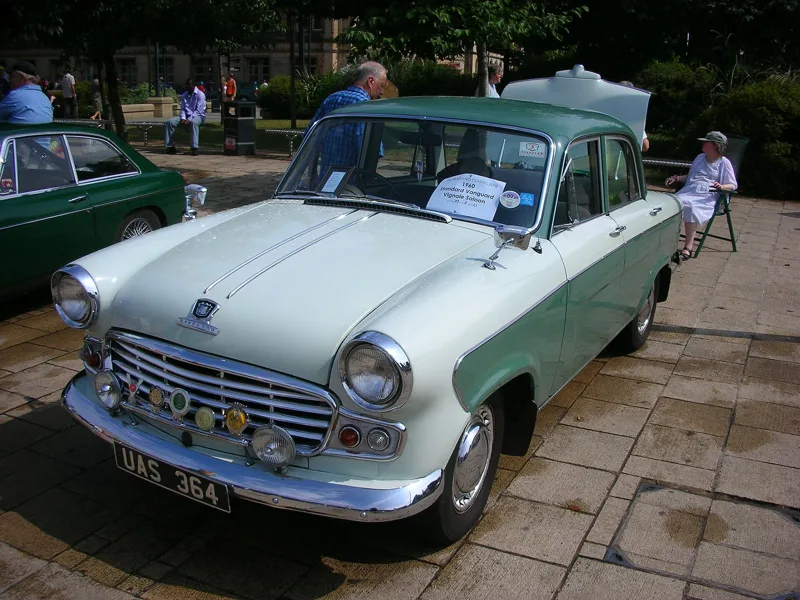
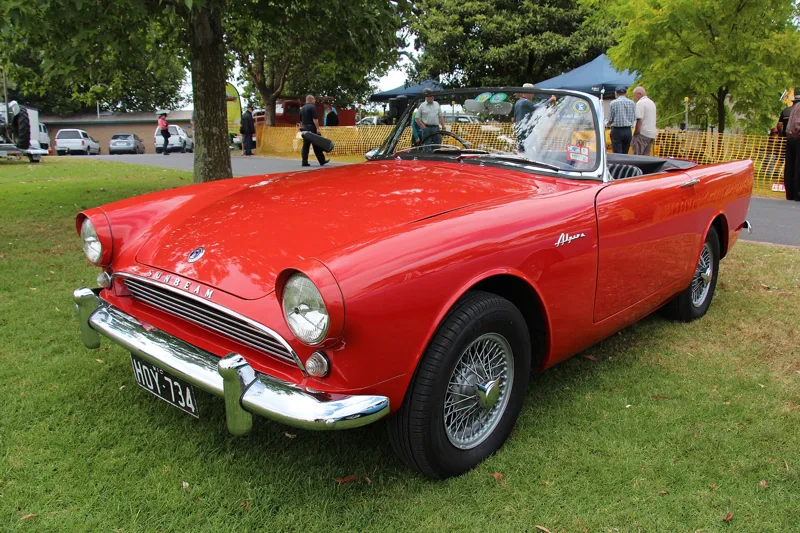
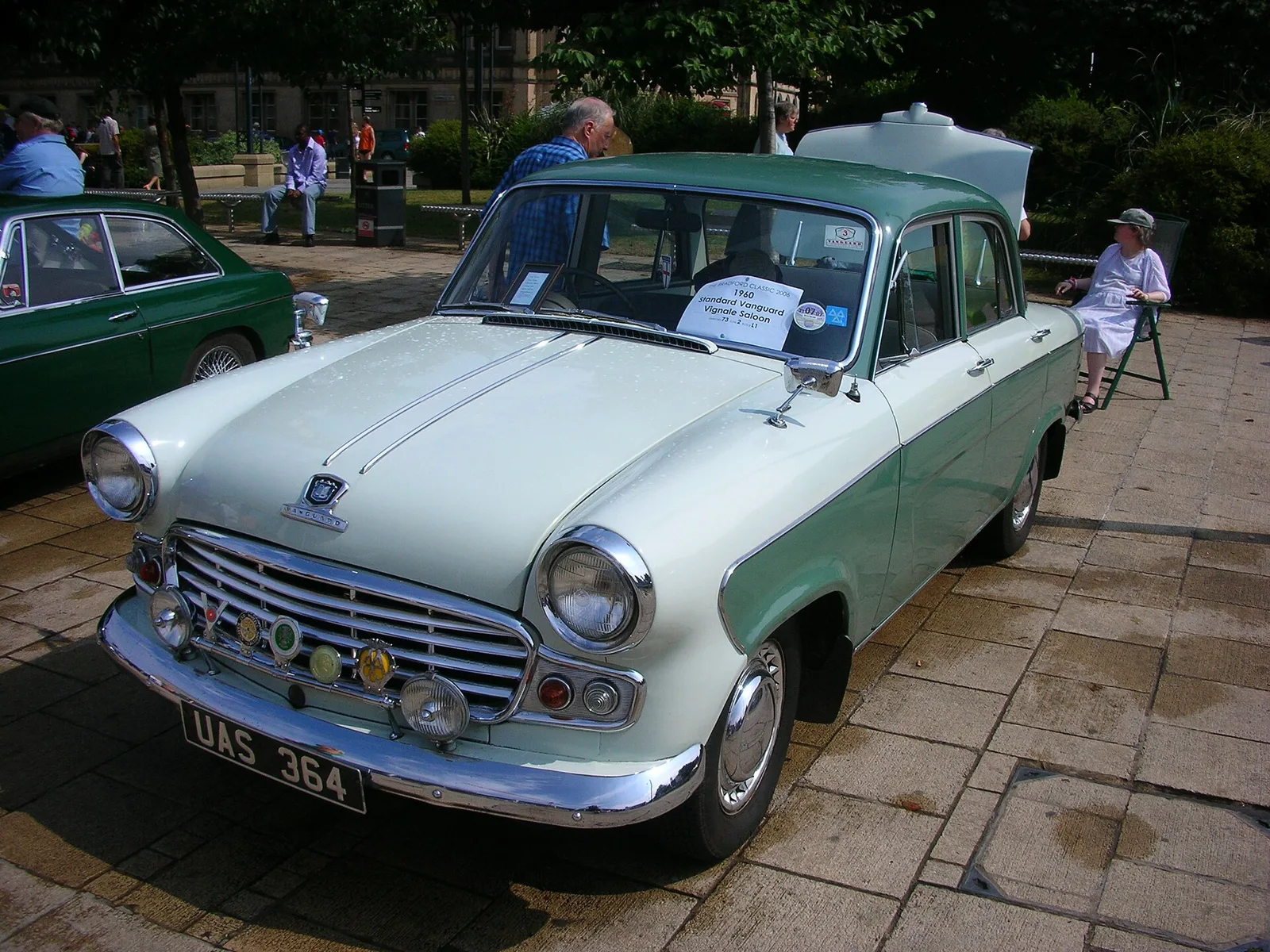
Most European overdrives were the work of Edgar de Normanville, made in Sheffield by Laycock Engineering, which later became GKN Laycock. The Standard Vanguard Saloon of 1948 was the first production car to carry the system. The A-type went into many sports cars through the 1950s and into the late 1960s, including Jaguars, Aston Martins, Ferraris, Austin-Healeys and Triumph TRs from the TR2 to the TR6. The D-type arrived in 1959 for the Volvo 120 and 1800, the Sunbeam Alpine, the Triumph Spitfire and the 1962-1967 MGB. The LH-type followed from 1967, fitted to the 1968-1980 MGB among others, and the J-type, from the late 1960s, was adapted to cars from Volvo, Triumph, Vauxhall and Opel, American Motors and Chrysler, and to the Ford Transit.
A bolt-on overdrive can often be used in more gears than just top, which turns third and fourth into extra, in-between ratios, a third-and-a-half and a fifth. In practice that means more ratios, closer together, and more flexibility in a performance car. That is the difference between close-ratio and wide-ratio thinking in a nutshell: close ratios keep the engine nearer to its best speed, while wide ratios stretch a few gears across a larger range.
How do automatic and dual-clutch gearboxes handle ratios?
All of the following change the ratio, but in different ways.
| Type | How it changes ratio | Where it is used |
|---|---|---|
| Manual with synchromesh | Driver uses stick and clutch; synchromesh matches shaft speeds | Most modern manual cars |
| Sequential manual | Dog clutches; only the next or previous gear | Motorcycles and racing cars |
| Dog box | Constant mesh with dog clutches; clutchless shifts possible | Racing and performance use |
| Automated manual | Automatic actuation of clutch and gear changes | Systems such as Selespeed and Easytronic |
| Hydraulic automatic | Planetary gearsets operated by hydraulics, with a torque converter | The most common automatic design |
| Dual-clutch | Two clutches, one for odd and one for even gear sets | Cars and trucks, working as an automatic |
| Continuously variable | A continuous range, most often two pulleys and a belt or chain | Cars, scooters, tractors and more |
Automatics arrived on the US market from 1939, drawing on the engine's own power to alter the effective ratio with load. They are now fitted to over two thirds of cars worldwide and almost all new cars in the US. A continuously variable transmission removes the steps altogether, and with suitable control it may allow the engine to run at a constant speed while the car's speed changes.
A dog box, nicknamed for the dog clutches it uses, is built for racing. First gear is used mostly for taking off, and having second and third opposite one another gives a time advantage when shifting between them, so most dog boxes use a dog-leg pattern, with first placed left and down. The cost is noise. Straight-cut gears whine, and the pitch rises with wheel speed.
What does a driver do with an overdrive button?
Overdrive is generally the highest gear in the transmission. With it engaged, the engine turns at lower rpm for a given road speed, which brings better fuel efficiency and often quieter running on the highway. An automatic with overdrive on will move into it past a threshold that depends on load, typically from about 70 km/h (40-45 mph). It is best selected when average speed stays above 70 km/h (40-45 mph).
Under load the car shifts back. On a hill, or when towing, the transmission may hunt between overdrive and the next gear, swapping back and forth. Switching overdrive off lets it settle, and it can also help when you want engine braking on a descent. Virtually all vehicles have overdrive today, built in rather than bolted on.
What about electric cars?
Electric vehicles typically use a fixed ratio or a two-speed transmission, and they have no reverse gear. Electric motors work efficiently across a wide range of speeds, all the way down to a stop, and they change direction electrically. Where a petrol engine must be steered into its power band with ratios, an electric motor largely does not need to be.
What does it mean when you buy or drive a car?
Reading a ratio table comes down to a few habits. A number such as 4:1 says the input turns that many times for each turn of the output. A figure of 1:1 means a direct connection. Anything below 1:1 is an overdrive gear. The final drive multiplies whatever the gearbox does. Gear whine in lower gears is normal, because those gears tend to be cheaper and have a shorter design life than the helical gears used for high ratios, so they generate more noise.
Failure is possible in any gearbox. The recognised mechanisms include wear, scuffing, two kinds of pitting, tooth flank fracture and fatigue fracture at the tooth root, driven by friction, contact stress, bending fatigue and poor lubrication. Standards such as ISO 6336 and AGMA 2001 set out how gears are designed and checked, and without correct design and manufacture a transmission can show low efficiency, high noise and vibration, and a short life.