Who has held the outright land speed record, why Thrust SSC's 1997 mark still stands, and what has happened to the Bloodhound LSR 1,000 mph dream.
Thrust SSC holds the land speed record at 1,228 km/h (763 mph), set by Andy Green on 15 October 1997 in Nevada. A challenger must beat that by one percent over two runs in an hour. Bloodhound LSR reached 628 mph in 2019 but needs funding and a driver.
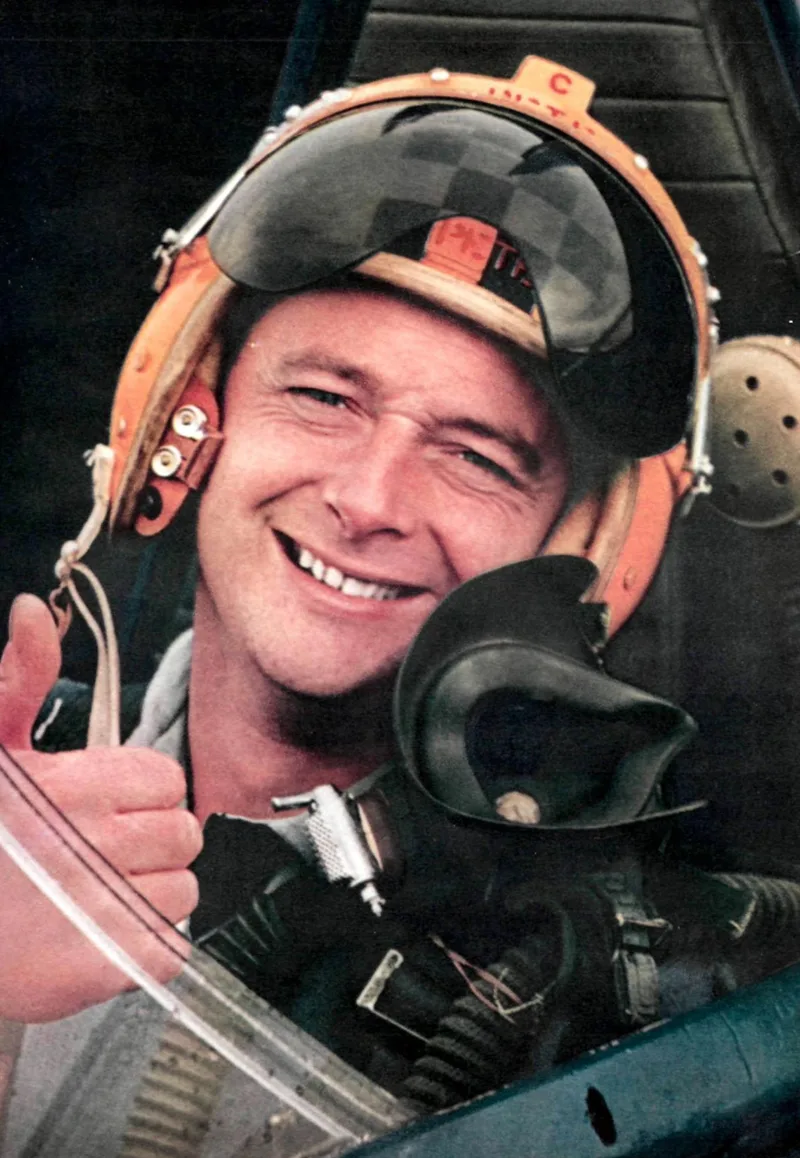
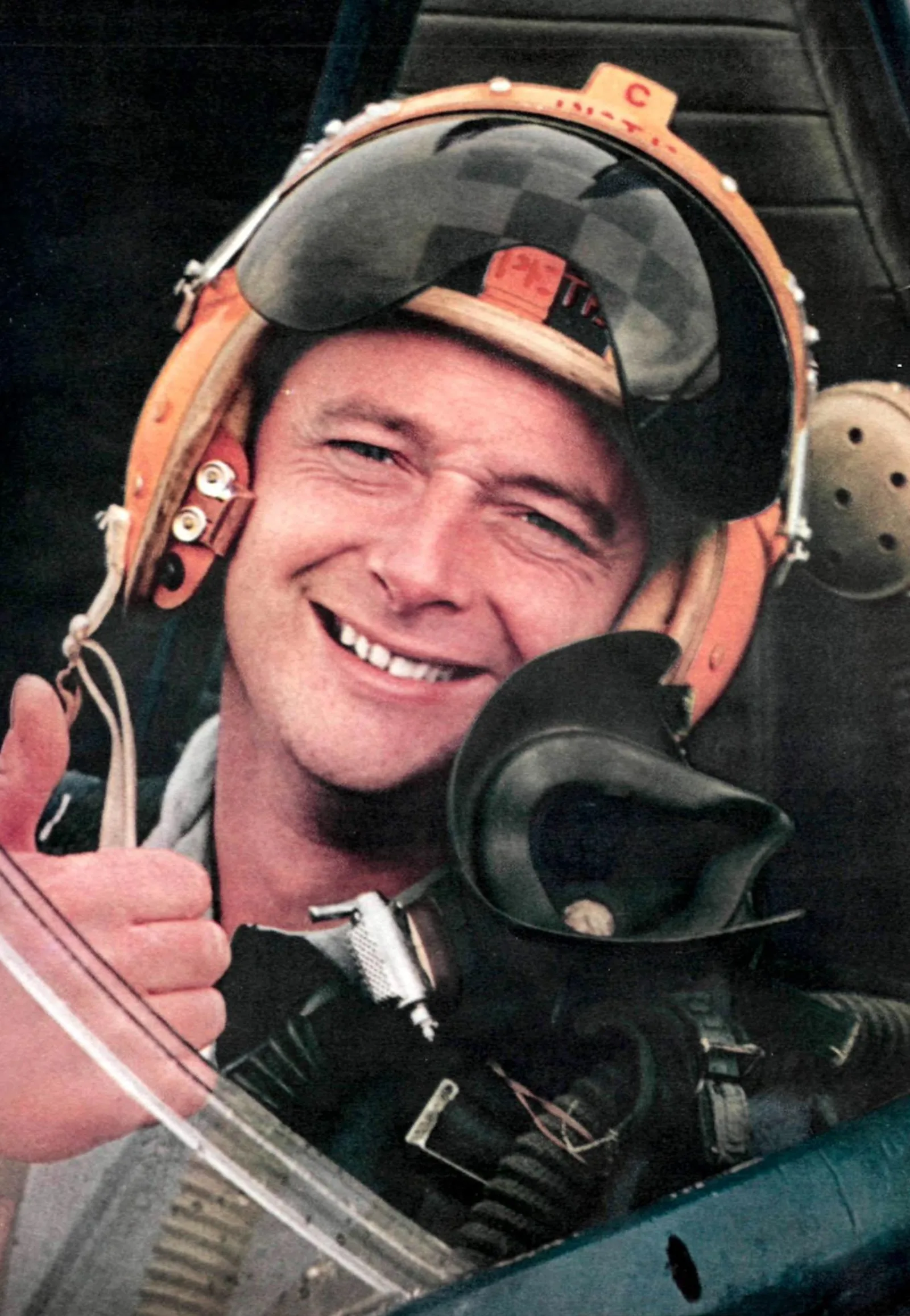
On 15 October 1997 a car driven by an RAF pilot broke the sound barrier on the ground, 50 years and one day after Chuck Yeager did it in the air. The land speed record it set has not been beaten.
What is the land speed record, and how is it measured?
The land speed record is the highest speed a person has reached in a vehicle on land. It is timed over a 1 kilometre (0.62 mi) or 1 mile (1.6 km) course, averaged over two runs in opposite directions within one hour, and a new mark has to beat the old one by at least one percent.
The two-way average exists to cancel the effect of wind. Those rules date from 1924, when the AIACR, the body that became the FIA in 1947, replaced a patchwork of club standards. Its regulations also demanded timing gear accurate to a hundredth of a second, a surface with an average gradient of no more than 1 percent and, at that point, cars that were wheel-driven. Before motor cars the question hardly arose: until 1829 the fastest land transport was a horse, and then railways took over. In the United States and Australia many record runs take place on salt flats, which is why the cars are often called salt cars.
Since the 1964 agreement, every absolute record holder has been a special jet or rocket vehicle, and none of them has been wheel-driven. The record sits in a different category from the top speed of a road car.
Beating it is hard on paper and harder in practice.
Why did a three-wheeled jet change the rules in 1963?
Craig Breedlove's Spirit of America reached 407.447 mph (655.722 km/h) in September 1963, but it broke the rules on two grounds: it had three wheels and its jet engine did not drive the axles. The FIA refused to recognise it, and the motorcycle federation, the FIM, certified it as a three-wheel motorcycle record.
Donald Campbell then posted 403.10 mph (648.73 km/h) in Bluebird CN7 at Lake Eyre in Australia on 17 July 1964. That became the official FIA record, though Campbell was disappointed to fall short of Breedlove's figure. Later that October a few four-wheel jet cars went faster than the 1963 mark, yet neither body recognised them. The confusion of three separate records ended on 11 December 1964, when the two federations met in Paris and agreed that the absolute record would be the higher speed recorded by either body, by any vehicle running on wheels, whether wheel-driven or not. The FIA created a special class for jet and rocket power as a result. Wheel-driven cars kept their own record, and Goldenrod held it from 1965 to 1991.
Which speeds mark the climb of the land speed record?
| Date | Driver and vehicle | Speed | Notes |
|---|---|---|---|
| 1947 | John Cobb | 403 mph (649 km/h) | One-way mark at Bonneville |
| 1960 | Mickey Thompson | 406.60 mph (654.36 km/h) | First American over 400 mph, at Bonneville |
| September 1963 | Craig Breedlove, Spirit of America | 407.447 mph (655.722 km/h) | Three wheels; ratified later by the FIM |
| 17 July 1964 | Donald Campbell, Bluebird CN7 | 403.10 mph (648.73 km/h) | Lake Eyre; the official FIA record |
| 1983 | Richard Noble, Thrust2 | 1,019 km/h (633 mph) | Nevada desert |
| 15 October 1997 | Andy Green, Thrust SSC | 1,228 km/h (763 mph) | Black Rock Desert; first supersonic land vehicle |
How did Thrust SSC break the sound barrier?
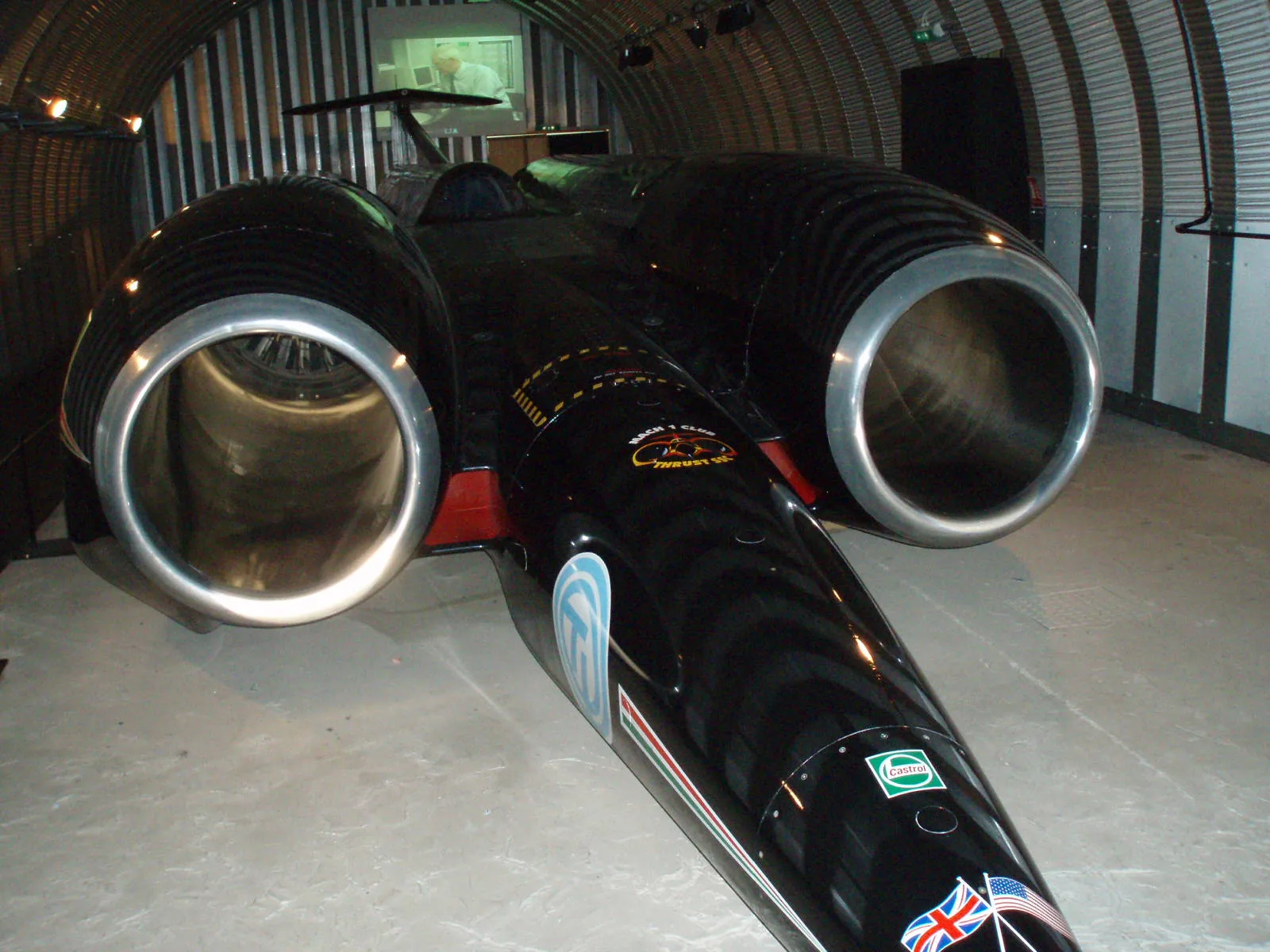
Thrust SSC used two afterburning Rolls-Royce Spey turbofans, the type fitted to the British F-4 Phantom II fighter. At the record speed of 341 metres per second they gave a net thrust of 223 kN (50,000 lbf). Wing Commander Andy Green drove it in the Black Rock Desert in Nevada.
The numbers are hard to picture. The car was 16.50 m (54.1 ft) long, 3.7 m (12 ft) wide and weighed 10.6 tons. It burned about 18 litres of fuel every second, which works out at roughly 4,850 L/100 km. Richard Noble, Glynne Bowsher, Ron Ayers and Jeremy Bliss developed it in Coventry. Noble had already set the record himself in 1983 with Thrust2, at 1,019 km/h (633 mph), and he and Green have held the record between them ever since.
The World Motor Sport Council approved the new marks on 11 November 1997 in Paris. The flying mile was timed at 1,227.985 km/h (763.035 mph) and the flying kilometre at 1,223.657 km/h (760.345 mph). In setting them the car passed the speed of sound on both the north and south runs, which made Thrust SSC the first and so far the only land vehicle to officially do so. The car and Thrust2 are now displayed at the Coventry Transport Museum, where a 4D motion simulator recreates the run from Green's seat.
Why has the Thrust SSC record stood so long?
Because beating it is hard on paper and harder in practice. A challenger must exceed 1,228 km/h by at least one percent, in two directions within an hour, on a stretch of ground long enough and flat enough to use. The attempts that have followed have stalled on money, sites and, in one case, a fatal crash.
The North American Eagle Project, which ran from 2004 and aimed at 808 mph (1,300 km/h), was abandoned in 2019 after a fatal crash. Rosco McGlashan's Aussie Invader team is building a rocket-powered car, but its attempt is on hold pending funding. A claim for the Budweiser Rocket in 1979, 739.666 mph (1,190.377 km/h) and past the sound barrier, has never been verified. The Bloodhound project has been the most visible challenger since it began in 2008.
What is the Bloodhound LSR project?
Bloodhound LSR is an arrow-shaped British car powered by a jet engine, with a rocket to add thrust, intended to beat Thrust SSC. Lord Drayson announced it on 23 October 2008 at the London Science Museum, and it is named after the Bristol Bloodhound missile, which its chief aerodynamicist Ron Ayers had worked on.
The car uses one Eurojet EJ200, an engine developed for the Eurofighter, to reach around 650 mph (1,050 km/h). A rocket designed by the Norwegian company Nammo is meant to add thrust for record runs, with a hybrid rocket planned for any attempt at 1,000 mph. A supercharged Jaguar V8 drives the oxidiser pump, although the plan is to replace it with an electric motor. For 800 mph (1,300 km/h) the rocket would need around 40 kN (8,992 lbf) and the jet 90 kN (20,232 lbf) in reheat. The design calls for 0 to 800 mph in 38 seconds, with 2.5 g on the driver under acceleration and up to 3 g under braking, using airbrakes, a parachute and disc brakes in turn.
The wheels are forged from an aircraft-grade aluminium zinc alloy, 90 cm (35 in) across and 95 kg (209 lb) each. They are designed to spin at up to 10,200 rpm and withstand 50000 g at the rim.
A car like this needs a vast, flat surface. The team picked Hakskeen Pan in the Northern Cape of South Africa after finding that the Thrust SSC test site had become unsuitable. By hand, the local community removed 16,500 tonnes of stones across 22 million square metres to create 20 tracks, each 10 metres wide, because the car cannot run twice on the same strip.
How fast has Bloodhound actually gone?
The fastest run so far is 628 mph (1,011 km/h), on 16 November 2019 at Hakskeen Pan, driven by Andy Green on the EJ200 jet alone. That made it the eighth vehicle to pass 600 mph (970 km/h). An earlier run on 6 November 2019 reached 501 mph (806 km/h).
Low-speed runway tests had taken place at Newquay Airport on 26, 28 and 30 October 2017 at up to 200 mph (320 km/h). The team had announced plans in May 2018 for 500 to 600 mph testing in 2019 and a 1,000 mph (1,600 km/h) run in 2020, but in late 2018 the company behind it went into administration with a funding gap of 25 million pounds. Entrepreneur Ian Warhurst bought the car, formed Grafton LSR Ltd and moved the project to Berkeley in Gloucestershire. The car was repainted from blue and orange to white and red, and the first target dropped to over 800 mph (1,300 km/h), with 1,000 mph kept as a possible second goal.
Could Bloodhound ever return to attempt the record?
The project says it is still alive, but it needs a driver and funding. Andy Green stepped down in November 2023, and in January 2025 project ambassadors said the search for a replacement was continuing.
The setbacks piled up after the 2019 runs. Lack of funds meant the rocket was not fitted in 2020, the COVID-19 pandemic cost the opportunity to run in 2021, and in January 2021 Warhurst said the car was for sale. Stuart Edmondson took over as chief executive in 2021. In July 2022 he said the project was very much alive and that a record could come quickly if investment arrived, adding a new aim of a net zero carbon record. A roadshow from 8 to 14 November 2023 sought a driver and funding, with a record campaign estimated to cost between 8 million and 12 million pounds. The car now rests at the Coventry Transport Museum.
What happened to Bonneville Speedway?
Bonneville Speedway is the salt flat northeast of Wendover in Utah where Cobb and Thompson set their marks. It was first used for motor sport in 1912 and grew popular in the 1930s as Ab Jenkins and Sir Malcolm Campbell raced each other for records. It is listed on the National Register of Historic Places.
Speed Week has run since 1949, but it was cancelled in 2014 and 2015. Heavy rain washed mud from surrounding mountains over about 6 mi (9.7 km) of the track, and nearby salt mining had cut the size of the alternative course. The salt crust itself has thinned, from as much as 3 ft (0.91 m) in the 1940s and 1950s to 2 in (0.051 m) in 2015. Only 2.5 miles (4.0 km) were available instead of the traditional 9-mile (14 km) courses. The causes are not clear, although the evidence points to local climatic change and salt mining, and pumping salt back had no effect. The World Finals in October remain the last chance each year to enter the record book of the Southern California Timing Association.
Is there a women's land speed record?
Not officially. The FIA does not keep separate records for men and women, because a motor vehicle does not depend on muscle. Guinness World Records does recognise gender-based marks, and unofficial claims go back to Dorothy Levitt, who reached 154 km/h (96 mph) in a six-cylinder Napier at Blackpool in 1906.
In 1976 Kitty O'Neil drove the jet-powered, three-wheeled SMI Motivator to an average of 825.127 km/h (512.710 mph) at the Alvord Desert, using only 60 percent of the car's power because of her sponsor contract. Jessi Combs died on 27 August 2019 during an attempt with the North American Eagle Project. In June 2020 Guinness credited her with 841.338 km/h (522.783 mph) and noted that hers was the first break of the record in 40 years.