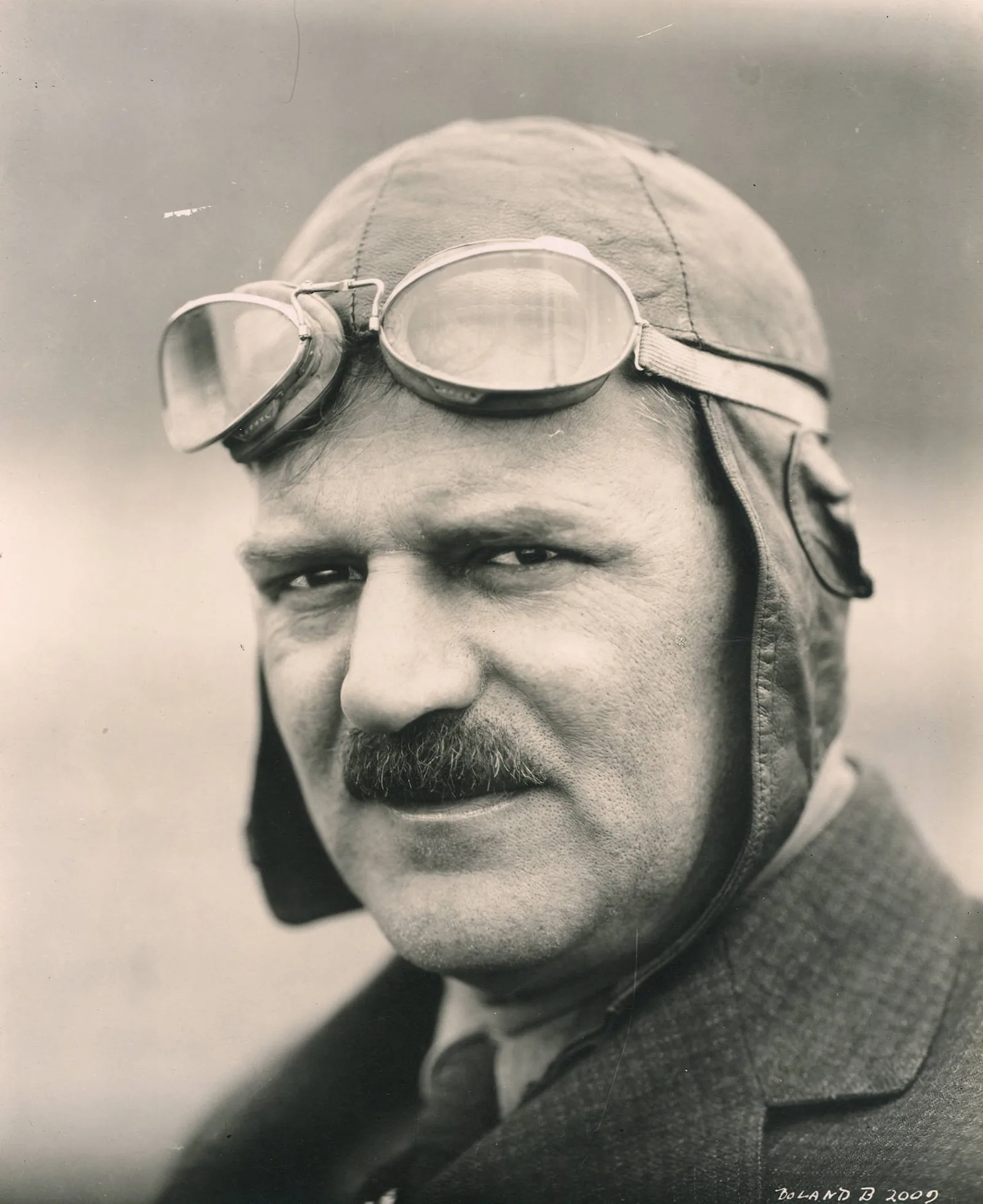
A Swiss watchmaker's son who sold his share of Chevrolet in 1915 and an Ulster mechanic who built a plane, a tractor hitch and a four-wheel-drive grand prix car.
Louis Chevrolet co-founded Chevrolet in 1911 and sold his share to William Durant in 1915, then raced and ended up working as a mechanic. Harry Ferguson built a plane, patented the tractor linkage in 1925 and spent decades promoting four-wheel drive.
Louis Chevrolet co-founded one of the world's best-known car companies in Detroit in 1911, sold his stake four years later and, late in his working life, was back on the factory floor of that company as a mechanic. His name outlived his control of the business. So did Harry Ferguson's, in a different field.
Chevrolet was a Swiss-born racing driver and engineer. Ferguson was an Ulster mechanic who flew his own aeroplane, rebuilt the farm tractor around a hitch and spent his last years trying to sell the motor industry on four-wheel drive. Neither man kept the empire that bears his name, but each left something that is still in use.
Who was Louis Chevrolet?
Louis-Joseph Chevrolet was a Swiss-born American racing driver, mechanic and entrepreneur, born on 25 December 1878 in La Chaux-de-Fonds, a watchmaking town in French-speaking Switzerland. He co-founded the Chevrolet Motor Car Company in 1911, fell out with his partner William Durant and sold his share in 1915.
His father was a watchmaker, and in 1887 the pair moved to Beaune in France. That is where Louis took up bicycle racing and built his first notable machine, a wine pump made from a defective one-cylinder motor mounted on a tricycle. From about 1889 to 1899 he worked at the Roblin mechanics shop in Beaune, spent a year in Paris, and then crossed the Atlantic, arriving in Montreal in 1900. The following year he moved to New York, where he worked for the Brooklyn operations of the French maker de Dion-Bouton.
The only four-wheel-drive grand prix car ever to win a race wore Harry Ferguson's name.
How did Louis Chevrolet become a racing driver and designer?
He won his first race in 1905, driving a Fiat at Morris Park, the first national championship race sanctioned by the American Automobile Association. In 1907 the Autocar Company of Philadelphia hired him, probably for a secret project to build a front-wheel-drive racing car. Then came Buick, where he drove and became a friend of the owner, William C. Durant, who founded General Motors.
Chevrolet had little formal education and learned car design on the job at Buick. In 1909 he began designing an engine of his own and built an overhead-valve six-cylinder in a workshop he owned in Detroit, on Grand River Boulevard. Chevrolet is also named as one of three co-designers of the 1910 Buick 60 Special, nicknamed the Buick Bug. The same year he raced at the Giants Despair Hillclimb.
Why did Louis Chevrolet leave the company that bears his name?
The two men disagreed over design. The company had been set up on 3 November 1911 by Chevrolet, his brother Arthur, Durant and two investors, William Little and Dr Edwin R. Campbell. By 1915 the differences with Durant had become too deep, and Chevrolet sold Durant his share and started a company in Canada, building Chevrolets under the McLaughlin name.
The corporate arithmetic then moved on without him. By 1916 an exchange of Chevrolet stock for GM Holding stock allowed Durant to buy back a controlling stake in General Motors, and by 1917 the Chevrolet company Louis had co-founded was merged into GM. The Canadian arm followed in 1918, when it combined with the McLaughlin company to become General Motors of Canada.
Even the badge has two rival origin stories. One says the logo was a modified Swiss cross, a tribute to the founder's homeland. The other says it was copied from the wallpaper of a Paris hotel room where he once stayed.
What did Chevrolet do after 1915?
Racing, mostly. Chevrolet partnered with Howard E. Blood to build the Cornelian racing car, in which he finished 20th at the 1915 Indianapolis 500. In 1916 he and his younger brothers Gaston and Arthur started the Frontenac Motor Corporation, making racing parts for the Model T Ford. Their Fronty-Ford racers became well known.
He drove at Indianapolis four times, with a best finish of seventh in 1919, and he and Gaston scored several third places in Sunbeams in 1916. Gaston did better still, winning the 1920 Indianapolis 500 in a Frontenac and taking the 1920 AAA National Championship that year.
Business was less kind. Also in 1916 a company called American Motors Corporation was formed in Newark, New Jersey, with Louis as vice president and chief engineer. It was producing cars at Plainfield by 1918, but a string of mergers from 1923 ended in a company that apparently ceased soon afterwards. It has no connection with the later American Motors of 1954. In 1927 he launched Chevrolair, a firm building aircraft engines, which failed three years later in the Great Depression. He went back to Chevrolet as a mechanic in its Detroit factories.
Chevrolet died in Detroit on 6 June 1941 of a heart attack. Atherosclerosis had earlier cost him a leg. He is buried in Indianapolis. Recognition came after his death: the Auto Racing Hall of Fame in 1952, the Automotive Hall of Fame in 1969 and four more halls of fame by 1995. A bronze bust of him in racing cap and goggles stands at the entrance to the Indianapolis Motor Speedway Museum, and the Swiss railway company SBB has named one of its long-distance trains after him.
Who was Harry Ferguson?
Henry George Ferguson, known as Harry, was a British mechanic and inventor born on 4 November 1884 near Dromore in County Down. He is known for the modern agricultural tractor and its three-point linkage, for building and flying the first aeroplane made by an Irishman, and for the Ferguson P99, the first four-wheel-drive Formula One car.
His father was a farmer. In 1902 Ferguson joined his older brother Joe in a bicycle and car repair business, and in 1904 he began racing motorcycles. The Wright brothers' first flight in 1903 had fired his imagination, and in 1909 he went to airshows at Blackpool and Rheims to take notes on early aircraft. Back in Belfast he persuaded his brother to build one. The Ferguson monoplane was towed behind a car through the streets to Hillsborough Park, and after propeller trouble and nearly a week of bad weather it took off on 31 December 1909. Ferguson was the first Irish person to build and fly his own aeroplane.
How did the Harry Ferguson tractor change farming?
Ferguson treated tractor and plough as a single machine rather than a towing vehicle and a trailer. His Master Patent, filed at Belfast on 12 February 1925, described quickly interchangeable implements attached so that, for the first time, tractor and implement acted as one unit, with automatic depth control and weight transfer.
The road to it was long. After falling out with his brother over aviation, he founded a company in 1911 selling Maxwell, Star and Vauxhall cars and Overtime Tractors. Seeing the weakness of a separate tractor and plough, he devised in 1917 a plough rigidly fixed to a Model T Ford, called the Eros. That year he also met Charles Sorensen of Ford, and he showed early versions of the three-point linkage fitted to Fordson tractors, at Cork in 1920 and at Dearborn in 1921. No deal followed. A hydraulic version was patented in 1926.
The production Ferguson Model A, built at a David Brown factory in Huddersfield, appeared in May 1936. Then, in October 1938, Ferguson showed his latest tractor to Henry Ford at Dearborn and the two men made a handshake agreement. It led to the Ford-Ferguson 9N, introduced on 29 June 1939. Ford was meant to build the tractor at Dagenham in England too, but never did.
The handshake did not survive Henry Ford's grandson. Henry Ford II ended it on 30 June 1947 but kept producing a tractor, the 8N, with Ferguson's inventions in it, leaving Ferguson with nothing to sell in North America. He sued. In April 1952 the case ended in an out-of-court settlement worth just over $9 million, about half of which the action itself consumed, and it left him stressed and unwell. Most of his key patents had expired by then, so other makers could use his ideas, and they did. A year later his business merged with Massey Harris, producing Massey-Harris-Ferguson and then Massey Ferguson.
Because Dagenham never built the tractor, Ferguson had earlier agreed with Sir John Black of the Standard Motor Company that its armaments plant at Banner Lane in Coventry would be refitted for the job. The TE20 went into production there in the autumn of 1946, and over 20,800 had been built before 1948 began. Thousands were shipped to the United States to fill the gap, until a US plant owned by Harry Ferguson Inc began making the TO20 in October 1948.
How did Ferguson four-wheel drive work?
Ferguson's system kept four-wheel drive engaged permanently and controlled the drive automatically whenever traction was lost and wheels began to slip. That set it apart from a Land Rover of the time, whose four-wheel drive could not be used on hard roads.
The work was done by Harry Ferguson Research Ltd, formed when Ferguson bought Dixon-Rolt Developments, a firm set up by racing drivers Tony Rolt and Fred Dixon who wanted to make a super-safe family car. Rolt became managing director and the company moved to Redhill in Surrey. Ferguson meant the cars to be built under licence by a major manufacturer, as his tractors had been, but the industry could not be persuaded.
After Ferguson died in 1960, his son-in-law Tony Sheldon took over as chairman and changed course, developing four-wheel-drive systems that makers could fit to their own production cars. To promote the idea the company built the Ferguson-Climax P99, which Stirling Moss drove to victory in the 1961 Oulton Park Gold Cup. No other four-wheel-drive grand prix car has ever won a race.
Adoption was thin. Jensen Motors was the only manufacturer to take the idea up, in the Jensen FF, and the system was renamed the Ferguson Formula. Ford Mustangs were converted to tempt American makers, without result. A batch of Ford Zephyr V6 saloons given four-wheel drive for British police forces handled far better in all weathers, but they cost too much to build and run. A licence taken by GKN made a four-wheel-drive Ford Capri look possible, until the plan fell through. The BRM P67 of 1964 and the Matra MS84 of 1967 also carried Ferguson drive, and both performed worse than their two-wheel-drive versions.
In 1971, after more than twenty years of effort without the expected results, Sheldon closed Harry Ferguson Research. Tony Rolt thought the work still had a future, particularly with a new viscous control unit that would lower manufacturing costs, and with Sheldon's support he formed FF Developments the same year.
Two names, two outcomes
| Louis Chevrolet | Harry Ferguson | |
|---|---|---|
| Born | 25 December 1878, La Chaux-de-Fonds | 4 November 1884, County Down |
| Died | 6 June 1941, Detroit | 25 October 1960, Lower Swell |
| Start | Mechanic, then racing driver | Repair shop, motorcycle racing, aviation |
| Landmark | Co-founded Chevrolet, 3 November 1911 | Master Patent, 12 February 1925 |
| Parting | Sold his share to Durant, 1915 | Merged with Massey Harris, a year after the Ford settlement |
| Racing mark | Best Indianapolis 500 finish, seventh in 1919 | Ferguson-Climax P99 won at Oulton Park, 1961 |
| Name today | Chevrolet, merged into General Motors in 1917 | Massey Ferguson |
Where this went next
After Harry Ferguson Research closed, the idea lived on through Rolt's FF Developments and its viscous control unit, as above. The tractor business has the longer line: Ferguson's inventions were free for every other maker to use once the patents expired, and his name continues as Massey Ferguson.
Memorials to both men are easy to find. For Chevrolet there is the Swiss train and the bust at Indianapolis. For Ferguson there is a blue plaque on the former site of his showroom in Belfast, a granite memorial to his flight at Newcastle, a replica monoplane at the Ulster Folk and Transport Museum, and the Harry Ferguson Memorial Gardens opened in 2008 near Dromara. Danske Bank's 20-pound notes in Northern Ireland carry his portrait beside a Ferguson tractor. In 2025 a plaque marked a hundred years since the Master Patent. Ferguson died at his home at Lower Swell in 1960 after a barbiturate overdose, and the inquest could not decide whether it was accidental.