Forced local assembly, a Carrera Panamericana publicity stunt and a Volkswagen plant that kept the Beetle alive after Germany stopped.
Mexico became a car-making country through early assembly plants, 1960s rules forcing local assembly, and Volkswagen's Puebla plant, which built its first Beetle in 1967. When German production ended, Mexico exported Beetles to Europe from 1978, and the industry built 4 million vehicles in 2017.
When production of the Beetle was cancelled in Germany, Europe kept buying it, and the cars came from Mexico. Small shipments to Europe had begun in 1971, and from 1978 Mexican-built Beetles went to showrooms in West Germany and beyond.
That reversal is the high point of a longer story in which a country with no car makers of its own became the second-largest vehicle producer in the Western Hemisphere. The Mexican car industry grew from a few hundred imported cars, through revolution, forced local assembly and a very Mexican affection for a German sedan, into a sector that built 4 million vehicles in 2017.
How did cars first reach Mexico?
Motorcars arrived in Mexico City in 1903, with 136 on the road that year and 800 by 1906. President Porfirio Diaz responded with the country's first highway code, which capped speeds at 10 km/h (6 mph) on crowded or narrow streets and 40 km/h (25 mph) elsewhere, and with a tax on car owners. The tax was scrapped in 1911 when Francisco Madero defeated Diaz at the start of the Mexican Revolution.
Local assembly was an early ambition. In 1910 Daimler and Renault each set up a small facility at Diaz's request, mostly to supply the government, but the revolution destroyed both within months. After the fighting ended, Buick became the first car maker to be officially established in the country, in 1921. Ford followed in 1925 and, as of 2020, is the longest-running brand there. The first fully Mexican vehicle came in 1961: a small truck called the Rural Ramirez, built by the Ramirez truck company.
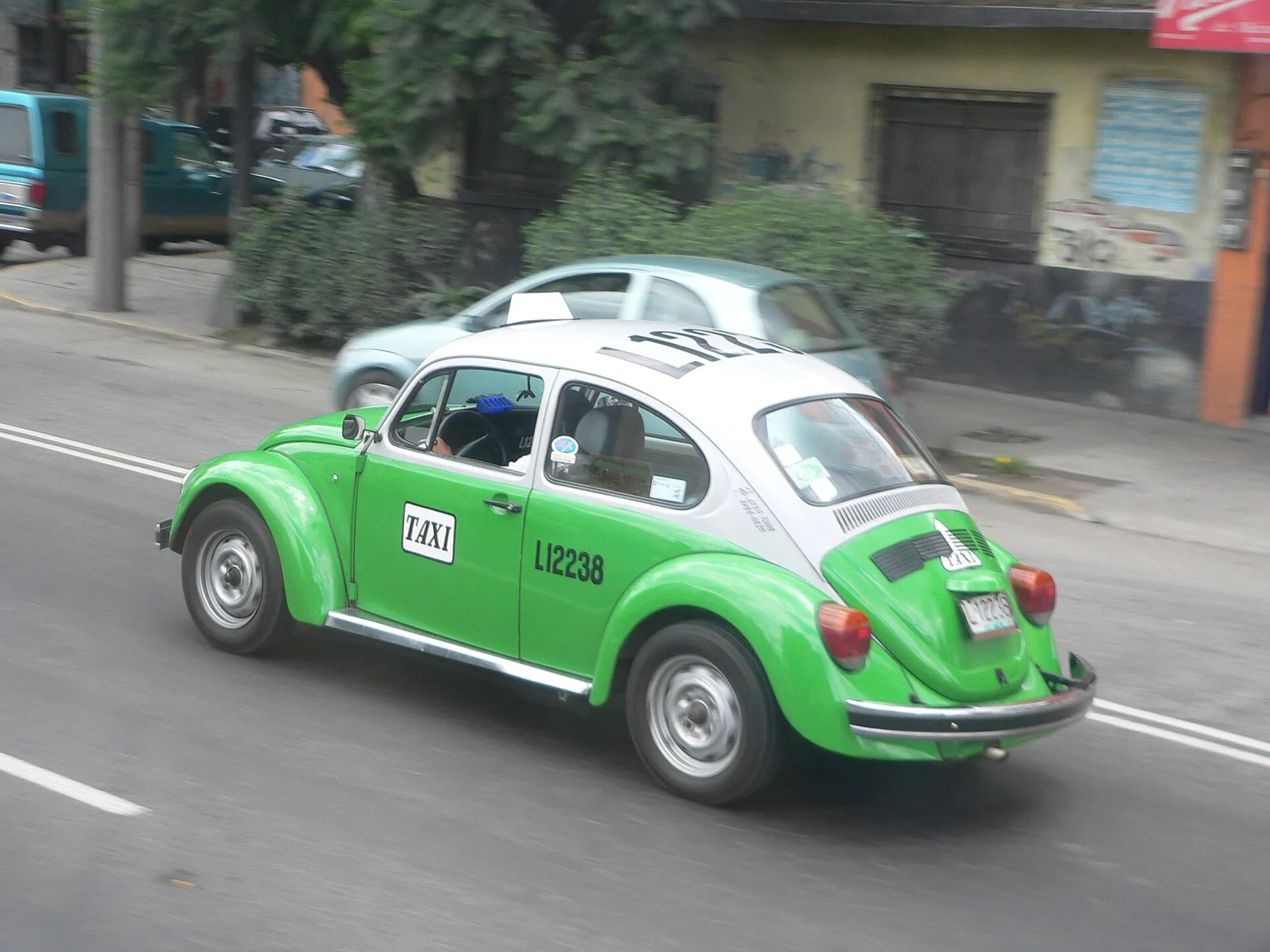
When production was cancelled in Germany, Europe kept buying Beetles from Mexico.
What did the government do to build a national car industry?
It made foreign brands build cars in Mexico. In the early 1960s, regulations forced manufacturers to assemble vehicles locally, with a mixture of Mexican and imported parts, in the hope of creating a national industry that would bring jobs and technology. Not everyone accepted. Mercedes-Benz, FIAT, Citroen, Peugeot and Volvo left. General Motors, Ford, Chrysler, American Motors, Renault, Volkswagen, Datsun and Borgward stayed.
Taxes of a different sort grew up around the car. Ahead of the 1968 Summer Olympics, the government reissued Diaz's old owner's tax as the Tenencia Vehicular, supposedly to pay for the venues, and kept it for the 1970 FIFA World Cup, too. It has lasted far longer than either event. The charge depends on the car's value and features and can reach 10 per cent of that value. A second levy, ISAN, applies once to new cars, and by law advertised prices must include both it and 16 per cent VAT. On 4 March 2011, President Felipe Calderon announced that the Tenencia would be abolished in every state by 2012, except in the Federal District, which covers most of Mexico City. Until then only Queretaro had dropped it.
How did Mexico's car industry recover?
Economic growth in the late 1990s brought most of the departed brands back. Honda and Porsche arrived for the first time, and Peugeot and Mercedes-Benz returned in 1997. Annual passenger vehicle sales passed one million in 2005. Hybrids such as the Honda Civic Hybrid appeared, though diesel stayed rare because Mexico's emissions rules were stricter than Europe's Euro IV standard, and new diesel vehicles face the Hoy no Circula restrictions in Mexico City.
That programme gives every vehicle a coloured sticker based on the last digit of its plate and bans it from the road on one weekday a week, and on one Saturday a month. Brand new cars carry a "00" exemption and recent ones a "0"; only vehicles older than 8 years fall under the rules.
The industry has also created its own cars. The Mastretta MXT, announced in May 2007, was the first Mexican sports car, with production starting in January 2011. In 2010 the bus builder Cimex announced a pickup called the Conin, expecting it to be the first domestic pickup truck in 2013.
How big is the automotive industry in Mexico now?
Forty-two makers have official representation, offering nearly 400 models, which makes the Mexican market one of the most varied in the world. The automotive sector accounts for 17.6 per cent of manufacturing. The industry makes technically complex parts and does research and development. General Motors, Ford and Chrysler have operated there since the 1930s, while Volkswagen and Nissan built their plants in the 1960s. Around Volkswagen in Puebla alone, 70 part-makers cluster.
The 2010s brought a surge. In the first months of 2014, more than $10 billion in investment was committed. Kia announced a $1 billion factory in Nuevo Leon in August 2014. Mercedes-Benz and Nissan were already building a $1.4 billion plant near Aguascalientes, BMW was planning a $1-billion assembly plant in San Luis Potosi, and Audi started a $1.3 billion factory near Puebla in 2013. Most of Mexico's car exports to the United States travel by rail, with some by sea.
When did the Mexican VW Beetle arrive?
In March 1954, at an exhibition called Alemania y su Industria (Germany and its Industry). Four Volkswagen vehicles came through Veracruz: a convertible, a luxury-trim VW Bus and two Export-trim Sedans. Officially the Beetle was the Type I sedan and the Bus the Type II station wagon. The Mexican market was dominated by large American cars with big engines, so the small German newcomer made a startling contrast. At an exhibition at Ciudad Universitaria in Mexico City the public admired the oval-window Beetles, and former president Lazaro Cardenas travelled from Michoacan to see one. The press ran the story across eight columns under the headline "The People's Man", with the "People's Car".
Doubts about long-term reliability were answered on the road. Prince Alfonso de Hohenlohe, a car enthusiast living in Mexico City, entered seven VW sedans in the 1954 Carrera Panamericana. All seven finished the 3211 km race, though none won, and all ran stock 1200cc engines. When newspapers whispered that the engines were really Porsche units, a mechanic from Houston inspected the cars and certified that they had unmodified Volkswagen engines. The episode led to the creation of Volkswagen Mexicana, S.A. The same year Hohenlohe founded Distribuidora Volkswagen Central, which opened the following year as Mexico's first Volkswagen dealership.
Volkswagen Puebla: how did the Beetle become Mexican-built?
In 1961 the first 250 cars were put together by Automex, the firm that later became Chrysler de Mexico, and in June that year a six-month contract with Studebaker-Packard de Mexico covered assembly from kits imported from Germany. The first Volkswagen assembly plant opened in 1962 at Xalostoc in the State of Mexico under the name PROMEXA and turned out 10 cars a day. Volkswagen de Mexico was established in January 1964. Production at Xalostoc could not keep up, so in June 1965 a new plant opened in the suburbs of Puebla on 2 million square metres (204 hectares or 505 acres).
The first Beetle rolled off the Puebla line on 23 October 1967. A 1500 cc engine replaced the 1200 cc unit in mid-1968, and the 100,000th Mexican Beetle was built on 12 June of that year.
| Year | Milestone |
|---|---|
| 1962 | PROMEXA plant opens at Xalostoc, 10 cars a day |
| 1967 | First Beetle at Puebla, 23 October |
| 1968 | 100,000th Beetle; 1500 cc engine |
| 1971 | 200,000th Beetle; exports to Costa Rica and Europe begin |
| 1974 | 1600 cc engine, 44 HP SAE (50 PS DIN) |
| 1975 | 500,000th Beetle, June |
| 1980 | One millionth Mexican-made Volkswagen, September |
| 1990 | Two millionth Mexican Volkswagen, one millionth Beetle |
What changed on the Mexican Beetle through the 1970s?
Details drifted away from the German cars and then back toward them. The 1971 model year brought new bumpers, an engine cover with two groups of five louvres and vertical headlights. That year the 200,000th Mexican Beetle was built and exports to Costa Rica and Europe began, and the Federal District chose the Volkswagen Sedan for public transport, which made it the standard Mexico City taxi. In 1972 the Beetle received the larger front windows used in Germany since 1965, though the larger rear window had to wait until 1985.
The 1973 model was highly popular, with four-bolt 15-inch wheels, flat hubcaps, a padded matt black dashboard and a fuel filler moved from the boot to the right front wing. In 1974 a 1600 cc engine making 44 HP SAE (50 PS DIN) replaced the 1500. The 500,000th Mexican Beetle arrived in June 1975, together with two limited editions, the Jeans and Sport Jeans, which had special wheels and unique colours. In 1977 the front indicators moved to the bumper, as on European cars from 1975, and vinyl seats gave way to cloth-vinyl.
Why did Europe import Mexican Beetles?
From 1978, with German production cancelled, the Mexican Beetle was exported across Europe, with Switzerland, Italy, the Netherlands, Belgium, Austria and West Germany among the buyers. The export car was not the same as the one Mexicans bought: it used a 1200cc engine rated at 34CV (33 hp), and from the 1982 model year its engine cover had no exterior vents. Optional metallic colours included Silver, Copper Red, Cadmium Blue and Viper Green.
Milestones came quickly. In September 1980 the one millionth Mexican-made Volkswagen was built. On 15 May 1981, Volkswagen de Mexico built the 20 millionth Beetle in the world, marked by a silver limited edition. Around then the nickname Vocho took hold in Mexico. For the Beetle's 30th anniversary in the country in 1984, three commemorative editions were produced, including a velvet-red one only for West Germany.
Exports ended in 1985, and a grey metallic edition called the Jubilee Kafer, marking 50 years of the Beetle, closed the run for European buyers. In 1986 the Mexican car received the larger 1972-style rear window and a bulged rear apron. The Europa Edition 1 that year was the first black Volkswagen in Mexico in many years, with Recaro headrests and a cassette stereo, followed by the grey Europa Edition 2 in 1987, the first Mexican Beetle with tinted windows.
What ended the old Mexican Beetle?
Politics and pollution rules reshaped it. For the 1989 model year a government decree forced a cut in the retail price and a tax reduction, and the car was relaunched as the Volkswagen Sedan, minus wheel caps, body vents and some quality in the fittings. Production reached two million Mexican Volkswagens in 1990, and one million Mexican Beetles with them.
For 1991, by government order, the Beetle gained a catalytic converter while keeping its carburettor, generator and old ignition system, and its power and performance did not suffer. The dashboard borrowed light switches and a two-arm steering wheel from the Golf, and a single tailpipe replaced two. In 1992, on 23 June, the Beetle passed 21 million units worldwide, and Puebla launched a "21 Million" edition with chrome wheel caps, tinted windows and light grey velour in five colours.
Which cars took over as Mexico's best sellers?
The Volkswagen Sedan was Mexico's favourite until the Chevrolet Chevy arrived. That car, a second-generation Opel Corsa from Spain, was introduced in 1994, and from 1996 it was built at Ramos Arizpe and is credited with replacing the Beetle at the top. The Nissan Tsuru, a Sentra first sold under that name in 1983, is described as overtaking both, reaching number one in 1998 and staying there until 2005. No other car has been sold in Mexico for as many consecutive years this century, and it is still a favourite with city taxi drivers. Volkswagen's own Jetta, renamed Atlantic for Mexico in its first generation, sold well enough that the company built it in Puebla.
Where this goes next
The plans that shaped the 2010s are dated. President Calderon aimed to abolish the Tenencia by 2012, Cimex expected its Conin pickup in 2013, and the investment announced in 2014 covered plants for Kia, Mercedes-Benz and Nissan, BMW and Audi. The common thread is foreign manufacturers choosing Mexico as a base, with Puebla at the centre of Volkswagen's operation there.