How the Car of Tomorrow, the playoff format and the rulebook for liveries, numbers and sponsors changed what a NASCAR car is and who becomes champion.
The Car of Tomorrow was NASCAR's safety-driven car, revealed in 2006 and raced in the Cup Series from 2007 to 2012. The Chase, announced in 2004, is its championship playoff, now sixteen Cup drivers over ten races. The rulebook sets liveries, numbers and sponsors.
Not one driver has been killed in Cup Series racing since the Car of Tomorrow arrived in 2007. The car came out of a five-year project that began after Dale Earnhardt Sr. was killed on the last lap of the 2001 Daytona 500, and it arrived alongside a championship format, the Chase, that reshaped how titles were won.
Why did NASCAR build the Car of Tomorrow?
NASCAR wanted a safer car, and the Car of Tomorrow was the answer. Its five-year design programme was sparked mainly by Earnhardt's death at Daytona in 2001. NASCAR revealed the car on 11 January 2006, naming three aims: safety, closer racing, and lower costs for teams.
The loss was not isolated. Three drivers had already died in on-track accidents the season before: Tony Roper, Adam Petty and Kenny Irwin Jr. The cars of the time were based on a Holman Moody design first used for the 1966 Ford Fairlane. The new car was larger and boxier than the one it replaced, and it was criticised for a generic appearance and poor handling. Against that, it brought dramatic safety gains, cost less to maintain and was meant to produce closer competition.
No Cup Series driver has died in competition since the Car of Tomorrow arrived.
What did the Car of Tomorrow change?
The changes were mostly about protecting the driver. The seat moved four inches toward the centre of the car and the roll cage three inches rearward, while the body grew two inches in height and four in width. Bigger crumple zones and energy-absorbing foam went into both sides.
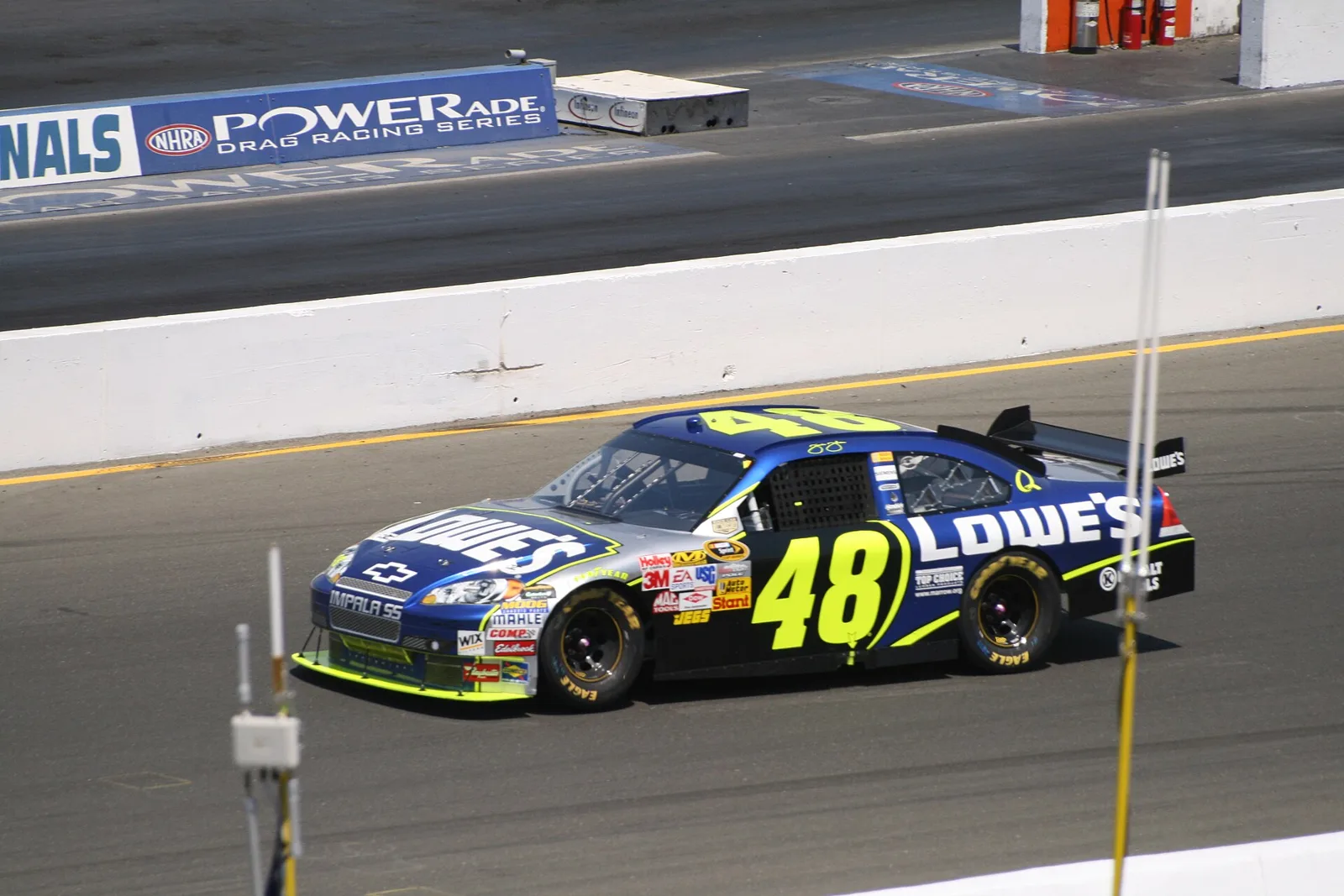
An adjustable splitter of fibre-reinforced plastic replaced the front valance and produced downforce. The exhaust exited on the right side, away from the driver, and the fuel cell used thicker material and shrank to 67.2 litres (17.75 US gallons) from 83 litres (22 US gallons). The windshield stood more upright to resist collapse in a rollover, at the price of extra drag. The radiator intake sat below the bumper so that debris-clogged grilles caused less overheating, and the boxier bumper and gapped airdam were meant to blunt aerodynamics and slow the cars.
Early cars also wore a detached rear wing instead of a spoiler, a part last used by the Dodge Charger Daytona and Plymouth Superbird back in 1970. NASCAR officials first said the car depended less on aerodynamics. By 15 January 2010, Cup Series director John Darby was telling teams the sport would return to a spoiler, because the wing was believed to cause airborne accidents. The spoiler returned in 2010, at the Goody's Fast Pain Relief 500, only the sixth points race of that year.
How were the new cars policed?
Every car had to fit the same set of templates, with minor differences between the makes, checked with a laser inspection device nicknamed the claw. Previously NASCAR had used separate templates for Ford, Chevrolet, Dodge and Toyota. For the opening pair of races, at Bristol and Martinsville, garages opened a day early and inspections took up to 10 hours while everyone learned the system.
During the era NASCAR tried to eliminate gray areas in the rule book and kept adjusting rules to keep the makes relatively equal. Two cases stand out. After the 2008 Sprint All-Star Challenge, where Sam Hornish Jr. made the main event with a skewed setup, rules were tightened. So they were in 2012 after Hendrick Motorsports teams used skewed sway bars to win five races in the spring. The claw and the manufacturer-specific templates carried on with the next car until 2018, when a laser-based Optical Scanning System replaced them.
How did the Car of Tomorrow reach the track?
It took longer than planned. NASCAR first tested the car in December 2005 at Atlanta Motor Speedway, then ran it at Daytona, Bristol, Martinsville, Charlotte, Talladega and Michigan. Its early target had been 2004 or 2005, but negative driver comments led to the splitter and the wing and pushed the debut to 2007.
Its race debut came at Bristol on 25 March 2007, in the Food City 500, the fifth race of the season, and it ran only 16 races that year. The plan was to require it of every team in 2009, but after a successful February test at Bristol, and a survey in which 80 per cent of owners favoured the switch, NASCAR confirmed on 22 May 2007 that it would arrive for the full 2008 schedule instead, partly as a cost-saving measure.
Kyle Busch won that first race, which gave the Chevrolet Impala its first victory since Wendell Scott's historic win in 1963. Reactions were mixed. Dale Earnhardt Jr., seventh at the flag, said it was not the disaster everybody had anticipated. Drivers liked that the cars could bump one another without spinning, and Jeff Gordon and Jeff Burton said it opened a second passing lane at Bristol. Busch himself, in victory lane, said the car sucked. Rusty Wallace complained of single-file racing, though he later called running the full schedule one of the best decisions NASCAR had made.
What went wrong with the early cars?
Two problems showed up straight away. In the first race one car's splitter could run into the tyre of a neighbour and puncture it, though that did not recur at the second race. And the safety foam in the sides could catch fire, filling the cockpit with smoke, so NASCAR made changes before the 21 April race in Arizona. In a side impact for Brian Vickers at Watkins Glen the foam was sheared out and left debris on the track.
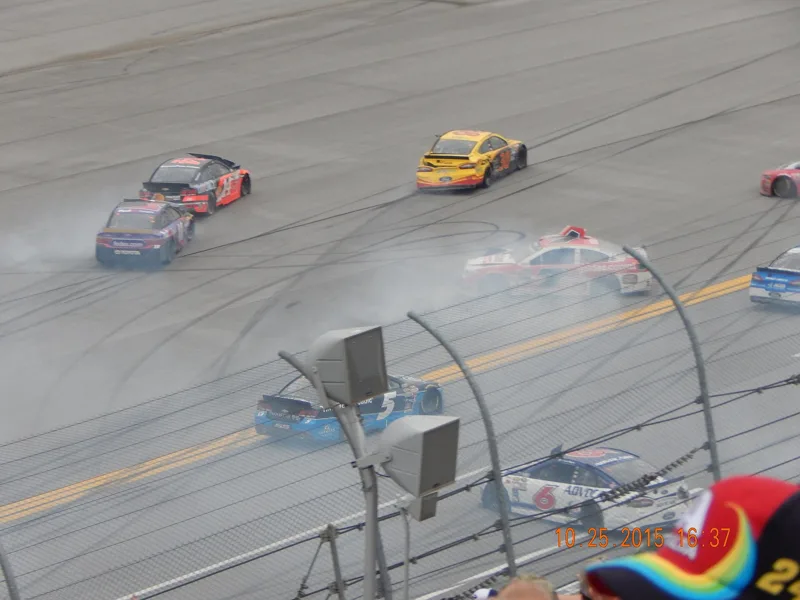
At Talladega in 2007 the car's less aerodynamic shape meant NASCAR assigned a restrictor plate of 25 mm (31/32 in), letting engines turn about 8,800 rpm. The previous car ran around 7,000 rpm with a 22 mm (7/8 in) plate. It was the most open plate at Talladega since 1988.
Criticism of the handling went on. Gordon, after the 2007 New England 300, said he could have told anyone from his first drive that the car would worsen the aero push rather than reduce it. Busch, at Dover in 2008, said the car ran into a wall of air behind a leading rival. On 4 April 2008, during qualifying at Texas, a broken sway bar sent Michael McDowell head-on into the wall at 185 mph, and his car barrel-rolled eight times; he emerged from the Toyota unharmed.
NASCAR retired the Car of Tomorrow body after the final race of 2012. The sixth-generation car, with extra chassis safety improvements and better bodies, arrived in 2013, and many teams simply swapped the bodies on existing chassis. The chassis lasted to the end of 2021, when the Next Gen car replaced it. The second-tier series ran its own version from 2010 on a shorter wheelbase and made it mandatory in 2011.
What is the Chase, and why did NASCAR create it?
The Chase is NASCAR's championship playoff. NASCAR unveiled it on 21 January 2004 under the title Chase for the Championship, with the stated purpose of making the middle of the season more competitive and lifting fan interest and television ratings. Before it, the title could be settled mathematically before the finale.
The start of the playoff lines up with the football seasons and the last month of the baseball year. Squeezing the points of the leading drivers together gave each of them a better shot at the title, while still leaving anyone with a genuine chance in contention. The first cut-off of the top 10 rested on history: with 10 races left, nobody outside that group had ever gone on to win.
NASCAR also looked at short-track racing. In 2001 the Hooters Pro Cup organisers devised a five-race playoff called the Four Champions, named for four Hooters staff, including 1992 Winston Cup champion Alan Kulwicki, killed in a plane crash on 1 April 1993. NASCAR watched it succeed.
The name has followed the sponsors: Nextel until 2007, Sprint from 2008, and from 2017 a rebrand as the NASCAR Playoffs. In 2026 the playoffs are due to be called The Chase again, as part of a revamp of the format. Today the Cup version has sixteen drivers racing for the title over the last ten races; the O'Reilly Auto Parts Series uses twelve drivers over nine races and the Truck Series ten over seven.
What was the Matt Kenseth rule?
It is the nickname for the points changes of 2004, taken from Kenseth's 2003 title. Kenseth won that championship with a single victory, 25 top-ten finishes and 33 races leading the standings. Ryan Newman won eight of the 36 races, 22 per cent, but crashed out of several and finished sixth.
NASCAR said the 2003 outcome was not the driving factor and that it had been weighing points tweaks to reward wins since 2000. The new scoring system that arrived with the Chase paid winners more, stressing victory over consistency.
How did the Chase format change over the years?
| Period | Who qualified | Points and scoring |
|---|---|---|
| 2004-2006 | Top 10 after 26 races, plus anyone within 400 points of the leader | First place started on 5,050, then 5,045 and so on in five-point steps |
| 2007-2010 | Top 12 after 26 races | Everyone reset to 5,000, with ten bonus points per win |
| 2011-2013 | Top 10 plus two wild cards with the most wins from 11th to 20th | Base of 2,000, three bonus points per win for the ten automatic qualifiers |
| 2014-2016 | 16 drivers, chosen mainly on regular-season wins | Three cuts remove drivers as the Chase progresses |
In 2007 Brian France explained that the adjustments put a greater emphasis on winning races. In the 2011 version, race winners took 43 base points plus 3 bonus points, every driver who led a lap earned 1 point, and the driver who led most laps earned 1 more.
The 2013 season produced a scandal. At Richmond, with seven laps left, Clint Bowyer spun and brought out a caution as his Michael Waltrip Racing teammate Martin Truex Jr. fought for the last wild card place. NASCAR said it could not find solid evidence that the spin was deliberate, but it did judge that general manager Ty Norris's order for Brian Vickers to pit was a calculated effort to manipulate the standings. Michael Waltrip Racing lost 50 owner and driver points per team and was put on probation, Norris was suspended indefinitely, and Newman took the wild card place. A separate deal between two other teams to help Joey Logano also drew probation, and the field was expanded to 13 by adding Jeff Gordon.
The 2014 format, announced on 30 January 2014, looked more like playoffs in other major sports, with sixteen drivers and three cuts. Brian France announced the current version on 23 January 2017, the fifth format since 2004. It was also the 15th change to the points system since 1949.
What does the NASCAR rulebook set for cars?
Each NASCAR series has its own rule book, and the books go only to members rather than the public. Even so, many rules are widely known. Each car must show its number on both doors and the roof, and its front end and the bottom of the rear bumper must match the manufacturer's decal specifications.
Looks have a rulebook of their own. The Cup liveries changed in 2013 with the sixth-generation car, so that the driver's last name sat on the windshield header. In 2014 Chase cars wore yellow roof numbers and splitters. When the Next Gen car came in 2022 the door number moved forward, into the space the contingency decals once occupied. Contingency decals themselves fell from around 30 to a handful.
Teams must send paint schemes and sponsor identities to NASCAR for approval, and both sides of the car must share the same colour pattern. That rule came to light at Talladega in October 2014, when Terry Labonte's team painted his car in two different schemes before approval; NASCAR let it stand for qualifying but made them match for the race. By 2016 the rule appeared to have been relaxed for teams that got permission.
NASCAR legally owns every car number, and teams apply and pay to use them. Numbers run from 0 to 99 and 00 to 09, and the 00 to 09 group are scored as 100 to 109 so that, for example, 107 cannot be confused with 7. Only one number has been formally retired, the 61 of the Whelen Modified Tour, in memory of Richie Evans. The 3 of Dale Earnhardt and Richard Childress has been unofficially retired for everyone outside those families, with Childress paying a licensing fee while it was out of circulation from 2001 to 2013.
How do sponsorship rules shape NASCAR?
The Viceroy Rule gives NASCAR's title sponsors exclusive protection from direct competitors within a series. It is named after a cigarette brand that entered the 1972 USAC Championship Car season and prompted Marlboro, the title sponsor, to drop its branding. It came into play when Nextel signed a ten-year deal worth US$700 million to replace Winston as Cup sponsor. Sponsors already in place, such as Cingular and Alltel, were allowed to continue.
Tobacco and alcohol have their own history. R. J. Reynolds declined to renew its Winston sponsorship of the Cup Series after 2003, and in June 2010 the Food and Drug Administration banned cigarette and smokeless tobacco sponsorship in any sporting event. Until 2004 alcohol sponsorship was restricted to beer; NASCAR reversed the ban on hard liquor for 2005, with responsible drinking messages required. In 2020 the Cup Series moved to a new package of sponsors and the Viceroy Rule was lifted for Cup cars, though it still applies in the lower series and for fuel sponsors.
For combination races, in which two series share compatible rules, drivers have scored points in their own series since 2017 based on their actual finish among all competitors.