One circles a 25.3 km track with a field of amateurs and professionals; the other began on public roads in 1924. How the two great GT endurance races differ.
The Nurburgring 24 Hours has run since 1970 on a 25.3 km lap that mixes amateurs and GT3 cars, while the 24 Hours of Spa has run since 1924 on a 7.004 km circuit and now uses GT3 cars. Both are GT endurance races in the Intercontinental GT Challenge.
In 2006 a Manthey Racing Porsche covered 3,832 km (2,381 mi) in 151 laps of a circuit 25.3 km long, a new distance record for the Nurburgring 24 Hours. By 2023 the race had gone farther still, and it also produced the first Ferrari win.
The Nurburgring 24 Hours and the 24 Hours of Spa are the two great GT endurance races in Europe's calendar, and they could hardly be more different.
What is the Nurburgring 24 Hours?
It is a 24-hour touring car and GT endurance race held each year on a combination of the Nordschleife, the North Loop, and the GP-Strecke, the Grand Prix track, at the Nurburgring in Rhineland-Palatinate, Germany. It has run since 1970, and with a lap of more than 25.3 km (15.7 mi) the track has allowed fields of over 200 cars and over 700 drivers.
The German organiser ADAC introduced it in 1970 as an official race. Earlier endurance contests there had covered 12, 24, 36, 84 and even 96 hours, such as the Marathon de la Route, which replaced the Liege-Rome-Liege and Liege-Sofia-Liege rallies and ran at the Nurburgring from 1965 to 1971. From 2024 the event carries the title ADAC RAVENOL 24h Nurburgring for sponsorship reasons, and it has been part of the Intercontinental GT Challenge calendar since the same year.
One race is a 25.3 km marathon with amateurs and factory cars on the same track. The other has run since 1924 and now laps a 7.004 km circuit.
What is the 24 Hours of Spa?
The Spa 24 Hours is an annual car endurance race that has been run since 1924 at the Circuit de Spa-Francorchamps, in Stavelot, Belgium.
Henri Langlois Van Ophem and Jules de Their dreamed it up a year after the first 24 Hours of Le Mans. It debuted in 1924 on a 15 km (9.3 mi) circuit of public roads linking Francorchamps, Malmedy and Stavelot, under the Royal Automobile Club of Belgium. The present 7.004 km (4.352 mi) circuit opened in 1979 and has changed only slightly since.
How do the two tracks differ?
Length is the obvious gap. Spa's lap is a little over a quarter of the Nurburgring's, and the German course has changed far more. Depending on the version of the Grand Prix circuit, the Nurburgring 24 Hours lap has ranged from 22.835 km (14.189 mi) when first drawn up to close on 26 km (16.2 mi) in 2002 and 2003, once the Mercedes Arena extended the GP track. Since 2005 that section has been bypassed by a sharp Z-shaped chicane, giving today's 25.3 km (15.7 mi).
The two races once formed a pair. Both circuits held a 24-hour and a 1000 km event: the ADAC had staged its first 1000 km Nurburgring sports car race in 1953, and the 1000 km Spa began in 1966. With the 24 Hours at the Ring starting in 1970, each circuit hosted two endurance events on a very long lap, until Spa was cut down in 1979.
| Detail | Nurburgring 24 Hours | 24 Hours of Spa |
|---|---|---|
| First held | 1970 (as an official ADAC race) | 1924 |
| Location | Nurburgring, Rhineland-Palatinate, Germany | Spa-Francorchamps, Stavelot, Belgium |
| Lap length | 25.3 km (15.7 mi) | 7.004 km (4.352 mi) |
| Typical classes | 20 classes in 2023, from SP1 to SP10 and production cars | FIA GT3 and GT3 Cup |
| International GT calendar | Intercontinental GT Challenge from 2024 | Intercontinental GT Challenge from 2016 |
| Usual timing | May or June, around Ascension Day or Corpus Christi | Traditionally late July; moved to early July in 2023 |
Who races at the Nurburgring 24 Hours?
Like the four-hour races of the VLN series, the Nurburgring 24 is mainly aimed at amateurs, so that around 200 cars fill the field. Unlike VLN it is officially international, with organisation and paperwork in three languages: French, German and English, the French because SRO regulations are written in that language. Entry fees are due. In 2010 the price was 7,508 euro per car, of which 3,000 euro was an advance payment for fuel.
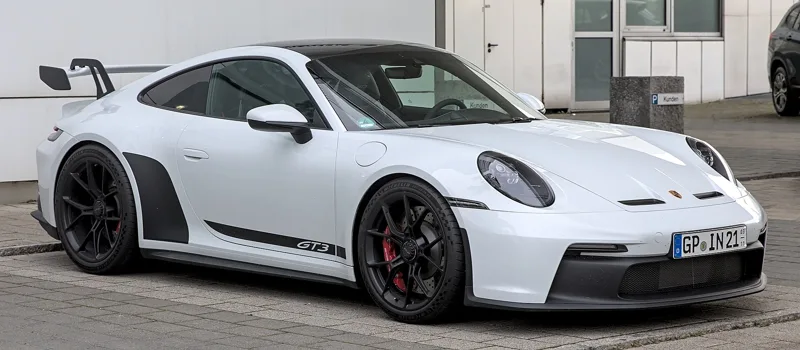
Entries run from second-hand road cars up to GT3 machinery such as the Porsche 911 GT3, with European Touring Car Championship cars in between. The involvement of manufacturers and professional teams has swung over the decades. Spectator numbers fell in the 1990s, when only fairly standard FIA Group N cars competed, so from 1999 more spectacular machinery was admitted. Examples were the Zakspeed Chrysler Viper GTS-R, originally built by Oreca to FIA GT2 specification, turbocharged Porsches, Opel and Abt Sportsline-Audi touring cars adapted from the Deutsche Tourenwagen Masters, and a Schnitzer Motorsport BMW M3 GTR V8 that had run in the 2001 American Le Mans Series.
As of 2024 the field is capped at 150 cars, driven by up to 600 drivers, with two, three or four sharing each car. A driver can drive 150 minutes without a break and may enter on two cars, but must rest for at least two hours between stints.
Which classes run at the Nurburgring?
In 2023, 135 cars in 20 classes took part. The classes are:
- 24h-Special, pure race cars that may also compete in other series: SP1 to SP8, split by engine displacement with an optional T suffix for turbocharging, SP9 for FIA GT3 cars and SP10 for SRO GT4 cars.
- VLN production classes for relatively low-cost racing with near-standard cars: V3 to V6 for normally aspirated cars, VT1 to VT3 for turbocharged ones, with separate front-wheel-drive classes.
- Single-make cup classes: the Porsche 911 GT3 Cup and Cayman GT4 Clubsport, plus BMW's M240i and M2 CS.
- TCR touring cars.
- The AT class for cars running on alternative fuels.
The race has also welcomed cars rarely seen in international events. A 1988 Opel Manta raced from 1994 to 2023; other oddities include the P4/5 Competizione in the 2010s, a Volkswagen Caravelle in 2000 and Fiat Cinquecentos in the 1990s.
What cars race at Spa?
Spa's history is a story of change. Entries have gone from the Russian Moskvitch and tiny cars under one litre, like the NSU Prinz TT, up to the plush Mercedes-Benz 300 SEL 6.3 with its V8. Mercedes-AMG tuned one to 6834 cc and 420 hp (313 kW), and that car, nicknamed the Red pig, took second place in 1971.
The cars now are FIA GT3 and GT3 Cup machines, and the race belongs to the GT World Challenge Europe and the Intercontinental GT Challenge, the latter since its inaugural season in 2016. Before that it was part of the FIA GT Championship with GT1 and GT2 cars and various touring car series. It was a European Touring Car Championship round from 1966 to 1973, again in 1976 and from 1982 to 1988, though in 1987 it served the first World Touring Car Championship instead. It also counted for the 1953 World Sportscar Championship and the 1981 World Endurance Championship.
In 2004 Swiss driver Lilian Bryner shared the winning BMS Scuderia Italia Ferrari 550, which made her the first woman on a victorious team in a 24-hour race for Gran Turismo cars with over 500 hp (370 kW).
What is the Coupe du Roi at Spa?
The Coupe du Roi, the King's Cup, goes to the best manufacturer rather than the race winner. It is decided on points scored by cars from the same make. Holden of Australia won it in 1986 even though its cars finished the race 18th, 22nd and 23rd outright.
How is safety handled at the Nurburgring?
The length of the track forces unusual procedures. Safety cars are used only for red flags and the restarts that follow. Double yellows impose a local limit of 120 km/h (75 mph). Code 60 flags, used on shorter tracks when a safety car would be called, drop speeds to 60 km/h (37 mph). Course cars and recovery trucks regularly circle the track while double yellows are out.
From 2015 competitors have needed a valid DMSB Permit Nordschleife, a licence for that section of the track, and three races on the track in the last two calendar years. Class speed differences worry organisers, since the track is full of blind crests and corners. In 2023 a Porsche 911 GT3 R struck the slowest car in the field, a Dacia Logan SP3, at the fast Stefan-Bellof-S, throwing the smaller car into the barriers.
Weather in the Eifel is a hazard too: rain and fog halted the race for several hours in 2018, 2020 and 2021, and in 2016 a freak hailstorm led to crashes and a red flag. In 2001 Christian Peruzzi died following a practice crash in an Alfa Romeo 147.
Spa has had its own losses: two people died in separate incidents in 1975, Wim Boshuis, a Dutch driver, and a track marshal.
Notable Nurburgring 24 Hours races
The 2006 race broke from the two previous cold, rainy Ascension Day races to run in warm, sunny, dry weather on Corpus Christi weekend. With purely factory teams absent from the overall fight, Manthey Racing's Porsche 996 GT3 set the distance record, 3,832 km (2,381 mi) in 151 laps. The team is partly supported by Porsche, with factory drivers and a sequential gearbox, plus a 3.8L engine of 500 PS (370 kW; 490 hp). Second place went to Jurgen Alzen Motorsport, one lap down, with a conventional gearbox and a privately built engine of the same output. In fifth was a BMW 120d from Schubert Motors, with roughly half the power of some cars it beat.
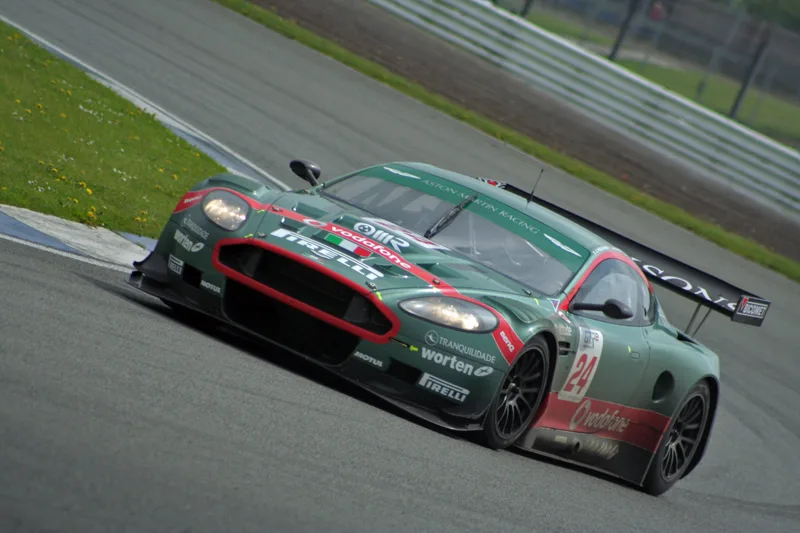
The 2007 race had more than 260 teams applying for 220 entries, then a thunderstorm delaying the start. Lightning struck the fans' camp and injured several people. The race began at 16:51 after two laps behind a safety car, and Klaus Ludwig in the Aston Martin DBRS9, number 007, led in the wet before hesitating over a change to dry tyres. Fog stopped the race for six hours, cutting it to 18 hours, and Manthey defended its victory in a new Porsche 997 GT3-RSR.
In 2008 over 270 cars were entered and 230 accepted. Manthey won for the third time in a row, with its 2006 winning car second, and the mechanics cut off the tips of Olaf Manthey's famous moustache in celebration. Sabine Schmitz came third. A strong showing for the three new Volkswagen Scirocco cars, ninth and twelfth, saw Hans Joachim Stuck drive both.
For 2009 the organisers wanted to narrow the speed gap, refusing small cars and slowing the SP7 and SP8 classes, and adopted FIA GT3 and GT4 as SP9 and SP10. Some rules proved controversial, notably expensive fuel equipment designed to equalise refuelling times so economical cars lost their advantage. Zakspeed withdrew its Viper. With only 170 starters, a Ford GT took pole, followed by four factory-entered Audi R8 LMS cars and two Manthey Porsches. The 2010 race on Ascension Day weekend saw Marco Werner set pole at 8:24.753, a record average speed of 181 km/h (112 mph), in one of four Audi R8 LMS cars officially entered by customers.
Later years brought extremes. The 2023 race ran the longest distance yet and gave Ferrari its first win. The 2024 race, hit by rain and overnight fog, set a record shortest distance of just 50 laps in under 10 hours.
When does each race run?
The Nurburgring race is usually held in May or June, on Ascension Day or Corpus Christi, though 2013 fell on Pentecost instead. The 2020 edition moved to September, with a restricted crowd confined to the Grand Prix area. Support races run on Thursday, Friday and Saturday, including the 3-hour ADAC 24h-Classic on Saturday morning.
Spa also adjusted in 2020 by running behind closed doors for the first time. In September 2022 the 2023 Belgian Grand Prix was set for 28 to 30 July, clashing with Spa's usual date, so the Spa 24 Hours moved to early July.
What does this mean for a team or a fan?
For a driver or team, the Nurburgring is a test of local knowledge as much as speed, with a licence requirement and a wide spread of cars on one track. Spa offers GT3 racing on a circuit that has barely changed in decades. For fans, one race gives variety, from an Opel Manta to a Ferrari winner, while the other shows the best GT3 cars in a single class structure.