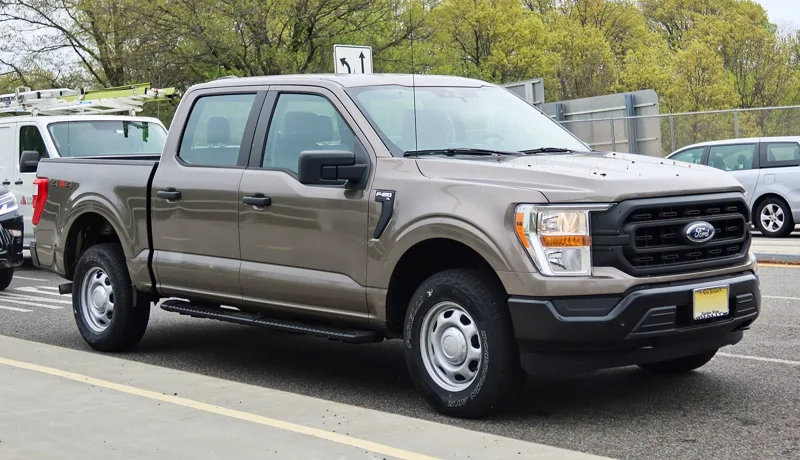
A folding-roof V8, a trophy-truck lookalike, a 702 hp Hemi and an electric truck that Ford has now decided to stop building.
The Chevrolet SSR, Ford Raptor, Ram 1500 TRX and F-150 Lightning each made pickups quick in a different way: a folding-roof V8, long-travel off-road V6 and V8 trucks, a 702 hp Hemi, and a 4.5-second electric. Ford is ending Lightning production.
By the end of 2021 Ford had taken more than 200,000 reservations for the F-150 Lightning, enough to fill a projected three-year backlog at planned production rates. In December 2025 the company announced that it would stop making the truck, citing a failure to earn a profit. The electric pickup sits at one end of a short, loud history in which American makers kept finding new ways to make a work truck fast: a retro roadster with a folding roof, a trophy-truck lookalike and a 702-horsepower Hemi.
Four trucks mark the main turns, the Chevrolet SSR, the Ford Raptor, the Ram 1500 TRX and the F-150 Lightning. Each solved the same puzzle in a different way, and their rivalry explains much of what buyers see in showrooms today.
Chevrolet SSR: the pickup with a folding roof
The SSR, short for Super Sport Roadster, was a retro-styled pickup with a retractable hardtop, built by Chevrolet from 2003 to 2006. Its shape drew on the Advance Design trucks of 1947 to 1955, and it sat on a frame called the GMT368, a version of the GMT360 platform made only for the SSR. Karmann advised on the steel roof, which ASC engineered and built. Stamping the front and rear fenders took a specially developed deep-draw process. The production truck was based on a concept shown at the 2000 Detroit show, which had used an S-10 chassis.
The SSR went on sale on 31 December 2002 as a 2003 model. Its first V8 displaced 5.3L and gave 300 hp (224 kW) and 331 lb-ft (449 N-m). MotorWeek recorded 7.9 seconds from 0 to 60 mph (97 km/h) and 16.0 seconds for the quarter mile (402.3 m), crossing the line at 87 mph (140 km/h). For 2005, GM swapped in a 6.0L LS2 V8 with 390 hp (291 kW), and buyers could choose a six-speed Tremec T-56 manual as well as the four-speed automatic. Chevrolet quoted 5.3 seconds to 60 mph for manual cars and 5.5 seconds for automatics. Output rose again for 2006, to 395 hp for automatics and 400 hp (298 kW) for manuals.
Despite the Super Sport name, an SS version never got past the concept stage. Every one carried the LS designation in the US and LT Decor in Canada, rode on 19-inch front and 20-inch rear wheels, sent power to the rear wheels through a Torsen limited-slip differential and stopped on four disc brakes. OnStar and XM satellite radio were never offered on a car sold to the public.
Four makers found four different ways to make a pickup fast.
Ford Raptor: the street-legal trophy truck
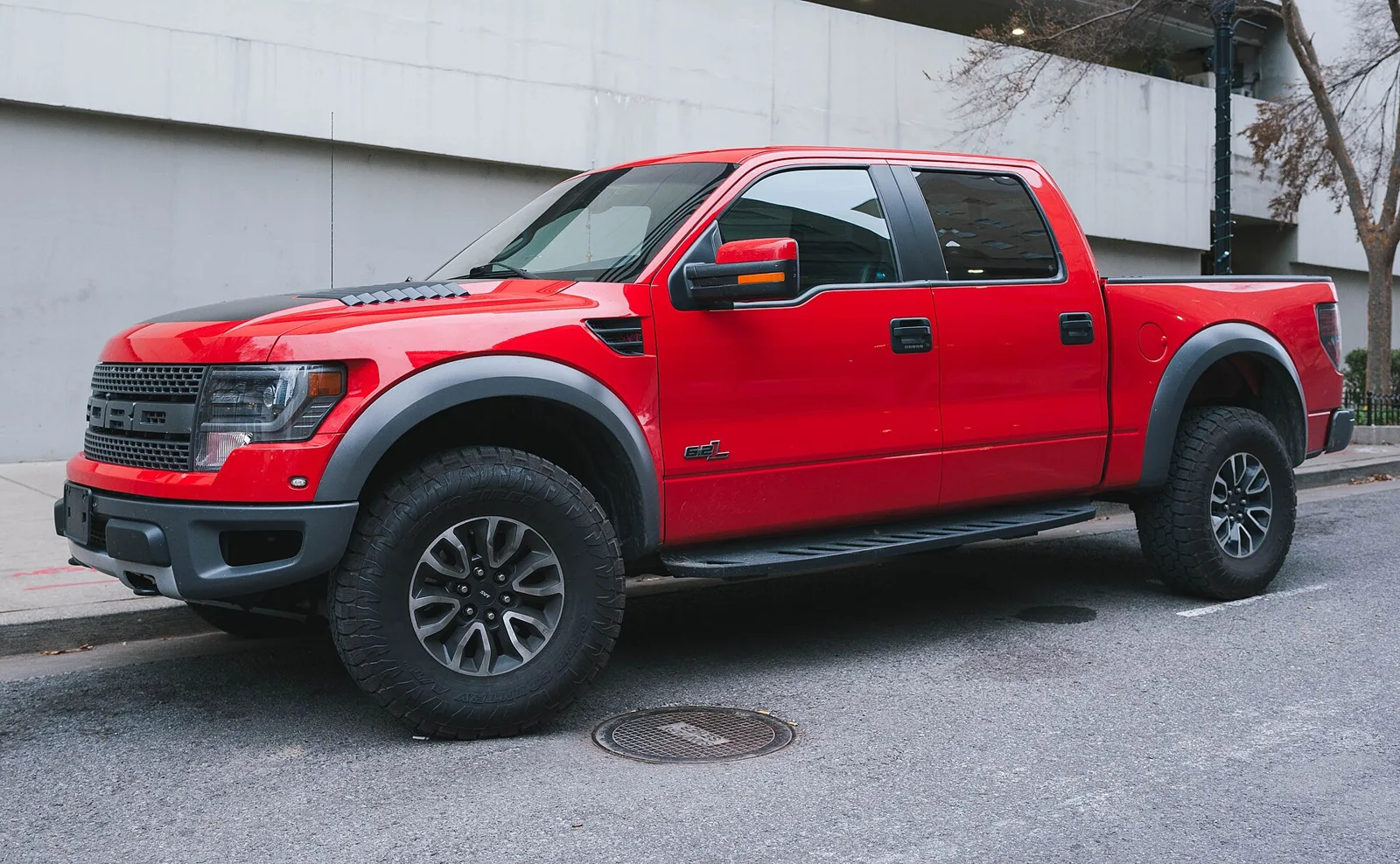
Ford has used the Raptor name since 2010 for the hardest-core off-road editions of its F-150, Ranger and Bronco. The F-150 version came first in 2010; the Ranger Raptor followed in 2019 outside North America, with the Bronco Raptor arriving in late 2021. The name comes from both the bird of prey and the velociraptor, and the truck is meant to be the road-legal counterpart of an off-road racing trophy truck.
First generation: the SVT Raptor, 2010
The SVT Raptor was a deliberate contrast to the on-road 1993-2004 SVT Lightning. Ford had to reach an arrangement with Mosler over the Raptor name. The first production truck, in molten orange, sold at auction for $130,000, with everything above its list price going to charity. SVT fitted Fox Racing bypass shocks giving 11.2 inches of front travel and 12.1 inches at the rear, widened the track by seven inches and raised the ride height by two. It ran 315/70/17 BFGoodrich KO tyres, could tow up to 8,000 pounds (3,629 kg) and was the first Ford with hill descent control.
The 2010 base engine was a 5.4L V8 rated at 320 hp (239 kW), and a 6.2L unit with 411 hp (306 kW) was optional, both mated to a six-speed automatic. From 2011 the larger engine was the only choice. A four-door SuperCrew joined the 2+2 SuperCab that year.
Second generation: V6 and a lighter body, 2017
After a two-year gap, the second-generation Raptor was shown as a pre-production truck at the Detroit show in January 2015 and released for the 2017 model year without the SVT prefix. Its aluminium-heavy body cut curb weight by more than 500 pounds. Shock size grew from 2.5 to 3 inches, travel rose to 13 inches at the front and 13.9 at the rear, and a new torque-on-demand transfer case blended the on-demand behaviour of all-wheel drive with four-wheel-drive toughness. Beadlock wheels were offered to stop tyres from slipping off the rim at low pressure, and from 2019 Live Valve shocks adjusted themselves to the terrain.
The big change was under the bonnet. There was no V8, only a 3.5-litre twin-turbo EcoBoost V6 with 450 hp and 510 lb-ft, a detuned version of the Ford GT engine. It also debuted the 10-speed 10R80 automatic, making the 2017 Raptor the first non-commercial vehicle to carry a ten-speed gearbox of any sort.
Third generation and the Raptor R, 2021 onward
Ford introduced the third generation in February 2021. The standard truck kept the V6, the Raptor 37 became the first light-duty production truck to offer 37-inch tyres from the factory, and the leaf springs at the rear gave way to coil springs and a five-link layout with a Panhard bar. Ford also promised a V8 again, in the Raptor R, built to take on the new Ram 1500 TRX. It uses a 5.2-litre supercharged Carnivore V8, based on the Predator in the Mustang Shelby GT500, producing 700 hp (522 kW) and 640 lb-ft (868 N-m). Torque rose to 645 lb-ft (875 N-m) for 2023, and for 2024 power went up to 720 hp (537 kW), which made it the strongest petrol production pickup in its class on release.
The 2024 refresh brought FOX Dual Live Valve shocks, C-clamp LED headlamps, a modular front bumper, a side-swinging Pro Access Tailgate, a head-up display and a new Shelter Green paint, with 37-inch BFGoodrich tyres as standard on the Raptor R. The mid-size Ranger Raptor took a longer route. It debuted with a 210 hp 2.0L diesel, and in October 2018 Ford said it would not be sold in the United States, citing overlap with a bigger Raptor whose demand exceeded supply and the cost of redesigning the engine for US emissions. The second generation, unveiled in February 2022, uses a twin-turbo 3.0-litre V6 rated at 292 kW (392 hp) for Australia, 212 kW (284 hp) for Europe to meet EU emissions rules, and 405 hp in the United States, where it was slated for 2023 and officially arrived in 2024.
Ram 1500 TRX: Hellcat power in a pickup
The TRX started as a show car. The Ram Rebel TRX concept appeared at the 2016 State Fair of Texas with 37-inch tyres, a track six inches wider and a detuned 575 hp supercharged Hemi. Reaction was positive, and on 1 June 2018 Ram said it would build the truck for the 2021 model year.
The production version, announced on 17 August 2020 as the Launch Edition, dropped the detune. Its supercharged 6.2-litre Hellcat Hemi made 702 hp (523 kW) and 650 lb-ft (881 N-m). Launch Edition production was limited to 702 trucks in Anvil Gray. Later limited editions ran from the Ignition (1,003 built) and Sandblast (1,202) to the Final Edition (4,000), and the standard TRX turned out rarer than several of them, with 1707 built: 664 in 2021, 825 in 2022 and 218 in 2023.
Why it stopped, and why it is back
The original TRX ended after the 2024 model year. It could not be modified to meet tougher emissions standards, and Stellantis was moving toward electrification and replacing its Hemi engines with the 3.0-litre Hurricane. The last TRX was built on 16th February 2024. The Ram 1500 RHO that followed uses the less powerful Hurricane and is not a direct successor. Then, in late July 2025, Stellantis chief executive Antonio Filosa confirmed that the TRX would return. On 1 January 2026 Ram unveiled the 2027 Ram 1500 TRX, renamed the Ram 1500 SRT TRX, with 777 hp (579 kW) and 680 lb-ft (922 N-m) to compete more closely with the Raptor R, and a Bloodshot Night Edition to mark the relaunch.
The truck has its critics too. On the environmental damage index of the American Council for an Energy-Efficient Economy, the TRX came last among mass-market vehicles in 2021, 2022 and 2023.
Ford F-150 Lightning: the electric pickup
Ford unveiled the F-150 Lightning on 19 May 2021, as a member of the fourteenth F-Series generation. In July 2019 a prototype had towed 1,250,000 pounds (570,000 kg) along rails as a demonstration. Orders came quickly, with 69,500 refundable deposits in four days and more than 100,000 reservations by 11 June 2021. Production began in April 2022 at the Rouge Electric Vehicle Center in Michigan.
The base truck has 452 hp (337 kW) and 230 miles (370 km) of range, while the top version has 580 hp (430 kW), 300 miles (480 km) of EPA range and a 0-60 mph time in the mid-four-second range. All versions have 775 lb-ft (1,051 N-m) of torque, dual motors and independent rear suspension. Ford quotes 4.5 seconds to 62 mph (100 km/h), a towing limit of 10,000 pounds (4,500 kg) and a maximum payload of 2,235 pounds (1,014 kg), including 400 pounds (180 kg) in the front boot, or frunk. It can supply 9.6 kW through up to eleven outlets, and with the right charging station can run an average American house for between three and ten days.
The costs of the battery show up on the scales. The truck weighs between 6,015 and 6,893 pounds (2,728 to 3,127 kg), up to 35 percent more than a petrol F-150, and its battery alone weighs 1,800 pounds (820 kg). National Transportation Safety Board chair Jennifer Homendy cited it among heavier electric vehicles that raise the risk to other road users. In a MotorTrend test, a Platinum travelled 255 miles (410 km) with only the driver aboard, but managed 90 miles (140 km) towing a 7,218-pound (3,274 kg) camper.
Awards, sales and the end of production
The Lightning was named 2023 North American Truck of the Year and 2023 MotorTrend Truck of the Year. A modified version won the 2024 Pikes Peak International Hill Climb in 8:53.553. It reached Europe in April 2023, with Norway first. Sales were 15,617 in 2022 and 24,165 in 2023, and with lower expectations Ford halved its 2024 plan from roughly 3200 to 1600 trucks a week. The company had planned to spend $3.7 billion hiring 6,200 union workers in a bid to sell 2 million electric vehicles a year by 2026; it missed the target and made no profit on the Lightning.
| Truck | Engine and output | Notable fact |
|---|---|---|
| Chevrolet SSR (2005 and 2006) | 6.0L V8, 390 to 400 hp | Retractable hardtop; 0-60 mph in 5.3 seconds claimed |
| Ford F-150 Raptor (2017) | 3.5-litre twin-turbo V6, 450 hp | First non-commercial vehicle with a 10-speed gearbox |
| Ford Raptor R (2024) | 5.2-litre supercharged V8, 720 hp | Most powerful gas pickup in its class at release |
| Ram 1500 TRX (2021 to 2024) | 6.2L supercharged V8, 702 hp | Last built 16th February 2024 |
| Ram 1500 SRT TRX (2027) | Supercharged V8, 777 hp | Unveiled 1 January 2026 |
| Ford F-150 Lightning | Dual electric motors, 452 to 580 hp | 775 lb-ft; 0-62 mph in 4.5 seconds |
Which is the fastest pickup truck?
On the quoted figures, the Ram TRX and Raptor R lead on power, at 777 hp and 720 hp. The Lightning has the quickest stated sprint, 4.5 seconds to 62 mph, and the SSR claimed 5.3 seconds to 60 mph with its manual gearbox back in 2005. The numbers come from different makers and different tests, so the answer depends on the measure: peak power, acceleration or towing.
What it means if you are shopping
A Raptor or TRX buyer is choosing between a V6 and a supercharged V8, and between the Ford's long-travel suspension and the Ram's Hellcat power. A Lightning buyer faces a different calculation: the truck's range falls sharply when it tows a heavy camper, and a heavy battery adds weight. The SSR was an oddity from 2003 to 2006 with a folding roof. In every case the higher-spec variants, the Raptor R, the final TRX editions and the top Lightning, carried the headline figures.
What comes next for performance pickups
Ram's returning 2027 TRX arrives with 777 hp. Ford said in December 2025 that it remained on track to produce a $30,000 electric pickup for sale by 2027, the first of a planned series of cheaper EVs; Ford named it the Fathom in August 2026, with orders and deliveries due in 2027. The Raptor family carries on with its 2024 refresh, and the Ranger Raptor now sells in North America.