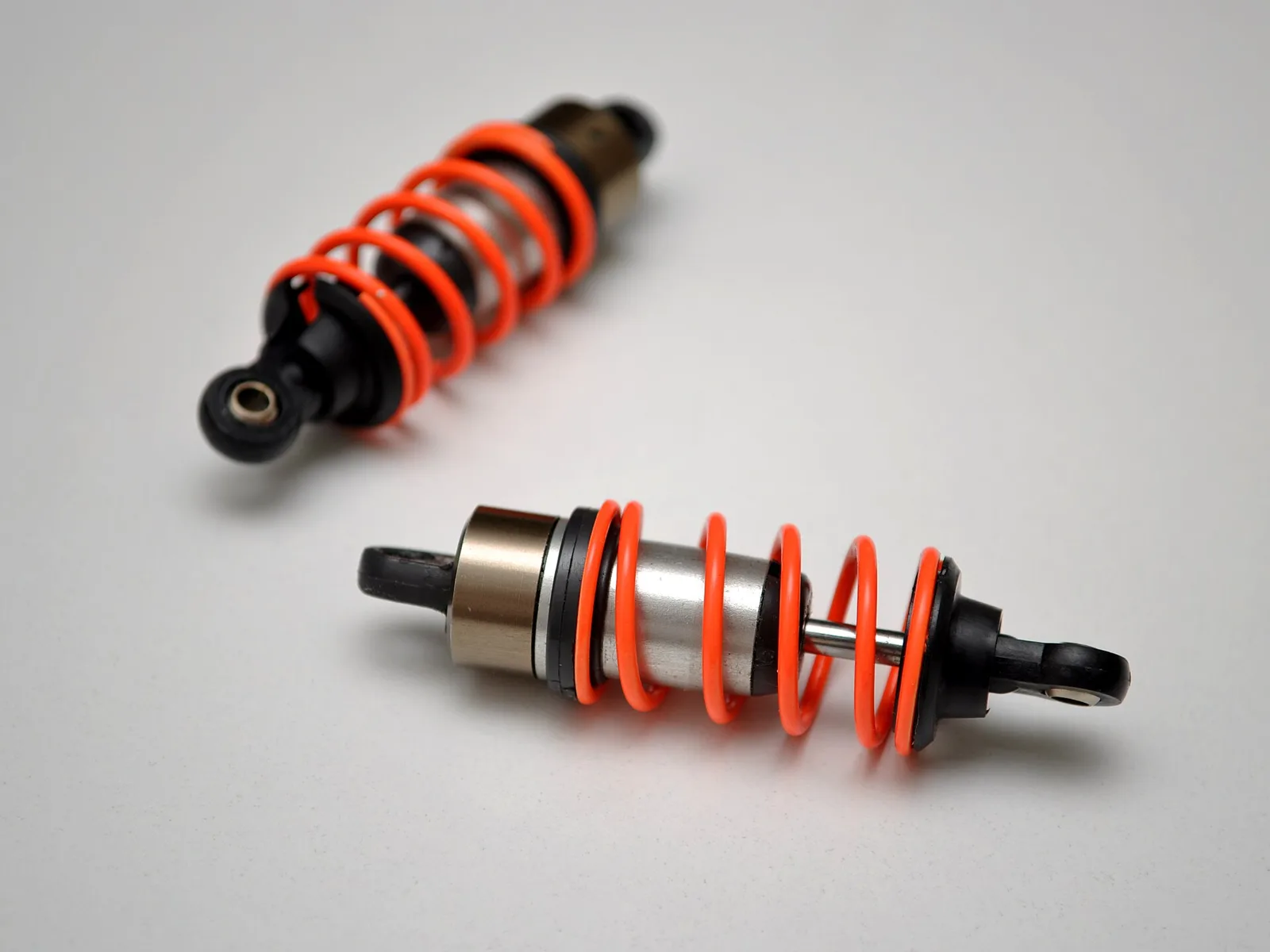
A 3 kilogram plastic spring, a mono-tube damper and a suspension that reads the road ahead: how cars keep the wheels on the ground.
A shock absorber converts the kinetic energy of a bump into heat by forcing oil through a piston, damping the spring. The Corvette used a plastic transverse leaf spring to save weight and resist roll, while Mercedes Active Body Control adds sensors, servos and, since 2013, a road-scanning camera.
In the third-generation Corvette, a steel leaf spring weighing 22 kilograms (48 lb) could be swapped for a plastic one that weighed 3 kilograms (7 lb). The single transverse spring Corvette engineers developed did the job of the coils and, in some cases, the anti-roll bar as well, and Volvo, Mercedes-Benz and others later followed.
That spring is only one answer to a bigger question: how does a car turn a bump in the road into a calm ride? Springs take the hit, shock absorbers stop the bouncing that follows, and at the top of the range a computer decides, millisecond by millisecond, what each wheel should do.
How do shock absorbers work?
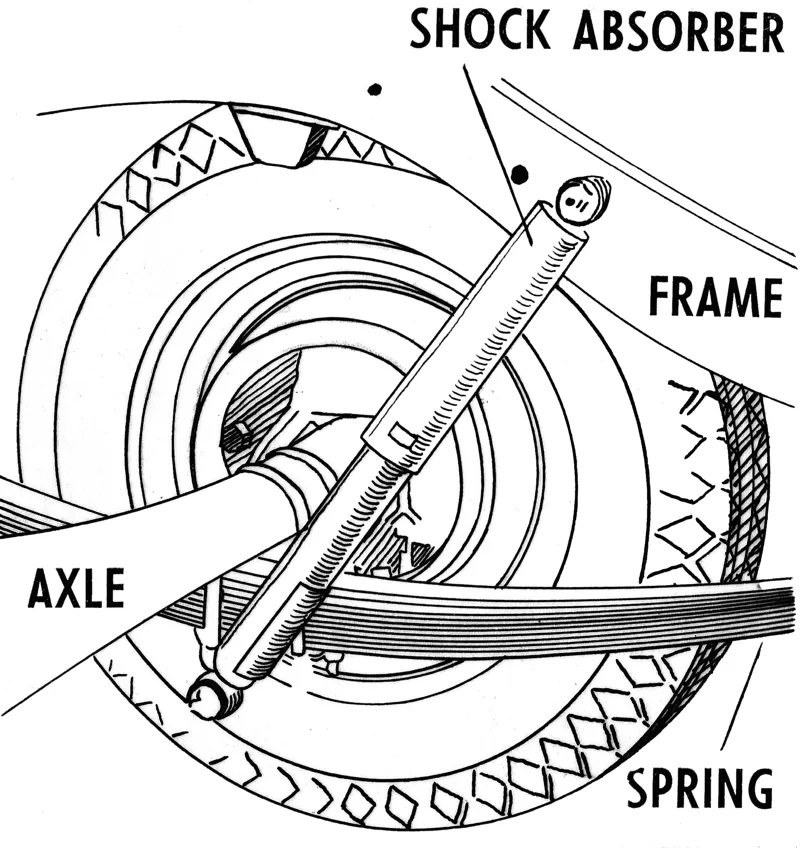
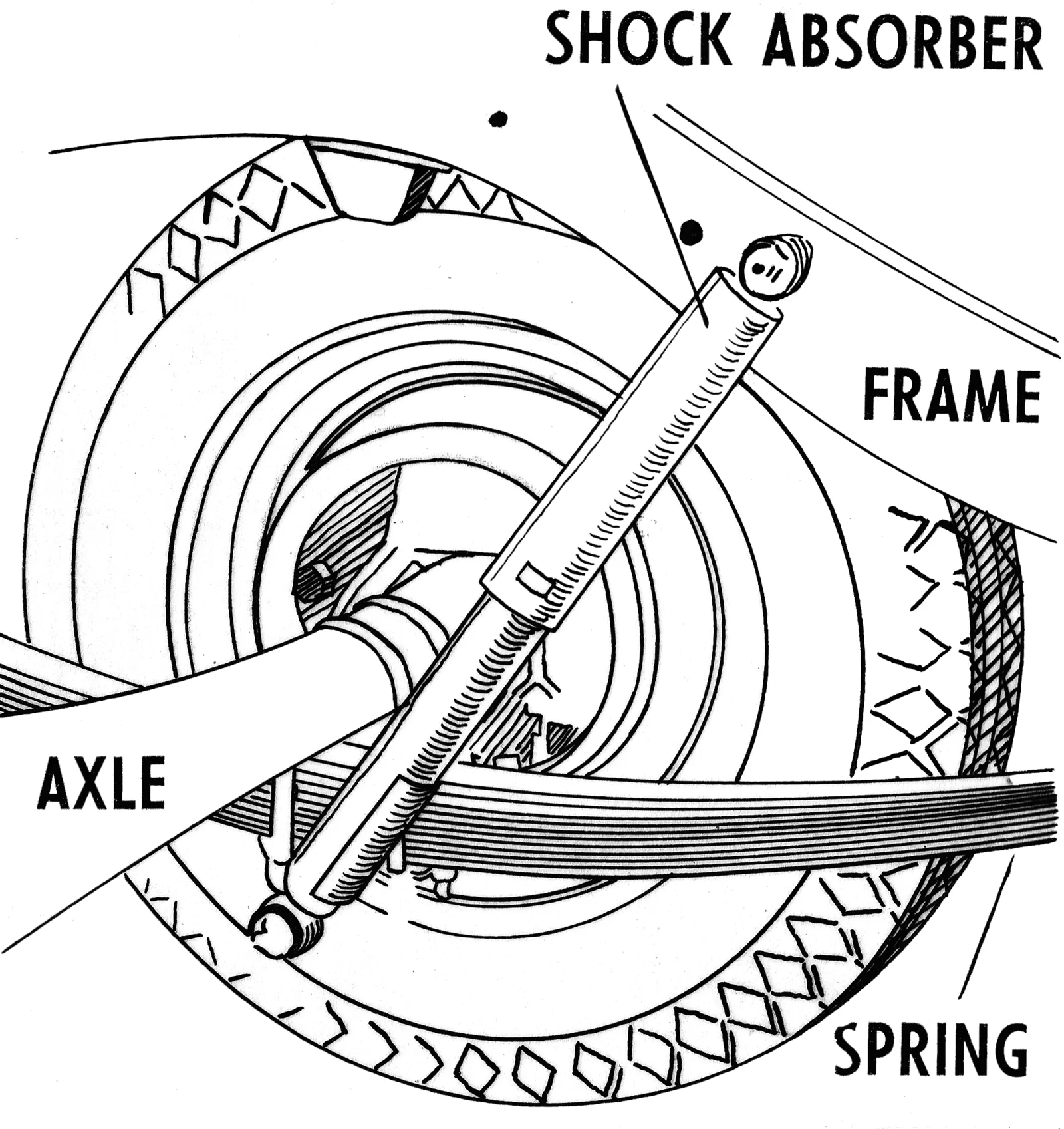
A shock absorber, or damper, takes the kinetic energy of a jolt and turns it into something less troublesome, usually heat, which then drains away. Most are a form of dashpot, a device that resists motion through the viscous friction of a fluid. In a car's hydraulic damper, oil is forced through small holes and spring-loaded valves in a piston, and the resistance of that flow is what slows the movement.
The heat goes into the oil in a hydraulic cylinder, whereas an air-filled version usually vents hot air to the atmosphere. Electromagnetic designs can store the energy for later. Whatever the type, the aim is the same: cushion the car on uneven roads and keep the wheels in contact with the ground.
A spring only stores energy. It does not get rid of it, so a spring on its own would keep bouncing. The damper's main purpose is to calm those spring oscillations, with limiting excessive suspension travel a secondary job.
Manufacturers choose the spring rate according to the vehicle's weight, loaded and unloaded. Fitting different shocks to change that rate is not their proper use. In the combined arrangement, the words "shock absorber" refer specifically to the hydraulic piston, while the spring can be a coil, a leaf or a torsion bar.
The wider the pivots, the more the leaf spring acts as an anti-roll bar.
Where shock absorbers came from
Early cars borrowed their springs from carriages and railway locomotives, and those leaf springs came with a bonus: friction between the leaves damped the motion. A 1912 review of suspension argued that helical springs were "impossible" as main springs precisely because they lacked it. The trouble was that the damping from leaf friction was limited, changed with whether the leaves were wet or dry, and worked in both directions.
The bigger problem was weight. A rear spring that suited a lightly loaded car could bottom out under a full load, and rebound after a bump could throw passengers from their seats. What was needed was damping on the rebound.
C.L. Horock came up with hydraulic damping in 1901, but only in one direction, and mechanical devices took the lead first. The Gabriel Snubber and the similar Stromberg Anti-Shox used a belt coiled inside a case that wound in freely under a spring but met friction when pulled out. An 11.9HP Arrol-Johnston fitted with Gabriel Snubbers took a six-hour Class B record at Brooklands in late 1912.
The Telesco Shock Absorber, shown at the 1912 Olympia Motor Show, was among the first hydraulic dampers built for sale. It combined a spring with oil and an internal valve so that it damped on rebound, though it acted only on its own small spring, not the main one. Probably the first dampers built for sale that controlled the main leaf spring itself were based on Maurice Houdaille's concept, patented in 1908 and 1909. A lever arm moved hydraulically damped vanes, so the unit fought sudden movement yet let slow movement through, unlike rotary friction dampers, which tended to stick. After World War I they came into widespread use, and one of them was standard on the 1927 Ford Model A, made by Houde Engineering Corporation of Buffalo, New York.
Types of shock absorber
| Type | Build | Gas | What sets it apart |
|---|---|---|---|
| Basic twin-tube | Working tube inside a reserve tube, base valve | None | Oil moves through piston holes and the valve, turning shock energy into heat |
| Twin-tube gas charged | As above | Low-pressure nitrogen in the reserve tube | Far less foaming; the vast majority of original modern installations |
| Position sensitive damping | Twin-tube with grooves in the pressure tube | Nitrogen | Soft in the comfort zone, firmer in the control zone |
| Coilover | Usually twin-tube, gas charged, inside the road spring | Yes | Common on motorcycle rear ends and widely used in cars |
| Mono-tube | One pressure tube, working piston and floating piston | High pressure, 260-360 psi | Longer, mounts either way, sheds heat better |
Twin-tube or mono-tube?
In a twin-tube damper, two nested tubes share the work. The inner one is the pressure or working tube, the outer one the reserve tube, and a base valve sits at the bottom. Add a low-pressure charge of nitrogen to the reserve tube and the oil is much less likely to foam, which is why this gas-charged version accounts for the vast majority of original modern installations.
Position sensitive damping adds grooves to the pressure tube. In the middle of the stroke, the comfort zone of ordinary road use, the piston moves freely. When the road turns rough and travel grows, the grooves restrict the piston, which firms up the control zone. That let designers tailor a damper to a model's size, weight and power.
The mono-tube damper was regarded as a major advance when it appeared in the 1950s. It has just one tube but two pistons, a working piston and a floating dividing piston, which keep oil and gas apart entirely. The dividing piston replaces the compression valve, and the gas is held at roughly 260-360 psi, high enough to help bear some of the vehicle's weight, something no other shock absorber is designed to do. Being larger, it also sheds heat better. The price is length: a mono-tube is much longer than a twin-tube and hard to squeeze into a car designed for the latter. Its one convenience is that, with no directionality, it can be mounted either way up.
Mercedes was the first manufacturer to fit mono-tube shocks as standard on some cars, starting in 1958. They were made by Bilstein, which held the patent, and no other maker could use the design until it expired in 1971.
Specialist variants have followed. Spool valve dampers swap flexible shims for hollow sleeves with machined oil passages. A remote reservoir or piggy-back adds an extra oil container to carry more oil without a longer body.
What a failing shock looks like
The failure mode described for these dampers is foaming. A twin-tube damper that overheats can aerate its fluid, and the result is foaming hydraulic oil dripping out of the assembly. Gas charging brought a dramatic reduction in it. In advanced designs a compressed-gas section holds dehydrated nitrogen at high pressure, typically 500psi, to squeeze the oil and stop dissolved air from frothing.
How does the Corvette leaf spring work?
A Corvette leaf spring is an independent suspension with a single fibre-reinforced plastic (FRP) leaf running across the width of the car in place of coil springs. It takes its name from the Chevrolet Corvette, where it first appeared, and it supports the vehicle's weight like a coil spring would. Control arms, not the spring, locate each wheel.
The clever part is the anti-roll action. When both wheels rise together over a bump, the middle of the spring bends evenly between its pivot mounts. In a roll only one wheel moves up, and the centre of the spring bends into an S-shaped curve, so each side's stiffness depends on how far the other has travelled. The wider the pivots and the stiffer their mounts, the more the spring behaves like an anti-roll bar. Corvette engineers say it let them fit a lighter anti-roll bar, and even drop the rear one on some seventh-generation cars. A rigid centre mount, as on second- and third-generation Corvettes, gives no such coupling.
Corvette leaf spring: weight, life and cost
FRP stores 4.3 to 5.5 times as much strain energy per unit of weight as steel, so the spring can be lighter. The single FRP leaf on the fourth-generation Corvette's front end weighs 33 percent of an equivalent set of coil springs, and the third-generation saving from 22 kilograms to 3 kilograms was greater still. Volvo claims a 5 kilogram (10 lb) saving from an FRP spring in the rear of the second-generation XC90, compared with coils.
A multi-leaf steel spring suffers from stiction as its leaves slide against each other, and that hurts compliance, ride and handling. A mono-leaf has no leaves to rub. Makers advertise FRP springs for cycle life and corrosion resistance, and in a GM comparison on third-generation Corvette springs, the steel multi-leaf was likely to fail after 200,000 full-travel cycles, while the FRP replacement showed no loss of performance after two million.
Packaging cuts both ways. The spring sits low, which lowers the centre of gravity, and it avoids tall spring mounts, giving a flatter load floor. According to James Schefter, on the C5 and later cars coilover springs would have forced engineers to raise the shock towers or move them inward, costing luggage space at the rear and crowding the engine at the front. The disadvantages are that a spring spanning the full width limits race car design, FRP springs have limited availability and choice, and cost has been cited against them on production road cars.
Who else used a transverse leaf spring?
The C4 used it at the front only, from 1984 to 1996, with a centrally mounted rear spring that had no anti-roll effect. The C5 to C7, built from 1997 to 2019, used it at both ends. Other General Motors users included the first-generation W platform (Lumina, Grand Prix, Regal, Cutlass Supreme) and E platform (Eldorado, Toronado, Riviera).
Volvo adopted the idea for the 960 from model year 1995, then the S90 and V90, and later the V60 (Polestar Engineered), V90 and second-generation XC90. The Mercedes-Benz Sprinter van uses it at the front only. The Opel GT of 1969 to 1973 (front only), the Smart ForTwo Mk1 to Mk3 and the Swedish Indigo 3000 roadster, which needs no separate front anti-roll bar, belong on the list too.
Steel versions exist too: the Fiat 128 used a multi-leaf steel spring with two pivots to give the anti-roll effect. Patents show wider interest: Ford filed in 2006, Porsche in 2000 (describing its stabilising effect), Honda in 1992 and DaimlerChrysler in 2004, and in October 2009 ZF released a concept rear suspension using a transverse leaf spring as both ride and anti-roll spring and as one of the suspension links.
What is Active Body Control?
Active Body Control (ABC) is Mercedes-Benz's own name for an electronically controlled hydropneumatic suspension. It improves ride quality and lets the car control its body motions, reducing roll in cornering, accelerating and braking. Mercedes had been experimenting since the 1963 600 and 1974 6.9. The production version arrived at the 1999 Geneva Motor Show on the new CL-Class (C215), after prototype versions in the 1991 C112, the 1995 Vario Research Car and the 1996 F200.
A computer reads body movement from 13 sensors that send fresh data every ten milliseconds, among them four level sensors, one at each wheel, three accelerometers for vertical movement, and one each for longitudinal and transverse acceleration. It then drives four hydraulic servos, one beside each wheel, each mounted on an air and pressurised-fluid strut. The pressure comes from a high-pressure radial piston pump, working at 3,000psi, and accumulators with a nitrogen bubble behind a membrane steady it.
Each strut still has a steel coil spring and a shock absorber working side by side, but an adjusting cylinder changes the strut length, creating a force that acts on spring and damping for movements up to five hertz. The result counters lean, dive and squat almost instantly.
Between 60 and 160 km/h (37 and 99 mph) the car lowers by up to 11 mm (0.43 in) for better aerodynamics, fuel consumption and handling. Self-levelling adjusts to passengers and cargo, and an ABC Sport button lets the driver adjust the suspension range. The system needs regular hydraulic oil changes and filter replacement.
For years ABC was fitted only to rear-wheel-drive models, because 4MATIC cars got the Airmatic semi-active air suspension. The 2019 GLE 450 4MATIC was the first all-wheel-drive car to offer ABC.
ABC Plus, Magic Body Control and the road scanner
The second generation, ABC Plus (or ABC II), came on the 2006 CL-Class (C216). The update cut body roll by 45% compared with the first generation, and the hydraulic lines were shortened. In 2010 a crosswind function was added that varies wheel load distribution in strong gusts, drawing on the yaw rate, lateral acceleration, steering angle and road speed sensors of the stability programme.
The F700 concept of 2007 previewed a road-scanning suspension called PRE-SCAN, using lidar. In 2013 the S-Class (W222) brought the series version, with a stereo camera instead. The system, called Magic Body Control, scans the road up to 15 metres ahead at speeds up to 130 km/h (81 mph) and pre-loads the shocks for the surface it sees, adjusting damping at each wheel by predicting rather than reacting. It was first available on 8-cylinder models and above. Wheel damping became continuously adjustable, the FlexRay bus connected the control unit to the vehicle electronics, and processing power more than doubled.
The 2014 C217 S-Class Coupe added Active Curve Tilting, which lets the car lean up to 2.5 degrees into a turn, like a tilting train, to counter the effect of centrifugal force on the occupants. It is limited to rear-wheel-drive models.
E-Active Body Control and the active suspension timeline
E-Active Body Control (EABC) debuted in 2019 on the fourth-generation GLE (V167). It combines the air springs of Airmatic with a 48-volt electrohydraulic system that controls spring and damping force at each wheel, and it can manage individual wheel movement up and down, not only roll and pitch. Using sensors and cameras it scans the road ahead and prepares each wheel. The 48-volt network allows a faster hydraulic response and energy recovery, which enables Free Driving Assist, rocking the car free from sand or snow. It went to the GLS and then the S-Class (W223).
Mercedes was far from alone. Paul Mages's 1955 Citroen DS was the first car with height-adjustable and self-levelling suspension. Rolls-Royce licensed the technology for the 1965 Silver Shadow, Maserati used the Citroen SM system in the 1974 Quattroporte II, and Mercedes brought out the fully hydropneumatic 450SEL 6.9 in 1975.
- 1989: Citroen XM with Hydractive, and the Toyota Celica with Toyota Active Control Suspension.
- 1991: Infiniti Q45 offered "Full Active Suspension", a world first in a production car, and the Toyota Soarer had a fully active hydraulic system.
- 1994: Citroen Xantia ACTIVA adds active anti-roll bars.
- 1999: Mercedes-Benz introduces Active Body Control.
- 2023: BYD launches DiSus, a hydropneumatic system, on the Yangwang U8 SUV and U9 sportscar, which can reportedly run with three wheels fitted and jump while parked yet stay level.
Where this goes next
The published timelines point one way, towards suspension that prepares the wheels before they meet the road. Mercedes-Benz describes E-Active Body Control as the evolution of its fully active systems, with air suspension, hydraulics and predictive control sharing one electronic architecture. Its predictive function derives from the camera-based Magic Body Control, and the system moved from the GLE and GLS to the S-Class (W223).
BYD's DiSus system, introduced in 2023 on the Yangwang U8 and U9, shows another company moving into hydropneumatic suspension.