How the seven-pin Type 2 connector carries AC power, how it compares with other EV charging plug types, and what ISO 15118 Plug and Charge does.
The Type 2 connector, IEC 62196-2, is the seven-pin plug for AC electric vehicle charging, adopted as the EU standard in 2013 and delivering up to 43 kW. Plug and Charge, defined in ISO 15118, lets a car identify and authorise itself to a station by exchanging certificates, so the driver only plugs in.
Add two pins to the base of the plug that charges most European electric cars and its ceiling rises from about 43 kW to roughly 350 kW. That is the neat trick at the heart of the Type 2 connector and the Combined Charging System built on it, and it explains why one round plug shape ended up carrying everything from a home wallbox to a motorway rapid charger.
What is the Type 2 connector, and why is it called Mennekes?
The IEC 62196-2 Type 2 connector charges electric vehicles with alternating current (AC). It is used mainly in Europe, Australia, New Zealand and many other countries outside North America. In the US it is often, and improperly, called Mennekes, after the German company involved in developing it.
The story begins in 2009, when Mennekes proposed the system. The German Association of the Automotive Industry (VDA) then tested it and issued it as VDE-AR-E 2623-2-2, and in 2011 the European Automobile Manufacturers Association (ACEA) gave it a recommendation. In January 2013 the European Commission selected it as the official AC charging plug of the European Union. The aim was to promote electric mobility and make sure every vehicle could use every station. Full compliance was required by 2025. Since then it has become the recommended connector in most countries worldwide, New Zealand included.
By 2015 the plan was for Type 2 to replace the earlier AC connectors in the European network, displacing both Type 1, known as SAE J1772, and Type 3, the EV Plug Alliance types 3A and 3C, colloquially called Scame. For DC charging, the Combo 2 socket, which is a Type 2 plus two DC pins, was to become standard in cars and replace Type 4, the CHAdeMO. The transition period was scheduled to last until 2020.
Add two pins to the base and a home-charging plug becomes a 350 kW rapid charger.
Type 2 charger: how the plug and socket fit together
Under IEC 62196, the car carries a standardised male vehicle inlet, while the charging station has a female socket outlet. That outlet is either on the station itself, or on the end of a flexible cable with a connector permanently attached. A station with a fixed cable works much like a petrol pump: you take the connector and plug it into the car. Where there is no fixed cable, you use a separate male-to-female cable between the car and the station, or between the car and a traditional IEC 60309-2 industrial connector.
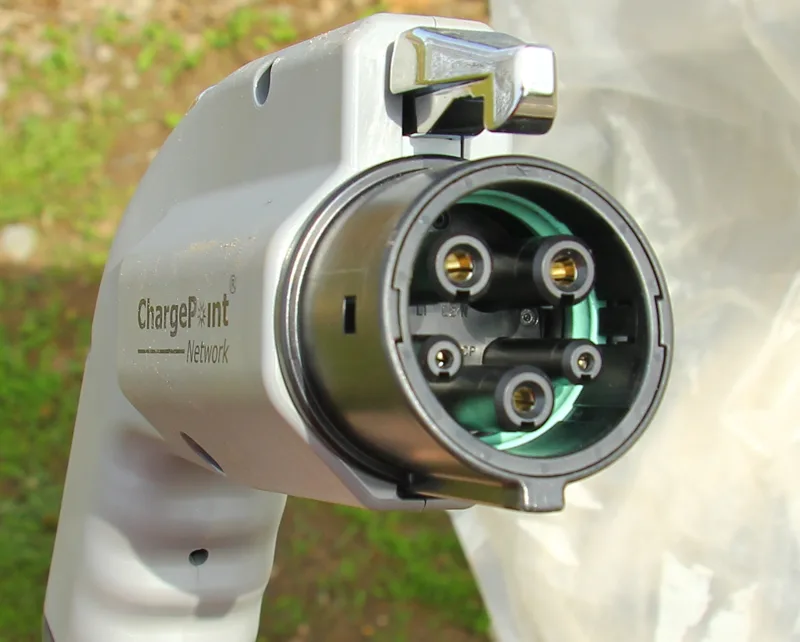
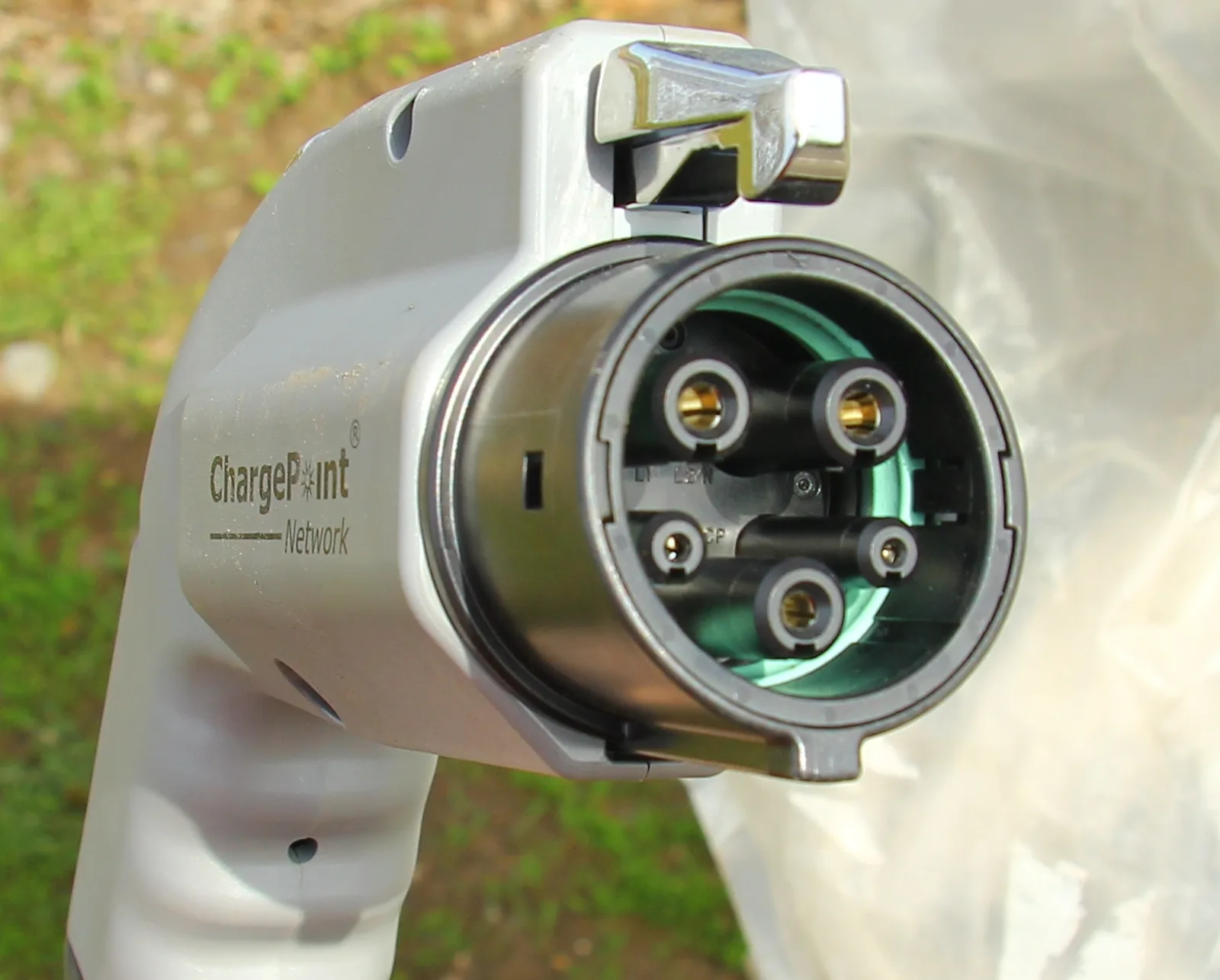
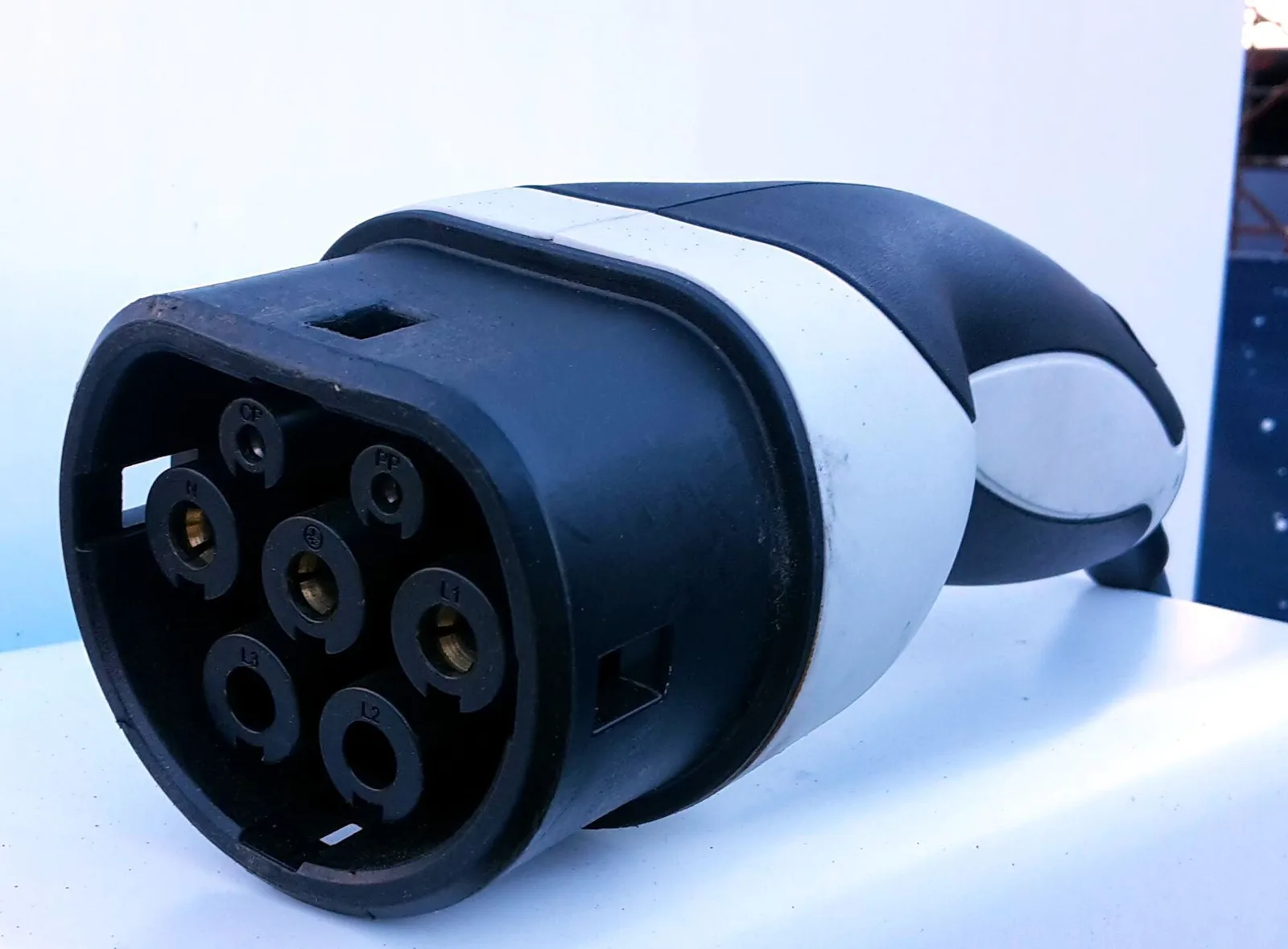
The plug is circular with a flattened top edge. Openings on its sides allow both the car and the charger to lock it automatically, which stops charging being interrupted and stops the cable being stolen.
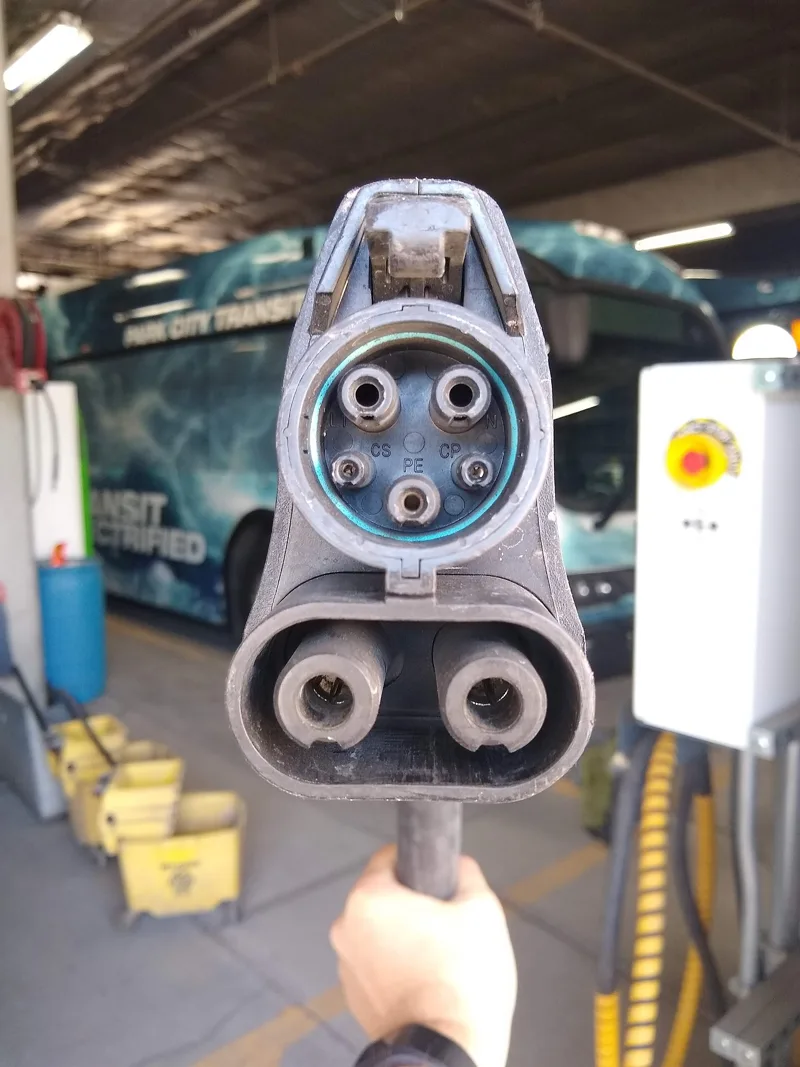
Inside are seven contact places, two small and five larger. The top row holds two small contacts for signalling. The middle row has three pins: the centre one is the earth, and the outer two supply power. The bottom row has two more power pins that can be used alongside them. Three of the pins never change jobs. The proximity pilot (PP) does signalling before the plug is inserted, the control pilot (CP) does it after insertion, and the protective earth (PE), a 6 mm pin, gives full-current protective earthing. The other four power pins are allocated differently depending on the mode of operation.
The signalling pins are what make the connector clever. Across them, the charger, the cable and the vehicle talk to each other so that the highest voltage and current all three can handle is the one chosen. Think of it as a handshake before any real electricity moves. The protocol is identical to that of Type 1 connectors under the SAE J1772 standard.
The power numbers depend on who is quoting. The connector uses seven pins for communication with the J1772 protocol and for single-phase or three-phase AC with a maximum of 400 V and 63 A, which gives up to 43 kW. The original design specification, on the other hand, gave an output of 3 to 50 kW from a single-phase 230V or three-phase 400V supply. In common practice, a typical maximum is 32 A, which means 7.2 kW on single-phase AC and 22 kW on three-phase.
EV charging plug types compared
| Connector | What it does | Where | Power |
|---|---|---|---|
| Type 1 (SAE J1772) | Single-phase AC | US, Canada, South Korea | Up to 19.2 kW |
| Type 2 (IEC 62196-2) | Single-phase or three-phase AC | EU, Australia, New Zealand and many other countries | Up to 43 kW |
| Type 2 under SAE J3068 | Three-phase AC, with LIN control signalling | North America | Up to 166 kW |
| CCS Combo 2 | Type 2 plus two DC pins | EU standard | Up to approximately 350 kW |
| Tesla European Supercharger (up to Version 2) | Modified Type 2, DC via two pins each | Europe | 150 kW |
| Tesla Version 3 Supercharger | CCS2 | Europe | 250 kW |
| GB/T 20234.2-2015 | AC, Type 2-style | China | AC charging |
CCS Combo 2 reuses the signalling and protective earth pins of the Type 2 and adds the two DC pins for rapid charging. Some vehicle inlets include the extra connections so a DC-only charger can be inserted.
North America runs a different story. The Type 1 plug, codified as SAE J1772, handles single-phase AC in the United States, Canada and South Korea and tops out at 19.2 kW. Yet the same physical Type 2 connector is used in North America for three-phase AC under SAE J3068, which uses a Local Interconnect Network (LIN) for control signalling and raises the maximum to 166 kW.
China uses the same shape for AC charging under the Guobiao standard GB/T 20234.2-2015, but with a twist. Its cables carry Type 2-style male connectors on both ends and the vehicle has a female inlet, the opposite gender to the rest of the world, and the control signalling differs.
Tesla complicates the picture. For its European Supercharger network, up to Version 2, it modified the Type 2 so each pair of pins could carry DC at up to 150 kW, with a switch inside the Model S or X selecting the mode. As of 2017 Tesla was the only automaker offering both AC and DC charging based on the IEC 62196-2 specification. Since 2019 it has adopted CCS2 on its Version 3 Superchargers, which output 250 kW, and added a second cable for CCS on Version 2 sites. All European Model 3 and Model Y cars use CCS2, with a hardware upgrade and adapter for pre-2019 Model S and X, and from 2022 the Model S and X use it as their new connector. Elsewhere, DC charging in Europe favours CCS under the IEC 62196-3 specification.
What is Plug and Charge?
A plug is only half of the experience. The other half is getting authorised, and paying. ISO 15118, Road vehicles - Vehicle to grid communication interface, is the international standard that handles this. It sets out a vehicle-to-grid (V2G) communication interface, so electric vehicles can charge and discharge in both directions, and its use cases include secure communication, smart charging and the Plug & Charge feature.
The work belongs to Joint Working Group 1 of IEC Technical Committee 69, together with subcommittee 31 of ISO Technical Committee 22. The two bodies began working together in 2010, and a Plug & Charge section was released in 2014. By 2018 no automaker had a productive implementation.
The idea is simple. An electric vehicle identifies and authorises itself to a compatible charging station without the driver doing anything. The only action is plugging the cable into the car or the station, or both. The car and the station recognise each other by exchanging public key certificates, which are the digital equivalent of showing a signed ID, and that exchange facilitates payment. A test system open to the public over the internet launched in November 2021. The proposed standard covers wired charging, AC and DC, and wireless charging.
Which cars support Plug and Charge?
Some 2021 model year EVs support the standard: the Audi e-tron GT quattro, the Audi RS e-tron GT, the Porsche Taycan, the Mercedes-Benz EQS, the Lucid Air and the Ford Mustang Mach-E. By model year 2024, most Audi models, the BMW i4, i5, i7 and iX, and the Hyundai Ioniq 5 and Ioniq 6 were added. Volkswagen has updated its ID family, including the ID.4 and ID.5, and some cars need hardware updates to get the feature.
Tesla got there first in its own way. Every Tesla built since 2012, two years before ISO 15118-2 appeared, has its own proprietary take on Plug & Charge, and other proprietary schemes exist too.
There is also a workaround called Autocharge. It is based on DIN Spec 70121, which belongs to CCS, and it recognises the car by its fixed MAC address, a hardware identifier. To the user it works the same way, but it is tied to the specific charging operator and its rates. Autocharge has been used for years at stations operated by Fastned, among others. The market regards it as less secure than Plug & Charge, because it has no certificate chain. Volkswagen Group cars have received a software update that switched them to variable MAC addresses, so they can no longer use Autocharge, although it worked perfectly when the ID.3 launched. Some say the reason is commercial, since the group invested heavily in Plug & Charge, and a successful Autocharge would reduce the need for it.
Security, certificates and the parts of ISO 15118
Communication between the car and the charging equipment (EVSE) can be secured using Transport Layer Security (TLS), and for Plug & Charge it is mandatory. The standard also describes how a vehicle-to-grid public key infrastructure, V2G-PKI, must be set up to support it. Hubject provided the first working V2G-PKI in 2018, with an ecosystem for the European Union and the United States, while CharIn and Gireve were among others working on solutions. Charge station operators and automakers can also manage certificates themselves, provided they follow ISO 15118. As of 2019 and 2020, several PKI issues remained unsolved for using the standard as proposed.
The standard is split into parts. Part 1 covers general information and use cases, Part 2 the network and application protocol requirements, Part 3 the physical and data link layers, and Parts 4 and 5 the conformance tests. Parts 6 and 7, for wireless communication, were never developed and were merged into other parts. Part 8 covers wireless physical and data link layers, Part 10 single-pair Ethernet, and Part 20 the second-generation network and application layers, which is being amended. Parts 11 and 12 were under development.
The same protocol is used for heavy-duty charging of harbour automated guided vehicles, buses and lorries. In commercial operation, wireless communication over WLAN under Part 8 has to be considered carefully because there is no way to guarantee uptime. In those cases, the same protocol as for passenger cars, Part 2, can be used.
What this means for drivers
In Europe, Australia and New Zealand the practical rule is that a car with a Type 2 inlet can use a Type 2 station, whether the cable is fixed to the station or a loose lead links the two. For DC, the car needs the Combo 2 version. In North America, a different shape applies for single-phase AC. And a car that supports Plug & Charge can start a session just by being plugged in, provided both car and station support the standard.
Where this goes next
The Combo 2 socket is meant to become standard in cars, replacing CHAdeMO, and the open test system launched in November 2021 gives manufacturers a place to prove Plug & Charge implementations. Model year 2024 lists show the feature spreading across the BMW, Hyundai and Audi ranges. ISO 15118-20, the second generation of the communication standard, was still being amended at the time of writing, and parts covering single-pair Ethernet conformance and battery information services were under development.