A small engine that shakes and a long engine that whips: how balance, length and crankshaft design explain the rise of the triple and the fall of the straight-eight.
Three-cylinder engines are lighter and simpler than fours and grew from under 1% to about 5% of US new vehicles by 2025, despite vibration. The straight-eight ran smoothly but was too long, suffered crankshaft whip, and was displaced by the V8 by 1954.
In the United States, three-cylinder engines rose from below 1% of new vehicles before 2020 to about 5% for the 2025 model year, close to the share of eight-cylinder petrol engines. The eight in a row, which once powered some of the most expensive cars on the road, has been displaced almost completely by the V8.
One layout is gaining ground because it is small and light. The other was loved for its smoothness and killed by its length. Between them they show how cylinder count, crankshaft design and the shape of a car decide which engines survive.
Why do small cars use a three cylinder engine?
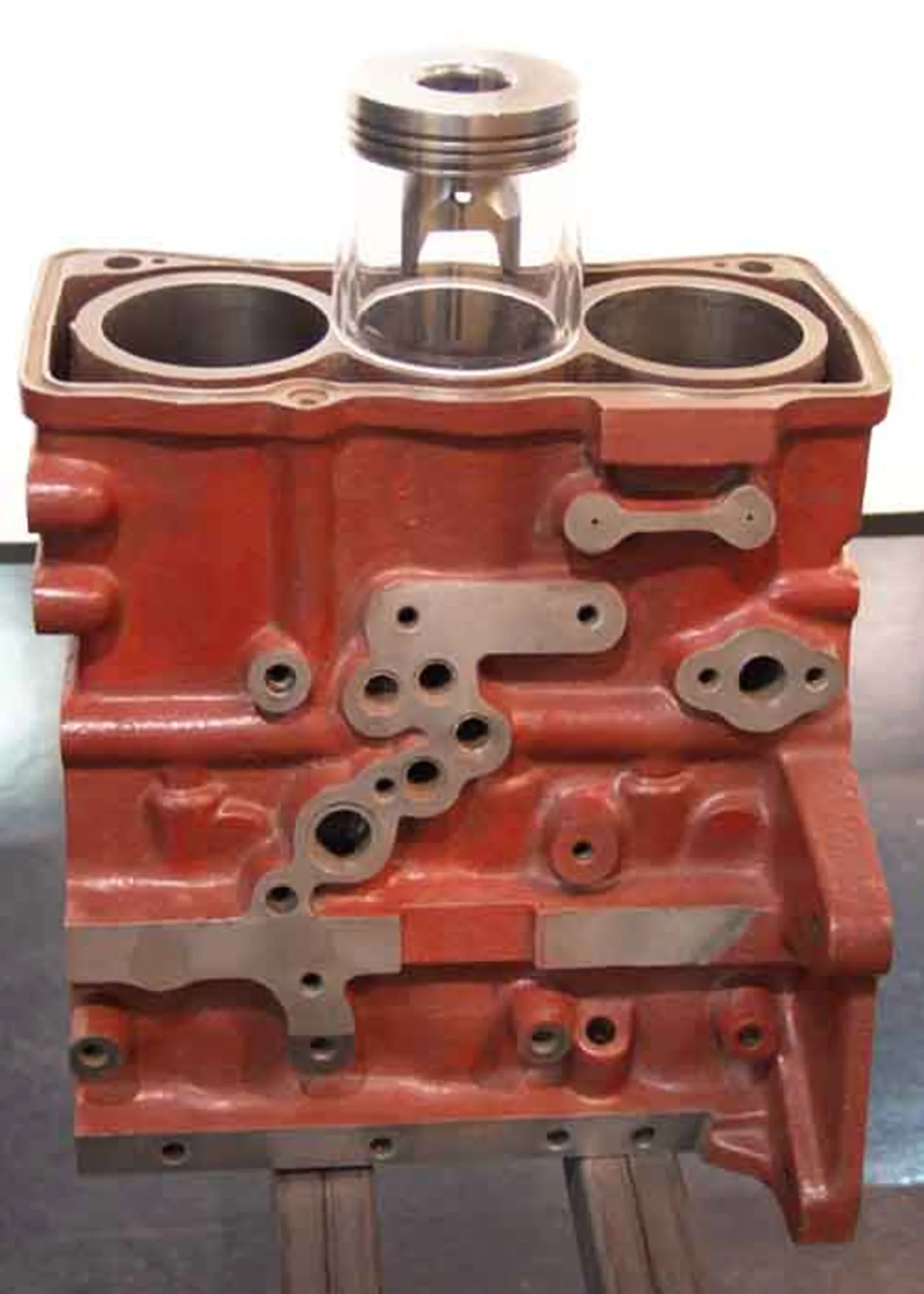
A straight-three, also called an inline-triple or inline-three, puts three cylinders in a row along one crankshaft. Against a straight-four it is typically lighter and has fewer moving parts, and both help efficiency. The smaller size, lower mass and reduced friction are the reason. There is a quieter advantage too. For a given displacement each cylinder is bigger than in a four, so it can have larger valves and breathe better.
The weakness is the rhythm of the engine. A four always has one cylinder on its power stroke, whereas a three has gaps with none, so every combustion event has to be stronger to deliver comparable output. Performance limits and vibration followed, though advances in engine and vehicle design have largely overcome them.
The layout has been less common than the four in small and mid-sized vehicles, but the 2020s changed that. Carmakers shrank and turbocharged their engines to satisfy fuel economy and emissions rules, and by the mid-2020s the three-cylinder had a small but growing share of new vehicles. In the United States the four-cylinder remained dominant at 60% of the market in 2025.
The straight-eight was loved for its smoothness and killed by its length.
How does an inline 3 engine handle vibration?
The usual crankshaft has its three throws 120 degrees apart, which spaces the firing intervals evenly. It gives perfect primary and secondary balance in the plane where the pistons move up and down. But the pistons are not symmetrical about the centre cylinder, so the engine rocks end to end, which produces pronounced low-frequency vibration that is hard to isolate. Balance shafts and carefully designed engine mounts are the usual remedies, because they limit how much of the shaking reaches the vehicle structure.
Other crank layouts have been tried. The Laverda Jota motorcycle of 1976-1981 had a 180-degree crank: the outer pistons rise and fall together while the middle one runs half a turn out of step, so evenly spaced power strokes are followed by a longer pause. The 2020 Triumph Tiger 900 uses a T-plane crank, its throws 90 degrees apart, with cylinders 1 and 3 half a turn apart.
Ford took another path with its turbocharged 1.0-litre EcoBoost, introduced in the 2012 Focus. It uses an unbalanced flywheel to move the engine's inherent imbalance into the horizontal plane, where engine mounts deal with it more easily, and so no balance shafts are needed. In 2016 cylinder deactivation was added to the engine, which Ford claimed was a world first for a three-cylinder.
Where did three-cylinder engines come from?
One of the first three-cylinder cars was a 15hp Rolls Royce of 1905. The first three-cylinder two-stroke was fitted to the German DKW F9 of 1938, and it kept being built in both halves of divided Germany for over three decades. In the West it powered the DKW Sonderklasse, the DKW Junior, the Auto Union 1000 and the DKW F102 until 1965. In East Germany the IFA F9 grew into the Wartburg, which kept the engine until 1988. In the 1950s Saab copied the whole DKW powertrain for the 93, 95, 96 and 97, as did the Polish maker FSO for the Syrena.
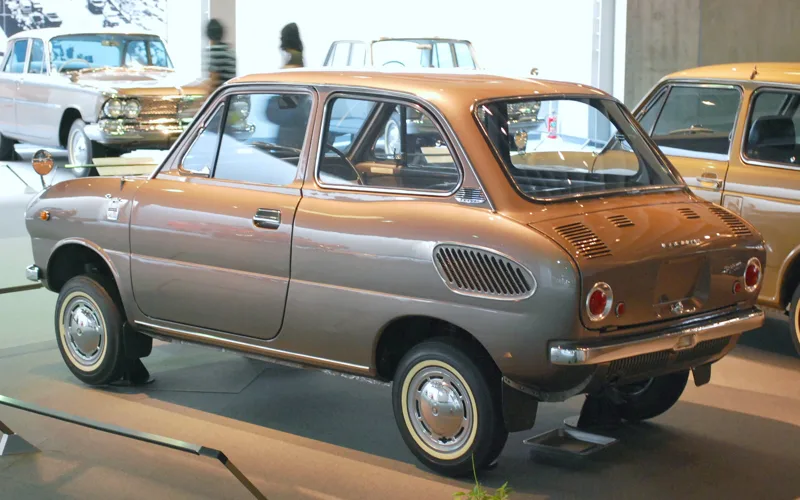
Japanese small cars took to the layout. The 1967 Suzuki Fronte 360 had a 256 cc (16 cu in) two-stroke, and in 1980 Suzuki began building a 543 cc (33 cu in) four-stroke for the Alto and the Fronte. The Subaru EF, a four-stroke petrol engine from 1984, went into the Justy and the Sumo, which was the export version of the Sambar.
On two wheels, the attraction is that a three is shorter than an inline-four and shakes less than a straight-twin. The BMW K75, built from 1985 to 1995, was a three derived from the K100 four. Triumph is best known for its transversely mounted triple, used in the Speed Triple, Trident, Sprint and Tiger. Its Rocket III has held the record for the largest motorcycle engine displacement. In 2019 the Moto2 class of the MotoGP World Championship switched to Triumph 765 cc (46.7 cu in) triples.
Two-stroke triples were less common but several came from Japan between the late 1960s and the 1980s. Kawasaki built its triple from 1968 to 1980, mostly air-cooled with a few water-cooled, and the Suzuki GT series of 1972 to 1980 came in both air-cooled and water-cooled forms. Beyond the road, the straight-three is common in diesel tractors such as the Perkins AD3.152, which powered the Massey Ferguson 35 and the Fordson Dextra as well as marine and stationary equipment. Aircraft have used it too: the Hewland AE75 of the mid-1980s was an inverted, liquid-cooled 750 cc two-stroke making 75 bhp (56 kW).
What made the straight eight engine so smooth?
The straight-eight, also called the inline-eight or I8, puts all eight cylinders in a line along the crankcase. It has been built with side valves, inlet-over-exhaust valves, overhead valves, sleeve valves and overhead camshafts. Its firing order can be arranged to give inherent primary and secondary balance, leaving no unbalanced forces or moments.
An inline six can be balanced in the same way, yet the eight delivers more power strokes per revolution and so runs more smoothly under load. And because the number of power strokes per revolution is even, it avoids the unpleasant odd-order vibration an engine can send through the driveline at low revs. That smoothness is why it was popular in luxury and racing cars.
The crankshaft still needs help. Torsional vibration, present to some degree in every engine, is enough to demand a harmonic damper at the accessory end. Without one, fatigue cracks can start near the rear main bearing journal and the engine can fail.
Why did the inline 8 engine disappear?
Length was the problem. The engine needs a long engine compartment, which modern vehicles cannot spare. Its length also lets torsional vibration in both crankshaft and camshaft damage reliability and performance at high speed. At high revs the centrifugal force on the crank throws can cause a phenomenon called crankshaft whip, in which the connecting rods touch the crankcase walls and wreck the engine. The shorter V8 displaced the straight-eight almost completely.
World War II sealed it. Improved refining made large amounts of cheap high-octane petrol available, so designers could raise compression ratios. The engines grew more highly stressed, and that exposed the limits already present in the straight-eight's long crankshaft and camshaft.
| Maker | How its straight-eight ended |
|---|---|
| Oldsmobile | Replaced by the overhead-valve Rocket V8 in 1949 |
| Chrysler | Replaced by the Hemi V8 for 1951 |
| Hudson | Retired at the end of the 1952 model year |
| Buick | 322 cu in (5.3 L) V8 arrived in 1953; the 320.2 cu in (5.2 L) straight-8 ran to the end of that model year |
| Pontiac | Straight-eight built to the end of the 1954 model year, when a V8 took over |
| Packard | Signature straight-eight ended at the end of 1954, succeeded by an overhead-valve V8 |
Overhead-valve V8s were under the bonnets of 80% of American cars by the end of the 1970s, and most of the rest had six cylinders. In Europe, many factories had been destroyed in the war and economies took years to recover enough for large cars to sell again. Cars changed from a long engine bay between separate wings to a shorter modern body, and the straight-eight went the same way. Petrol cost several times what it did in the United States, so four- and six-cylinder engines powered most European cars, and the few eight-cylinder cars were V8s.
How did the straight-eight rise?
Charron, Girardot et Voigt conceived the first straight-eight in 1903, though it was never produced or raced. The big strides came in World War I, when Mercedes built straight-eight aircraft engines such as the D.IV. A long, narrow engine was aerodynamically efficient, and its inherent balance meant the crankshaft needed no counterweights. The twisting of the crank and camshaft did not worry anyone, because aircraft engines of the time turned slowly to keep propeller tips below the speed of sound.
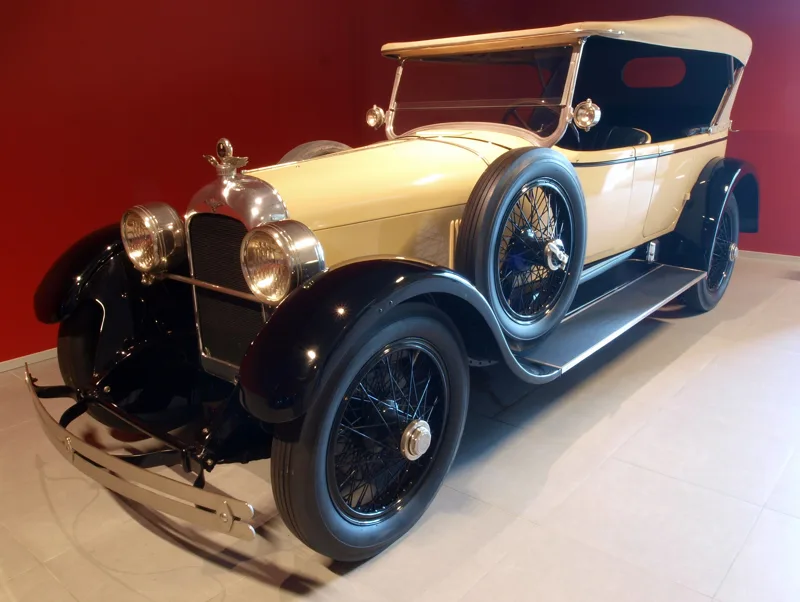
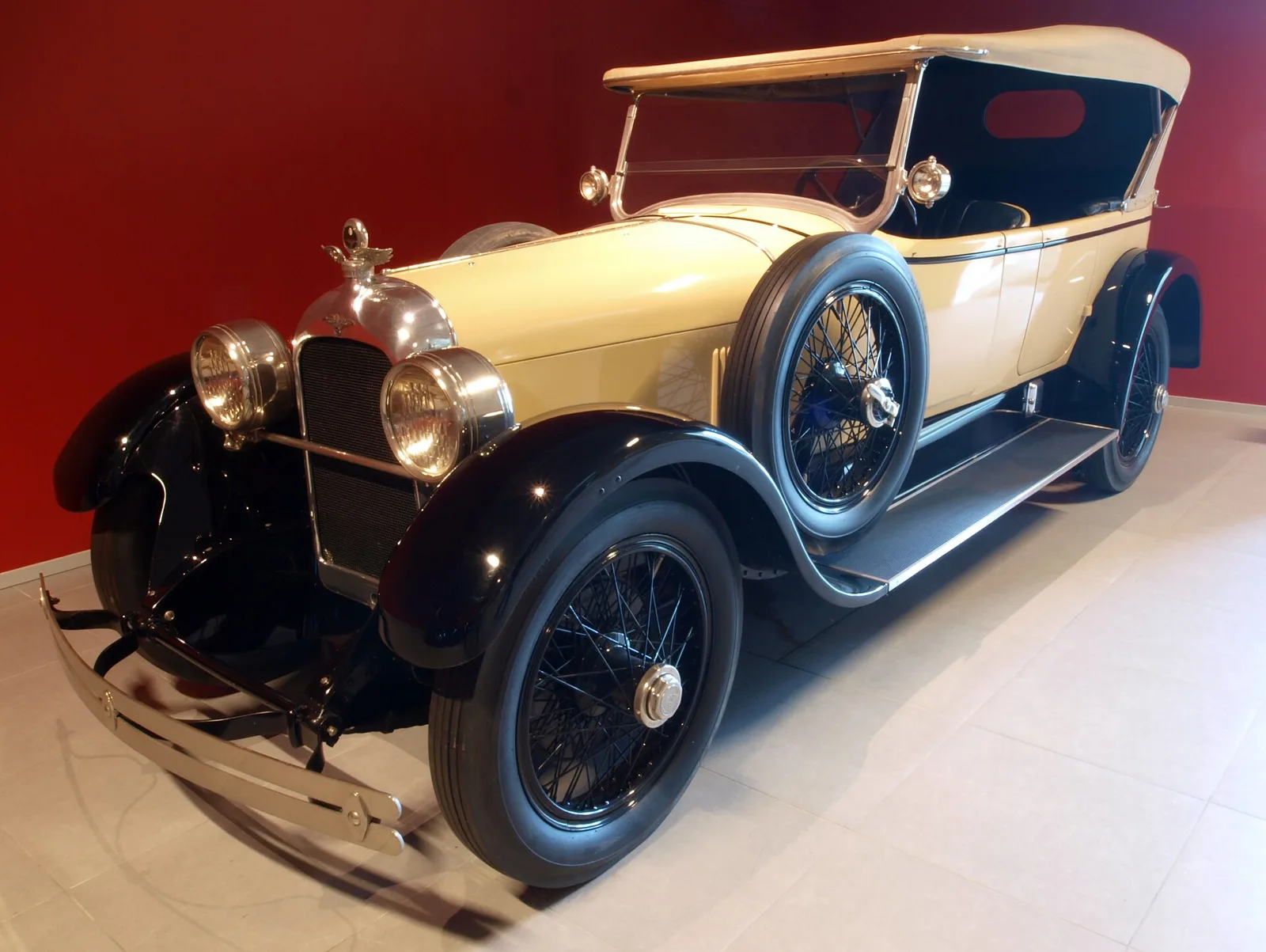
V8s had reached cars by 1914, with De Dion-Bouton, Scripps-Booth and Cadillac, yet no production car used a straight-eight before 1920. Italy's Isotta Fraschini unveiled the first, the Tipo 8, in Paris in 1919. Leyland Motors showed an overhead-cam straight-eight luxury car, the Leyland Eight, at Olympia in London in 1920. The Duesenberg brothers launched their first production straight-eight in 1921.
For the next two decades straight-eights powered expensive luxury and performance cars. Bugattis and Duesenbergs commonly had double overhead cams, and notable eights came from Daimler, Mercedes-Benz, Isotta Fraschini and Alfa Romeo in Europe and from Stutz, Stearns-Knight and Packard in America. The length was a selling point. Some Duesenberg engines were over 4 ft (1.2 m) long, and that gave the cars their long bonnets.
In the 1920s American makers took the engine to the middle class: Hupmobile in 1925, Chandler in 1926, Marmon in 1927, and Gardner, Kissel, Locomobile and Auburn, all in 1925. Lycoming built straight-eights for Gardner, Auburn, Kissel and Locomobile, while Hupmobile made its own. Auburn's owner, Errett Lobban Cord, bought Lycoming, fitted its engine to his front-wheel-drive Cord L-29, and had it build the engine for the Duesenberg Model J. The three car makers of the Cord Corporation, Auburn, Cord and Duesenberg, closed in 1937. Lycoming survives as an aircraft engine maker.
Hudson and Studebaker added straight-eights to their premium lines in the late 1920s, followed in the early 1930s by Nash, REO and three General Motors divisions, Buick, Oldsmobile and Pontiac. Buick's eight had overhead valves; Oldsmobile's and Pontiac's were flatheads. Chevrolet, an entry-level brand, never had one. Cadillac stayed with V8 power and, to match the smoothness of its rivals' eights, gave its V8 a crossplane crankshaft and put V12 and V16 engines above it in the range. Ford never adopted the straight-eight at all, while Chrysler's premium cars, the Imperial among them, ran flathead straight-eights.
There were stranger uses. The British R101 rigid airship carried five Beardmore Tornado Mk I diesels, each an inline eight. The design target was 700 bhp (520 kW) at 1,000 rpm, but the continuous rating turned out to be 585 bhp (436 kW) at 900 rpm. After the war the Buick eight also powered a Flxible inter-city bus, and the British Army chose the Rolls-Royce B80 series for the Alvis FV 600 family. That included the Saladin armoured car, the Saracen personnel carrier, the Stalwart amphibious carrier with the larger B81 engine and the Salamander fire vehicle. The same engines went into the Leyland Martian truck, the winch of the Centurion recovery vehicle and Dennis fire engines.
Why did racing teams love the straight-eight?
From the late 1920s to the late 1940s the straight-eight was the performance engine of choice, and it stayed competitive until the mid-1950s. Successful twin-cam eights came from Bugatti, Duesenberg, Alfa Romeo, Mercedes-Benz and Miller in the 1920s and 1930s.
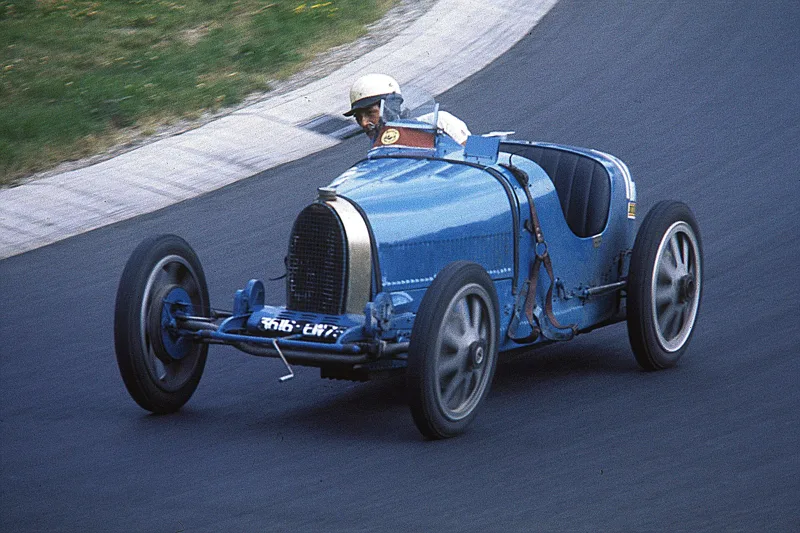
Duesenberg showed the way in 1920, when its 3 L car took third, fourth and sixth places in the Indianapolis 500. The next year one of its cars won the French Grand Prix. Its overhead-cam, three-valve engine made 115 bhp (86 kW) at 4,250 rpm and could rev to 5,000 rpm, astonishing at a time when no pre-war Grand Prix engine had peaked above 3,000 rpm. Bugatti followed. Its 2 L Type 35 of 1924 had a similar high-revving three-valve overhead-cam eight making 100 bhp (75 kW) at 5,000 rpm, and it went on to win over 1000 races. Nearly 400 Type 35s and derivatives were built, a record for Grand Prix racing. Both firms took their ideas from building aircraft engines in World War I.
Alfa Romeo was first to answer the engineering problems. In its P2 and P3 racers and the 8C 2300, 2600 and 2900 sports cars, it moved the camshaft drive to the middle of the engine, between cylinders four and five, which reduced the limitations of length. The engine was in effect two straight-fours set end to end and sharing gear trains for the camshafts and superchargers; it had two overhead camshafts yet just two valves per cylinder.
The Alfa Romeo eight returned after the war to dominate the first Formula One season in 1950 and win the second in 1951 against Ferrari's V12. The Alfetta 158/159, designed in 1937, won 47 of the 54 Grands Prix it contested from 1938 to 1951, a war interrupting the run for six years. By 1951 the supercharged 1.5 L engine produced 425 bhp (317 kW), peaking at 9,300 rpm with a ceiling of 10,500, but it was at the end of its potential, and rule changes for 1952 made the car obsolete.
Mercedes-Benz built the last notable straight-eight racers in 1955, the championship-winning W196 Formula One car and the 300SLR sports racer. The 300SLR won the 1955 Mille Miglia with Stirling Moss and Denis Jenkinson, and was notorious for Pierre Levegh's fatal accident at that year's 24 Hours of Le Mans. Engineers judged the stresses in the long crankshaft too high to take power from its end, so they put a gear train at the engine's midpoint to run the camshafts, magnetos and accessories, and carried the drive back to the clutch housing on a shaft.
Where this goes next
The straight-eight has no place in modern cars, where the V8 displaced it, and its last notable appearance was in the Mercedes-Benz racers of 1955. The three-cylinder is the one still moving. It rides the wider shift to smaller turbocharged engines, and its share of new vehicles is described as small but growing, with the United States figure at about 5% for the 2025 model year, against 60% for four-cylinder engines.