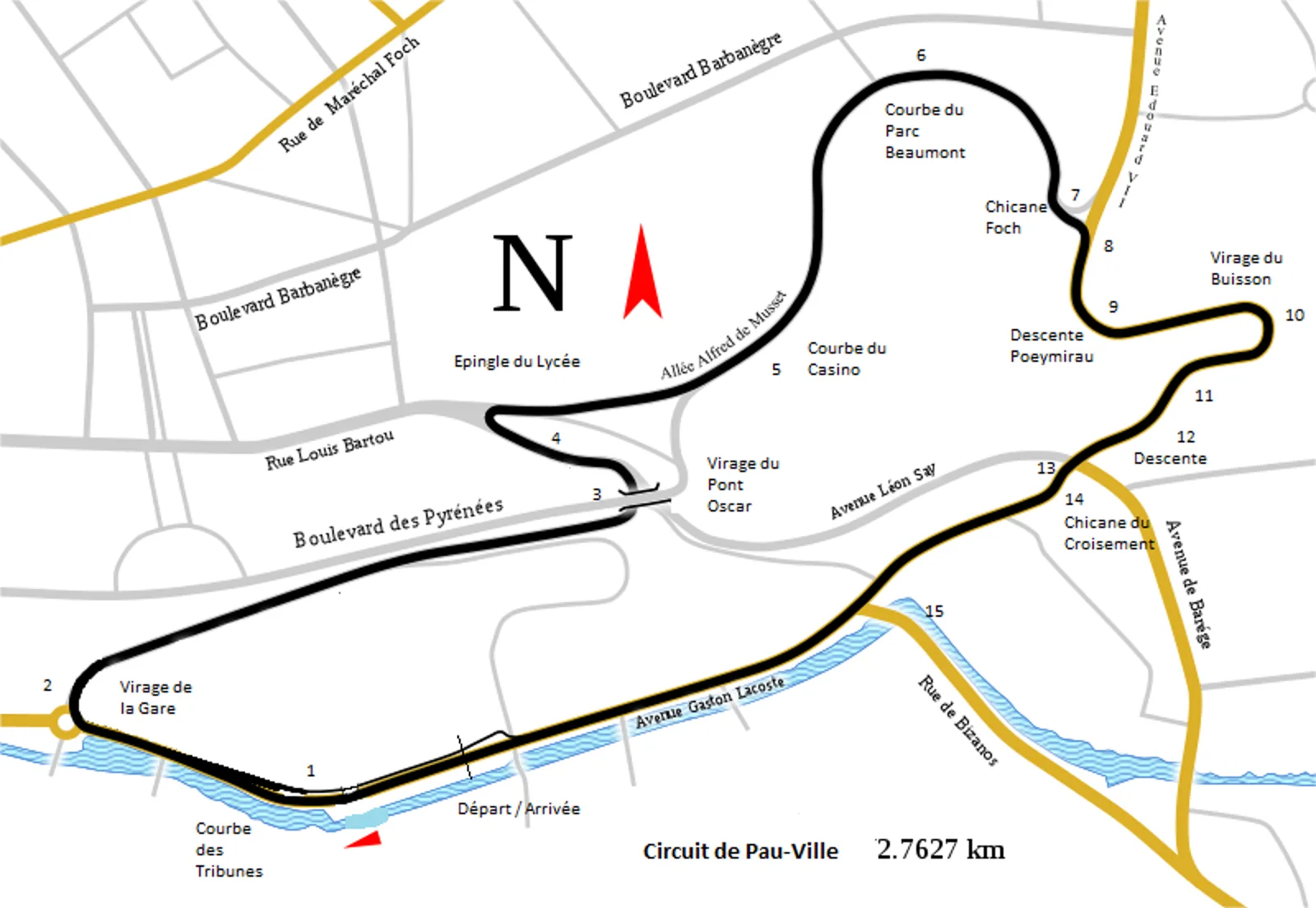
A 2.769 km (1.721 mi) street circuit in southwestern France, host of the Pau Grand Prix since 1933 and a proving ground for generations of drivers.
Pau's annual street race, run on a 2.769 km (1.721 mi) circuit in south-western France since 1933, has been won by drivers including Juan Manuel Fangio and Jim Clark. The event was cancelled for 2024 amid financial difficulties.
The Pau Grand Prix is a motor race run around the centre of Pau, in south-western France, on a 2.769 km (1.721 mi) street circuit. The event has run since 1933 and has been won by many of motorsport's best-known drivers, but its future was uncertain after its 2024 cancellation.
What is the Pau Grand Prix?
The Pau Grand Prix is a street race held in Pau, a city in the Pyrenees-Atlantiques department. Public roads are closed to form the circuit, and the category has changed many times, from Formula One and Formula Two to touring cars.
The race has a long history on the streets of Pau, and in 2021 Autocar named it among its best street circuits. The event was not run during the Second World War or in 2020 and 2021 because of the COVID-19 pandemic.
A street circuit in south-western France that has hosted Fangio, Clark, Stewart and Hamilton, and now faces an uncertain return.
Where is the Circuit de Pau-Ville?
The circuit is 2.769 km (1.721 mi) long and was laid out around the town centre. It is similar in its character to the Monaco Grand Prix, with tight streets and a limited space for overtaking.
Because the surface undulates, the cars are set up with more suspension travel than a purpose-built track would require. A separate club track, Circuit Pau-Arnos, lies around 20 km (12 mi) west of town and measures 3.030 km (1.883 mi).
How did the event begin?
The first major race in the area was the Circuit du Sud-Ouest of 1900, a road race of 300 km (190 mi) from Pau through Tarbes and Bayonne and back. It was part of the Semaine de Pau, and it was won by Rene de Knyff.
The 1901 event split its entrants into four classes, with separate prizes for each. Maurice Farman won the main Grand Prix de Pau in a 24 hp Panhard, Henri Farman won a light car class in a Darracq, and Louis Renault won the smallest category.
A French Grand Prix took place at Pau in 1930, and the yearly Grand Prix de Pau began in 1933. The first annual race took place in February, with snow lying on the ground, and Marcel Lehoux won it in a Bugatti.
The 1900 race was part of the Semaine de Pau, a week of events organised around the newly created Automobile-club du Bearn.
Who were the early winners?
The race was held almost every year until the Second World War, and it came back in 1947. The 1947 and 1948 events kept crowds on edge from start to finish, and Nello Pagani won in 1948 ahead of Wimille, Etancelin and Sommer.
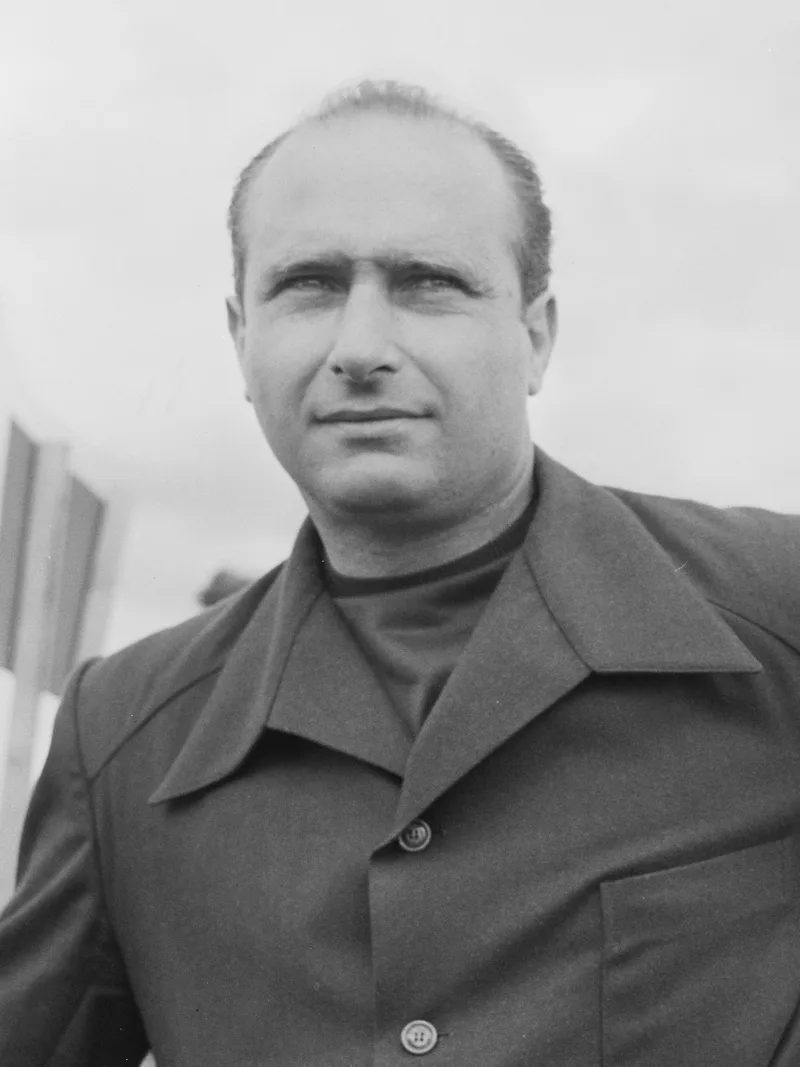
Juan Manuel Fangio won in 1949 while controlling the race from the front. He had started from pole, as he had the year before, and he also set the fastest lap on his way to victory.
In 1954, Jean Behra won before a record crowd in a Simca-Gordini, after a duel with the Ferrari driver Maurice Trintignant. Many French manufacturers had withdrawn from the Grand Prix by then, which made the win a notable national result.
How did the 1938 duel shape the race?
The 1938 race produced a symbolic duel between Rene Dreyfus, who drove a Delahaye 145, and the German pair of Rudolf Caracciola and Hermann Lang. Caracciola and Lang shared a Mercedes-Benz W154 and had to make a pit stop, while Dreyfus did not stop and won.
A year later the race was another Mercedes contest, as Hermann Lang beat his teammate Manfred von Brauchitsch in 1939. The race remained a stage for the strongest teams of the era until the war interrupted it.
What dangers did the circuit present?
On 11 April 1955 the Italian driver Mario Alborghetti died in a racing accident. His Maserati crashed into hay bales after he appeared to confuse his pedals while distracted, and the crowd only learned of his death once the racing had finished.
The 1956 race was called off after the Le Mans disaster of the previous year. The 1957 event benefited from course work intended to improve safety and make life easier for competitors and spectators.
In 1994 Nicolas Leboissetier crashed dramatically at the Virage de la gare, the station corner, which stirred the fear felt after Ayrton Senna and Roland Ratzenberger were killed at Imola in the same season.
In 2009, after chaos at the start of the second race, the safety car was called. Its driver moved onto the track without an order, just as the warning boards went up. Franz Engstler, who was leading, collided heavily with the safety car, and the FIA sanctioned the officials responsible.
What were the 1960s and 1970s like?
The race drew famous names in the 1960s. Jack Brabham, Maurice Trintignant and Jim Clark were among the winners, and Clark won his first Formula One car race at Pau in 1961. He went on to win the race three more times, in 1963, 1964 and 1965, as the format changed between Formula One and Formula Two.
Jochen Rindt won in 1967 and then twice more, in 1969 and 1970. Jackie Stewart won in 1968 with Matra Sports, and Reine Wisell and Peter Gethin won in 1971 and 1972. Francois Cevert won in 1973, after the mayor, Andre Labarrere, stepped in to deal with homologation problems that had threatened the event.
Several future world champions raced in the period, including Graham Hill, Denny Hulme and Emerson Fittipaldi. The 40th edition, in 1980, went to the Frenchman Richard Dallest.
How did Formula 3000 and Formula 3 shape the race?
From 1985 Formula 3000 took over from Formula Two as the second tier, and Pau joined the new European championship. Alain Prost became a co-organiser of the race that same year.
Jean Alesi took his first victory in 1989, after a difficult start in which the race was restarted four times. Juan-Pablo Montoya, a Colombian, claimed a pair of wins in 1997 and 1998, before the Formula 3000 race was dropped at the end of 1998.
Formula Three returned in 1999 with the new European Formula Three Cup, which Benoit Treluyer won that year. Anthony Davidson won from pole in 2001 for Carlin, and Davidson went on to win the European Formula Three series that year.
Lewis Hamilton won in 2005, and three years later he took the Formula One world title. In 2006 Romain Grosjean won both races in the British championship, although he was not a regular competitor in that series.
| Year | Winner | Car or team | Formula |
|---|---|---|---|
| 1933 | Marcel Lehoux | Bugatti | Grand Prix |
| 1938 | Rene Dreyfus | Delahaye 145 | Grand Prix |
| 1949 | Juan Manuel Fangio | Pole and fastest lap | Grand Prix |
| 1954 | Jean Behra | Simca-Gordini | Grand Prix |
| 1968 | Jackie Stewart | Matra Sports | Formula Two |
| 1989 | Jean Alesi | First victory | Formula 3000 |
| 1997 | Juan-Pablo Montoya | First of two wins | Formula 3000 |
| 2001 | Anthony Davidson | Carlin Dallara-Honda | Formula Three |
| 2005 | Lewis Hamilton | Formula Three | Formula Three |
Did touring cars and Formula Three return?
From 2007 to 2009 the event switched to touring cars and hosted the World Touring Car Championship for the Race of France. The Formula 3 Euro Series supported the touring cars in 2008, when the Brazilian driver Augusto Farfus crashed at the Foch Chicane.
The Grand Prix was suspended in 2010 for financial reasons decided by the municipality, and the World Touring Car Championship did not return. Peter Auto brought the event back in 2011, with Formula Three as the headline race, and the International Trophy was won by the German Marco Wittmann.
Only fifteen drivers were on the entry list that year, and there were few spectators. In 2012 a British Formula Three round was planned, before the event joined the new FIA Formula 3 European Championship. Porsche Carrera Cup France was also on the programme that year, and Sebastien Loeb won both of its races. Crowds reached 22,000 to 23,000 that year, up 10 to 15 percent on 2011. Raffaele Marciello won in 2012 after dominating qualifying and the race, and he became one of the youngest winners of the race at only 18.
How has the race declined recently?
Between 2014 and 2018 the FIA Formula 3 European Championship was the headline series at Pau. The event added the GT4 European Series in 2016, and it later hosted the Euroformula Open Championship in 2019 and 2022. The 2020 race was cancelled because of the pandemic, and no race was planned for 2021.
At the end of 2023 the local club, known as ASAC BB, which runs the event, announced that there would be no race in 2024, and it planned a comeback in 2025. On 8 October 2024 the association appeared before the Pau Judicial Court to seek safeguard proceedings over unpaid dues of around 150,000 euros.
On 8 December 2024 a general assembly for the city revealed that the association had experienced financial difficulties since 2022. The race was expected to return in the 2025 to 2027 seasons, but its future for 2025 was in doubt. It had been halted before, in 1956 and in 2010, and the 2020 and 2021 gaps were caused by the pandemic.
What is the Historic Grand Prix?
Since 2001, historic races have run a week either side of the modern event. Former Formula One cars from the 1960s are among the entries, and the programme includes a range of classic classes.
The historic programme features races such as the Trophee Argentin, which honours Juan Manuel Fangio, the Trophee de Pau and the Trophee Junior. Other classes include the Trophee des Pyrenees, the Trophee Phil Hill and the Trophee Mini Classic. The Trophee Mini Classic is reserved for Mini Coopers, and the Trophee Flat4 is limited to older Porsches with flat-four engines. Pre-war Grand Prix cars run in the Trophee Legende, and Formula Junior machines compete in the Trophee Junior.
What are the lap records?
The unofficial all-time lap belongs to Andrea Montermini, who posted 1:08.600 in a Reynard 92D in 1992 qualifying. Official race lap records are tracked separately from that unofficial mark.