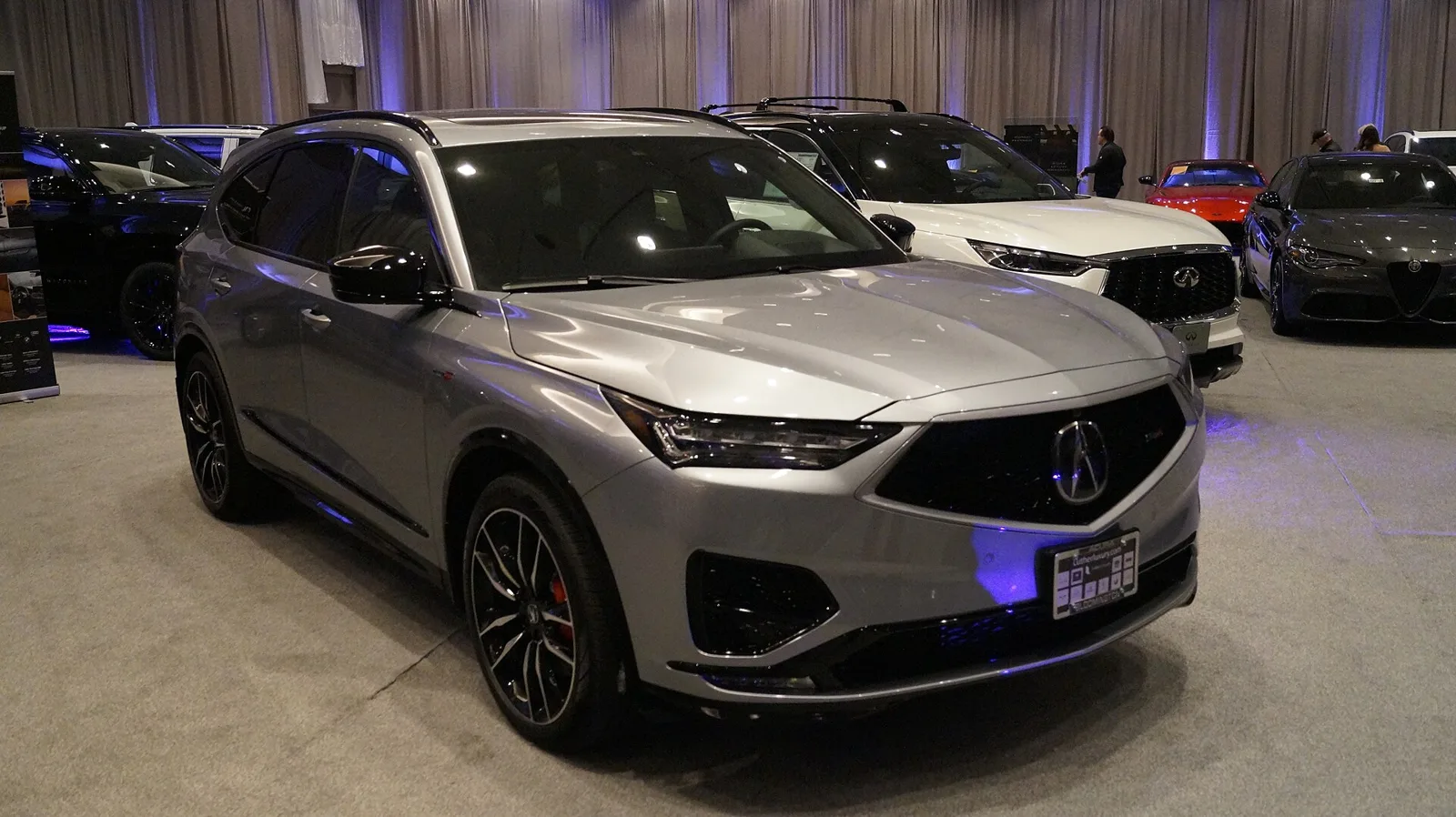
From the 2001 SUV built on a Honda platform to the fourth-generation car with a turbocharged Type-S, the MDX became Acura's flagship.
The Acura MDX is a mid-size, three-row luxury crossover that Honda builds for its Acura division. It debuted for the 2001 model year and became the Acura flagship in 2020. Its all-wheel drive moved from VTM-4 to SH-AWD, and a turbocharged Type-S joined the fourth generation.
The Acura MDX is a mid-size luxury crossover with three rows of seats, built by Honda for its Acura division since 2000. The name stands for Multi-Dimensional luxury, and the model has long been one of the strongest sellers in its class. It became the flagship of the Acura range in 2020 and has stayed central to the brand through four generations.
Where did the Acura MDX come from?
The MDX arrived on 5 October 2000 as a 2001 model. It replaced the SLX, a slow-selling vehicle sold only in the United States that rode on a body-on-frame layout and was based on the Isuzu Trooper. In Japan the new car took over from the Honda Horizon, which had been discontinued in 1999.
From 2003 the car was also sold in Japan and Australia under the Honda MDX name. Honda badges were dropped when the second generation arrived in 2006, leaving Acura as the only brand on the car.
A Honda-built three-row SUV that grew from a family hauler into Acura's flagship, and then into a turbocharged Type-S.
How was the first-generation MDX engineered?
The first MDX rode on Honda's Global mid-size platform, the same basis used by the Accord, TL, TSX and Odyssey. Power came from a 3.5-litre V6 with VTEC valve control. Early examples produced 240 hp (179 kW) and 245 lb ft (332 Nm) of torque, pulling a body that weighed 2,019 kg (4,451 lb) on a 2,700 mm (106.3 in) wheelbase.
The all-wheel drive system was called VTM-4. It worked automatically, engaging when the car pulled away from rest or when the wheels began to slip, and running as front-wheel drive during steady cruising to save fuel. A lock mode provided permanent four-wheel drive and a locked rear differential for steep hills and getting unstuck.
Seating was the weak point. The third row was small and seated only two adults, which compared poorly with the Odyssey and Pilot, whose third rows held three. The cargo floor could be flipped up to create two extra seats, a useful trick for a family SUV that was not quite a seven-seater in practice.
Options followed a clear pattern. From 2003 the navigation system came with a backup camera, and the navigation and DVD entertainment options could be ordered together. Since 2005 the navigation software carried restaurant and point-of-interest listings from Zagat.
What changed with the second-generation MDX?
The second generation arrived in the United States on 17 October 2006 as a 2007 model. It had a wider track and a longer wheelbase, and its 3.7-litre V6 produced 300 hp (224 kW) and 270 lb ft (366 Nm). SH-AWD replaced the older VTM-4 system, and the suspension was tuned at the Nurburgring in Germany.
SH-AWD first appeared on the 2005 Acura RL. It adds an active rear differential, a feature more often found on high-performance cars, and it helps offset the nose-heavy weight of a transversely mounted engine. Rivals such as the BMW X5 and Audi Q5 use longitudinal engines to reach a more even weight split, but at a cost to passenger and cargo room.
Packaging for 2007 to 2009 came as Sport, Technology and Entertainment packages. The Sport package added active dampers co-developed by Honda and Beijing West Industries, which switch between Sport and Comfort settings using magneto-rheological fluid. The Entertainment package offered a flip-down 9-inch LCD screen with wireless headphones.
The redesigned MDX overtook the TL in 2006 as Acura's best-selling model in the United States. A 2010 facelift adopted the brand's Power Plenum grille, added a six-speed SportShift automatic with rev-matching downshifts, and lifted compression to 11.2:1.
How did the third-generation MDX change the formula?
The third generation was previewed as a prototype at the 2013 North American International Auto Show, and production began on 2 May 2013. Assembly moved from Ontario to Lincoln, Alabama, and US sales started on 20 June 2013 as a 2014 model. For the first time a front-wheel drive model was offered, while Canadian buyers kept all-wheel drive only.
Acura claimed the body cut drag by 16 percent, and the car lapped the Nurburgring eight seconds faster than its predecessor. About 64 percent of the body mass was high-strength steel, aluminium and magnesium, and the front lower control arms were forged aluminium to reduce unsprung weight.
The interior swapped many buttons for a 7-inch touchscreen with haptic feedback. Acura's Jewel Eye LED headlights came from the RLX, with five LED sources in each lamp.
For 2016 the Honda six-speed gave way to a ZF nine-speed automatic, and the console lever became a push-button selector. The 2017 refresh brought a diamond pentagon grille borrowed from the Precision Concept, and the same year the MDX Sport Hybrid joined the range.
What is the Sport Hybrid, and why does it matter?
The 2017 Sport Hybrid paired a 3.0-litre SOHC V6 with a 7-speed dual-clutch gearbox and a 1.3 kWh lithium-ion battery. The front wheels were driven by the engine and one electric motor, while the rear wheels were driven by two electric motors. It made 321 hp (239 kW) and 289 lb ft (392 Nm), and it came standard with SH-AWD and the Integrated Dynamics System with a SPORT+ mode.
Acura's active damper system, previously exclusive to the hybrid, became available on the regular MDX with the Advance package for 2019. The A-Spec appearance package also arrived that year, limited to SH-AWD cars, with 20-inch Shark Grey wheels, Alcantara trim and a thicker steering wheel with paddle shifters.
What is the fourth-generation MDX like?
The fourth generation was revealed as a prototype on 14 October 2020 and entered bulk production on 12 January 2021 for the 2022 model year. The Type-S trim was released on 23 December, ahead of sales starting on 2 February. The 2021 model year was skipped entirely.
The base powertrain was the 3.5-litre V6 paired with a 10-speed automatic. All-wheel drive was optional on the base and Technology trims and standard on the A-Spec and Advance. The Type-S used a 3.0-litre turbocharged V6, with four-piston Brembo front brakes and all-wheel drive as standard.
There is no hybrid option in this generation. Towing starts at 3,500 lb (1,600 kg), rising to 5,000 lb (2,300 kg) with the transmission cooler kit, which is an accessory on the all-wheel drive models.
The cabin brought a 12.3-inch infotainment system, a 12-inch digital instrument cluster and 16-way power front seats with memory positions. A panoramic sunroof was standard, and the car came in nine exterior colours and seven interior colours. The optional audio system had 16 speakers, four of them in the roof. The redesigned key fob had an irregular polygon shape, and a foot sensor could open and close the power tailgate when the fob was nearby.
What did the 2025 facelift change?
The facelift was revealed on 9 April 2024 for the 2025 model year. It brought updated exterior styling, new alloy wheel designs and a 12.3-inch touchscreen running Google built-in. The touchpad controller was removed to free up storage and a wireless charging pad.
The audio system became a Bang and Olufsen set with 19 speakers in most trims and 31 in the Type-S. SiriusXM satellite radio was discontinued from the 2025 model year, and the facelift added the AcuraWatch 360 safety suite.
What are the Acura MDX specifications?
The table below gives the main figures for each generation, along with the Type-S and the Sport Hybrid. Where a figure belongs to one generation or trim, the row says so, so the early V6 numbers do not blend into the later turbo car.
| Specification | Detail |
|---|---|
| Class | Mid-size luxury three-row crossover SUV |
| First-generation engine | 3.5 L J35A3 V6, 240 hp (179 kW) at launch; 265 hp (198 kW) from 2004 |
| First-generation weight | 2,019 kg (4,451 lb) curb weight |
| First-generation wheelbase | 2,700 mm (106.3 in) |
| Second-generation engine | 3.7 L V6, 300 hp (224 kW) at 6,000 rpm; 270 lb ft (366 Nm) |
| Second-generation towing | 5,000 lb (2,300 kg) |
| Third-generation engine | 3.5 L direct-injected V6 with cylinder management |
| Transmission (2016 on) | ZF 9-speed automatic |
| 2017 Sport Hybrid | 3.0 L V6 with electric motors; 321 hp (239 kW); 1.3 kWh battery |
| Fourth-generation transmission | 10-speed automatic |
| Fourth-generation Type-S | 3.0 L turbocharged V6, all-wheel drive standard |
| Fourth-generation towing | 3,500 lb (1,600 kg) standard; 5,000 lb (2,300 kg) with cooler |
Which awards and safety ratings did the MDX earn?
The MDX was named Best Luxury SUV by Car and Driver in 2001, and it was a North American Car of the Year utility finalist for 2019. Motor Trend listed it as an SUV of the Year contender in 2017. Safety results were just as strong, with the IIHS Top Safety Pick for the 2018 model year and the Top Safety Pick+ rating for the 2022 car.
Owner loyalty also stood out. An iSeeCars study in 2019 ranked the MDX seventh among SUVs that owners keep the longest, and US News placed it sixth among luxury midsize SUVs that year.
How did Acura market the third-generation MDX?
The 2014 launch campaign was titled Made for Mankind and centred on the link between people and machines, a theme meant to sum up the engineering philosophy behind every Acura. Eight comedic commercials featured the comedian Jerry Seinfeld and the director Barry Sonnenfeld, and Acura became an exclusive sponsor of the show Comedians in Cars Getting Coffee.
How did Canadian MDX models differ?
Canadian buyers were offered two packages, Technology and Elite, rather than the three available in the United States. The Elite package combined the American Sport and Entertainment packages, while the Technology package matched its US counterpart. Canadian cars also came with headlight washers, a feature unique to that market.
The main functional gap was in traffic data. XM NavTraffic real-time traffic reporting was not available on Canadian models, even though it came with the Technology package in the US. Alliston, Ontario built the first and second generations exclusively, so the Canadian plant was central to the model's early history.
Frequently asked questions
Is the Acura MDX a true seven-seater?
It seats seven in principle, but the third row differs by generation. The first-generation third row was small and seated two, which made the car more of a flexible five-seater for most families. Later generations improved rear access and room, and the third row became a practical option for children and occasional adults.
How much can an Acura MDX tow?
Second-generation models were rated to tow 5,000 lb (2,300 kg). The fourth generation has a standard rating of 3,500 lb (1,600 kg), which rises to 5,000 lb (2,300 kg) when the transmission cooler kit is fitted to all-wheel drive cars.
Was there a hybrid MDX?
Yes. The 2017 Sport Hybrid used a 3.0-litre V6, a 7-speed dual-clutch gearbox and electric motors, making 321 hp (239 kW). The fourth generation does not offer a hybrid, so the Sport Hybrid remains the only electrified MDX.
When did the MDX become Acura's flagship?
The MDX became the flagship of the Acura line in June 2020, after the RLX mid-size luxury sedan was discontinued. That made it the most important model in the brand's US range until the fourth generation arrived.
.jpg)