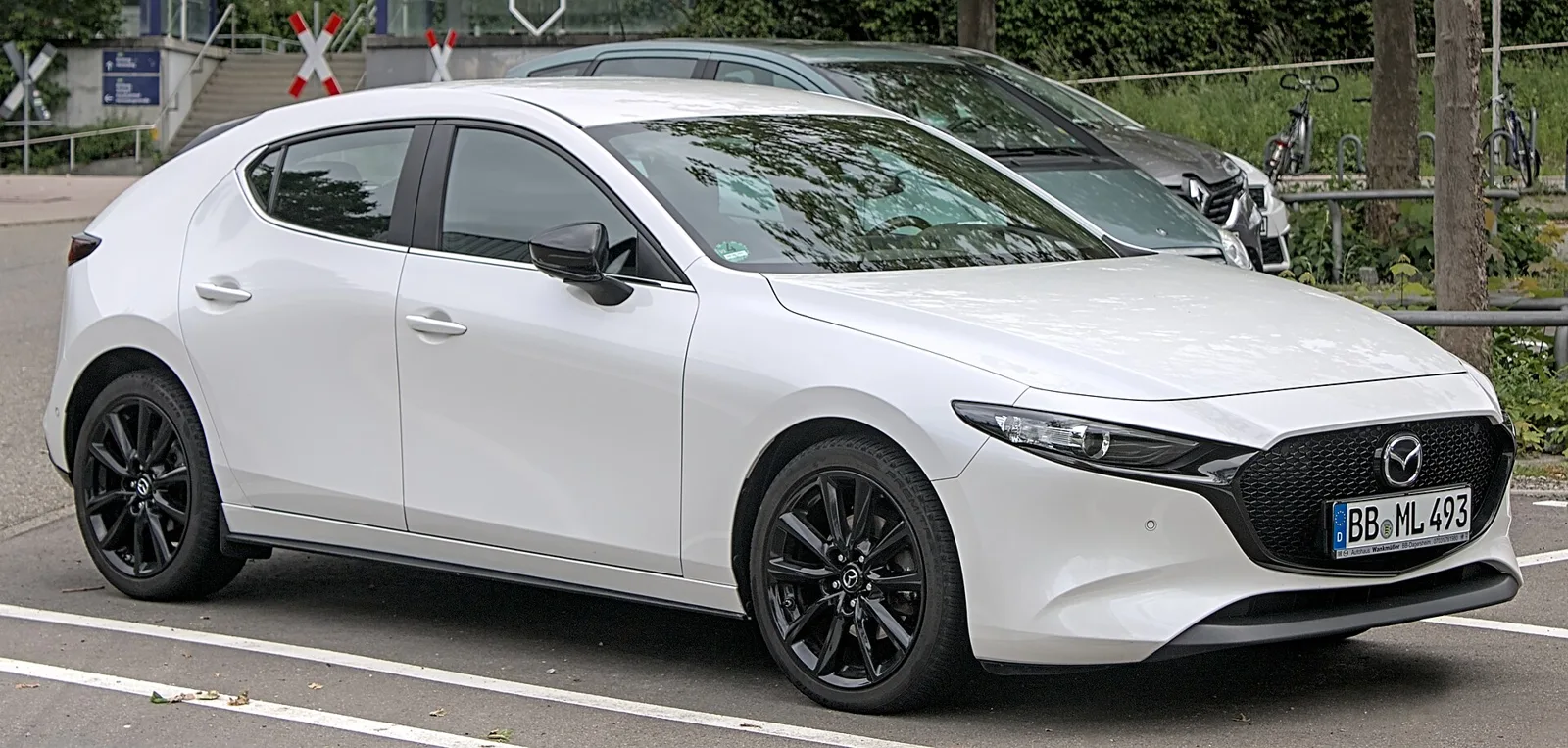
From the 2003 Axela on Ford's C1 platform to the Skyactiv-X generation of 2019, the Mazda3 became one of the brand's biggest sellers.
The Mazda3 is a compact car that Mazda has built since 2003 across four generations, offered as a five-door hatchback or a four-door sedan. It was sold as the Axela in Japan until 2019. Cumulative sales had passed over 6 million units by January 2019.
The Mazda3 has been one of Mazda's most important cars for more than two decades. It has carried the brand through several design shifts, from the first car built on Ford's C1 platform to a fourth generation that introduced Skyactiv-X. Along the way it became one of the company's fastest-selling models.
Where did the Mazda3 come from?
The Mazda3 began as the BK series, first shown at the 60th Frankfurt Motor Show on 10 September 2003 and launched in Japan that October as the Axela. It replaced the Familia, known abroad as the 323 or Protege, as Mazda's C-segment model. The car had been previewed by the MX-Sportif concept.
Design work began in 1999 at three Mazda design centres in California, Frankfurt and Hiroshima. By 2001 Hasip Girgin's design had been chosen as a finalist, and he spent six months working in Hiroshima before the final design was frozen for the 2003 production schedule.
The car was built on the Ford global C1 platform, which it shared with the Ford Focus and the Volvo S40. Mazda sold it in two body styles: a four-door fastback sedan, marketed as a coupe-style saloon in Europe, and a five-door hatchback branded as the Sport in Canada, Japan and the United States.
A compact that started as an Axela in Japan and became one of Mazda's biggest sellers across four generations.
How did the first generation perform on the road?
Official figures for the lowest-powered European car, a 1.4 S, gave 0-100 km/h in 14.3 seconds and a top speed of 170 km/h. Car and Driver measured a 2004 five-door with the 2.3-liter engine at 7.4 seconds to 60 mph. Performance rose sharply with the larger engines and the turbocharged MZR option.
Euro NCAP gave the early car four stars, a result that was improved when six airbags became standard. Mazda's Macau police force used the car on patrol alongside the Toyota Corolla and Honda Civic.
The car sold strongly in Canada, where it was the second best-selling car in 2006. That year Mazda also added variable valve timing and variable-length intake runners to the 2.0-liter engine, lifting its power, and the 2.3-liter's automatic moved to five speeds.
What did the second generation bring?
The second-generation car was revealed at the Los Angeles show on 19 November 2008, with the sedan leading and the hatchback following at the Bologna show. The North American versions used a 2.0-liter engine rated at 148 bhp, while the 2.5-liter unit produced 167 bhp (125 kW; 169 PS) and 167 lb-ft (226 N-m).
The Mazdaspeed3 performance version kept the line fresh. Full details of the Mazdaspeed3 came out at Geneva in March 2009, and it was based on the hatchback body. The facelifted car later earned a 5/5 star ANCAP rating, and it has kept that score ever since.
The 2012 update brought Skyactiv technology, including a direct-injection 2.0-liter Skyactiv-G petrol engine and a choice of 6-speed automatic or 6-speed manual transmissions. Engineers added high tensile steel to the centre floor pan and B-pillar, which stiffened the body and improved handling.
How did the third generation differ?
The third-generation car was revealed in Australia on 26 June 2013. It sat on Mazda's own Skyactiv chassis rather than the Ford C1 platform, and it became the first Mazda3 to adopt the Kodo design language. Its drag coefficient was 0.26 for the sedan.
Engines were a 2.0-liter with 155 hp (116 kW) and 150 lb-ft (200 N-m), and a 2.5-liter with 184 hp and 185 lb-ft. The 2.5-liter automatic reached 60 mph in 6.9 seconds, and its quarter mile took 15.2 seconds at 95 mph. The 2.0-liter with the six-speed manual needed 7.8 seconds for the same sprint.
Production moved as well. Mazda built the US sedan at its Salamanca plant in Mexico from 7 January 2014, and Thai production at AutoAlliance began on 14 March 2014. Cumulative production had reached four million units by 22 January 2014, since June 2003.
The August 2016 facelift introduced the BN model code, a new dashboard, G-Vectoring Control and the removal of the diesel option. It debuted in North America for the 2017 model year, where the earlier i and s labels were dropped in favour of Sport, Touring and Grand Touring names.
What is the fourth-generation Mazda3?
The fourth generation was previewed by a clay prototype sculpted live at the 2017 Los Angeles Auto Show, and the production hatchback and sedan were unveiled at the 2018 Los Angeles show on 28 November 2018. Global sales began in early 2019 as the 2019 model year in North America. The car was longer, with a wheelbase stretched by 25 mm (1.0 in).
The prototype was based on a design by Mallory McMorrow, a student at Notre Dame. Its sedan and hatchback differ heavily in their exterior design, sharing only the hood and headlights, and the interior received a stitched dash pad, a new steering wheel and an 8.8-inch display with redesigned Mazda Connect software.
Structurally, the body uses ultra-high-strength steel for 30 percent of the body, up from 3 percent in the prior generation. Mazda replaced the multi-link rear with a torsion beam, a move it said improved quietness, and it added G-Vectoring Control Plus torque vectoring.
Which engines did the fourth-generation Mazda3 offer?
The 2.0-liter Skyactiv-X engine is a spark-controlled compression ignition petrol unit. The original version produced 178 hp (132.5 kW; 180 PS) and 224 N-m, while the updated e-Skyactiv-X made 188 hp (140 kW) in Japan and 240 N-m (177 lb-ft) of torque.
Other markets had the 1.5-, 2.0- and 2.5-liter Skyactiv-G petrol engines, plus a 1.8-liter Skyactiv-D diesel offered in selected countries. For the 2021 model year Mazda introduced an all-wheel-drive 2.5-liter turbocharged petrol engine, mated exclusively to a six-speed automatic.
Where did the fourth generation launch first?
Mexico was the first country to receive the car in both hatchback and sedan form, in February 2019. Canada and the United States followed in March 2019, and Europe also debuted the model that month with three engines. Japan sales started on 24 May 2019, and the Axela name was dropped there.
Australia took the hatchback in April 2019, with the sedan following in May 2019. Thai production started on 28 August 2019, and in South Africa the sedan body was discontinued in September 2021 as Mazda South Africa said local buyers preferred compact crossovers and SUVs.
How did the Mazda3 race?
The Mazda3 was introduced to the Speed World Challenge in 2009, and Team Sahlen entered one in the 2010 Continental Tire Sports Car Challenge. Mazda South Africa ran two Mazda3 MPS models in the South African Production Car Championship from 2007 to 2010, in Class-T.
The car also featured in the NASCAR Stock V6 Series in Mexico. A Mazda3 TCR racing programme was announced in October 2019, but it was cancelled in August 2020 because of the COVID-19 pandemic.
What awards has the Mazda3 won?
The fourth-generation car won the World Car Design of the Year award in 2020, and Car and Driver put the Mazda3 on its 2024 Editors' Choice list. In Canada the 2014 model was named Best New Small Car, and US News ranked the 2014 model first among affordable small cars.
The IIHS named the 2022 car a Top Safety Pick+. Its ANCAP record has been strong too, with five stars from the 2009 facelift onward.
What changed in the 2007 facelift?
The 2007 facelift was a light cosmetic update. It changed the front fascia and foglights, reshaped the lower air intake and added LED brake lights to the Grand Touring trim. The alloy wheel range was also redesigned, with a 17-inch wheel for Grand Touring.
Mechanical changes were less visible but significant. The keyless entry system was improved, the body shell was reinforced, and the front dampers were retuned to quicken steering response. Engineers also added sound-deadening material to the roof lining and the bonnet to address cabin noise.
Warranty terms changed as well. The bumper-to-bumper cover fell to 36 months or 36,000 miles, while the powertrain warranty rose to 60 months or 60,000 miles in most markets. Canadian cars also gained seat-mounted side airbags and body-shell-mounted side-curtain airbags.
Which Asian markets received the fourth generation first?
Taiwan was among the first Asian markets to receive the fourth generation, launching on 9 May 2019. Japan followed on 24 May 2019, and Malaysia, Indonesia and South Africa all went on sale in July 2019. New Zealand followed on 1 June 2019.
Later in the year the launches continued across Southeast Asia. Singapore arrived on 20 July 2019, Brunei on 27 July 2019 and Cambodia on 9 August 2019. The Philippines followed on 14 August 2019, Thailand on 18 September 2019 and Vietnam on 4 November 2019.
Each market set its own trim structure. Vietnam launched with three trim levels, while Taiwan later added a Retro Sports Edition and Thailand introduced a Carbon Edition in October 2022. These regional variations meant that the same global car could look quite different from one market to the next.
What was the Mazdaspeed3?
The Mazdaspeed3 was the high-performance version of the Mazda3, revealed at the Geneva Motor Show in March 2009. It went by Mazda3 MPS in Europe and Mazdaspeed Axela in Japan. In North America it produced 263 hp (196 kW) and 280 lb-ft (380 N-m).
The model used the hatchback body and was offered only with a six-speed manual transmission. In North America it was sold as the Mazdaspeed3 until 2013, and the name stayed tied to the hatchback body for the whole of that run.
What did the second-generation engines offer in the United States?
The US second generation used a 2.0-litre engine rated at 148 bhp and a 2.5-litre rated at 167 bhp. Both engines were also offered in PZEV form, with the 2.0 producing 144 bhp and the 2.5 producing 165 bhp, which reflected the stricter emissions rules of California and other states.
The 2008 model year added the Sport GX, which paired a 2.0-litre engine with a hatchback body, bringing a new entry point to the range. The second-generation sedan was unveiled at the Los Angeles Auto Show on 19 November 2008, so the range was taking shape before its first full model year.
Mazda3 specifications at a glance
| Specification | Detail |
|---|---|
| First generation launch | 10 September 2003, Frankfurt Motor Show |
| Japanese name | Axela, until 2019 |
| Second generation 2.5-liter | 167 bhp (125 kW; 169 PS), 167 lb-ft (226 N-m) |
| Third generation revealed | 26 June 2013, Australia |
| Third generation economy (2.0 sedan) | 30 mpg-US city, 41 mpg-US highway |
| Fourth generation show reveal | 28 November 2018, Los Angeles |
| Fourth generation engine | 2.0-liter Skyactiv-X, 178 hp (132.5 kW; 180 PS) |
| Cumulative sales | Over 6 million units by January 2019 |
Frequently asked questions
How fast was the first-generation Mazda3?
The lowest-powered European car reached 100 km/h in 14.3 seconds. A 2.3-liter hatchback tested by Car and Driver reached 60 mph in 7.4 seconds, with the turbocharged MZR option the most powerful in the range.
Did the Mazda3 ever use a diesel engine?
Yes, in some markets. The fourth generation used a 1.8-liter Skyactiv-D diesel in some places, while the 2016 facelift removed the diesel option from the third generation.
What is Skyactiv-X?
Skyactiv-X is a spark-controlled compression ignition petrol engine. The original 2.0-liter unit produced 178 hp (132.5 kW; 180 PS), and the updated version made 188 hp (140 kW) in Japan.
How many Mazda3s have been sold?
Cumulative sales passed over 6 million units by January 2019. Cumulative production had reached four million by 22 January 2014.
_X_e-Skyactiv-X_IMG_9015_(edit_zm).jpg)