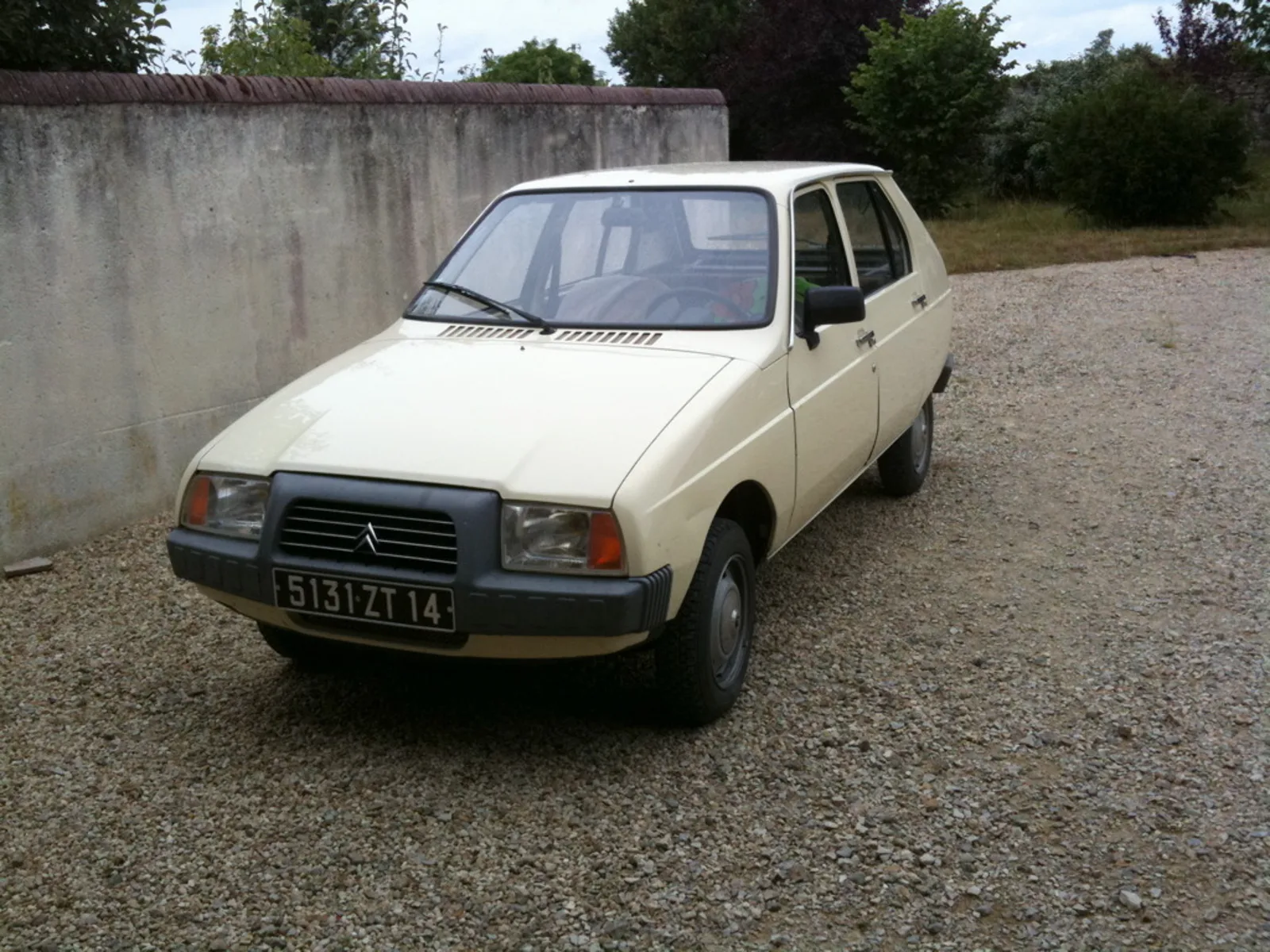
Built from 1978 to 1988 and sharing parts with Peugeot, the Visa sold 1,254,390 cars and spawned Group B rally cars and a four-wheel-drive special.
The Citroen Visa was a supermini built by Citroen from 1978 to 1988, with five-door hatchback and four-door semi-convertible bodies. Citroen built 1,254,390 examples over a single generation. Its rally variants, including the Trophee and Mille Pistes, were among its most notable special models.
The Citroen Visa was a supermini that Citroen built from 1978 to 1988 as a five-door hatchback or four-door semi-convertible. It shared engines and floor pans with Peugeot, which was then linked to Citroen. Its sporting variants, from the GT to the Group B rally cars, gave the small car a reputation far beyond the family run.
Where did the Visa come from?
The story began in 1965, when Robert Opron started work on the Citroen G-mini prototype and project EN101. It was meant to replace the 2CV, using its flat-twin engine, and it was intended to launch in 1970. Those advanced, space-efficient designs were never fully developed, because potential customers gave negative feedback.
Work then shifted to a successor for the Ami, which was still built on the 2CV. The team borrowed lessons from the G-mini and EN101 projects, and it drew on a Fiat 127 floor plan, along with the transverse front-engine, front-wheel-drive configuration Fiat had road-tested in the Autobianchi Primula.
Once Fiat stepped away, Citroen engineered its own platform. Peugeot's acquisition of the company followed the 1974 oil crisis, and the project, renamed Projet VD (Voiture Diminuee), emerged as the Visa with the Peugeot 104 floor pan, engine and transmission underneath. It was the first car to follow the group's platform-sharing approach.
A supermini with a finger-tip dashboard that sold 1,254,390 cars and became a rally legend.
Why does the Visa matter to Citroen?
The Visa gave Citroen a small, modern car at a time when its finances were fragile and its parent group was reshaping its platforms. Its pairing of Peugeot mechanicals with Citroen's suspension thinking showed how the two brands could share costs without losing their character.
Sporting variants and rally programmes helped the car stay in the public eye long after its launch. The Visa proved that a modest small car could be turned into a credible competitor in homologation classes.
What was the Oltcit Club?
A later offshoot of the Project Y work surfaced in 1984 in Romania as the Oltcit Club. It borrowed a Visa flat-twin with a GS-derived gearbox, or the GS flat-four and its transmission. Western European buyers could also get a flat-four-only version under the Citroen Axel name.
The Romanian venture was meant to earn back money Citroen had put into the country, a sum the Romanian government was unable to repay. Quality suffered in the process, and 60,184 cars were eventually built.
Which engines did the Visa use?
From its launch in September 1978, the Visa was offered in Special and Club models with a mapped electronic ignition and a 652 cc two-cylinder engine. The Super E used the 1124 cc Douvrin engine from the PSA X family, a four-cylinder unit with an aluminium alloy block and a chain-driven overhead cam.
The 1124 cc unit was as economical as the 2CV-derived twin, but with much better performance. The flat twin was mounted longitudinally, while the four-cylinder engines sat transversely. Later the Visa offered 1219 cc in the Super X, 954 cc in the 10E from 1984, and 1360 cc in the GT and 14 TRS from 1985.
Citroen's engineers tried hard to improve fuel economy and responsiveness in the original engines. The results were limited, and by the time the 1.4-litre models arrived the engines were taken over from Peugeot without modification.
How did the Visa handle and ride?
The Visa had a soft but well-damped, long-travel, fully independent suspension, with coil-sprung MacPherson struts at the front and coil-sprung trailing arms at the rear. It gave a soft ride similar to the 2CV, but with less extreme body roll, which made it easy to live with day to day.
The ride was one of the car's strongest points, and it sat well with its light steering and compact dimensions. Buyers who wanted the comfort of a larger car in a smaller package found much to like in the Visa.
What did the Visa interior look like?
The driver controls sat in two pods flanking the steering wheel, marketed as PRN Lunule satellites, where P stood for Pluie (rain), R for Route (road) and N for Nuit (night). Wipers, washers, horn, indicators and headlamps were mounted on a cylindrical unit, all within finger-tip reach.
The layout let a driver work the lights, wipers and horn without taking a hand off the wheel. In 1979 Popular Science described the system as a finger-tip control drum. Heating and ventilation controls were on a separate flat pod, with laterally arcing sliders, and the car's heating system could direct air to the face while warming the cabin.
The rear parcel shelf was split into two hinged sections, one in the car and one on the tailgate. That allowed slightly tall objects to fit without removing the shelf, and the tailgate section could be folded up to protect the rear window when carrying larger loads.
What changed with the Visa II facelift?
In March 1981 the Visa received a facelift designed by Heuliez, which kept the original interior and the PRN satellite controls. The car was now called the Visa II. Its curved windscreen allowed a very large single wiper on the long, narrow glass.
In summer 1984, for the 1985 model year, the Visa was updated again with a new dashboard, instruments and switchgear. The turn signals became self-cancelling, which made the Visa the first Citroen fitted with that now near-universal feature.
Was there a Visa convertible?
Heuliez produced a four-door open Visa for Citroen in 1984, sold as the Decapotable. Few cabriolets of that era were built on coach-style bodies like this one, which kept the doors and window frames in place.
Built on the 11RE, the open car weighed more and ran slower than the hatchback, and its price was roughly half as much again. Rival convertibles from Fiat and Ford were priced in a similar way.
Which Visa was the GT?
The GT was the car that showed what the Visa could do with proper tuning. Its engine and chassis changes turned a modest hatchback into something with real presence on a country road. The first mass-produced sport variant was the GT, introduced in 1982. It used the 1360 cc XY engine with two downdraft Weber single-barrel carburettors and produced 80 PS. A lower-power single-carburettor engine was built for Switzerland.
For model year 1983 the Visa GT added alloy wheels with Michelin TRX tyres, spoilers, sideskirts and special colours, along with a more sporting suspension tune than was usual for Citroen. In 1985 a limited-production GT Tonic arrived with a sportier body kit based on the Chrono.
What were the Trophee and Chrono rally cars?
The Trophee arrived in late 1981, built in small batches so that it could qualify under Group B homologation rules. Its 1219 cc XZ unit came from the Super X, but a reworked cylinder head and a pair of side-draft Weber carburettors lifted output to 100 PS (74 kW).
Privateers and dealership teams were the intended buyers. Lighter fibreglass panels, a revised dashboard and Lexan side windows brought the weight down to just under 700 kg. Later rally cars could be enlarged to 1299 cc and reach 140 PS (103 kW).
The Chrono, which followed in 1982, targeted the larger Group B engine class. It shared the GT's 1360 cc XY block but received a bigger valve head and two double-barrel Solex C35 carburettors, giving 93 PS (68 kW). Around 2160 went to French buyers and a further 1600 to the rest of the continent.
What was the Mille Pistes?
The Visa Mille Pistes was a four-wheel-drive version homologated for the Group B B/10 class. The production cars, known as the Visa 1000 Pistes 4x4, numbered 200 and were built for homologation in 1984. Its four-wheel drive gave it grip that the front-drive cars could not match on loose surfaces. They were essentially a 4WD Chrono with twin Weber 40 DCOE carburettors, producing 112 PS (82 kW).
The name came from a Visa 4x4 that won the Mille Pistes rally in the experimental category in 1983, with Wambergue and Laverne driving. Later Evolution models, modified by Denis Mathiot, increased the displacement to 1440 cc, with power between 135 and 140 PS and a weight of 750 kg.
How did the GTi and the diesel perform?
The 1.6 GTi was presented at the 1984 Paris Salon for model year 1985. It used the fuel-injected 1.6-litre XU5J engine and transmission from the Peugeot 205 GTI, in 105 or 115 PS (77 or 85 kW) versions. Plastic wheel-arch extensions covered the wider track it needed.
The GTi earned good reviews for ride, performance and roadholding. Journalists were largely positive about its handling, which set it apart from the rest of the range. It was not a big seller, partly because its facelift looks had aged and it had five doors. The diesel version, the 17D and 17RD, used the 1769 cc XUD from the Peugeot 205, which needed extended front wings with large black plastic arch panels.
How was the Visa built in China?
The Chinese story started in 1991, when Liuzhou Wuling put together Visas from European kits. The resulting LZW 7100 was built in modest quantities until 1994, and official registrations stood at 901 against 1,314 examples actually produced.
The kits used Visa diesel bodywork and were sent complete, apart from engines. Wuling did not have a licence to assemble cars, so the Chinese government halted sales and left the company with unsold stock. Some of those cars were still in storage as late as 1997. Its three-cylinder 1-litre 376Q engine came from the Daihatsu-derived unit made by the Tianjin factory, producing 48 PS (35.3 kW) and enough for a respectable top speed.
When did production end?
The Visa went out of production late in 1988, in the same season that the five-door Citroen AX went on sale. The AX took on the job of carrying Citroen's supermini line forward.
The C15 van, which was a box van variant of the Visa, was marketed from 1985 to 2005 and outlived the car it came from by many years. That longevity is a quiet footnote to the Visa story.
Frequently asked questions
How many Citroen Visas were built?
A total of 1,254,390 examples were manufactured over a single generation, with one facelift in 1981. The car was produced in both petrol and diesel variants.
What was the Visa Trophee?
The Trophee was a Group B rally car built in late 1981 for homologation. It used the 1219 cc XZ engine to produce 100 PS (74 kW), and it weighed just under 700 kg.
Was there an automatic Visa?
No automatic gearbox version was produced. The Visa was offered with manual transmissions across the range.
When did the Visa stop production?
Output stopped late in 1988, just before the five-door AX reached showrooms. The box van variant, the C15, continued to be marketed until 2005.