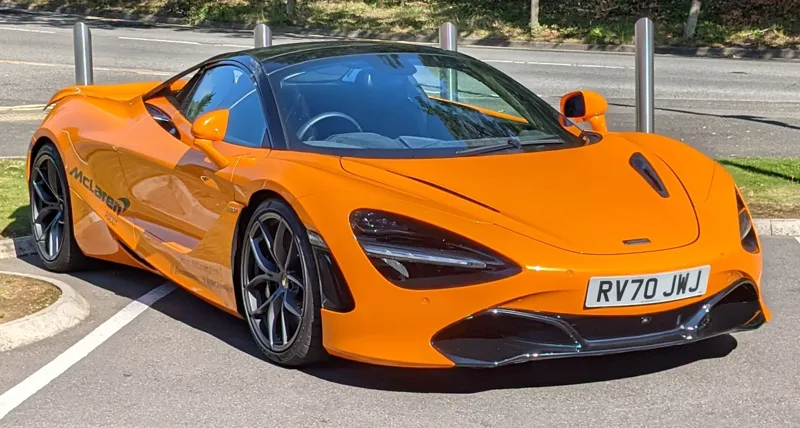
A carbon MonoCell, a twin-turbo V8 and a purpose-built factory in Woking marked McLaren's return to selling production cars after the F1.
The McLaren MP4-12C, later the 12C, was a carbon-structured sports car built in Woking from 2011 to 2014. It came as a coupe and a Spider, used a 3.8-litre twin-turbo V8 and ended with more than 3,400 units built before the 650S succeeded it.
McLaren's return to selling production cars came with the MP4-12C, a two-door coupe with a carbon MonoCell and a mid-mounted turbocharged V8. The car arrived in 2011, was rebranded as the 12C the following year and later gained a retractable hardtop Spider. It was a deliberate attempt to put a racing company's engineering into a road car that owners could live with.
Development began in 2005 and the car made its online debut in September 2009. McLaren began series manufacture at its Woking plant in February 2011, and the Spider followed in July 2012. Each stage of that timeline shows how carefully the company planned its first full production model.
Why did McLaren return to road cars with the MP4-12C?
McLaren had not sold a production car since the F1 ended in 1998, so the MP4-12C marked the company's return to road sales. Work on the car started in 2005, and the Woking factory was funded with a GBP 50 million investment. Production ran from 2011 to 2014 before the 650S took over the line.
The Woking facility could build approximately 4,000 cars a year, a capacity that was planned from the outset. Prime minister David Cameron opened the building on 18 November 2011, a public sign of how much the project mattered to British manufacturing. The 650S later shared most of its components with the 12C, which kept the design family intact.
For buyers, the attraction was a supercar designed from the ground up by a racing company rather than adapted from another maker's platform.
A carbon MonoCell, a 616 PS twin-turbo V8 and a Woking factory built McLaren's road return.
Where did the name MP4-12C come from?
The MP4 prefix came from McLaren's Formula One team, which had used it as a chassis designation since 1981. It stood for McLaren Project 4. The 12 referred to the company's Vehicle Performance index, and the C signified a carbon structure. McLaren dropped the MP4 part of the name in 2012.
The name carried a racing lineage onto the road, even though the car was built as a production sports car. Each part of the badge told buyers something about how the car was assessed, from its power and weight to its construction method.
How was the 12C tested before launch?
McLaren built over fifty experimental prototypes to test heat management and performance. Testing took place in Bahrain, Arizona, Nevada, the Arctic and Sweden, among other places. Development bases at Idiada and Nardo ran some sessions for 24 hours at a time.
The first mule, MV1, was a modified Ferrari 360 with a 3.8-litre V8. A second mule, MV2, was a modified Ultima GTR used for braking tests. The in-house CP1 and CP2 cars used a MonoCell monocoque for heat tests.
Each stage of that programme tested one part of the package, from the chassis to the cooling. The results fed back into the final car, which is why the production model carried features that first appeared on the prototypes.
How was the MonoCell made?
The MonoCell is a carbon fibre structure that reduced weight and raised stiffness. Carbo Tech in Salzburg, Austria built it, and each structure weighs 80 kilograms (176 lb). McLaren invested GBP 127.7 million in the process, which cut production time to four hours per structure.
Earlier monocoques took far longer to make. The F1 needed 3,000 hours and the SLR needed 500 hours, against four hours for the 12C. That gap was the main argument for carbon in a series-produced car, because it made the process fast enough for regular production.
The work created approximately 100 new jobs, both in building the new facility and in producing the monocoque itself. Carbo Tech supplied MonoCells for over eight years, and the arrangement was described as the largest carbon fibre order for series-produced cars.
Who styled the 12C and when was it shown?
Frank Stephenson was appointed lead design director in 2008 and made small changes to the headlights, bumper and interior. The design was unveiled online in September 2009, and it made its physical debut at the Goodwood Festival of Speed in July 2010.
The Goodwood appearance gave the public its first look at the car before series manufacture began in February 2011. Stephenson's changes were modest, and they sat on top of a structure that had already been settled.
What engine did the 12C use?
The 12C used a 3.8-litre twin-turbocharged V8 codenamed M838T, built by Ricardo PLC in West Sussex. It produced 453 kilowatts (616 PS) at 7,500 rpm and 601 newton-metres (443 lb ft) at 3,000 rpm. The engine drove the rear wheels through a seven-speed dual-clutch gearbox.
Power was also quoted as 607 bhp in some sources, which shows how the figures varied between markets. Whatever unit is used, the car was rated at 0-97 km/h (0-60 mph) in 2.9 seconds and reached a top speed of 333 km/h (207 mph). The engine sat behind the cabin in a longitudinal mid-engine layout.
How was the 12C suspended and steered?
The chassis used double wishbone suspension and a hydraulic system called ProActive Chassis Control. The steering was hydraulically assisted, but the pump was electric rather than driven from the engine. The front brakes used four-piston fixed calipers paired with two-piece rotors.
Wheels were 19-inch at the front and 20-inch at the rear. The cabin centred on a seven-inch touchscreen that controls the Meridian entertainment system. The dihedral doors gave the car its distinctive entry and exit.
How did the Spider change the coupe?
The Spider is the convertible version, with a retractable hardtop and only 40 kg (88 lb) of added weight over the coupe. It reaches 328 km/h (204 mph) with the roof up, compared with 333 km/h (207 mph) for the coupe, and 315 km/h (196 mph) with the roof down.
The Spider kept the dihedral doors of the coupe. Its roof mechanism was the main visible difference, and the car was otherwise built around the same carbon structure and drivetrain.
What made the 12C HS different?
The HS, short for High Sport, was shown in March 2012 with more power, revised aerodynamics and different wheels. McLaren added 75 horsepower and built only 10 units, borrowing the aero thinking of the 12C GT3 racer.
The HS looked more aggressive than the standard car, and its styling followed the racing machine closely. Its limited run of 10 units made it one of the rarest variants in the family.
What happened when HS cars reached auction?
A 12C HS painted in F1 Vodafone colours was offered in January 2016 with an estimate of $1,300,000 to $1,600,000, and it did not sell. The same car returned in January 2017 with a lower estimate of $950,000 to $1,200,000 and again failed to sell.
Both attempts ended without a sale, so the figures remain estimates rather than confirmed prices. Its scarcity, with only 10 units built, was a central part of its appeal to collectors.
How did the 12C perform on Top Gear's test track?
On 10 July 2011 the MP4-12C set the second-fastest lap at Top Gear's test track, with a time of 1 minute and 16.2 seconds. It was 1.1 seconds slower than the Ariel Atom 500 and 2.4 seconds behind the Pagani Huayra. It also lapped the Nurburgring in 7 minutes and 28 seconds.
The car collected awards as well. It won the Middle East Best Supercar award in 2012 and took the overall Car of the Year honour that year. Those results gave the car credibility in a market where prestige matters.
How did the GT3 racer perform?
McLaren announced the GT3 programme in December 2010, and racing began in 2012 with the CRS Racing team. It readied 25 cars for the 2012 FIA GT1 World Championship. The racer produced 493 bhp (368 kW; 500 PS), less than the road car's output.
The car was the first McLaren sportscar racer since the F1 GTR. A bespoke six-speed gearbox, 80 kg lighter than the road car's seven-speed, was fitted to the racer. The first world victories came at the Circuito de Navarra round of the 2012 championship.
The programme began earlier than the championship. The first outings included a three-car entry at the 2011 Spa 24 Hours, and Danny Watts drove another car in the 2011 Macau GT cup.
What came after the 12C?
The 650S succeeded the 12C and shares most of its components with it. The two cars were therefore closely related, and the 650S is best seen as a refined version of the same engineering rather than a clean break. Production of the 12C ended in April 2014 after more than 3,400 units were made.
The 12C therefore set the template for the cars that followed it, even though each new model brought its own detail changes.
What was the McLaren X-1?
The X-1 was a one-off built by McLaren Special Operations on the 12C platform and shown at Pebble Beach in 2012. The project had been under development for three years. Its styling drew on the 1961 Facel Vega, the 1953 Chrysler D'Elegance Ghia and the 1959 Buick Electra.
The X-1 was a design exercise rather than a production plan. Its influences came from older grand tourers, which gave the car a retro shape on a modern carbon base. That mix made it a rare case of a concept built on a production platform.
Specifications at a glance
The table below collects the core figures for the coupe and the main variants. Where a value belongs to a single version, the table names that version so the figures stay separate.
| Specification | Detail |
|---|---|
| Production | 2011 to 2014; more than 3,400 units |
| Engine | 3.8-litre twin-turbocharged V8, M838T |
| Power | 453 kilowatts (616 PS) at 7,500 rpm |
| Torque | 601 newton-metres (443 lb ft) at 3,000 rpm |
| Transmission | Seven-speed dual-clutch, SSG |
| 0-97 km/h (0-60 mph) | 2.9 seconds |
| Top speed | 333 km/h (207 mph) coupe; 328 km/h (204 mph) Spider roof up |
| Fuel economy | 279 grams per kilometre; about 12.7 L/100 km (22.2 mpg-imp) |
| Structure | MonoCell carbon fibre, 80 kilograms (176 lb) |
| Wheels | 19-inch front, 20-inch rear |
| HS version | 75 horsepower more; 10 units made |
| Successor | 650S |
Frequently asked questions
How many MP4-12C cars were made?
More than 3,400 were manufactured before production ended in April 2014. The Woking plant could build approximately 4,000 cars annually, so the factory had room beyond the actual output. The car was then succeeded by the 650S, which shares most of its components.
Was there a convertible version?
Yes. The Spider has a retractable hardtop and weighs only 40 kg (88 lb) more than the coupe. Its top speed is 328 km/h (204 mph) with the roof up.
What did the 12C HS add?
The HS gained 75 horsepower over the standard car, and only 10 were made. Its aero drew on the GT3 racer, giving the variant a more aggressive look. An HS was offered at auction in 2016 and again in 2017, and neither offer found a buyer.
Did the 12C win any awards?
In 2012 it was named Best Supercar at Middle East awards, and it also took the overall Car of the Year title. The recognition came shortly after the car went into series production, and it helped the 12C build its reputation in the region.