Launched in 1988 on a stretched Cedric/Gloria chassis, the Cima rode Japan's bubble economy to fame, crossed the Pacific as the Infiniti Q45, and was cancelled, revived and cancelled again.
The Nissan Cima is a Japanese luxury sedan launched in 1988 as a larger, more luxurious version of the Cedric and Gloria. It crossed the Pacific under a different badge for three of its five generations, becoming a symbol of Japan's bubble economy before Nissan finally retired it in 2022.
The Nissan Cima arrived in 1988 as a stretched, more luxurious Cedric and Gloria, rode Japan's bubble economy to sales success, and went on to live three separate lives as the export-market Infiniti Q45 before Nissan cancelled and revived it twice more.
What is the Nissan Cima?
The Cima is a Japanese luxury sedan that Nissan built across five separate generations in total, sold internationally under the Infiniti Q45 badge for three of those five. Its name actually comes from the Spanish word for 'summit' or 'top', a genuinely fitting tag for a car positioned well above the Cedric and Gloria it was based on.
Early cars carried an acanthus-leaf hood ornament, the same leaf motif that gave the Nissan Laurel its name, and one with a pointed meaning: classical Greeks used the acanthus leaf to weave a ceremonial wreath or crown, a quiet dig at the Cima's chief domestic rival, the Toyota Crown. The Cima also shared its V8 with Nissan's grander flagship, the President, Nissan's own answer to the Toyota Century.
The turbocharged version was so popular during the booming bubble economy that the Japanese media coined the phrase 'the Cima phenomenon'.
Where did the Cima's name and styling come from?
The Cima was introduced in 1988 on an elongated Cedric/Gloria chassis, created partly in response to rumours that Toyota was developing a wider, larger Crown variant called the 4000 Royal Saloon G.
Nissan could not get its own wider body ready in time for the all-new Y31 Cedric and Gloria's June 1987 launch, so the Cima arrived half a year later instead, announced in September 1987 and unveiled at the Tokyo Motor Show that October alongside the MID4-II concept, with sales starting in January 1988. That gap gave Nissan time to improve on the recently launched, performance-oriented Gran Turismo trim and to fold in gains from Project 901, the company's broader technical renewal programme running at the time. Later generations shared the President's own platform rather than the smaller Cedric/Gloria, with Cima built as the shorter version, a clever bit of platform-sharing that let Nissan keep selling it through Nissan Prince Store outlets. Size itself had already been a battleground before Cima existed at all: pre-1989 Japanese tax rules drew a hard line at 4,700 mm (185.0 in) long and 1,700 mm (66.9 in) wide before a 2-litre engine pushed a car into a costlier bracket, and both the Cedric/Gloria and the rival Crown had already been stretched right up to that exact limit, leaving bigger bumpers as the only legal way to look larger without actually growing wider. A 1993 comparison shows the family relationship clearly: the Nissan Store-exclusive President JS rode a 2,880 mm (113.4 in) wheelbase, the ordinary Gloria sat on a shorter 2,760 mm (108.7 in) base, and Cima slotted in between the two.
What was the original Y31 Cima like?
The first Cima came only one way bodywise, a 4-door pillarless hardtop with nothing joining the roof between the front and rear door glass, offered with a choice of two sixes: a 200 PS (147 kW; 197 hp) VG30DE V6, or a punchier 255 PS (188 kW; 252 hp) turbocharged VG30DET that proved so popular during the booming bubble economy that Japanese media coined the phrase 'the Cima phenomenon' around it.
The cabin matched the ambition: genuine lacquer wood inserts throughout, and a choice of Connolly leather or a silk-wool upholstery blend later shared with the flagship President. Top Type III cars could be loaded with an interactive CRT display for climate and audio, built by Fujitsu Ten, paired with a Sony CD changer and a cellular phone tucked into the armrest console, all operated from a stationary control hub at the centre of the steering wheel that stayed upright no matter which way the wheel itself was turned. Underneath sat MacPherson struts up front and semi-trailing arm geometry at both ends, with air-chamber struts available as a Type III option. The Y31 sold 36,400 units in its debut year and 129,000 across the whole generation, through both Nissan Store (as the Cedric Cima) and Nissan Prince Store (as the Gloria Cima) dealership networks.
How did the Y32 and Y33 generations change the Cima?
The redesigned Y32 arrived in August 1991 as a premium trim package sold alongside the Skyline, Gloria and Infiniti Q45 at Nissan Prince Store, initially offered only with the VH41DE V8, a short-stroke version of the President's own V8, alongside a 3.0-litre turbo V6 kept around for its lower road-tax bracket.
The collapse of Japan's asset-price bubble hit sales hard, and Nissan responded by narrowing interior colours to black, grey or tan rather than expanding choice. A September 1992 addition, the Type II Limited S-Four, brought the ATTESA E-TS all-wheel-drive system to the V8 car. Peak power landed at 270 PS (199 kW; 266 hp), arriving at 6,000 rpm, with torque topping out at 371 N.m (274 lb-ft) a little lower down, at 4,400 rpm, while the suspension moved from semi-trailing arm to a multi-link layout shared with the President and the R32 Skyline. Nissan also replaced the previous generation's adjustable air suspension with a new hydraulic Full-Active Suspension, shared with the contemporary US-market Q45 and the President. The all-new Y33, unveiled June 1996, swapped Japanese trim names for European-style alphanumeric badges built around engine size: 41LX, 41LV, 41L, 30LV and 30L sedans, plus sportier Grand Touring grades badged 41TR-X, 30TR and 30T, with the range-topping 41LX and 41LV adding a VIP package built around chauffeur-driven service. From 1997, all-wheel drive became available on the 41LV too, earning it the familiar 'S-Four' badge, and for the first time sold overseas directly as the second-generation Infiniti Q45; when Japan's own Q45 was discontinued in August 1997, the Cima simply took over as its de facto domestic replacement.
Nissan Cima generations at a glance
Five generations spanned over three decades, each one tied closely to either the Cedric/Gloria or the President underneath.
| Generation | Launched | Headline engine | Notes |
|---|---|---|---|
| Y31 | 1988 | 200 PS V6 / 255 PS turbo V6 | 'The Cima phenomenon'; 129,000 sold |
| Y32 | 1991 | VH41DE V8 / turbo V6 | Bubble collapse cut sales |
| Y33 | 1996 | VH41DE V8 / VQ30DET V6 | Became JDM Infiniti Q45 replacement |
| F50 | 2001 | VK45DD V8, 280 PS JDM / 340 hp US | 7-reflector headlights; lane-departure warning |
| Revived Cima | 2012-2022 | Fuga Hybrid-based | Cancelled, restarted, then ended for good |
By 1999 the Cima had also moved dealership networks again, shifting to the reorganised Nissan Red Stage outlets alongside the Skyline, while the President moved to the new Nissan Blue Stage network, formalising a split that had been building since the Y33's launch.
How did the Cima become the Infiniti Q45?
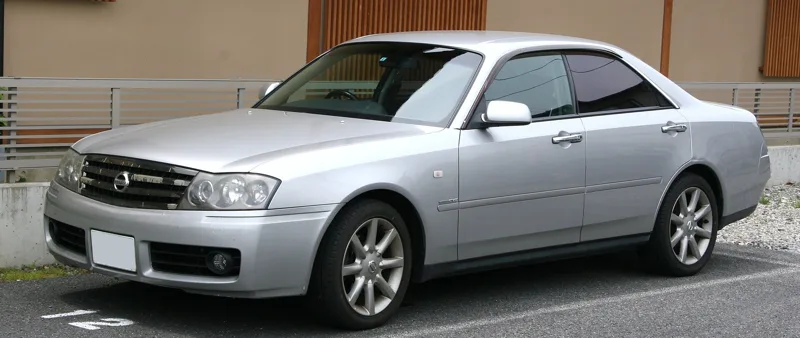
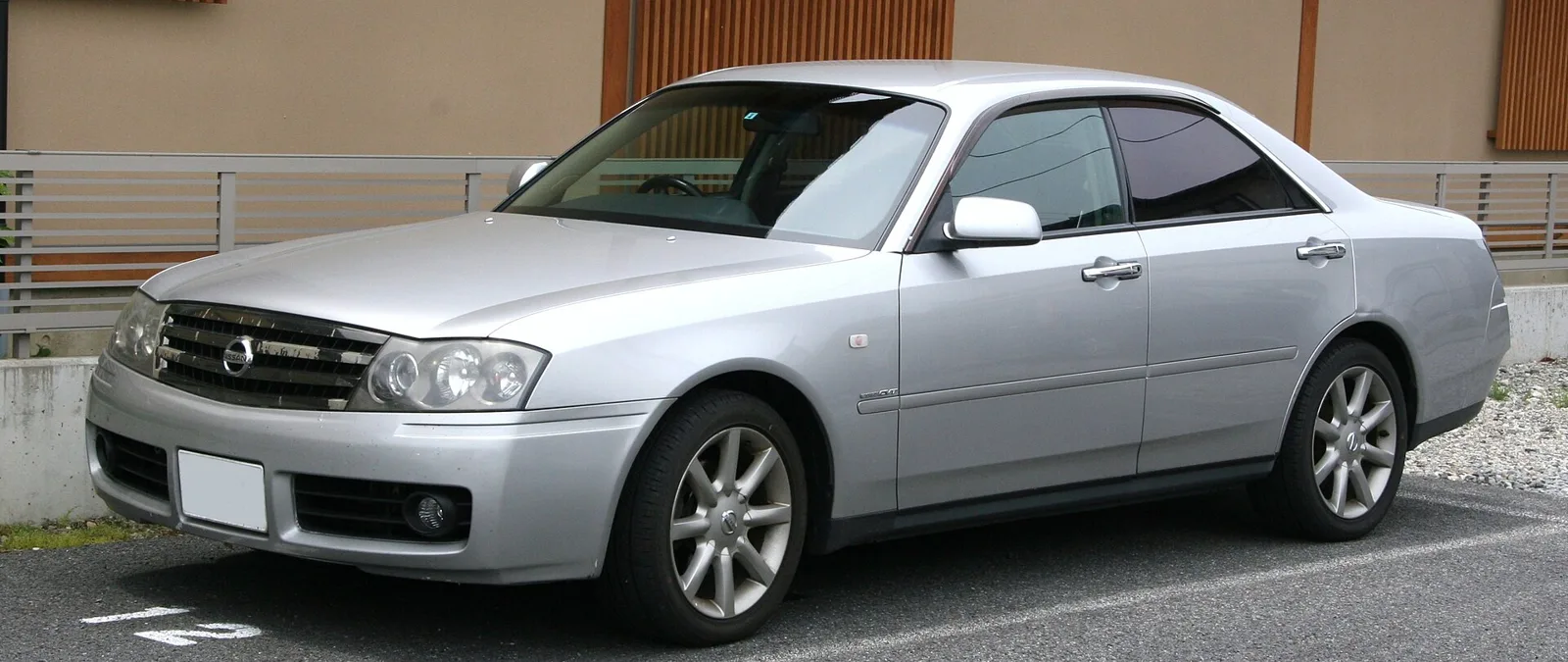
Unlike the Japan-only first two generations, the Y33 onward was marketed abroad as the Infiniti Q45, and the fourth-generation F50, launched January 2001 early in the Nissan Revival Plan, continued that export role with a JDM VK45DD V8 making 280 PS (206 kW) and a US-market Infiniti version of the same engine tuned to 340 hp (254 kW; 345 PS). Japanese buyers picked between 450VIP, 450XV Limited, 450XV, 450XL and 300G in rear-wheel-drive form, or 450VIP Four and 450X Four whenever all-wheel drive mattered more than outright trim level.
The F50 competed directly with the Toyota Crown Majesta, and over a three-year window it also squared off against the Japan-only Mitsubishi Proudia, a rival that stuck stubbornly with front-wheel drive rather than Cima's rear- or all-wheel-drive layout. A left-hand-drive F50 even appeared at the Shanghai Auto Show in April 2003 as Nissan tested Chinese market interest, though tightening emissions rules ended the turbocharged V6 option from July 2005. US Q45 exports stopped after the 2006 model year, and in August 2010 Nissan ended production of both the Cima and the closely related President, which had shared the same chassis throughout the F50's run.
What safety and technology firsts did the Cima introduce?
The Cima collected a genuinely striking list of industry firsts along the way. The Y33 became Japan's first production car with standard side airbags and, in 1999, gave Nissan its first laser adaptive cruise control.
The F50 went further still: its 450XV Limited trim was the first car anywhere in the world to offer lane departure warning using CCD cameras to read painted road markings, and from August 2003 Nissan added Intelligent Brake Assist, front-seat emergency pre-crash seatbelt sensing, and Active AFS, which automatically switched xenon headlights between low and high beam. Navigation kept pace too, moving from Nissan's disc-based Compass Link telematics system, introduced alongside the Y33, to the renamed CarWings system standard across every F50 grade from February 2002, alongside a Bose sound system offered from June 2002.
Why did Nissan keep cancelling and reviving the Cima?
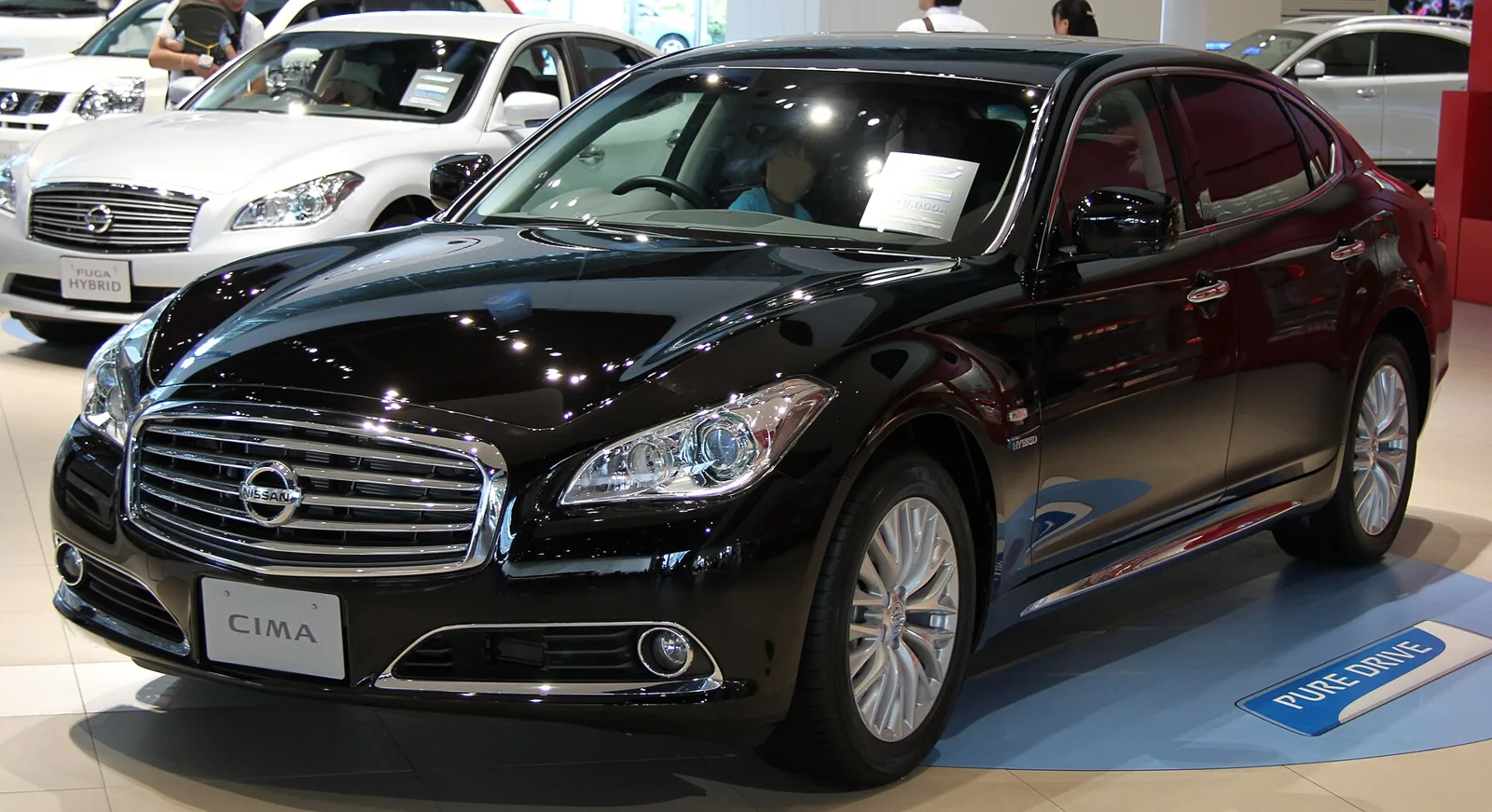
The Cima nameplate returned in April 2012, stretched onto a Fuga Hybrid body with extra wheelbase added, resuming flagship status in Japan once the Fuga itself had taken over from the discontinued Q45 internationally.
That particular revival, in the end, did not last cleanly at all. In January 2021, not so very long after that relaunch at all, Nissan was already being reported as considering cancelling the Cima a second time, after production had already paused at the end of 2020, even as the Japanese Nissan website kept listing it as available to order with a hybrid powertrain across three trim levels. Production nonetheless restarted again at Nissan's Tochigi plant in October 2021, only for the Cima to be discontinued for a third and genuinely final time in 2022, leaving the Skyline as the sole sedan remaining in Nissan's Japanese lineup, a quiet, almost anonymous end for a nameplate that had once defined an entire economic era in the public imagination, from bubble-era excess through to a long, patient wind-down most ordinary buyers barely noticed.
What happened to one owner's Cima after decades on the road?
Japanese actress Kazue Ito bought her Y31 Cima at the age of just 24 and simply never gave it up afterward, driving it on and on, past 250,000 km (155,342.8 mi), across the many decades that followed.
Rather than let a loyal customer's car fade away quietly, Nissan offered instead to restore it completely, replacing every worn part at no cost to her across an eight-month process that ran from April through to 7 December 2021, treating a privately owned, three-decade-old sedan with the same care the factory would give a concours restoration. The finished car was presented back to her at Nissan's Ginza showroom in Tokyo, with the handover timed to coincide with her birthday and announced in a Nissan press release the same day. The restoration reportedly cost more than the Cima's original 1990 price of 5 million yen, around US$44,000 at the time, a small, almost sentimental postscript to a car whose much bigger story had already been written decades earlier, in bubble-era sales charts, a decade of safety firsts, and three full generations spent wearing an Infiniti badge overseas.