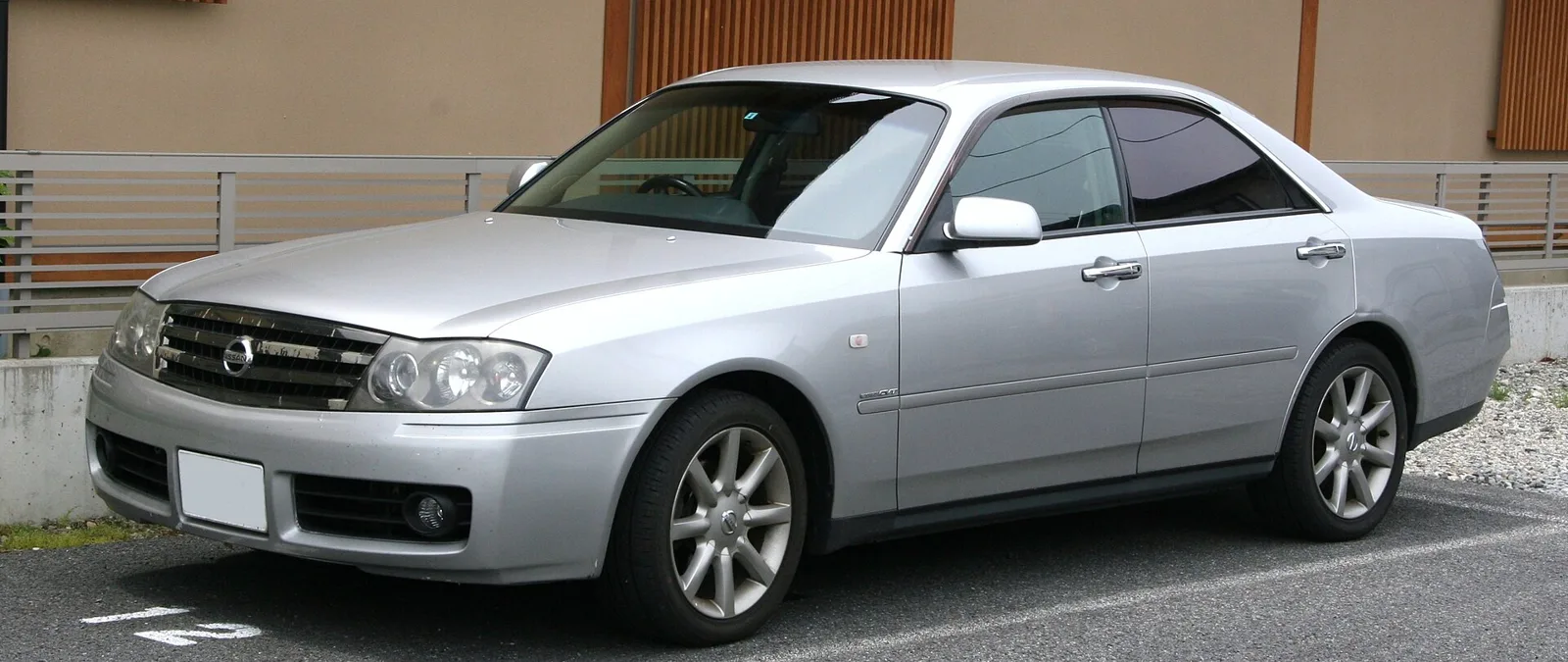
Born at Prince Motor Company in 1959, the Gloria survived the Nissan merger, shared a body with the Cedric and ended production after 46 years.
Prince first sold the Gloria in February 1959 as a luxury version of the Skyline. After Nissan absorbed Prince, the car was shared with the Cedric from 1971, and production ended in 2004 after 46 years, when the Fuga took over.
The Nissan Gloria is a large luxury car that began life in 1959 at the Prince Motor Company, a firm later absorbed by Nissan. It started as a more luxurious version of the Prince Skyline and was later merged with the Nissan Cedric. Production ran for 46 years, and the Gloria was replaced by the Nissan Fuga in October 2004.
Where did the Gloria come from?
Prince presented a more luxurious version of its Skyline at the All Japan Automobile Show in October 1958, with modified exterior sheet metal. The Gloria, as it became known, went on sale in February 1959 with an 80 PS (59 kW) 1.9-litre engine. Its name was inspired by the Latin word for glory.
Prince had previously been known as Fuji Precision Industry, and it became the official vehicle supplier to the Imperial Household Agency. In April 1959 the first Gloria was presented to Crown Prince Akihito as a wedding gift, and the car is said to have been named as a tribute to the royal couple.
After Nissan took over Prince's operations, the Gloria was sold with the Nissan Skyline through the Nissan Prince Shop network. Those dealers had previously been affiliated with Prince, and the Prince G engine remained in the Gloria until 1969.
A Prince luxury car that survived the merger, shared a body with the Cedric and ended after 46 years.
What did the first Gloria look like?
The first Gloria borrowed North American styling cues. Its front bumper had Dagmar bumpers, and the grille carried PRINCE in individual gold letters. The car was based on the Skyline's dashboard, but a clock and radio were standard, and the radio had two speakers, which was a new idea at the time.
The side trim resembled the Skyline's, except that the chrome-framed painted strip ended at the rear door. Inside, the seats were trimmed in plush cloth, and the rear seat had a fold-down armrest. The car used double wishbones and coil springs at the front, with a De Dion arrangement at the rear.
In February 1960 the BLSIP-2 arrived with quad headlights and a grille that used six thick horizontal bars in place of 13 thin ones. Its tail fins echoed the 1957 Chevrolet, and the tail lights sat low, just above the rear bumper.
How did the Gloria grow in the 1960s?
The second generation, the S40, arrived in 1962 as the first six-cylinder Prince. It also kept an updated 1.9-litre straight-four, the G-2, producing 94 hp (70 kW). In June 1963 Prince introduced the G-7, the first mass-produced Japanese SOHC six-cylinder engine, which was fitted to the Gloria Super 6.
The G-7 produced 106 PS SAE (78 kW) at 5,400 rpm. The Gloria used independent front suspension with a de Dion tube at the back, and the car was sold in Finland from April 1965. A 2.5-litre G-11 engine was presented at the 1962 Japan show, and in May 1964 it appeared in the Grand Gloria S44P.
The Grand Gloria, with electric power windows and 130 PS (96 kW), was the first Gloria no longer classed as a compact sedan under Japanese rules, because its engine exceeded two litres. The G7B-R engine also won the T-VI class at the second Japan Grand Prix, installed in a lighter Skyline.
Why did the Gloria become a Nissan?
Prince merged with Nissan in 1966, and the S41-2 series that year carried the new badges. Non-Asian markets sold the car as the Prince B200, and the export Super Gloria was the Prince B250. Some European markets used the PMC-Mikado Gloria 6 name, and many cars carried a small Nissan badge on the back.
The Gloria was also the first Prince to be assembled outside Japan. In New Zealand, Croyden Motors contracted Steel Brothers Addington to build an initial 300 units from CKD kits, at a new factory built for 1,000 units.
The third generation, the A30, arrived in April 1967 with a restyle that used stacked headlights and a side profile influenced by the Ford Galaxie. Nissan also used the Prince team to design the Nissan Prince Royal for the Imperial Household, and the Gloria took on some of its cues.
How did the Gloria and Cedric become one car?
The Gloria and Cedric were merged to save production costs, and from the third generation onward the Gloria's rear axle was downgraded from a De Dion setup to a solid axle on leaf springs. The first A30 sedan had Prince's G7 six, while the four-cylinder version used Nissan's H20. In November 1969 the six was swapped for Nissan's L20.
From February 1971 the fourth generation, the 230, made the Cedric and Gloria essentially the same vehicle, with the Gloria the more upscale of the two. Its hood ornament was a stylised Japanese paper crane, and its styling followed the coke-bottle look shared with other 1970s Nissans. The SD20 diesel was the first diesel ever offered in a Gloria.
The fifth generation, the 330, arrived in 1975 and was shared with the Cedric almost completely. It brought halogen headlights, a two-door and four-door hardtop, and a four-door sedan. Its six was enlarged to 2.8 litres, and the SD22 2.2-litre diesel arrived in June 1977 as another first for the Gloria.
What changed with the sixth-generation Gloria?
The sixth generation, the 430, was redesigned in June 1979 with help from Pininfarina. It had a simpler look and four sealed beam headlight units in place of the single halogen units. The two-door hardtop was discontinued and replaced by the Nissan Leopard, a luxury sports coupe.
The trims ran from the Brougham and SGL Extra down to the Standard, with the Jack Nicklaus edition and the Turbo S in between. The first turbo L20ET arrived in December 1979, and the LD28 six-cylinder diesel joined in October that year. A Turbo Brougham followed in April 1980.
To avoid confusion with the Cedric, the two cars were given different grilles from 1979, with vertical bars for the Cedric and a horizontal grille for the Gloria. The April 1981 facelift changed the grille, headlamps and tail lamps.
Why did the seventh-generation Gloria matter?
The seventh generation, the Y30, received a major restyle on June 22, 1983. It introduced the VG series engine, the first mass-production V6 built in Japan. The VG20ET was turbocharged, which kept the car within the compact tax band, and the twin-carburettor CA20S four powered the lowest-specification cars.
The 3-litre VG30ET turbo V6 arrived in June 1984, and the Brougham VIP became the top model. The Jack Nicklaus special edition was a sales success and was offered only as a hardtop with the turbo engine.
In June 1985 Nissan added a self-levelling rear suspension and a Super Sonic Suspension system. A sonar module under the front bumper scanned the road surface and adjusted the MacPherson struts, with an Auto, Soft, Medium and Hard switch by the steering wheel. PIN-activated keyless entry also appeared on the front door handles.
How did export Glorias differ?
Export versions usually had the diesel sixes or the three-litre engines, and some used a 2.3-litre SD23 four producing 74 PS (54 kW). The fuel-injected three-litre claimed 166 PS SAE (122 kW) in export, against 180 PS JIS (132 kW) in Japan, while the Middle East received a carbureted VG30S with 148 PS (109 kW) at 4,800 rpm.
The Gloria was also assembled in New Zealand by Steel Brothers, where 900 Prince and Nissan Glorias were built in total. That volume matched an annual low-volume import licence of 300 CKD units under the government policy of the time.
What did the eighth and ninth generations bring?
The Y31 sedan arrived in 1987, and the Y30 hardtop was replaced by the Y32. The VG20DET became Nissan's first DOHC engine, developed under Project 901. Trims included Standard, Custom, Super Custom, Classic, Classic SV, Gran Turismo and Brougham VIP, and Autech built a long-wheelbase Royal Limousine.
The Gran Turismo SV had short bumpers and a body kit, powered by the turbo twin-cam VG20DET. The rear suspension moved to a multi-link independent layout, and the Gloria was mechanically related to the Crew. In June 1998 the sedan gained double airbags on private cars, and the facelifted Y31 was discontinued in July 1999.
The ninth generation, the Y32, arrived in June 1991 as a sedan only, with a centre B pillar added to improve crash worthiness. Its top model was the Gran Turismo ULTIMA. Sales fell as the Nissan Cima grew more popular, and the Gloria's totals fell short of earlier generations.
How did the final Gloria generations end?
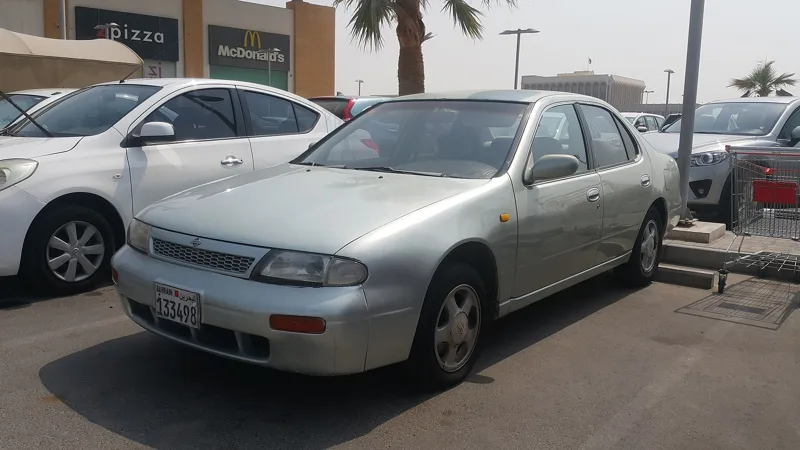
The tenth generation, the Y33, received a full restyle in June 1995. It brought the VQ engine series in place of the VG, including a top VQ30DET turbo with an intercooler, and the first optional four-wheel drive, which used the RB25DET engine and Nissan's ATTESA E-TS system.
In the Gulf Cooperation Council market the Gloria was sold alongside the Infiniti Q45 from late 1996 as the Al Safwa Class, with a 3.0-litre VQ30DE V6. Sales ended after 2000 without a direct successor.
The eleventh and final generation, the Y34, arrived in June 1999 with design assistance from Porsche. Direct injection was introduced on all engines, and the top 300 ULTIMA-Z and 300 ULTIMA-ZV were offered only with a CVT. On 7 January 2000 Autech released a 40th anniversary edition.
Production ended after 46 years, and the nameplate passed to the Fuga line.
What were the key Gloria specifications?
The table highlights the engines and milestones that defined the Gloria across its life. Each figure belongs to the generation or market shown, and metric values come first with imperial figures in brackets. Where a value was not available for a generation, the table shows not given.
| Specification | Early Gloria (1959 to 1963) | Mid generations (1963 to 1979) | Late generations (1983 to 1999) |
|---|---|---|---|
| Launch | February 1959, as the Prince Gloria | S40 in 1962; A30 in April 1967 | Y30 in June 1983; Y34 in June 1999 |
| Typical engine | 1.9-litre GB-30 OHV four, 80 PS (59 kW) | G-7 SOHC six, 106 PS SAE (78 kW) | VG series V6; VG30ET turbo 3-litre in June 1984 |
| Top output | GB-4 four, 94 PS (69 kW), from February 1961 | Grand Gloria 2.5-litre, 130 PS (96 kW) | Japanese three-litre, 180 PS JIS (132 kW) |
| Export output | Not given | Not given | Three-litre, 166 PS SAE (122 kW); 155 PS DIN (114 kW) |
| Diesel | Not given | SD20 OHV diesel from the fourth generation | SD22 2.2-litre from June 1977; LD28 six from October 1979 |
| Rear suspension | De Dion arrangement | Solid axle on leaf springs from 1967 | Multi-link independent from the Y31 in 1987 |
| Four-wheel drive | Not given | Not given | Optional from the Y33 in June 1995 |
Frequently asked questions
What replaced the Nissan Gloria?
The Nissan Fuga replaced the Gloria in October 2004, ending a run of 46 years. The Cedric had been merged with the Gloria much earlier, but both lines continued until 2004.
Why was the Gloria called Prince Gloria at first?
The car was built by the Prince Motor Company before Nissan took over the firm. The Gloria was marketed as Prince Gloria until the merger, and later as Nissan Gloria.
Did the Gloria ever have a diesel engine?
Yes. The SD20 OHV diesel from the fourth generation was the first diesel in a Gloria, and the SD22 2.2-litre followed in June 1977. The LD28 six-cylinder diesel arrived in October 1979.
Was the Gloria sold outside Japan?
Yes. It sold in Finland from April 1965, was assembled in New Zealand from CKD kits, and was sold in the Gulf states as the Al Safwa Class alongside the Infiniti Q45.