From the Prince sedan of 1957 to the R32 GT-R that earned the Godzilla name, with the fourteenth generation due in December 2026.
The Nissan Skyline began in 1957 as a Prince Motor Company luxury car and continued under Nissan after 1966. Its GT-R versions, from the 1969 Hakosuka to the R32 GT-R, made it a racing and cult legend. A fourteenth generation is due in December 2026.
The Nissan Skyline is a Japanese car nameplate that began with the Prince Motor Company in 1957 and carried on under Nissan after the 1966 merger. Its reputation rests on the GT-R versions, which won touring car races and built a cult following. Nissan has teased a fourteenth generation, with a debut planned for December 2026.
Where did the Skyline begin?
The model debuted on 24 April 1957 in Hibiya, Tokyo, at the Takarazuka Theater. Built for Fuji Precision Industries and marketed as a luxury car, it was designed largely by Shinichiro Sakurai, who remained a chief influence on the nameplate until his death in 2011.
The original engine was a 1.5-litre (1,482 cc) GA-30 rated at 60 hp (44 kW) at 4,400 rpm. The car could reach 140 km/h (87 mph) and tipped the scales at around 1,300 kg (2,900 lb), and it rode on a de Dion tube rear suspension. Buyers had a standard car and a Deluxe version to pick from.
The range offered sedans with four doors and wagons with five. The look drew on 1950s American cars, with tail fins, chrome moulding and two-tone paint. Critics compared it to the Simca Ariane, which had been released at the same time in Europe.
The Skyline reached the United States in 1959, but it sold poorly.
A cult nameplate that began as a 1957 Prince sedan and became the GT-R legend.
How did Nissan reshape the Skyline after the 1966 merger?
Prince and Nissan merged in 1966, and the Skyline went on sale with Nissan Prince badging. The third generation, the C10, arrived in August 1968 under the Nissan name and shared its platform with the longer wheelbase Laurel. Nissan placed it above the Bluebird in the range as the sportier choice.
The second generation came before that. The S50 Deluxe launched in September 1963 with the G-1 engine, which made 68 hp or 70 PS (51 kW). The lower-priced Standard model arrived in April 1964, aimed at taxi operators, and it had no bumper overriders, so it measured 11 cm less in length.
The C10 used MacPherson struts at the front and semi-trailing arms at the rear. Its round brake and tail lights gave way to square units with dual lamps on each side, a change that marked the car as a Nissan product rather than a Prince.
Under Nissan the GT models carried the sporting reputation that would later define the nameplate.
What made the Hakosuka GT-R important?
The first GT-R appeared in February 1969 as the PGC10, which fans called Hakosuka. It used the 2.0 L S20 inline six, a DOHC engine that made 119 kW (160 hp) and 133 lb-ft (180 N-m) of torque. The GT-R began life as a sedan, with spare equipment removed to save weight on the track.
The name combines hako, the Japanese word for box, with suka, a short form of Skyline. The S20 was designed by former Prince engineers, and it resembled the GR8 unit that powered the Prince R380 racer, which gave the GT-R a clear racing lineage.
Racing was the point. The sedan won 33 times in less than two years, and the coupe, which debuted in October 1970 and was introduced in March 1971, stretched the tally to 50 wins through 1972. Mazda's RX-3 became the main rival in late 1971 and ended the winning streak after a few more victories.
What was the Kenmeri Skyline?
The C110 was produced from September 1972 to August 1977, and it is known as the Kenmeri after an advertising campaign built around a young couple, Ken and Mary. The ads were highly successful, and the car sold in very large numbers in Japan.
The nickname also played on meriken, an old slang word for American, because the new body resembled American muscle cars of the time. The C110 brought back round tail and brake lights, and those lights became a traditional Skyline feature from that point on.
Emissions control arrived in October 1975 under the NAPS name. The turbocharged GT-EX used the L20ET, the first turbo engine in a Japanese production car. Turbo versions had no intercooler, only an emergency pressure release valve.
A KPGC110 GT-R was built from January to April 1973 after its introduction, but the car did not comply with new emissions laws. Only 197 were sold in Japan, and the GT-R badge stayed absent until the BNR32 arrived in 1989.
Why does the R30 matter?
The R30, launched in August 1981, introduced the 16-valve DOHC FJ20 four-cylinder and a turbocharged FJ20ET. The FJ20 was the first four-cylinder engine from a Japanese maker to use more than two valves per cylinder.
The RS arrived on 2 October 1981 as a lightweight racer with the naturally aspirated FJ20E. It produced 110 kW (150 PS; 148 hp) at 6,000 rpm, with torque of 181 N-m (133 lb-ft) arriving at 4,800 rpm. Its chassis designation was DR30, the official code for all FJ20-powered models.
In February 1983 the 2000RS-Turbo arrived with 140 kW (190 PS; 188 hp). An intercooler followed in 1984, lifting the Turbo C to 205 PS (151 kW; 202 hp).
Australia took the DR30 to the racetrack. George Fury took four rounds in the 1986 series, and the model remains a cult car in Japan, with one-make drag racing events still held there. The R30 is credited with rejuvenating the Skyline brand and paving the way for the return of the GT-R badge.
How did the R32 GT-R earn the Godzilla name?
The R32 GT-R used the RB26DETT twin-turbo inline six, producing 280 PS (206 kW; 276 hp) and 368 N-m (271 lb-ft) of torque. Its success in Australia earned it the nickname Godzilla, after the local press described it as a monster from Japan.
Homologation rules required 16-inch wheels, which limited brake size, and the four-piston calipers were not competitive. Once the rules changed, the V-Spec arrived in February 1993 with 17-inch BBS wheels and larger Brembo calipers, giving the car a far better match to its rivals.
In Japan the R32 won 29 of the 29 races it started in the Japanese Touring Car Championship and took the title every year from 1989 to 1993.
The GT-R joined the Australian series in 1990 and won the Bathurst 1000 in 1991 and 1992. Australia served as the car's first export market, and the name spread quickly from there. Its dominance was so complete that it helped end Group A touring car racing, and the JTCC splintered soon after.
Nismo built the first six R32 GT-Rs in 1989 and 554 more in 1990. Across the generation, 269,554 standard models and 43,937 GT-Rs were built, for a total of 313,491 cars.
What were the R33 and R34 GT-Rs like?
The R33 arrived in August 1993 and was rated 3.8 out of 5.5 for safety. Its GT-R kept the RB26DETT, now rated at 280 PS (206 kW; 276 hp), while torque rose to 375 N-m (277 lb-ft). Super HICAS electric rear steering replaced the older hydraulic system.
The R33 GT-R lapped the Nordschleife in 7 minutes 59 seconds, and it was the first production car reported to break eight minutes there. Its active limited-slip differential was standard on the V-Spec, and the car won in the JGTC GT500 class until the McLaren F1 GTR beat it in its final racing year.
The NISMO 400R followed as a limited edition in 1996. It drew on a Le Mans engine, tuned for the road, to produce 406 PS (298 kW; 400 hp).
The R34 arrived in May 1998, and its GT-R, the BNR34, reappeared in January 1999 with the ATTESA E-TS Pro all-wheel-drive system. Output of the R34 GT-R stopped on 29 August 2002, after 11,578 cars were built from 1999 to 2004.
US import came late. Early R34s arrived under the Show and Display exemption, and the 25-year rule opened the way in January 2024 for the 1999 cars.
How did the V35 change the Skyline?
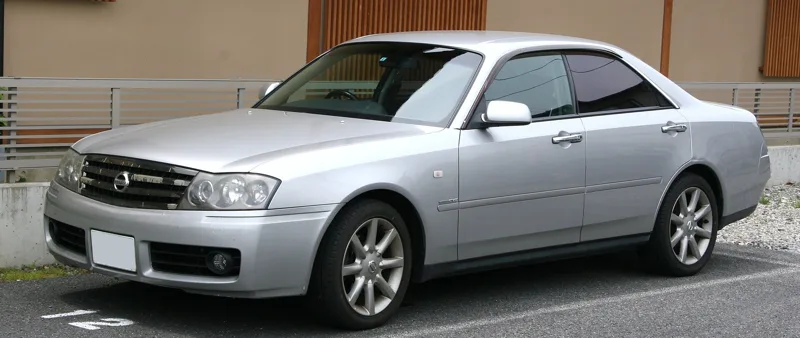
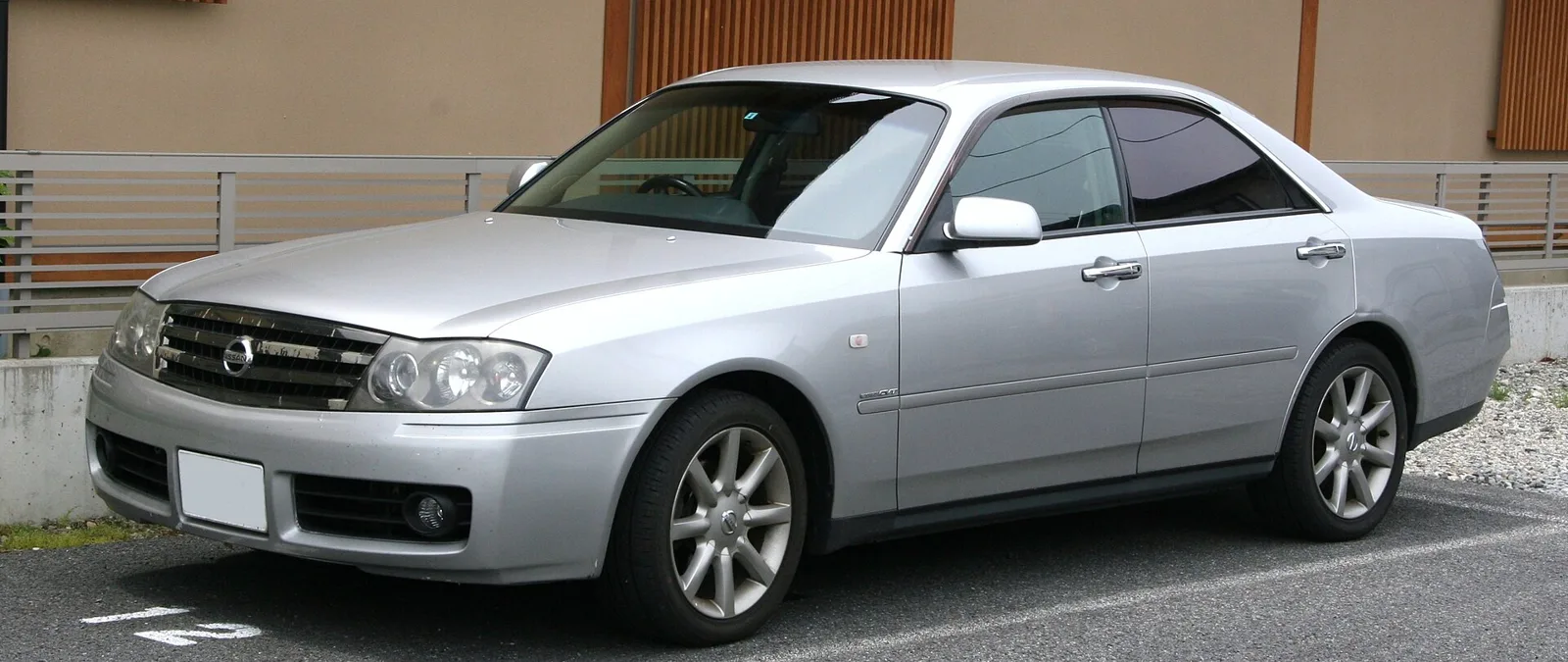
The V35 went on sale on 18 June 2001 on the FM platform shared with the 350Z. It used a front-midship VQ35DE V6 with rear-wheel drive and a 52% front and 48% rear weight split, and it dropped the straight six, the turbocharger and the GT-R version.
Nissan kept the Skyline in the luxury-sport segment once held by the Laurel. The V35 became the first Skyline exported to North America, and it was sold there as the Infiniti G35 from 2002.
Demand in Japan was strong, with 4200 orders recorded by 1 July 2001, only two weeks after launch. Japanese tuners largely ignored the V35.
The V36 was unveiled in November 2006 and sold as the Infiniti G35 in some markets. The 370GT used the 3.7-litre engine, and the 350GT's 3.5-litre engine was discontinued in December 2008. The 370GT became the base for the Infiniti G37 sold abroad.
What is the Skyline's latest story?
The V37, unveiled in November 2013, returned to turbocharging with a 2.0 L Mercedes-Benz M274 engine. Later models offered the VR30DDTT, a 3.0-litre twin-turbo V6, and in Japan the V37 was sold only as a four-door sedan, while the US received a coupe as the Infiniti Q60.
The 2019 update reintroduced the 400R name, with 405 PS (298 kW; 399 hp) from the VR30DDTT engine, and it added the ProPilot 2.0 safety system. The Skyline Nismo was unveiled on 8 August 2023, limited to 1,000 cars, with a Nismo Limited of 100 cars.
The fourteenth generation was teased on 14 April 2026 by a video that set a C10 silhouette against a new Skyline. It will return to four round taillights, and Nissan says generative AI and digital simulation cut its development time to 26 months from 55.
Frequently asked questions
What does Skyline GT-R mean?
GT-R is the high-performance version of the Skyline. The name first appeared on the 1969 PGC10, and it returned on the BNR32 in 1989 after a gap of several years.
Was the Skyline ever sold in the United States?
Yes. Early cars arrived in 1959 and did poorly there. The V35 later brought the nameplate to North America as the Infiniti G35 from 2002.
Why was the R32 GT-R called Godzilla?
The Australian press nicknamed the car after a monster from Japan, following its success in the Australian Touring Car Championship. The name spread quickly across the motoring press.
Is the fourteenth generation confirmed?
Nissan teased the fourteenth-generation Skyline on 14 April 2026, and it has confirmed a debut in December 2026.
What are the key Skyline specifications?
The table lists the figures that define the main Skyline models. Values are taken from the R32 GT-R, R33 GT-R, R34 GT-R and V35 entries, with production totals for the generations where they are known.
| Specification | Detail |
|---|---|
| R32 GT-R engine | 2.6 L RB26DETT twin-turbo inline six |
| R32 GT-R power | 280 PS (206 kW; 276 hp) |
| R32 GT-R torque | 368 N-m (271 lb-ft) |
| R32 GT-R 0-100 km/h (62 mph) | 4.7 seconds |
| R32 GT-R quarter mile | 12.8 seconds |
| R32 generation production | 313,491 cars, including 43,937 GT-Rs |
| R33 GT-R torque | 375 N-m (277 lb-ft) |
| R34 GT-R production | 11,578 cars, 1999 to 2004 |
| V35 weight split | 52% front, 48% rear |
| Fourteenth generation development | 26 months, down from 55 months |