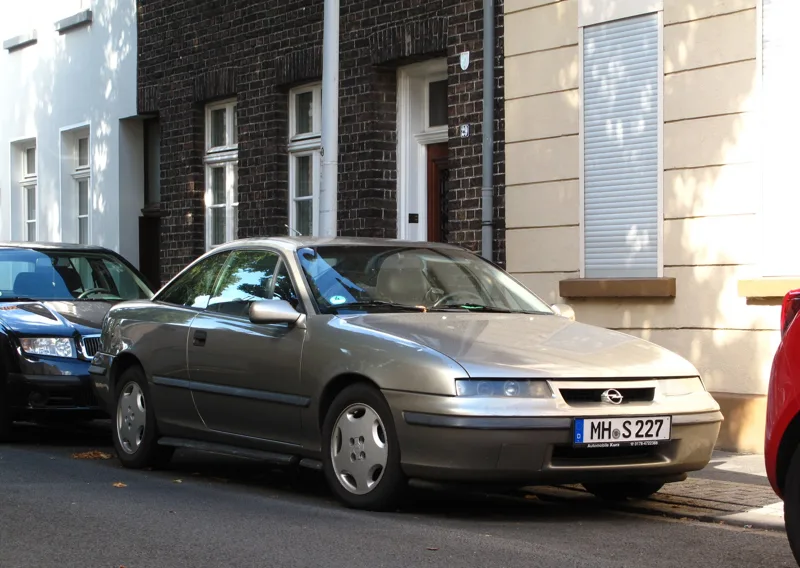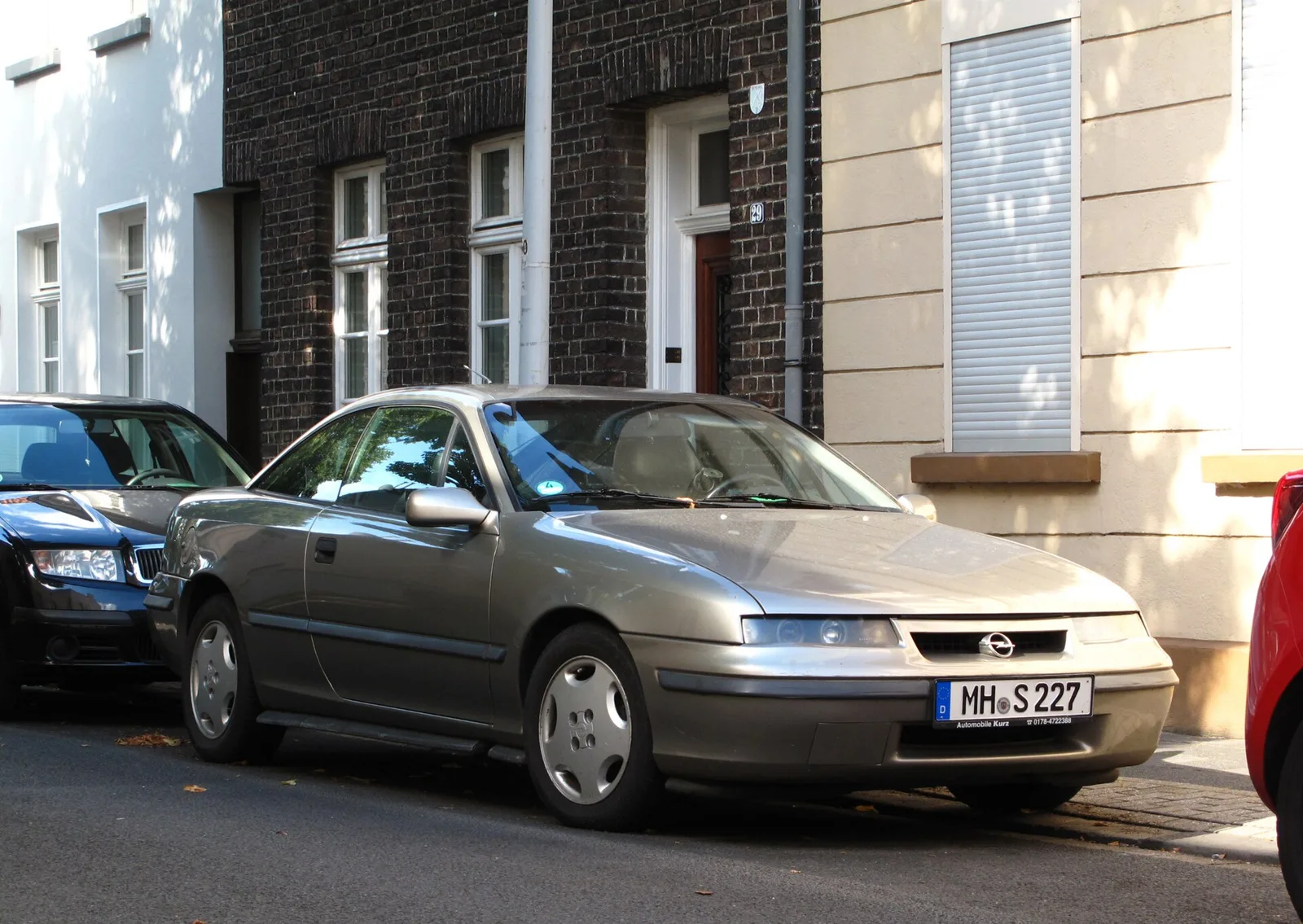
Built on Vectra A running gear, Opel's three-door coupe launched in 1989 with a record drag coefficient, sold in the hundreds of thousands and carried the Calibra name to 1997.
A three-door coupe built by Opel from 1989 to 1997 on Vectra A running gear, the Calibra was rated at a 0.26 drag coefficient at launch, making it the slipperiest production car of its time. Estimates put total output between 238,164 and 239,118 units.
The Opel Calibra was a three-door coupe that Opel built from 1989 to 1997, using the running gear of the Vectra A. It was sold as the Vauxhall Calibra in the UK until 1999, and it was badged Holden and Chevrolet in other markets. At launch it was the slipperiest production car on sale.
Why was the Calibra built?
The Calibra replaced the Manta and was meant to counter the Japanese sporting coupes of the period. It used the running gear of the Vectra A, which had launched in October 1988, and it was introduced on 10 June 1989. Opel had gone some time without a true sports coupe, and the Calibra was its answer.
GM's Wayne Cherry and the German stylist Erhard Schnell shaped the body. Built as a front-drive three-door hatchback on the Vectra A chassis, it was not dramatically sharper than its family sibling, yet it looked like a different proposition.
Production was split between Russelsheim in Germany and the Valmet plant in Uusikaupunki, Finland. The Finnish plant built 93,978 of the cars, and it also made the Porsche Boxster and Saab 9-3 Cabriolet.
An aerodynamic three-door coupe built on family-car running gear, the Calibra outsold its rivals and set a drag record.
How aerodynamic was the Calibra?
At launch the Calibra's Cd was 0.26, the best figure any production car had managed. That record held until November 1999, when the Honda Insight appeared with a Cd of 0.25. Later 16V, V6, four-wheel-drive and turbo models carried a slightly higher figure.
The shape depended on a slim headlamp only 7 cm high, made possible by ellipsoid lighting technology developed with Hella. Small changes to the waistline and panel lines made a measurable difference, as the team hunted for the last few points of drag reduction.
Practicality was not sacrificed. The Calibra seated four average-sized passengers, although rear space was tight for taller adults, and it swallowed 300 litres of luggage, which was competitive for a coupe of its size.
Which engines did the Calibra use?
Power began with a 2.0-litre 8-valve engine rated 117 PS (86 kW; 115 bhp), and a 16-valve 2.0-litre unit rated 152 PS (112 kW; 150 bhp) followed. The turbocharged C20LET arrived in 1992 at 207 PS (152 kW; 204 bhp), and a 2.5-litre V6 followed in 1993 at 170 PS (125 kW; 168 bhp).
The Turbo was the performance flagship, with four-wheel drive and a six-speed Getrag manual gearbox. Its top speed was 245 km/h (152 mph), and it was notable for five-stud wheel hubs and extreme negative camber on the rear wheels.
Four-wheel-drive cars had a transfer gearbox that demanded care. Owners were told to swap tyres from front to rear every 15,000 miles (24,000 km), and recent advice suggests every 3,000 miles (5,000 km), with all four tyres of the same make and model.
What are the Calibra's specifications?
The table brings together the engine outputs, the turbo and V6 figures and the body dimensions. Engine rows name the years each unit was available, so the 16-valve 1995 car is not confused with the earlier 8-valve model. Dimensions are given in millimetres as the factory published them.
| Specification | Detail |
|---|---|
| Launch engine | 2.0-litre 8-valve, 115 bhp (117 PS; 86 kW) |
| C20XE engine | 150 bhp (152 PS; 112 kW) |
| X20XEV engine | 136 bhp (138 PS; 101 kW), 1995 to 1997 |
| C20LET turbo | 204 bhp (207 PS; 152 kW), 1992 to 1997 |
| C25XE V6 | 168 bhp (170 PS; 125 kW), 1993 onward |
| Turbo top speed | 245 km/h (152 mph) |
| Launch drag coefficient | Cd 0.26 |
| Dimensions | 4492 mm long, 1688 mm wide without mirrors, 1320 mm high empty, 2600 mm wheelbase |
Those dimensions made the Calibra a compact coupe with a generous wheelbase, which helped its stability at speed and kept the cabin usable for four passengers.
How many Calibras were built and where did they sell?
Estimates put total output at 238,164 to 239,118 units. Around 100,000 were sold in Germany and over 40,000 in the UK, while Italy took over 27,000 and Spain over 17,000. Most of the remaining cars went to other European markets, including France, Switzerland and the Netherlands.
Valmet built 93,978 of them. Across its life the Calibra beat the Ford Probe in sales, even though the Probe was seen as underpowered and too American in character for many European buyers.
Survivors are scarce. Around 5,060 cars remain in Germany and around 450 in the UK, which means good examples are increasingly hard to find.
How did the Calibra do in motorsport?
The DTM and ITC race cars used an all-wheel-drive layout with a longitudinal engine. Early cars used a Cosworth-developed 54-degree V6, and between 1993 and 1995 output climbed from 420 PS to 480 PS, equal to 310 to 350 kW or 410 to 470 hp.
From 1996 the cars switched to the all-aluminium 75-degree KF V6 based on the Isuzu 6VD1, and Opel won the 1996 ITC Championship with it. The change of engine layout was one of the most significant technical steps in the programme.
A one-off South African car for the Wesbank Modifieds Series used a Buick-derived 3.5-litre V6 producing about 600 BHP. It was campaigned by Michael Briggs from 1991 to 1993, and the Calibra Turbo also finished ninth at the 1992 Sanremo Rallye.
What special editions did the Calibra get?
The Tickford conversion began in October 1991, although only 26 cars were converted. Vauxhall's own Special Edition range ran from the SE1 in 1993 to the SE9 in 1997, with unusual paint such as solar yellow on the SE2. Each of these editions gave buyers something the standard car did not offer.
The Keke Rosberg edition marked the car's German touring success and used yellow-grey textile seats. On the continent, the Last Edition closed out the run, bringing Irmscher suspension and BBS RX wheels in 16-inch sizes.
The final Turbo Limited Editions were built in early 1997 and lowered on Irmscher springs and dampers. They came in jet black with heated cream leather.
What happened after the Calibra ended?
Vectra A gave way to a new model in September 1995, yet Calibra output carried on until June 1997. Opel was then left without a sports car until the Speedster two-seater arrived in July 2000. Opel had no sports car of its own during that stretch.
A 1997 Calibra B design study, based on the Vectra B, was dropped because it did not fit General Motors' international model strategy. A non-functioning 1:1 model survives, and the March 2007 GTC concept previewed the first Opel Insignia rather than a new coupe.
How did the Calibra's equipment change over its life?
Early Calibra 8-valve cars came with a two-speaker stereo, sports seats, ABS and 14-inch alloys, while air-conditioning, traction control and leather were options. Later facelifted models with larger engines offered a six-speaker stereo, a CD changer and a sunroof. Later cars also picked up alloy wheels in sizes up to 16 inches.
Option lists grew with each special edition. Buyers could add a Bose system with a subwoofer, central locking, an immobiliser, a board computer and an alarm with motion sensors, which turned the Calibra into a far better equipped car than its launch specification suggested.
Safety also improved during production. From early 1993 every Calibra had a driver's airbag as standard, a co-driver airbag followed in August 1993, and the doors gained steel tube reinforcement as side protection.
Which colours did the Calibra come in?
Opel offered the Calibra in 28 colours over its production run, but only nine of them were black, grey or white. About half a dozen colours were available at any one time, so the palette changed quickly. Buyers often chose from a short list on any given day.
Limited editions often had fewer colour choices than the standard range. The Cliff Motorsport Edition used its own blue names, Ocean, Polar and Barracuda, and some late Keke Rosberg and DTM cars were painted in colours from the regular palette.
The colour story is a useful way of dating a car. Enthusiasts often check the paint code and the trim against the production records when they assess a used example.
Did the Calibra use recycled or lighter materials?
Yes. The Calibra used four types of recycled material in parts such as the headlight frames, the water deflector, bumper attachments, the inlet manifold and the wheel-arch liners. Water-based paint and CFC-free air-conditioning were further steps taken for sustainability. Those touches added up across the car rather than offering one standout feature.
Those choices were modest by today's standards, but they reflected a period when manufacturers were starting to think about materials across the whole car rather than only the engine.
The result was a car that was aerodynamically efficient and moderately clean in its build, without giving up the four-seat practicality of the Vectra-based body.
How did the Calibra handle compared with its Vectra sibling?
The Calibra used the Vectra A's running gear, but it was a stiffer chassis overall, with better torsional rigidity than its family car. That gave the coupe a more precise feel on the road, even though the base cars were not dramatically sharper.
Irmscher suspension on the sporty limited editions added further handling gains, and the four-wheel-drive turbo models used independent rear suspension taken from the Omega A with minor changes.
Owners of the all-wheel-drive models had to pay attention to the transfer gearbox, which tolerated little difference in tyre wear between the axles. That demand made the car a more involved ownership proposition than its front-drive siblings.
How did the Calibra compare with its rivals?
The Calibra outsold the Ford Probe in Europe, which was regarded as underpowered and very American in feel. Vauxhall's UK sales target of 15,000 a year was never met, but the car remained a popular coupe in several markets.
Its success in Germany, the UK and Italy showed how a practical coupe could appeal to European buyers who wanted more style than a family hatchback offered.
How did the Calibra's rivals shape its design?
The Calibra was pitched against Japanese sporting coupes, and it used its aerodynamic shape and practical rear seats to stand out. Its wedge-like silhouette and slim headlamps gave it a distinct identity in a crowded segment. That mix of style and practicality was the car's selling point.
Competitors of the era offered sporty styling but often less space behind the front seats, which made the Calibra's hatchback layout an attractive compromise. Opel's designers focused on a clean profile that reduced drag and kept the lines modern.
The result was a coupe that many European buyers saw as a sensible choice, not only a stylish one, and that balance helped it outsell the Ford Probe in its key markets.
Frequently asked questions
What was the Calibra's headline record?
At launch it had a drag coefficient of 0.26, the most aerodynamic production car of its time. The Honda Insight's Cd of 0.25 in November 1999 took that title.
How many Calibras were built?
Estimates range from 238,164 to 239,118 units, with 93,978 built at the Valmet plant in Finland.
Did Opel build a Calibra convertible?
Valmet built two red Cabrio prototypes in 1992 with the 2.0-litre 8-valve engine, but the project did not go beyond the prototype stage.
Which engine did the Calibra Turbo use?
The Turbo used the C20LET 2.0-litre turbo engine rated 207 PS (152 kW; 204 bhp), and it drove through a six-speed Getrag manual.