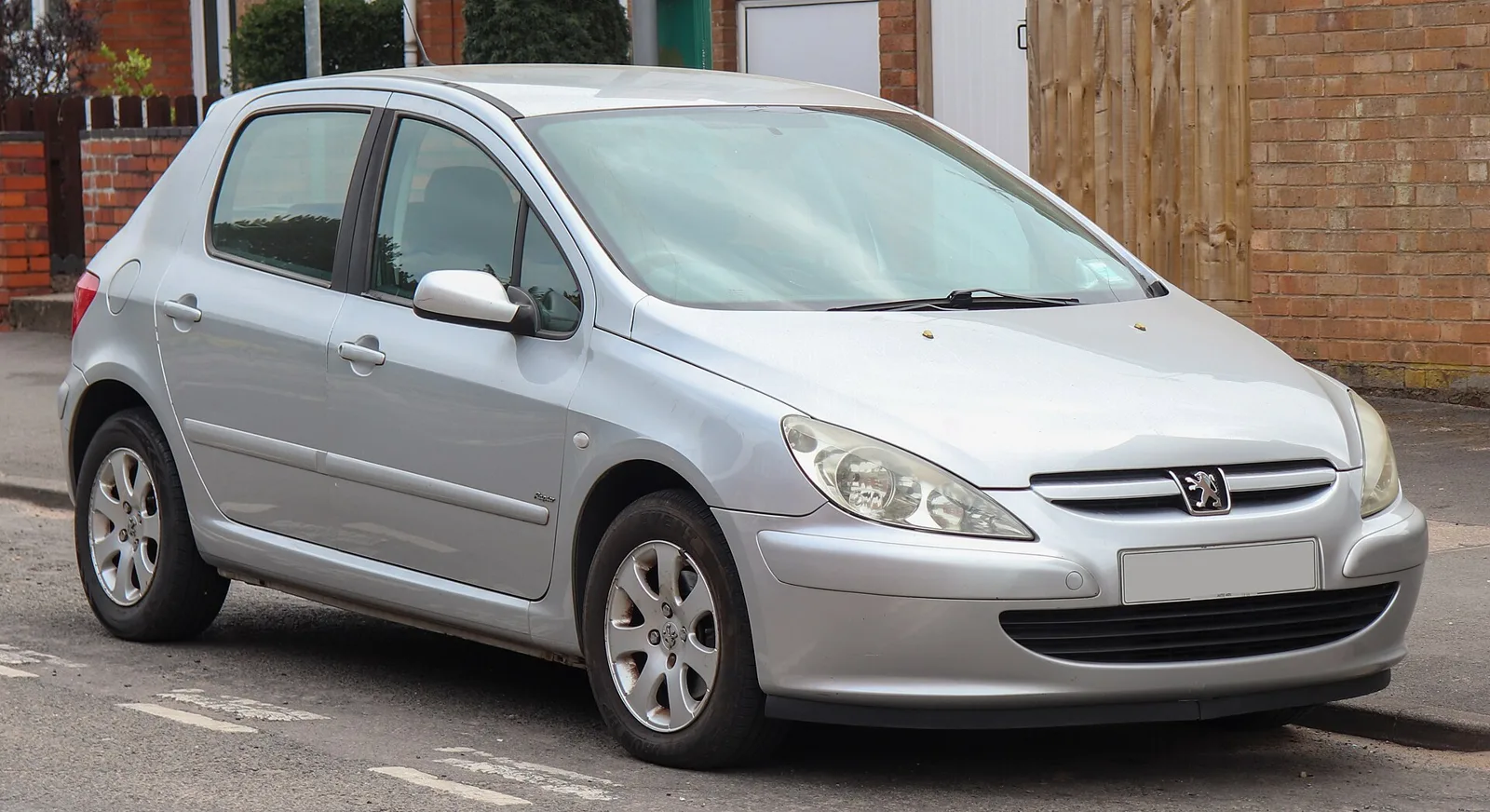
A 2001 to 2008 European family car on the PF2 platform that took the 2002 European Car of the Year title and then fed a world rally programme.
The Peugeot 307 was a European family car built from 2001 to 2008 on the PSA PF2 platform. It won the 2002 European Car of the Year title and later raced in the World Rally Championship as the 307 WRC. Successor was the 308, launched in September 2007.
The Peugeot 307 was a small family car that Peugeot built in Europe from 2001 to 2008. It succeeded the 306 on a reworked version of that car's platform and went on to win the European Car of the Year title for 2002. This profile covers its design, engines, competition history and the long tail of production that followed.
The 307 is an interesting car because it sat between two worlds. It was a practical family hatchback in showrooms and a serious rally car on the stages, and both sides of its life shaped how it is remembered.
When did the Peugeot 307 go on sale?
The Peugeot 307 went on sale in Europe in 2001 as the successor to the 306, which was discontinued in 2002. The European hatchbacks arrived on 26 April 2001, and the car was later sold in Australia, New Zealand, Asia and Mexico.
The 307 was previewed as a prototype at the 2000 Mondial de l'Automobile before production hatchbacks followed in April 2001. That sequence gave the new model a clear launch window and a clean break from the car it replaced.
The 307 also sold in Brazil with 1.6 and 2.0 flex fuel engines, a reflection of the car's wide export reach beyond Europe.
A family hatchback on a reworked platform, the 307 won Europe's top award and then fought on the rally stages.
What platform and styling did the 307 use?
The 307 used a reworked 306 platform, the PSA PF2, which also underpinned the Citroen Xsara. The car was larger than the 306 in every direction, and it continued the styling language first seen on the Peugeot 206 and 607.
Upswept front lights and a steeply rising bonnet led to a highly sloped windscreen. The upright rear doors came from the 206, while the overall look broke with the Pininfarina themes of the 205 and the 406 that had come before.
At 1,510 mm (59.4 in) tall, the car sat between a small family car and a compact MPV. Some critics called it a low compact MPV rather than a tall hatchback, a label that reflected its roomy and flexible character.
How did the 307 change in its facelift?
The June 2005 facelift restyled the front, with mildly revised lights, a new bonnet, an updated instrument cluster and the removal of the trademark Peugeot grille between the headlights. A larger air intake took over as the company's new grille.
Reliability was reportedly better after the facelift. The 2006 and 2007 models were referenced as more reliable and trustworthy, although the earlier cars had been at the bottom of a 2009 breakdown ranking for small family cars.
What body styles did the 307 come in?
The 307 launched as a three- and five-door hatchback. Estates arrived in February 2002 as the Break and the SW, with the SW offering a panoramic glass roof and an optional third row of removable seats.
The 307 CC cabriolet with a retractable hardtop arrived in August 2003, giving the range an open-top option. A four-door saloon launched in China in June 2004, reflecting local preferences for saloons over hatchbacks.
Which engines did the 307 offer?
The petrol range ran from a 1.4 L TU3 producing 75 PS (55 kW; 74 hp) to a 2.0 L EW10 with up to 177 PS (130 kW; 175 hp). The diesel line-up began with a 1.4 L HDi at 68 PS (50 kW; 67 hp) and reached 136 PS (100 kW; 134 hp) from the 2.0 L DW10TED4.
The 1.6 BioFlex arrived from September 2007 and could run on E85 ethanol, which suited markets with ethanol blends. The top 2.0 HDi diesel delivered 320 N m (236 lb ft) of torque, a strong figure for a family hatchback.
A diesel-electric hybrid HDi prototype was announced in January 2006, promising 83 mpg imp (3.4 L/100 km). It never reached sale before the 308 arrived in September 2007, and Citroen announced its own C4 Hybride HDi at the same time.
How did the 307 WRC perform in rallying?
The Peugeot 307 WRC was a World Rally Car based on the 307 CC, and it replaced the championship-winning 206 WRC for the 2004 season. In 2004 the car took seven podiums and a maiden win on Rally Finland, though Marcus Gronholm finished fifth in the drivers' championship.
The 2005 season was stronger. Peugeot led the manufacturers' championship after round 10, and Gronholm won Rally Finland and Rally Japan on the way to third in the drivers' championship. Peugeot finished second in the manufacturers' title.
Factory support ended at the close of 2005, when PSA withdrew both the Citroen and Peugeot teams from top-level rallying. Privateer team Bozian Racing ran 307 WRC cars in 2006, and the car finished with three WRC victories and 26 podiums in total.
What happened at Wales Rally GB in 2005?
On 18 September 2005, Markko Martin lost control of his 307 WRC on stage 15 of Wales Rally GB and hit a tree. Co-driver Michael Park was killed in the accident.
It was the first WRC fatality since Rodger Freeth in 1993. The crash marked a sombre end to the car's most competitive period and remains part of the 307 WRC's history.
How did the 307 perform in touring cars?
The car also found its way into several touring car series, from Brazil's Stock Car competition to the Danish Touring Car Championship. Its touring car careers were less famous than its rally career, but they show the car's adaptability across very different formats.
Each series put the 307 against different rivals and under different rules, which made its results a useful test of how far the platform could be pushed. Touring car fans tend to remember the cars that could compete on the same track week after week.
Where was the 307 built and sold beyond Europe?
Dongfeng Peugeot-Citroen built the 307 in China as a joint venture with PSA, and the saloon version remained in production there until 2014. In Argentina it was built from May 2006 to November 2010, with 60% local parts by 2006.
Brazil took imports, although sales were never satisfactory. The South American models used flex-fuel engines, which helped them suit local fuel choices and kept them relevant in the region.
How did the 307 compare with rivals in 2001?
Top Gear's June 2001 road test pitted the 307 1.6 16v TU5JP4 against the Ford Focus 1.6 Zetec SE and the Honda Civic 1.6 VTEC. The Peugeot won on price, space, handling, running costs and refinement.
The 307 took the top spot, followed by the Focus and then the Civic. The result gave Peugeot a strong opening with reviewers, and it set the stage for the European Car of the Year title the following year.
What are the Peugeot 307 specifications?
The table brings together the core figures for the 307, from the 2001 launch to the 2007 arrival of the 308. Each row names the engine or the feature it describes, so the petrol, diesel and motorsport details stay separate.
| Specification | Detail |
|---|---|
| Production | 2001 to 2008 in Europe |
| Platform | PSA PF2, reworked 306 platform |
| Height | 1,510 mm (59.4 in) |
| Petrol engines | 1.4 L TU3 75 PS (55 kW; 74 hp); 1.6 L TU5 110 PS (81 kW; 108 hp); 2.0 L EW10 up to 177 PS (130 kW; 175 hp) |
| Diesel engines | 1.4 L HDi 68 PS (50 kW; 67 hp); 2.0 L DW10TED4 136 PS (100 kW; 134 hp) |
| Top diesel torque | 320 N m (236 lb ft), 2.0 HDi |
| Hybrid target | 83 mpg imp (3.4 L/100 km), prototype announced January 2006 |
| European Car of the Year | 2002 |
| 307 WRC record | Three victories, 26 podiums |
| Successor | 308, September 2007 |
The specification list shows a family car with a wide engine range and a surprisingly serious competition life. Each engine answered a different buyer, from budget petrol to torque-rich diesel.
What did the 307 offer family buyers?
The 307 gave buyers the room of a larger hatchback in a compact footprint, with estate and MPV-like seating options. Some critics read its 1,510 mm (59.4 in) height as a sign that it straddled two categories in the market at once.
The SW estate's optional third row of removable seats was a flexible answer for families who needed occasional seven-seat capacity. Peugeot never developed a separate compact MPV spinoff, preferring to offer that flexibility within the 307 range.
The car's compromise was clear. Buyers got the space of a bigger hatch with the handling and running costs of a small family car, a balance that made it sensible for a wide range of households.
That balance underpinned its European success, and the 2002 title confirmed it. Reviewers responded to a car that combined everyday practicality with a settled driving feel.
Legacy: from the 307 to the 308
The 307's production run in Europe ended in 2008, but the platform did not disappear. The 308 arrived in September 2007 on the same platform and carried the basic engineering forward into a new body.
Production in China and South America continued well after Europe, with the Dongfeng-built saloon remaining in production there until 2014. That long tail shows how the design kept finding buyers in markets that valued saloons over hatchbacks.
For enthusiasts, the 307 is remembered in two ways: as a family hatchback that won a European title, and as a rally car that gave Peugeot strong results on the stages in 2004 and 2005. Each identity gives the car a different kind of appeal.
That dual character makes it a useful reference for anyone studying how a mainstream car can carry a competition programme without losing its everyday appeal.
Buying a 307 today
Buyers looking at a used 307 today would want to check the service history, since reliability varied by year. The advice applies to any car of its age, but the years after the facelift are the ones to focus on when comparing examples.
Engine choice matters too. A petrol 1.6 suits low-mileage town driving, while the 2.0 HDi diesel suits high-mileage motorway work, and the right pick depends on how the car will be used.
Rarer models such as the 307 CC and the saloon versions are harder to find in Europe, so prospective buyers should be prepared for a narrower choice of stock.
Frequently asked questions
Did the 307 win an award?
Yes. It was named European Car of the Year for 2002, after a strong 2001 road test in which it beat the Ford Focus and Honda Civic.
Was the 307 reliable?
Its record was mixed. The car placed poorly in one 2009 breakdown survey, yet the June 2005 facelift improved reliability.
What replaced the 307?
The 308 took over in September 2007 on the same platform. A saloon version continued to be built in China until 2014.
How many WRC wins did the 307 get?
The 307 WRC recorded three victories and 26 podiums, with Marcus Gronholm taking wins at Rally Finland in 2004 and 2005 and at Rally Japan in 2005.