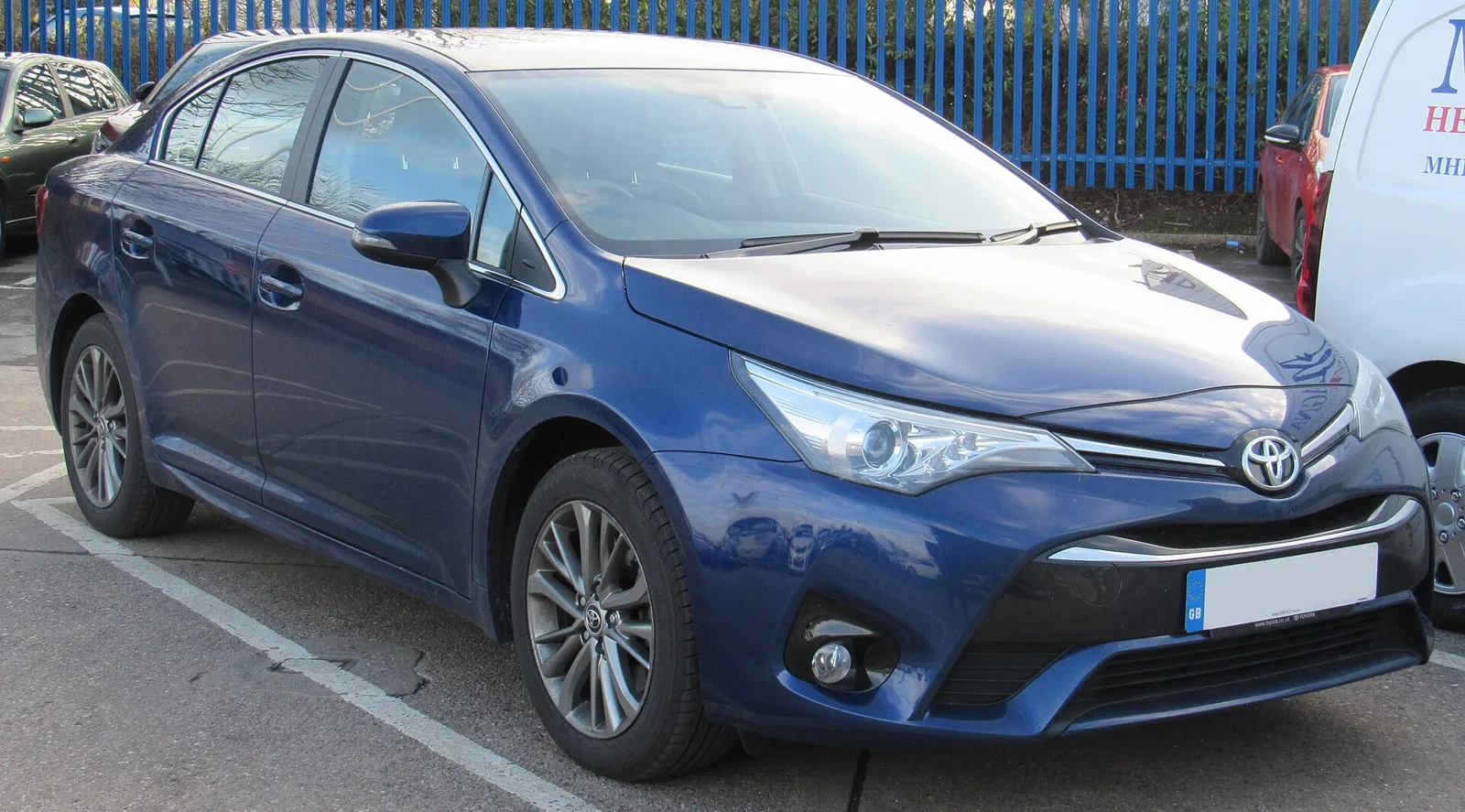
A Derbyshire-built saloon, estate and liftback that replaced the Carina E in 1997, won a Euro NCAP five-star rating and ran until 2018.
Built near Derby from October 1997 until August 2018, the Avensis succeeded the Carina E. Buyers could choose a saloon, liftback or estate, and the car earned five Euro NCAP stars in 2003. The XV70 Camry partly took over its role.
The Toyota Avensis was a mid-size family car built by Toyota at Burnaston in Derbyshire, England, from October 1997 until August 2018. It replaced the European Carina E and came in saloon, liftback and estate forms. Across three generations it became one of the company's best-known European products.
The car did not sell in North America. Its reputation rests on solid build quality, a roomy interior and a strong safety record in European testing, qualities that kept it in demand with fleet and family buyers.
Where did the Toyota Avensis come from?
Toyota introduced the Avensis name for a new model that went on sale at the end of 1997. The name was chosen to sound more modern than the Carina E it replaced, and it draws on the French word avancer, meaning to advance or move forward.
The first generation carried over the platform and engines of the Carina E, and it was built at the Burnaston factory alongside the five-door Toyota Corolla. The Avensis was not sold in North America, and it was related to the Scion tC coupe, which gave it a distant link to the American market.
The car also shared a platform with the Allion and Premio in Japan, where it was sold through the Toyota Netz Store network. A separate MPV called the Avensis Verso was built in Japan on its own platform, and it is covered later in this article.
A British-built family car that became Europe's safety benchmark for Toyota in 2003 and kept its five stars into the third generation.
How did the first-generation Avensis perform?
The first-generation Avensis came with four engines and three body styles: saloon, hatchback and estate. The estate was essentially the Japanese-market second-generation Toyota Caldina. Build quality was solid, the interior was spacious and the equipment list was generous.
That range gave buyers a wide choice of running costs, from the 1.6-litre base car to the 2.0-litre turbo-diesel. The diesel in particular suited higher-mileage drivers who wanted to keep fuel bills in check.
Driving dynamics were more conservative. Ride quality was smooth and refinement was good, but the car was not especially sharp to drive. That reflected the Avensis's brief as a comfortable family car rather than a sporting saloon.
A facelift in August 2000 added variable valve timing to the engines and made satellite navigation standard across the range. The sporty Avensis 2.0 SR, with a body kit and tuned suspension, was added in the same update, although overall sales stayed modest.
Toyota said the 2000 changes were meant to make the family saloon feel more sporty without losing its comfort, and the Corona name abroad continued to appear on certain markets' paperwork.
The name travelled under other badges abroad. In Argentina and Brazil the car was sold as the Toyota Corona, while in Chile and Peru it was the Corona Avensis. Greek taxi operators also received models with Corona badging until the 2000 facelift.
What changed with the second-generation Avensis?
The second generation, codenamed T250, was launched in February 2003 in an all-new format. It offered more driver involvement and visual appeal than its predecessor, and it was penned by the company's design studio in France, the same team responsible for the Echo and Yaris. Production began on 6 January 2003.
In Japan the car arrived in October 2003 as a saloon and estate, replacing the V50 series Vista and Vista Ardeo. Following the withdrawal of the Camry in 2004, the Avensis became the largest Toyota saloon sold in Western Europe, a position that gave it a distinct place in the range.
The second generation attracted attention in the 2004 European Car of the Year contest, where it finished fourth behind the Fiat Panda, the Mazda3 and the Volkswagen Golf. It also won the 2004 Semperit Irish Car of the Year, and What Car? named it the Best Family Car for 2004 and 2005.
UK buyers could pick from the T2 entry car up to the TR, with trims such as T Spirit and T180 in between, plus a Colour Collection special edition based on the T2. Ireland offered Terra, Aura, Strata, Luna and Sol, and Japan sold the car as the 2.0 Xi, 2.0 Li and 2.4 Qi.
The second generation was the only one sold in Egypt and Morocco. In South Africa it arrived in late 2006 to replace the Australian-sourced Camry, and it was the last large saloon that Toyota South Africa sold.
What engines did the Avensis use?
The 1.6, 1.8 and 2.0-litre petrol engines and the 2.0-litre turbo-diesel were carried over from the first generation, and the 2.4-litre four-cylinder from the Camry joined them. From 2005 the 2.4 litre was fitted with a five-speed automatic transmission.
The original 115 PS (85 kW) D-4D diesel was complemented by a 2.2-litre D-4D in 136 PS and 177 PS forms. Newer cars lost the D-4D script from the wings and the 2.0 mark from the tailgate.
The 2006 facelift raised the 2.0 D-4D output from 85 kW to 93 kW (126 hp). That diesel, paired with a six-speed manual, lowered fuel consumption and emissions. Toyota quoted 10.5 seconds for the 0-97 km/h sprint.
Toyota described the cosmetic changes as a way of strengthening the family connection with the Corolla and Yaris, while allowing the Avensis to keep a premium look with a sportier appearance.
The third generation used Toyota's Valvematic technology in its new ZR petrol engines, and the petrol units were sourced from the company's Deeside Engine Plant. The 1.6-litre produced 97 kW (130 hp), the 1.8-litre 108 kW (145 hp) and the 2.0-litre 112 kW (150 hp).
How safe was the Avensis?
In 2003 the Avensis became the first Japanese car to receive a five-star rating under Euro NCAP's redone testing, scoring 34 points, which was the highest the organisation had recorded at that time. It was also the first vehicle sold in Europe with a knee airbag.
The third generation carried seven airbags as standard, including front side airbags, curtain airbags covering both rows and a knee airbag for the driver. Active front headrests were designed to reduce whiplash, and the brake lamps flashed under emergency braking.
The third-generation Avensis also received a five-star Euro NCAP rating with an 81 percent overall score and 90 percent for adult occupant safety. Vehicle Stability Control Plus helped the driver steer, and a Pre-Collision System with lane departure warning became optional.
What did the third-generation Avensis bring?
The third generation, codenamed T270, was revealed at the 2008 Paris Motor Show and went on sale in January 2009. Like its predecessor it was built at Burnaston, but it came only as a saloon or estate. The five-door hatchback was dropped in favour of the saloon and estate styles.
The third generation had a planned full-year sales goal of 115,000 vehicles, a figure that showed how central the model remained to Toyota's European plans at the time.
Toyota's ED2 studio gave the car a sleeker and more athletic stance. The saloon's drag coefficient was 0.28 and the estate's 0.29. The suspension used front MacPherson struts and rear double wishbones, and bi-xenon headlamps, adaptive front lighting and adaptive cruise control were among the major options.
A facelift in January 2012 brought a revised front grille and modified tail lamps. A second facelift was shown at the Geneva Motor Show in March 2015 and launched in June 2015, with a new interior, new headlamps and taillamps and the Toyota Safety Sense package.
The second facelift also replaced the 2.0-litre diesel with a 1.6-litre unit.
Did the Avensis race in the British Touring Car Championship?
The Avensis did take part in motorsport, although not in a factory-backed touring car. On 2 August 2010 it was announced that the British Touring Car Championship's NGTC prototype would be built around the Avensis.
Series organiser TOCA planned to introduce the low-cost NGTC rules in 2011, and Toyota agreed to supply a donor car and a new body shell for the programme. Speedworks Motorsport, with driver Tom Ingram, ran the Avensis until the end of the 2018 season.
The programme was built around low costs, with Toyota supplying the donor car and body shell so that teams could run the car without the expense of a bespoke design.
Why did Toyota end the Avensis?
Production wound down in the United Kingdom in August 2018, with the rest of Europe following in late 2018, which closed the book on three generations. Toyota did not replace it with a direct successor. Instead the slightly larger XV70 Camry, built on the TNGA-K platform, partly took over its role in the range.
For a family saloon that had been built for more than two decades in one plant, the closure of the line marked the end of an important chapter for Burnaston.
What was the Avensis Verso?
The Verso was a large people carrier that arrived in 2001 under the Avensis name. It seated seven and was first offered with 2.0-litre engines alone. Its platform preceded the second-generation model.
The Verso won Australia's Best People Mover award in 2002 and again in 2003, a back-to-back result that helped establish the model in that market. It remained on sale alongside the second-generation Avensis until 2006. Its appeal lay in seating flexibility for families rather than in any sporting character.
Its seven seats made the Verso a practical people carrier, sitting apart from the saloon and estate in the range and giving families a different way to use the Avensis name.
What are the Toyota Avensis specifications?
The table brings together the key figures across three generations, from the first-generation top petrol engine to the third-generation diesel. It also records the safety and aerodynamic figures that the car was known for.
| Specification | Detail |
|---|---|
| Production | October 1997 to August 2018, Burnaston |
| First-generation top petrol | 2.0-litre D4 VVT-i, 110 kW (150 hp) |
| Second-generation diesel | 2.0-litre D-4D, 85 kW (115 hp), later 93 kW (126 hp) |
| Third-generation top petrol | 2.0-litre 3ZR-FAE, 112 kW (150 hp) |
| Third-generation top diesel | 2.2-litre D-4D, 130 kW (174 hp) |
| Drag coefficient | 0.28 saloon, 0.29 estate |
| Euro NCAP | Five stars in 2003 and five stars for the third generation |
| Airbags | Seven as standard on the third generation |
Frequently asked questions
Was the Avensis sold in the United States?
No. The car was never offered in North America, which is where the related Scion tC coupe was sold. The Avensis stayed in Europe, Japan and several other markets.
What replaced the Avensis?
The slightly larger XV70 Camry replaced the Avensis in part. It was built on the TNGA-K platform and took over the role of the larger family saloon in the Toyota range.
Where was the Avensis built?
The Avensis was built at the Burnaston factory in Derbyshire, England, which also produced the five-door Corolla from 1997.
Did the Avensis get five stars in safety testing?
Yes. The Avensis scored five stars in Euro NCAP testing in 2003, and the third generation also earned five stars with strong marks for adult occupants.