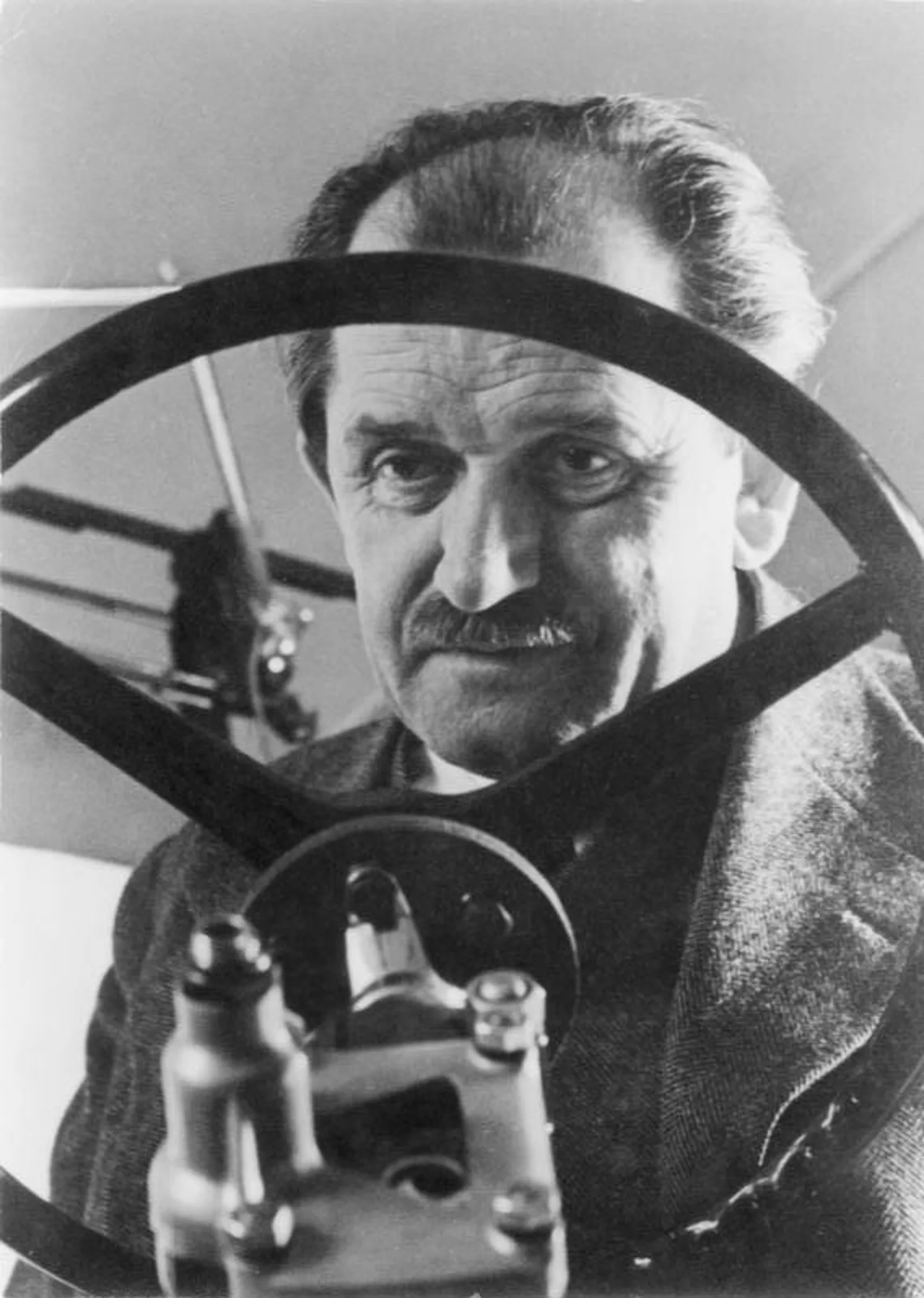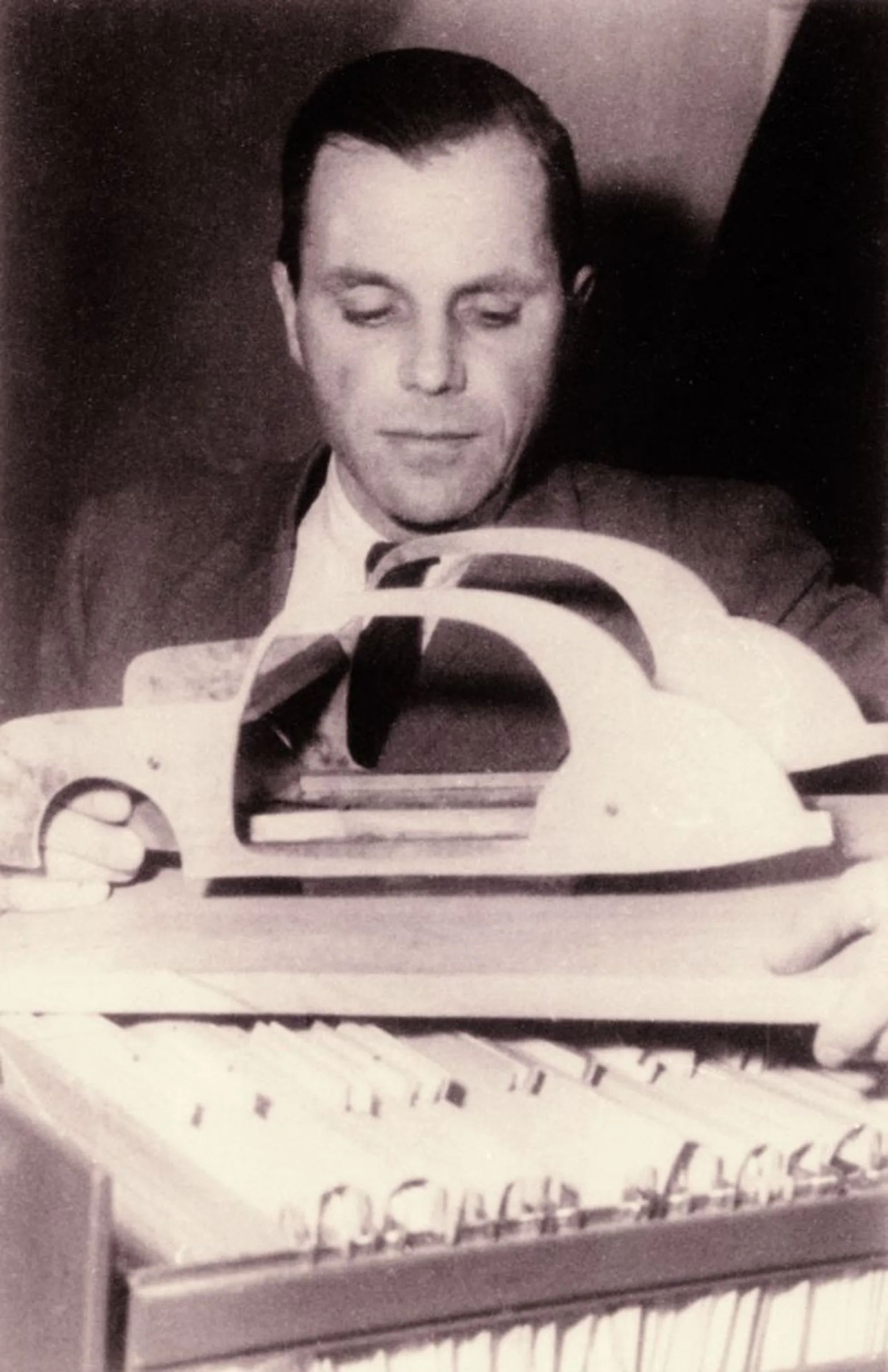
From the crumple zone and the Blitzen Benz to the Fiat 500 and the underslung Rohr 8, four engineers whose ideas ended up in everyday cars.
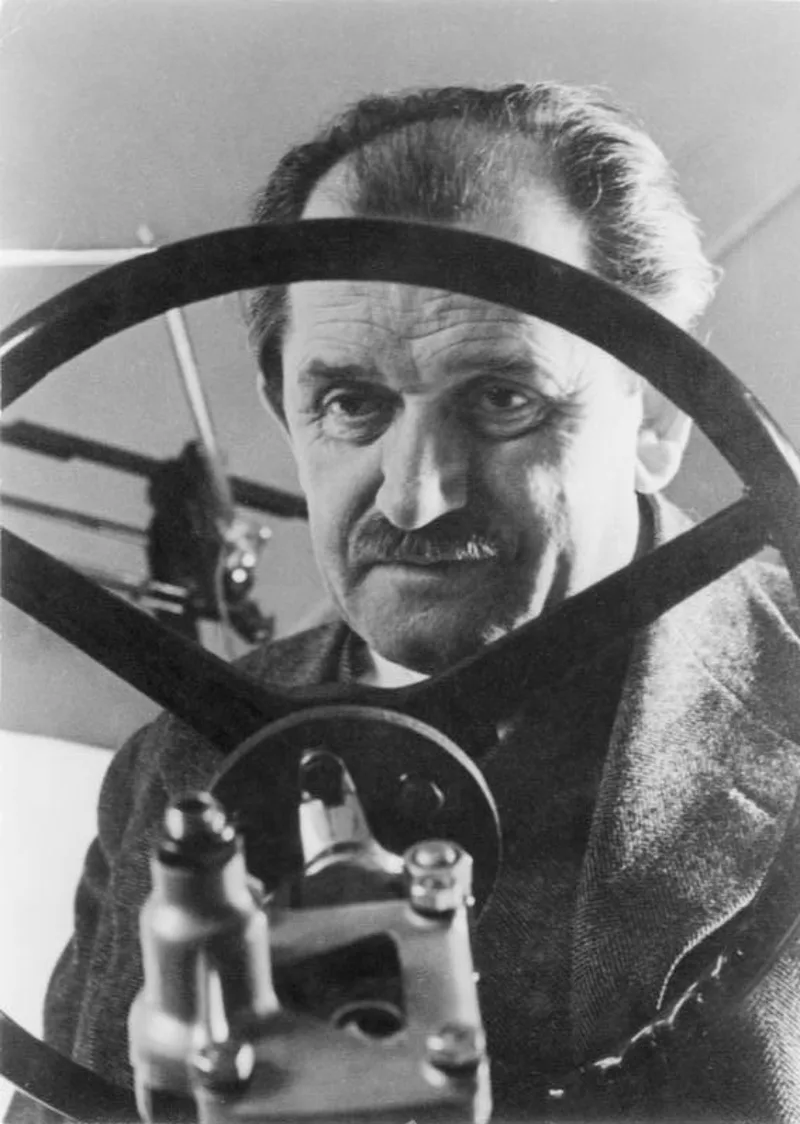
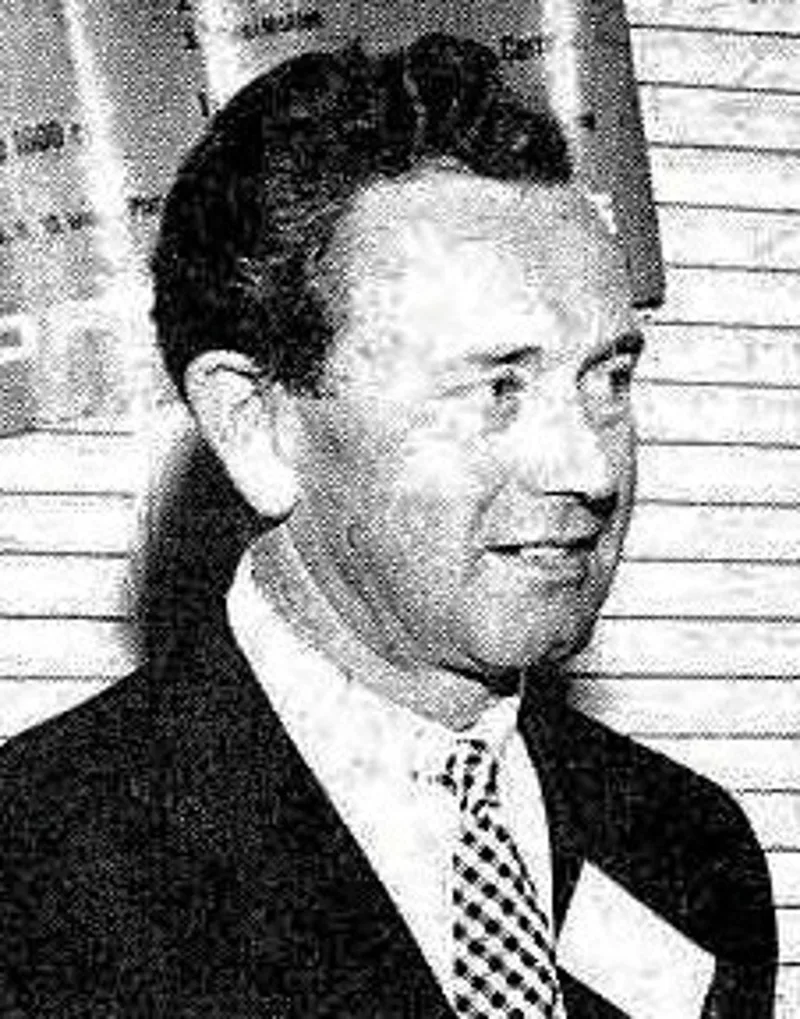
Bela Barenyi developed the crumple zone at Daimler-Benz, Hans Nibel led Benz and Mercedes-Benz design and the W15, Dante Giacosa designed Fiat's Topolino, 600, Nuova 500 and 128, and Hans Gustav Rohr created the Rohr 8 and the Adler Trumpf.
The engineer often called the father of passive safety is credited with 1,244 patents worldwide by the European Patent Office. Larger figures have circulated, with claims of more than 2,000 and later of over 2,500, but those counts include the same invention filed in several countries. Even the trimmed number dwarfs most careers. The man was Bela Barenyi, and he is one of four European engineers whose work set the pattern for how cars are built, kept safe and made cheap enough to buy.
Hans Nibel, Dante Giacosa and Hans Gustav Rohr complete the set, and between them they covered speed records, the small family car, front-wheel drive and the underslung chassis.
Who were Bela Barenyi, Hans Nibel, Dante Giacosa and Hans Gustav Rohr?
| Engineer | Lived | Main employers | Best-known work |
|---|---|---|---|
| Bela Barenyi | 1 March 1907 to 30 May 1997 | Austro-Daimler, Steyr, Adler, Daimler-Benz | Crumple zone and rigid passenger cell |
| Hans Nibel | 31 August 1880 to 25 November 1934 | Benz and Cie, Daimler-Benz | Blitzen Benz, Benz-Tropfenwagen, Mercedes-Benz W15 |
| Dante Giacosa | 3 January 1905 to 31 March 1996 | Fiat | Topolino, 600, Nuova 500, Fiat 128 layout |
| Hans Gustav Rohr | 10 February 1895 to 10 August 1937 | Rohr Auto AG, Adler, Daimler-Benz | Rohr 8, Adler Trumpf |
Barenyi argued that a safe car should not be rigid, and the crumple zone followed.
What did Bela Barenyi invent?
Bela Barenyi was born in Hirtenberg near Vienna on 1 March 1907, to a Hungarian military officer father and an Austrian mother. After studying mechanical and electrical engineering in Vienna in 1926, he worked for the Austrian carmakers Austro-Daimler, Steyr and Adler before joining Daimler-Benz in 1939.
His job interview was unusual. Barenyi told board member Wilhelm Haspel in detail that steering systems, columns, wheels, suspension and body design all needed rethinking to protect occupants. Haspel hired him, saying Barenyi was thinking 15 to 20 years ahead and that whatever he invented would go straight to the patent department. He headed pre-development at Daimler-Benz from 1939 to 1972 and retired on 31 December 1972.
How a crumple zone works
Before Barenyi, the common belief held that safety meant stiffness. He argued the opposite. Think of landing from a jump: you bend your knees so your legs absorb the blow rather than your spine. A car body can do the same. His design divides the body into three parts, a rigid, non-deforming passenger compartment in the middle and crumple zones at the front and rear that absorb the energy of an impact by deforming.
He first conceived the crumple zone in 1937, ahead of his Mercedes-Benz years, and a more developed form was patented in 1952 as Mercedes-Benz patent number 854157. The 1953 Ponton was a partial implementation, with a strong, deep platform that formed a partial safety cell and had been patented in 1941. The first body built on the full patent was the 1959 W111 Tail Fin saloon from Mercedes. Its longitudinal members ran straight through the middle and formed a rigid cage with the body panels, whereas the front and rear supports were curved to give way in a crash, absorbing part of the energy before it reached the occupants. A more recent refinement weakens those curved members with ribs to create telescoping crash cans or crush tubes.
Barenyi also developed the collapsible steering column and safer detachable hardtops. Mercedes-Benz credits him on its website with conceiving the original Volkswagen Beetle design in 1925, which is five years earlier than the first version Ferdinand Porsche claimed. The Detroit Automotive Hall of Fame inducted him in 1994, he was nominated as Car Engineer of the Century in 1999 and died in Boblingen on 30 May 1997. His records went to the Technisches Museum Wien.
What did Hans Nibel do at Benz and Daimler-Benz?
Hans Nibel was born on 31 August 1880 in Olleschau, in what was then Austria-Hungary, the son of a factory director. A school certificate from 1899 rated him outstanding in mathematics, physics and drawing, and he studied engineering at the Technical University of Munich. On 1 March 1904, aged 24, he joined the Mannheim design office of Benz and Cie, already one of the largest car makers in the world. In 1908, four years later, he was made head of product development and design.
Records, racers and diesels
His early innovations included the 1908 head-controlled motor, a four-valve engine in 1910, and a block-based engine with dual ignition in 1911. They began on racing and record cars and spread to ordinary ones over the following decades. In 1909 he designed an aircraft engine, which prompted Benz to set up a new division, and in 1912/13 Benz won the Kaiserpreis for the best German aircraft engine, which colleagues saw as a personal triumph for him.
His name is tied to the Blitzen Benz, which debuted in 1909. In April 1911 Bob Burman drove one at Daytona Beach to 228.1 km/h (141.7 mph) over a mile, a land-speed record that stood until February 1919. Nibel also took part in endurance events such as the Prince Heinrich Rally, the International Austrian Alpine Rally and the Carpathian Rally.
He became a deputy board member on 16 August 1917 and a full member on 25 August 1922. Meanwhile he drove Benz towards diesel power for road vehicles. In 1920 he instructed Kurt Eltze to start in-house manufacture of injection pumps and nozzles, and in 1922 Benz introduced a farm tractor with a compression-ignition engine, described as the first road-capable diesel vehicle in the world. A diesel truck followed in 1923. Also in 1922 he and chassis chief Max Wagner produced the Benz-Tropfenwagen race cars, after licensing the design of the Rumpler Tropfenwagen shown at the 1921 Berlin Motor Show, a streamlined car with its engine behind the passenger compartment. A 2-litre unsupercharged version finished fourth in the 1923 Italian Grand Prix.
Merger and the W15
Nibel was among the first to argue for a full merger of Benz and Daimler, which was formally concluded on 28 June 1926, masterminded by Wilhelm Kissel, and gave the new company a shared three-pointed star. At Daimler-Benz he worked alongside Ferdinand Porsche, who was five years older and carried ultimate responsibility for the department. There was at times friction between them, yet the years 1926 to 1929 brought a rush of product development. In 1927 he and Fritz Nallinger brought out Mercedes-Benz's first six-cylinder diesel with indirect injection for commercial vehicles.
Porsche's relations with senior colleagues on the board remained uncomfortable, and at the start of January 1929 Nibel took over as Technical Director. With Wagner he was already working on cars with an underslung chassis in place of the traditional overslung type, which gave a lower centre of gravity, better road holding and a more streamlined shape. Adler and Opel followed in the 1930s. The first relatively mass-market model built this way was the 1,692cc W15, finalised in 1930 and launched in 1931 as the Mercedes-Benz Typ 170. In the Depression it was relatively affordable, which let the company keep a major presence in the German market. Nibel died on 25 November 1934.
What did Dante Giacosa design at Fiat?
Dante Giacosa was born in Rome on 3 January 1905, with family roots in Piedmont, and studied engineering at the Polytechnic of Turin until 1927. He joined Fiat in 1928. In 1933, when work began on the Fiat 500, Antonio Fessia trusted him with all of the car's mechanical components, including the chassis. Giacosa was engineering manager by 1937 and director of the engineering division by 1950. One description of him is the deus ex machina of Fiat.
The small cars
The Topolino of 1936 put the engine of 569 cc over the front wheels with the radiator behind it, used the cabin space efficiently and returned about 5.6 l/100 km at a top speed of 90 km/h. Some 122,000 were built before production ended in 1948. The 508C Millecento followed in 1937 with a short-stroke 1,100 cc overhead-valve engine, and a streamlined coupe version, the 508CMM, won the 1100 cc class of the 1938 Mille Miglia. In 1944 the industrialist Piero Dusio asked him for a cheap single-seater, and in his spare time Giacosa produced the Cisitalia D46, on sale in 1946. It had a steel-tube space frame, light alloy panels and a tuned 1100 cc Fiat engine of 60 bhp for a claimed 175 km/h (109 mph).
Not every car went his way. Fiat's sales department held the final say on new models, and the 1400 of 1950 was only a qualified success, with about 120 thousand built in eight years. The 1100-103 that followed carried on the Millecento name and stayed in production until 1970.
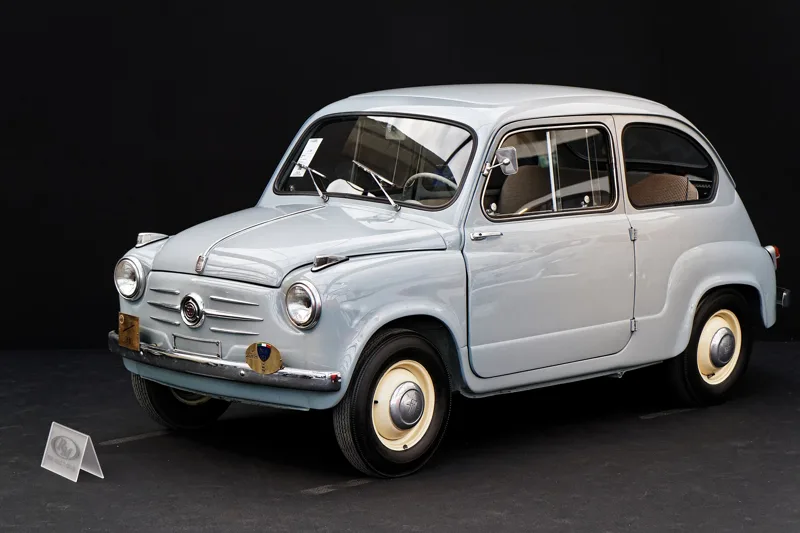
The Fiat 600 of 1955 was a new layout for Fiat, with the engine at the rear and unitary construction. Its 633 cc engine was enough for almost 100 km/h (62 mph) because the car weighed only 585 kg (1,290 lb). Giacosa tackled the stability problems of rear-engined cars by identifying the cause as the simple swing-axle rear suspension, not the weight distribution, and he fitted semi-trailing arms instead. A seven-seat Multipla version followed within a year, and more than two and a half million 600s were eventually built, partly under licence by SEAT, NSU/Fiat, Zastava and Concord.
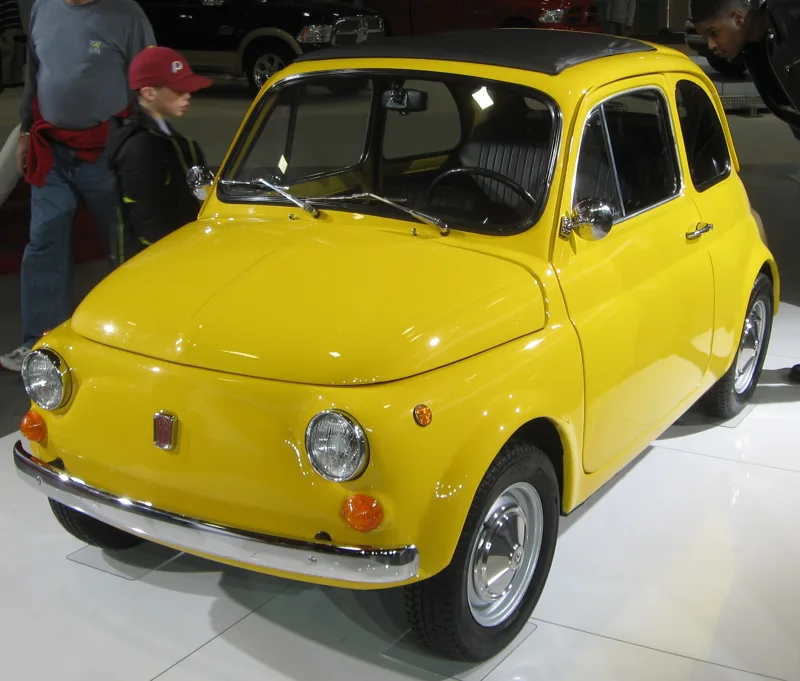
The Nuova 500 arrived in 1957 as the true replacement for the Topolino. Its two-cylinder air-cooled engine of 479 cc made only 13 bhp, so early cars were recalled and given an uprated 16.5 bhp unit. By the final 500F of 1965 the engine was 499 cc with 18 bhp, good for 95 km/h (59 mph). Giacosa won the 1959 Compasso d'Oro for the car. The 850 followed in 1964, and in 1972 the last rear-engined Fiat saloon, the 126, with a 594 cc engine and 23 bhp, stayed in production in Italy and then Poland until 2000, with almost five million built.
The Fiat 128 and front-wheel drive
When Fiat began selling the 128 in 1969, its engine and gearbox sat side by side across the car and drove the front wheels through unequal-length driveshafts. It also had MacPherson strut suspension, plus a radiator fan switched on electrically. That layout was adopted by virtually every other manufacturer for front-wheel drive. Transverse front drive in small cars had started with the DKW F1 in 1931 and become popular with the Mini, but the unequal driveshafts were Giacosa's work and Ettore Cordiano contributed a compact clutch release. Fiat first tested the arrangement on the Autobianchi Primula, which was ready for production in 1964.
Giacosa retired from full-time work in 1970, served as president of the engineering societies' federation FISITA from 1967 to 1969, and wrote Motori Endotermici, which became a reference for engineering courses. He died in Turin in 1996.
What did Hans Gustav Rohr build?
Hans Gustav Rohr was born on 10 February 1895 at Uerdingen near Krefeld, where his father ran a lead rolling mill. He had no interest in lead and every interest in aviation. At 17 he took an internship at Rheinische Aerowerke, where in 1912 he and his friend Joseph Dauben built a monoplane to his design with a five-cylinder radial engine he made from motorcycle cylinders and a closed cabin for the pilot. It flew for the first time in November 1913.
In the First World War he flew fighters in Flanders, scored two kills and was shot down. After hospital he was told to develop a 600 PS, 21-cylinder radial aero engine with a five-stage compressor. When the armistice came in November 1918, the French learned of the engines, and he had them destroyed. With aircraft building banned by the Treaty of Versailles, he and Dauben turned to cars, with the idea of building the aircraft of the high road. Their prototypes of 1919 to 1924 combined lightweight construction, an underslung sheet-steel frame, independent suspension and, on the second prototype, hydraulic brakes on all four wheels. No producer would build the design.
Rohr Auto AG
Hugo Greffenius of MIAG stepped in with 500,000 Marks, and Rohr Auto AG was set up on 30 October 1926 at Ober-Ramstadt. The Rohr 8 had an underslung frame, an unusually low centre of gravity, independent suspension at both ends and rack and pinion steering. It was much admired for its handling but its 1,980 cc engine gave only 40 PS (29 kW), and fewer than 100 were built in 1927 and 1928.
The 1928 Berlin show stand carried the slogan Der sicherste Wagen der Welt. The 2,246 cc Rohr 8 9/50 with 50 PS (37 kW) became the firm's first commercial success, and almost 1,000 were built from 1928 to 1930. By 1929 about 800 people worked at the plant, turning out approximately six cars a day. Some admired the rear swing axle; traditionalists missed a beam axle. The Rohr 8 10/55 of October 1930 grew to 2,496 cc with 55 PS (40 kW), used a narrow-V block with a 10 degree angle between alternate cylinders and cost about 8 percent more fuel, but arrived as the Wall Street crash spread across Europe. Greffenius had withdrawn in 1929, only around 350 were built between 1930 and 1933, and production stopped early in 1931. A Swiss holding company bought the assets in June 1931 and built about 2,000 more without Rohr or Dauben.
Adler and Daimler-Benz
Rohr joined Adlerwerke in Frankfurt in or before May 1931 as head of product development, technical director and deputy board member, bringing Dauben, Otto Winkelmann, Walter Kurtze and Laurenz Niessen. Adler ranked fourth in German sales, behind Opel, DKW and Mercedes-Benz, and was moving down-market. The Adler Trumpf of 1932 was both technologically innovative and a commercial success. In 1935 he became Technical Director at Daimler-Benz, but pneumonia ended his career, and according to at least one report it followed a drive in an open-topped car. He died on 10 August 1937.
Which cars should you look for?
- Barenyi: the 1959 Mercedes W111 Tail Fin and the 1953 Ponton, the cars that first carried his crumple zone ideas.
- Nibel: the Blitzen Benz and the Mercedes-Benz Typ 170.
- Giacosa: the Topolino, 600, Nuova 500 and 128.
- Rohr: the Rohr 8 and the Adler Trumpf.