A record that stood until 2022, a Subaru Impreza that became a PlayStation cover star, and a career that ended in 2007 with the sport still arguing about what he might have done next.
Colin McRae, from Lanark in Scotland, became the first Scot and, at 27, the youngest driver to win the World Rally Championship, in 1995 with Subaru. He won 25 rallies, a record when he stopped full-time in 2003, and lent his name to the Colin McRae Rally game from 1998. He died in a helicopter crash in 2007.
Colin McRae was 27 when he became World Rally champion in 1995, the youngest the sport had ever crowned, and the record stood until 2022. Three years after that title, a PlayStation game carrying his name and a Subaru Impreza on its cover arrived in the shops, the beginning of a franchise that would become a critical and commercial success.
Where did Colin McRae come from?
Colin Steele McRae was born in Lanark on 5 August 1968, the eldest of three brothers. His father Jimmy was a five-time British Rally champion, and his brother Alister and his maternal uncle Hugh "Shug" Steele also drove in rallies. He went to Lanark Grammar School, studied for a year at Coatbridge College and worked first at a garage, then at his father's plumbing and heating firm.
Racing came early. He rode trials bikes as a boy, even though he preferred machines with four wheels, and at 13 he was Scottish schoolboy motocross champion. At 16 he found autotesting through the Coltness Car Club and competed in a Mini Cooper. The next year he got the loan of a Hillman Avenger GT and entered the Kames Stages, a one-venue stage rally close to home. He finished thirteenth overall and first in his class, though he had spent much of the event running higher.
In 1986 he entered the Scottish Rally Championship in a Talbot Sunbeam with Ian Grindrod, his father's co-driver, alongside him. He soon had a name for sheer speed and a spectacular driving style, one that people compared to that of the Finnish former world champion Ari Vatanen, his lifelong hero.
He made his WRC bow at the 1987 Swedish Rally, finishing 36th in a Vauxhall Nova. He won the Scottish title in 1988. A fifth place overall at Rally New Zealand in 1989 came in a Sierra Cosworth that drove only its rear wheels, and in 1990 he took sixth place on the RAC Rally despite several accidents. In 1991 David Richards, boss of Prodrive, put him on a salary of roughly 10,000 pounds a year to drive its Subaru in the British Rally Championship, and McRae turned professional. He won the British title in 1991 and again in 1992.
Not everything went smoothly. In 1992 he made a one-off appearance in the British Touring Car Championship driving a BMW run by Prodrive at Knockhill. He collided with Matt Neal, officials judged the contact avoidable, and he was disqualified.
In 1995, aged 27, McRae became the youngest World Rally champion, a record that stood until 2022.
Colin McRae and the Subaru Impreza: the 1993 to 1998 years
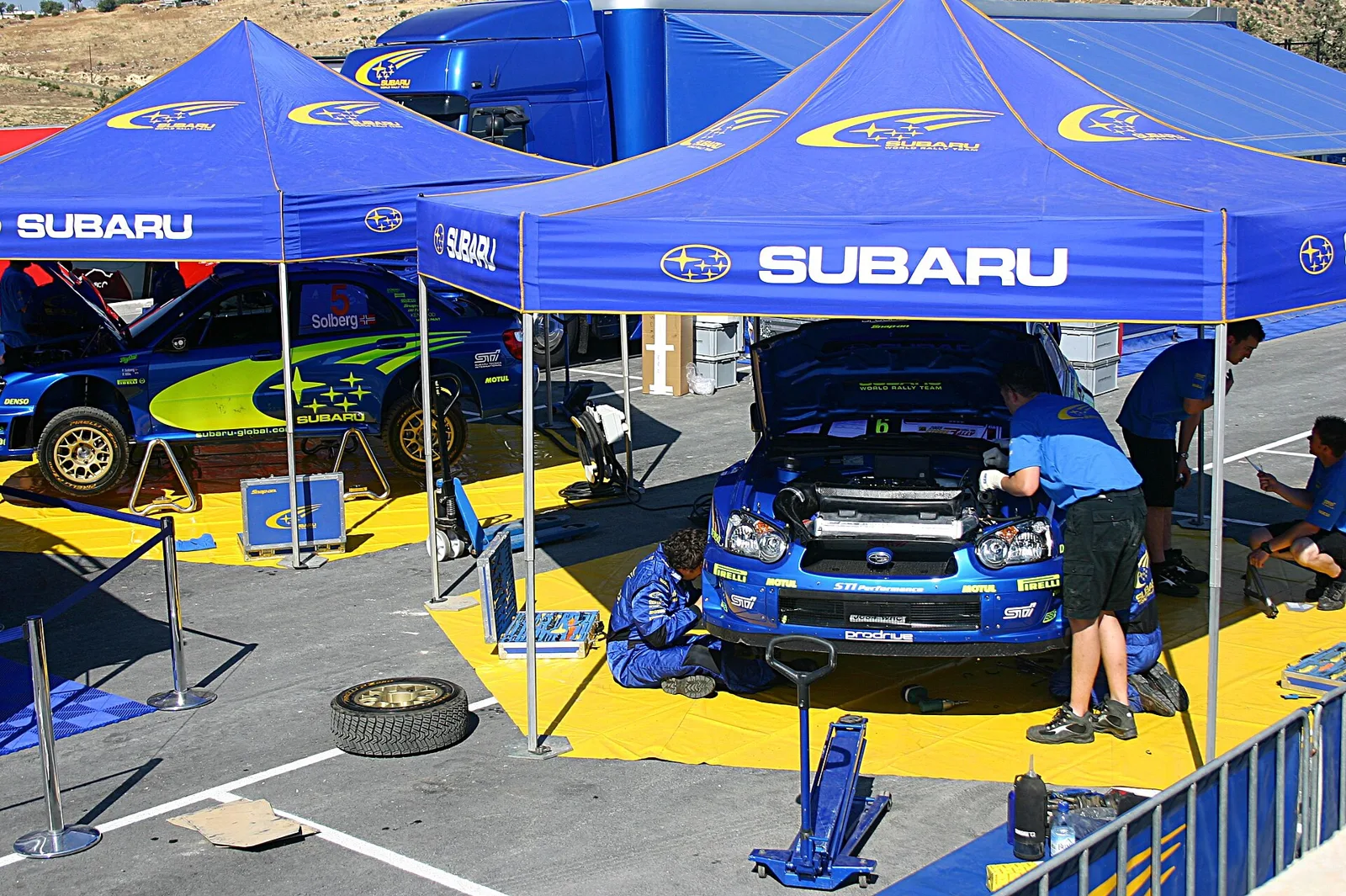
McRae stepped up to the Subaru factory team at world level in 1993. He drove the Prodrive-built Group A Legacy alongside the Finns Ari Vatanen, Hannu Mikkola and Markku Alen, and in the eighth round of the season, Rally New Zealand, he won his first WRC event. It was a landmark for Subaru too, the first victory for its newly created World Rally Team. He ended the year fifth in the standings with 50 points. The Legacy was then retired in favour of the Impreza 555.
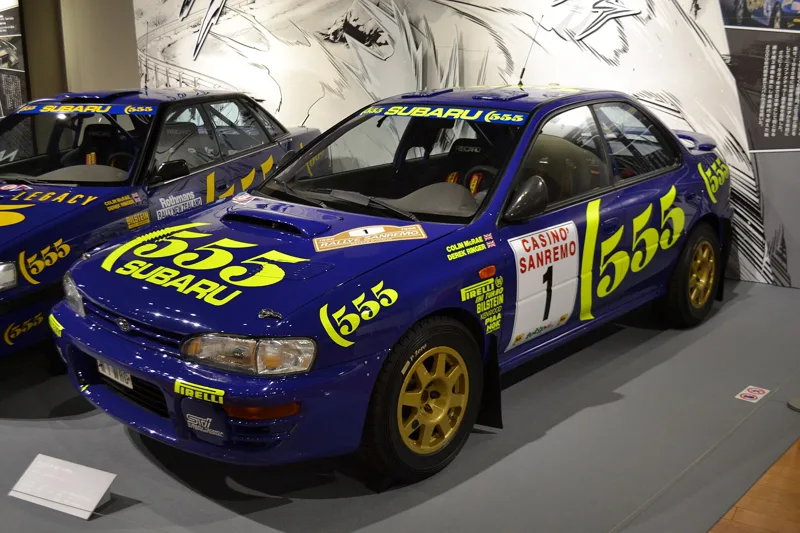
The blue and yellow colour scheme was a throwback to sponsor State Express 555, a cigarette brand popular in Asia. Subaru has credited its success in the WRC with increased sales of the Impreza and with popularising its all-wheel-drive system. The Impreza went on to win a record 46 rallies.
In 1994 Carlos Sainz joined as McRae's teammate and took the new car to its first win in Greece, at the Acropolis. McRae finished fourth in the drivers' standings. The pairing worked in 1995, but McRae's own season started badly: he crashed out at Monte Carlo, retired with engine trouble in Sweden, finished third in Portugal and fifth in France.
The McRae 1995 champion run: how the title was won
Things turned at Rally New Zealand, where McRae took his first win of the year. A second place in Australia followed, and then Subaru locked out the Catalunya podium, with Sainz first, McRae second and Piero Liatti third. Toyota's Team TTE, the front-running opposition, had been excluded from the championship after Catalunya because of an illegal air restrictor.
Sainz's win left him level with McRae as the season reached its final event, the RAC Rally of Great Britain, where McRae won on home ground and clinched his first and only Drivers' Championship, a first for Subaru. Sainz finished a close second, which gave him second place in the championship, and Richard Burns was third for a second consecutive Subaru 1-2-3. Between them McRae and Sainz won five of Subaru's eight rallies that year, and the team took its first Constructors' title. Sainz then moved to Ford.
McRae joined the 1996 season wearing the number 1 plate on his Impreza 555, and he won the Acropolis, Sanremo and Catalunya, but he lost the title to Mitsubishi's Tommi Makinen. In 1997 the Welshman Nicky Grist took over from Derek Ringer in the co-driver's seat. Subaru won eight of fourteen rallies and defended its Constructors' crown for a third time, but McRae once more finished behind Makinen, this time by only a single point. In 1998 he won in Portugal, Corsica and Greece and finished third, with poor weather and breakdowns costing the team dearly. He also won the Race of Champions in Gran Canaria. Then he left to join Ford.
| Season | Team | Drivers' championship result |
|---|---|---|
| 1993 | Subaru | Fifth, 50 points |
| 1994 | Subaru | Fourth |
| 1995 | Subaru | Champion |
| 1996 | Subaru | Second, behind Tommi Makinen |
| 1997 | Subaru | Second, one point behind Makinen |
| 1998 | Subaru | Third |
| 1999 | Ford | Sixth |
| 2000 | Ford | Fourth |
| 2001 | Ford | Second, two points behind Richard Burns |
| 2003 | Citroen | Seventh, no victories |
Why did McRae leave Subaru for Ford?
For 1999 he switched to the Ford factory team run by M-Sport and its new Focus rally car. The deal paid him six million pounds over two years, making him the best-paid rally driver ever, as things stood. He opened with consecutive victories in the Safari and in Portugal, but the Focus suffered a string of shunts and reliability problems, and he ended the year sixth. A rare pointless run began that season and ended only with a podium in Sweden the following February.
In 2000 he won on tarmac in Catalunya and on gravel in Greece, and ended fourth overall, though mid-season he threatened to leave if the reliability issues continued. When they improved, he renewed for two more years.
2001 brought the closest he came to a second title. He scored nothing in the opening four rounds, and at Monte Carlo had to retire after briefly leading Makinen, the defending winner. Then he won three in a row in Argentina, Cyprus and Greece to tie Makinen at the top of the table. He led the championship outright into the final round in Britain, then crashed out and finished second, two points behind Subaru's Richard Burns.
His 2002 victory in the Safari Rally gave him more WRC event wins than any other driver, though Carlos Sainz later broke the record. Ford then decided against renewing: McRae reportedly asked for five million pounds a year, and the company was reluctant to commit so much of its budget to one driver's salary. The parting was amicable.
What happened at Citroen in 2003?
He signed for Citroen for 2003, a team with a winning pedigree after the previous year's success with the young Frenchman Sebastien Loeb, but one that was doing its first complete campaign at world level. On his Monte Carlo debut McRae was second, behind Loeb and ahead of Sainz in a 1-2-3 for the Xsara WRC. It was the best result he would achieve for the team. He finished the season seventh in the championship with no wins, though he helped Citroen to its first manufacturers' title.
Rule changes for 2004 reduced the number of nominated points-scorers per team from three to two. With Loeb on a multi-year contract, Citroen had to choose between dropping McRae or Sainz. Sainz had been more successful in 2003, so McRae had to look elsewhere. David Richards, his former boss at Subaru, had by then taken over the commercial rights holder of the WRC and worried that losing a personality such as McRae would hurt his ability to market the sport. He tried to find a drive for McRae, without success. After more than ten years, McRae had no place on the WRC grid.
What did McRae do after the WRC?
He kept racing. In September 2002 he finished sixth in an ASCAR event at Rockingham. Prodrive took him back for the 2004 24 Hours of Le Mans, and with Darren Turner and Rickard Rydell took third in the GTS class and ninth overall in a Ferrari 550-GTS Maranello. Winner Allan McNish said McRae had adapted to endurance racing far better than people expected.
In January 2004 he made his Dakar Rally debut with Nissan and took two stage wins. He returned in 2005 and set the fastest time on two of the first three Moroccan stages, then went out in a crash during stage six. In 2004 and 2005 he represented Great Britain with David Coulthard in the Race of Champions Nations Cup, and in 2006 the two Scots reunited to represent Scotland. In 2005 he won the Baja 500 Portalegre.
His WRC appearances became one-offs. In 2005 he drove a Skoda in Rally GB, finishing seventh, and Rally Australia, where a clutch problem on the final leg ended the car's chance of its best finish. On 5 August 2006, at the X Games in Los Angeles, he drove a Subaru in the first live televised rally in the United States. He rolled on the penultimate corner after an awkward landing from a jump, yet kept going and finished only 0.13 seconds slower than the eventual winner Travis Pastrana.
His last rally came unexpectedly, at Rally Turkey in September 2006, when the semi-works Kronos Citroen team put him in for Loeb, who was recovering from a cycling accident. An alternator problem on the final stage ended his run from seventh place. Citroen dropped him for the next rally, in Australia, in favour of Xavier Pons.
In August 2007 McRae said he hoped to land a 2008 drive but that he would not come back if it did not materialise. Richards later confirmed that the two had discussed a return to Subaru for 2008. McRae had approached Robert Reid to co-drive, and a joint test was planned, but it never took place because McRae had died.
How did the Colin McRae Rally game come about?
The Dirt series, developed and published by Codemasters, began in 1998 under the name Colin McRae Rally. Critics and buyers both took to the series, which is regarded as a trailblazer in realistic rally racing. McRae gave extensive technical advice during development.
Colin McRae Rally reached UK shops in January 1998 on PlayStation and Windows, with a US release following in September 1999. Its cars and drivers came from the 1998 World Rally Championship season, and McRae's Subaru Impreza was on the cover. The second title, Colin McRae Rally 2.0 in 2000, covered the works cars and rallies of that year's championship, added an Arcade mode for head-to-head racing, and sold strongly in the UK. IGN gave it 9.4 out of 10. Colin McRae Rally 3 followed in 2002 and was the first for the Xbox and PlayStation 2. Colin McRae Rally 04 had no official WRC team licence, so its liveries were either fictitious or from other championships.
Colin McRae Rally 2005, released in 2004, had over 70 stages spread over nine countries and more than 30 cars. Its career mode started the player in the lower club leagues, and its Championship mode put the player in McRae's own seat for six rallies in any four-wheel-drive car. A Mac version appeared on 26 October 2007, six weeks after his death.
The brand carried on after him. Colin McRae: Dirt, released in June 2007, was followed in 2009 by Colin McRae: Dirt 2, which was dedicated to McRae and featured videos and a special tournament in his honour. Codemasters then dropped his name with Dirt 3 in 2011, although a mobile version of Colin McRae Rally, built from the content of the 2000 game, appeared in 2013. Dirt Rally came in 2015, Dirt 4 in 2017, Dirt Rally 2.0 in 2019 and Dirt 5 in 2020.
What happened in the Colin McRae crash of 2007?
On 15 September 2007 McRae was piloting his own helicopter, a Eurocopter AS350B2 Squirrel, when it came down a mile (1.6 km) north of Lanark and near the family home. He did not hold a licence to fly it. Also killed were his son Johnny, who was five, and two family friends, Graeme Duncan and six-year-old Ben Porcelli, a friend of Johnny's. A funeral for Colin and Johnny was held on 26 September, at the Daldowie Crematorium close to Glasgow.
He had been appointed MBE in the 1996 Birthday Honours for services to motorsport, and when he stepped back from full-time rallying in 2003 no one had won more WRC events than his 25.
Where this goes next
Codemasters acquired the exclusive WRC licence in June 2020, in a five-year deal that began in 2023. In 2021 it entered the Junior WRC as the Codemasters Dirt Rally Team, rebranded in 2022 as the EA Sports Rally Team after Electronic Arts took over the company. On 1 September 2023 EA Sports confirmed that its next game would be EA Sports WRC, which was released on 3 November 2023.