A rear-engine dragster born from a wrecked foot, the first woman with a Top Fuel licence and a 1954 slingshot that put the seat behind the axle.
Don Garlits perfected the rear-engine Top Fuel dragster, Shirley Muldowney became the first woman licensed in Top Fuel and won three titles, and Mickey Thompson built the first slingshot dragster and broke 400 mph at Bonneville.
In March 1970, a transmission that Don Garlits was developing exploded under him at Lions Drag Strip, took a piece out of his right foot and split his dragster in two. He spent the rest of the season out of the car, building the answer on a band saw from a wheelchair. That answer, a dragster with the engine behind the driver, is now the mainstream design in drag racing.
Garlits, Shirley Muldowney and Mickey Thompson came from three corners of American motorsport, and between them they changed how drag cars were built, who could drive them, and how fast a person could go on four wheels.
Don Garlits and the rear-engine dragster
Donald Glenn Garlits was born on 14 January 1932 in Tampa, Florida. Fans call him Big Daddy, and many consider him the godfather of drag racing. His first race car, built in 1954 under an oak tree at his home using an arc welder and a cutting torch, was a 1927 Ford Model T roadster fitted with a 1948 Mercury engine block. It ran the quarter mile in 13.5 seconds at 93 mph.
That car soon became a rail-job dragster. Garlits cut off the body panels, moved the engine back and put the seat behind the rear axle. In the slingshot he won the first NHRA race he entered, the Safety Safari at Lake City, Florida, with a pass of 12.1 seconds at 108 mph. Thompson built a similar design the same year.
Taking the Florida outsider's times to California
The first national meet sponsored by the NHRA took place in 1955 on an airfield near Great Bend, Kansas. Garlits, a Floridian, was something of an outsider on the West Coast circuit. He travelled to Bakersfield in 1959 for the US Fuel and Gas Championships, later renamed the March Meet, to prove that his times were as good as the California racers'. More than 30,000 people turned up, the biggest crowd at a drag race up to that point, and his visit helped the sport grow beyond its California base.
In 1964, after winning the US Nationals at Indianapolis, he crossed the Atlantic with TV Tommy Ivo, Tony Nancy, Dante Duce and other racers for the first International Drag Festival. The six-event series did much to promote the sport in the UK. He is also known as Swamp Rat, a nickname that became the name of every new dragster he built.
The crash that produced the modern dragster
The accident of 8 March 1970 happened in Swamp Rat XIII, the front-engined slingshot also called the Wynnscharger. Garlits later said the failure cut the car in two, and that was when he drew up plans for a rear-engine car he thought could win championships. He was not the first to try the layout. Steve Swaja's AA/Gas Wedge I came in 1963, Roger Lindwall's Top Fuel Re-Entry in 1966 and Kent Fuller's Sidewinder III in 1969. Garlits had help from T. C. Lemons and Connie Swingle.
His Swamp Rat XIV reached Pomona in 1971. Hot Rod magazine nicknamed it the Swamp Rat I-R, and the rodding press considered its drawbacks obvious. Garlits lost his first outing, to Gary Cochran at Lions. After that, though, he won two of his next three Top Fuel Eliminator titles of the year, the Winternats and Bakersfield, and was runner-up at Lions. The change was as significant as Thompson's 1954 decision to move the seat behind the rear axle, and rear-engine dragsters are now the norm.
Why does it matter? In the old slingshot layout the fuel system and the spinning parts sat ahead of the driver. Moving most of them behind him left the driver in front of nearly all the machinery, which protected him and gave him room to use safety equipment if something failed or caught fire. Garlits was also an early promoter of the full-body Nomex suit, complete with socks, gloves and balaclava.
Records, titles and a career that kept restarting
Garlits was the first drag racer to officially pass 170, 180, 200, 240, 250 and 270 mph in the quarter mile, and the first to top 320 km/h (200 mph) in the eighth-mile. In 1977 Ed Donovan talked him out of the 426 hemi he had used for thirteen years and into the Donovan 6,830 cc (417 cu in), an engine deal he said he could not refuse. After a brief hiatus he came back to NHRA Top Fuel full-time in 1984.
His 17 championships split three ways: ten with the American Hot Rod Association, four with the International Hot Rod Association and three with the NHRA. The last came when he was 54. His 144 national event wins stand beside the honours: his record-setting Swamp Rat XXX was enshrined at the Smithsonian's National Museum of American History on 20 October 1987.
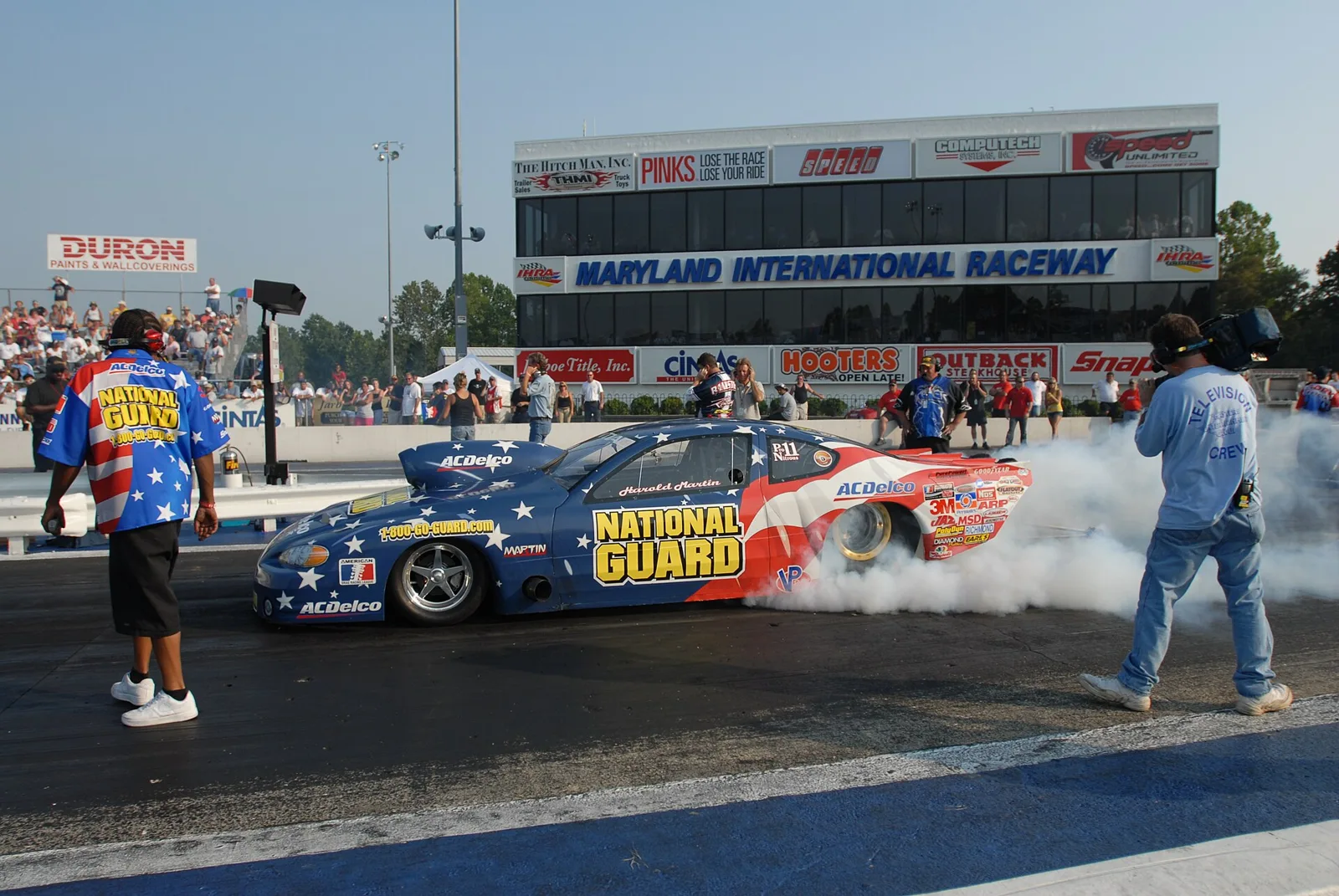
A transmission explosion cost Garlits part of a foot and gave drag racing the rear-engine dragster.
Shirley Muldowney, the first woman with a Top Fuel licence
Shirley Ann Roque was born in Burlington, Vermont, on 19 June 1940 and started street racing in Schenectady, New York, in the 1950s. At 16 she married 19-year-old Jack Muldowney, who built her first dragster and tuned the cars. They divorced in 1972 but stayed friends until his death in 2007. She made her debut at Fonda Speedway in 1958, held an NHRA pro licence by 1965 and ran the 1969 and 1970 US Nationals in a twin-engined Top Gas dragster.
When Top Gas lost popularity, she moved to Funny Car and bought her first car from Connie Kalitta. In 1971 she won her first major event, the IHRA Southern Nationals.
Top Fuel licence, three titles and the Bounty Huntress
Her Top Fuel licence came in 1973, in Poncho Rendon's digger, and she was the first woman to hold one. She needed three signatures on the application, and she got them from Tommy Ivo, Connie Kalitta and Garlits. Between 1973 and 1977 she and Kalitta ran match races as the Bounty Huntress and the Bounty Hunter in a pair of Ford Mustangs, hers on a Buttera chassis and his on a Logghe. Her car caught fire at Dragway 42 in Ohio in 1973.
At Columbus, Ohio, in 1976 she dominated: she qualified number one by 0.05 second, set the low elapsed time in every round, broke her own top speed record in the final and won the class. Three NHRA Top Fuel world championships followed, in 1977, 1980 and 1982. She was the first person to win two and then three Top Fuel titles, and the first woman to claim the most prestigious title in the sport. She won 18 NHRA national events in all, and in 1977 she was the first Top Fuel driver to win three nationals back-to-back.
Opposition, a crash and a comeback
Her success met heavy resistance from people who felt drag racing had no place for a woman. Garlits said she was the driver he respected most, because she went against all odds when the association and the racers did not want her in Top Fuel. Muldowney said the NHRA fought her all the way until it saw that a woman could fill the grandstands.
A crash in 1984 crushed her hands, pelvis and legs. She needed half a dozen operations and 18 months of therapy. She returned to the circuit in the late 1980s, and appeared on the Tonight Show with Johnny Carson on 21 February 1986 walking with a cane. Through the 1990s she raced mostly without major sponsorship in IHRA competition and match-racing events, then ran select NHRA events until she retired at the end of 2003.
The 1983 film Heart Like a Wheel, with Bonnie Bedelia in the lead, told her story. Muldowney thought it missed much of her life but was very good for the sport. Her memoir, Shirley Muldowney's Tales from the Track, came out in 2005, and her charity, Shirley's Kids, helps children in cities where drag racing is part of the community. In March 2016 she was the official starter at the Gatornationals after a lung cancer scare that turned out to be histoplasmosis, a curable fungal infection.
Mickey Thompson, the slingshot and the 400 mph barrier
Marion Lee Thompson was born in Alhambra, California, on 7 December 1928. In his early twenties he worked as a pressman at the Los Angeles Times while hot rodding. He is credited with building the first slingshot dragster in 1954, the Panorama City Special, with the seat behind the rear axle so that the tyres could handle the power of increasingly strong engines. It debuted at the first NHRA US Nationals at Great Bend in 1955 and reached a best of 243.43 km/h (151.26 mph). He also became the first manager of Lions Drag Strip at Wilmington, California.
He and Fritz Voight built a twin-engined dragster in 1958 that reached 473.335 km/h (294.117 mph). In 1960 he drove the four-engined Challenger 1 at Bonneville Salt Flats to a one-way top speed of 406.60 mph, becoming the first American past 400 mph and beating John Cobb's one-way mark of 402 mph. He is credited with setting more speed and endurance records than anyone else in the history of the automobile.
Stock-block Buicks and roller skate cars at Indianapolis
Thompson took on the Indianapolis 500 in the early 1960s. For 1962 he entered three John Crosthwaite-designed cars with a rear-mounted stock-block Buick V8, the first stock-block engine at Indy since 1946. The car was designed and built in 120 days, with a crew working 12- to 14-hour days. The engine was enlarged to 4.2 litres, the regulation maximum, and then detuned for fear it would not last. It was down more than 70 bhp on rivals, yet Dan Gurney qualified eighth and ran ninth until an oil seal seized the gearbox on lap 94. He was placed 20th of 33, and the team won the Mechanical Achievement Award.
For 1963 he brought five cars, three of them Harvey Aluminium Special "roller skate" cars with 12 in (300 mm) wheels and small tyres. One had a titanium chassis. Al Miller was ninth in a modified 1962 car after qualifying 31st, while Duane Carter qualified a roller skate car 15th and was 23rd after his engine failed on lap 100. Old hands complained, and minimum tyre sizes and car weights followed. Graham Hill tested one and refused to race it, saying it would not handle.
In 1964 he returned with three cars on larger 15-in tyres and Ford engines. Dave MacDonald died in a fiery crash on the second lap. Thompson failed to qualify in 1965, skipped 1966 and failed again in 1967 and 1968, the first of those with a rear-engined, four-wheel-steer, all-wheel-drive car.
Tyres, Bonneville and stadium off-road
In 1963 he founded Mickey Thompson Performance Tires, producing special tyres for racing, including for Indianapolis 500 competitors. In 1968 he and Danny Ongais took three Ford Mustang Mach 1 cars to Bonneville and set 295 speed and endurance records over 500-mile and 24-hour courses. With John Buttera and Pat Foster he developed a Mustang Mach 1 Funny Car with a dragster-style chassis. Driven by Ongais, it won the 1969 NHRA Spring Nationals at Dallas and the NHRA US Nationals.
In 1973 he founded SCORE International as a sanctioning body for off-road racing across North America. Together with Trudy he started the Mickey Thompson Entertainment Group, which moved indoor motocross and off-road racing out of the back country and into stadiums and arenas.
On 16 March 1988 two hooded gunmen shot Thompson and Trudy outside their home in Bradbury, California. Jewellery and cash found on the bodies ruled out robbery. Investigators looked at his former business partner, Michael Frank Goodwin, who had refused to pay a settlement of more than $768,000. Goodwin was charged in 2001, again in 2004, and a jury found him guilty on 4 January 2007 of two counts of murder. He received two consecutive life terms without parole. A 2015 appeal ruling called the circumstantial evidence overwhelming, and the two men who carried out the killings have not been found.
Garlits, Muldowney and Thompson compared
| Pioneer | Lasting contribution | NHRA Top 50 rank (1951-2000) | ESPN all-time list, 2008 |
|---|---|---|---|
| Don Garlits | Rear-engine Top Fuel dragster; Nomex suit; 144 national event wins | No. 1 | 23rd |
| Shirley Muldowney | First woman with a Top Fuel licence; three Top Fuel world titles; 18 national events | No. 5 | 21st |
| Mickey Thompson | First slingshot dragster; first American past 400 mph; stadium off-road racing | No. 11 | Not listed |
What did the three do later, and how were they honoured?
Garlits kept testing limits well into his eighties. In 2009, at 77, he raced a specially prepared Dodge Challenger in the Stock class at the US Nationals and lost in the first round. In May 2014 he set a speed record of 296 km/h (184 mph) in Swamp Rat 37, a 2,000 hp battery-powered dragster. In July 2019, aged 87, he reached 304.21 km/h (189.03 mph) in Swamp Rat 38, which has an 800 hp electric motor. He still runs the Don Garlits Museum of Drag Racing in Ocala, Florida.
His voice on safety has carried weight too. After Scott Kalitta died in a crash in June 2008, Garlits backed the NHRA decision to cut Top Fuel and Funny Car races from the quarter mile to 1,000 feet, and he suggested banning rev limiters and returning to a 70/30 mix of nitromethane and methanol.
Muldowney's recognition began in Michigan in 1989 and continued with the national Motorsports Hall of Fame of America a year later, then the International Motorsports Hall of Fame in 2004 and the Automotive Hall of Fame in 2005. For Thompson, who died in 1988, the honours were all posthumous: the American motorsports hall, the international one in 1990, the off-road hall in 2007 and the automotive hall in 2009.