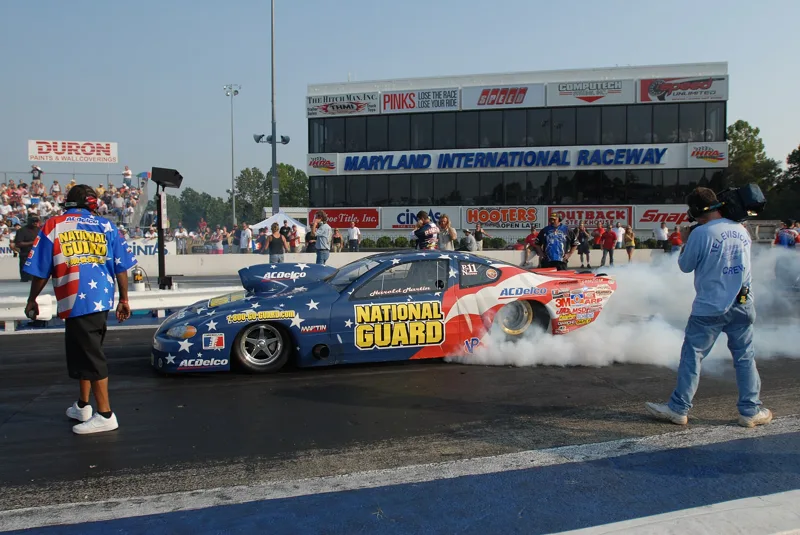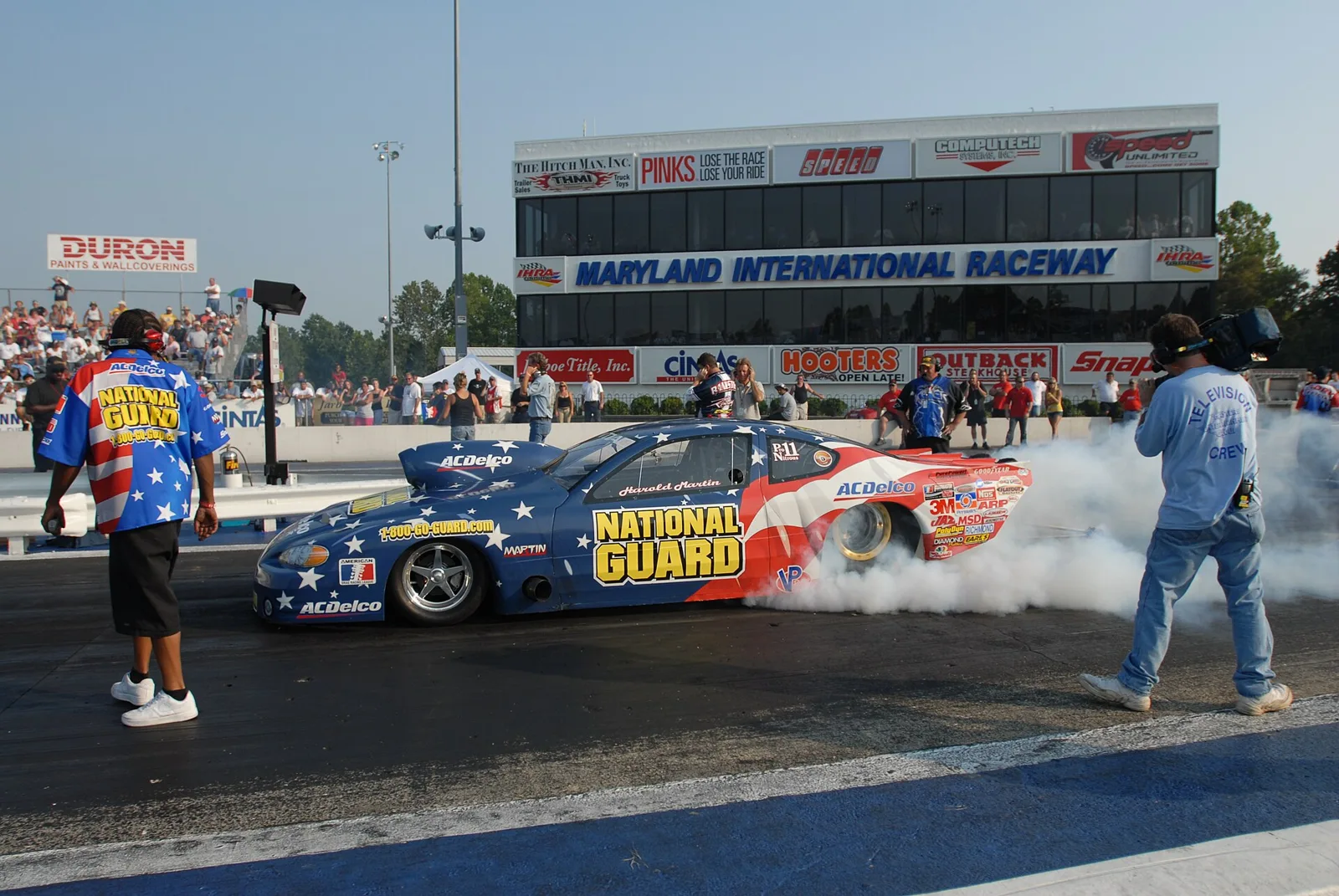
Nitromethane and a claimed 10,000 hp in Funny Car, a 500 cubic inch limit in Pro Stock, and a dial-in handicap in bracket racing, all started by the same seven-light tree.
Funny Cars are supercharged nitromethane V8s under a lift-off body, Pro Stock cars are naturally aspirated 8.2 litre V8s with fuel injection, and bracket racing handicaps any car by a predicted dial-in time. All three launch from the Christmas tree, a seven-light starter staged by two beams.
On a single run, burnout and all, a Funny Car can swallow as much as 57 litres (15 US gallons) of fuel, and its engine is claimed to make 10,000 hp or more. At the other end of drag racing, a weekend bracket racer may drive to the strip, race, and drive home again. One column of coloured lights, the Christmas tree, starts them all.
What is a Funny Car?
A Funny Car is a drag racing class built around a tilt-up body of fibreglass or carbon fibre that sits over a custom-made chassis. The shell hints at a showroom model, but the engine lives ahead of the driver, which is the main difference from a dragster, where the engine sits behind the cockpit.
The bodies follow fashion. In the 1970s the shells represented cars such as the Chevrolet Vega and Plymouth Barracuda, standing in for General Motors, Ford and Chrysler. NHRA racing today carries four badges: the Camaro, Charger, Mustang and Supra. Elsewhere in the world, many other body styles turn up. These fake shells are more than decoration, because they do aerodynamic work.
Running one is not cheap. Fielding a team in 2016 ran to somewhere between US$2.6 million and US$3 million, and a single carbon fibre body can set you back US$70,000. For that money the modern car can rival or even beat a Top Fuel dragster.
A column of seven lights starts every class, from nitromethane Funny Cars to weekend bracket racers.
How does a Funny Car make so much power?
The NHRA rulebook for Funny Cars is mostly an engine rulebook: a V8 of no more than 8.2 litres (500 cu in), supercharged and fed a fuel that is 85 to 90 per cent nitromethane, with methanol making up the rest. The favourite is the Donovan, a design that borrows loosely from Chrysler's second-generation 426 Hemi.
Everything inside is built for violence. Crankshafts are carved by CNC machine from billet steel and then nitrided in an oven to harden the surface. Intake valves are titanium and measure 61 mm (2.40 in) across, while the exhaust valves, made from Inconel, measure 48 mm (1.90 in). Compression ratios run from 6:1 to 7:1, modest by road-car standards, because the supercharger and the fuel do the heavy lifting. The supercharger wears a ballistic blanket because that part of the engine is prone to explode.
Getting that power to the tarmac is a job for the clutch. The car has one fixed gear ratio, 3.20:1, plus a reverse gear, and a multi-stage clutch that locks up progressively as the run unfolds. Think of a driver feathering the pedal in a road car, except that the feathering is preset to suit the conditions, above all the track surface. Torque is estimated at 7,000 ft-lbf (9,500 N m), and the cars routinely pull 6 G from a standing start.
Horsepower figures are claims rather than measurements, and they vary widely, from 10,000 to 11,000 hp (7.5 to 8 MW). The chassis rules are brief: a wheelbase between 2,500 and 3,200 mm (100 and 125 in) and 76 mm (3 in) of ground clearance.
Why do Funny Cars race over 1,000 feet?
Since July 2008 Funny Cars and Top Fuel dragsters have raced over 304 metres (1,000 feet) rather than the full quarter-mile. The NHRA made the change, effective 2 July 2008, after safety evaluations that followed the fatal crash of Scott Kalitta at Englishtown, New Jersey, on 21 June 2008.
Australia's National Drag Racing Championship later adopted the shorter distance too, while Pro Stock and the sportsman classes still run 402 metres (1,320 feet). The visible safety gear is the pair of parachutes that slow the car after the line; roll cages and fire extinguishers work out of sight.
Where did the Funny Car come from?
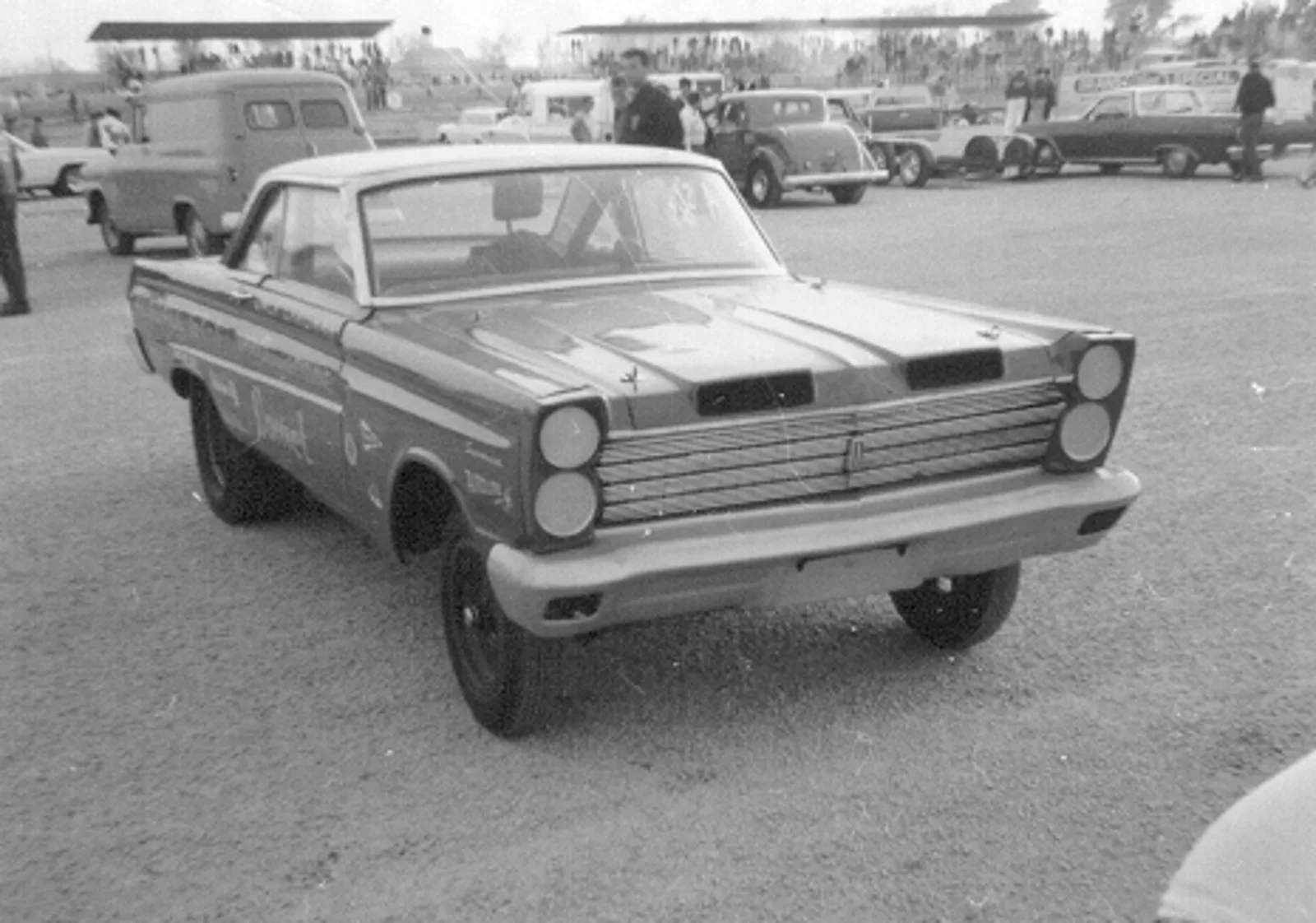
The class took shape in the mid-1960s, when racers put Top Fuel horsepower into bodied cars with altered wheelbases. The name is credited to Fran Hernandez, Mercury's racing chief, who is said to have remarked that his side needed to beat those funny cars.
Traction explains the look. Early rear slicks were bias-ply and gripped poorly, and NHRA rules insisted on tyres only 180 mm (7 in) wide. Moving the axles forward shifted weight rearward and pressed the driven wheels into the surface. The result looked odd, hence the name.
Which car counts as the first depends on who is asked. Three 1964 Dodge 330 Max Wedges, nicknamed the Dodge Chargers, debuted at San Diego Raceway that March. They ran high 10-second passes at about 210 km/h (130 mph) when Super Stock and Factory Experimental cars managed 11s, and they were the first factory cars to carry parachutes. Dick Landy's altered-wheelbase 1964 Dodge 330, which sat well forward on its axles, is the car usually considered the first real Funny Car. Later that year a supercharged Mercury Comet driven by Jack Chrisman created a sensation at the Nationals in Indianapolis with a pass of 10.25 seconds at 251.56 km/h (156.31 mph).
The NHRA treated the whole business as a passing fad and tried to legislate it out of existence, but the cars proved enormously popular. In 1966 came the flopper, a flip-top fibreglass body on a tube chassis, led by Don Nicholson's Comet. Eddie Schartman, in a similar car, beat Chrisman at the 1966 World Final in Tulsa with an 8.28 at 280.69 km/h (174.41 mph) and became the NHRA's first official Funny Car champion. A dedicated Funny Car Eliminator class followed in 1969.
What is Pro Stock?
Pro Stock is a drag racing class of so-called factory hot rods. It is often called all motor because the engines may not use a turbocharger, a supercharger or nitrous oxide, and strict rules govern both the engine and the body that sits over it.
The NHRA class grew out of the production-based Super Stock category in 1970, with looser rules and no handicaps. Big-block V8s were favoured at first, and Chrysler Hemi cars took the first two world titles. For 1972 the NHRA tried to level things by letting small V8 compacts run at favourable weights. In 1973 drivers had to hold competition licences, and at that year's Winternationals "Dyno Don" Nicholson posted the first official Pro Stock elapsed-time record, a 9.33, then bettered it with a 9.01 at 242.21 km/h (150.50 mph).
In 1982 the NHRA scrapped weight breaks for a flat 1,066 kg (2,350 lb) minimum and a 500 cu in cap, because the unlimited-displacement Mountain Motor cars in IHRA racing had become so popular.
How fast is a modern Pro Stock car?
The front runners cover the distance in about 6.47 seconds at more than 343 km/h (213 mph), and qualifying is tight: the gap between first and sixteenth on the grid can be as small as five-hundredths of a second. That from a naturally aspirated engine producing upwards of 1,500 hp, roughly 114 kW per litre (2.5 hp per cubic inch).
The heads are the most sophisticated in drag racing, with valve lift in the region of an inch, and a complete NHRA engine can cost upwards of $100,000. Apart from the NHRA 500 formula from 2018, the engine must come from the same maker as the body. Since 2016 the NHRA has required electronic fuel injection, with an engine control unit capping revs at 10,500 rpm, although modern engines approach 12,000 rpm. That change killed off the double four-barrel carburettors and the tall hood scoop that housed the tunnel-ram manifold, a layout that had been the most effective for nearly 40 years. The NHRA said the change reflected modern road cars, which had used fuel injection for more than 20 years.
Underneath, the cars are tidier than they look. The chassis is welded chrome-molybdenum tubing with an integrated cage around the driver, a feature that followed Bob Glidden's violent rollover at Commerce, Georgia, in 1986, and the fuel is 118-octane racing gasoline.
The bodies are NHRA-approved carbon fibre with polycarbonate windows, and some critics argue that the word stock no longer fits when so little of a body comes from a manufacturer's factory. Mountain Motor cars, with engines above 800 cu in, drop into the 6.30s at almost 354 km/h (220 mph), and the fastest car at the 2019 Houston race ran 6.233 seconds.
Who has won the most in Pro Stock?
Bob Glidden holds the record with ten championships. In 1974 and 1975 he became the first driver to win two. Across 1978 and 1979 he reached 18 of 19 final rounds and won 14, nine of them consecutively, a streak many regard as one of the most impressive in the sport.
Greg Anderson, a six-time champion, holds the single-season mark of 15 wins from 23 events, in his 2004 title year. Lee Shepherd took four titles in a row from 1981 to 1984. Erica Enders won in 2014, 2015, 2019, 2020, 2022 and 2023, and Dallas Glenn is the 2025 champion.
How do the three kinds of racing compare?
| Feature | Funny Car | Pro Stock | Bracket racing |
|---|---|---|---|
| Engine rule | V8, up to 8.2 litres (500 cu in) | 90-degree V8, 8.2 litres (500 cu in) in the NHRA | Any car that passes basic inspection |
| Power adders | Supercharger and nitromethane | None, naturally aspirated | Cars are handicapped by dial-in instead |
| Race distance | 304 metres (1,000 feet) in NHRA racing | 402 metres (1,320 feet) | Eighth-mile, 1,000 feet or quarter-mile |
| Cost | US$2.6 million to US$3 million for a team in 2016 | Engine alone upwards of $100,000 | Some racers drive their cars to the track and home again |
| Starting tree | Professional tree, all ambers together | Professional tree, all ambers together | Staggered start by the gap between the dial-ins |
How does bracket racing work?
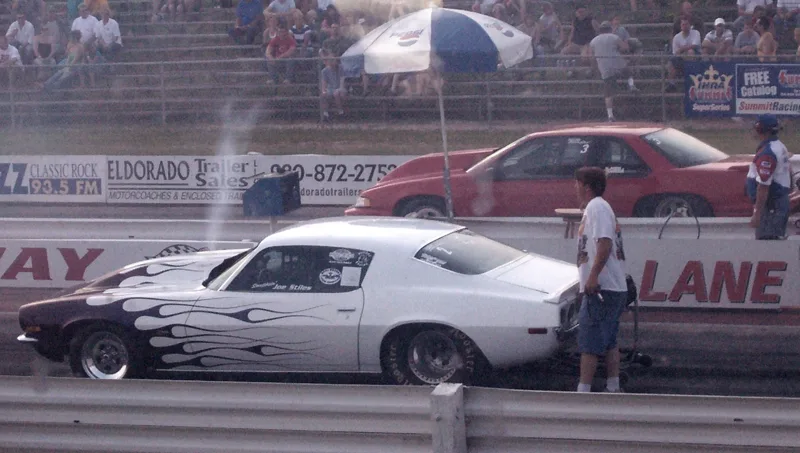
Bracket racing handicaps the cars against each other. Before the race each driver chooses a dial-in time, a prediction of the elapsed time the car will take, usually based on practice runs. The slower car gets the green light first, by exactly the gap between the two dial-ins.
In principle, two drivers with equal reactions whose cars run precisely their dial-ins arrive together. In practice that almost never happens, and timing gear that splits a second into hundred-thousandths makes a dead heat close to impossible. The format grew up in the western United States and Hawaii at the end of the 1960s, first as E.T. bracket racing, and by 1970 meetings were being held coast to coast. The NHRA set up a championship schedule for it in 1977.
The point is consistency. Because skill matters more than money, the format suits casual weekend racers and lets very different cars share the strip.
What is a breakout in bracket racing?
A breakout means beating your own dial-in. When one car does it, that car is disqualified and its opponent wins; when both do, the one nearer its number takes the round. Of all the fouls, it is the mildest.
Some breakouts are absolute, set by the licence of the driver or the certification of the chassis. They bring immediate disqualification and loss of every point earned at the event. A full-bodied car certified for 7.50 seconds that runs 7.49 is one example, and so is a car that reaches 240 km/h (150 mph) in the quarter-mile without a parachute. Rules like these stop anyone gaining a head start by posting a slow dial-in. Some racers still dial slowly and then lift or brake near the end, using strategy rather than the car to win.
How do bracket racers win by thousandths?
The winner is whoever puts up the best package, which is reaction time plus deviation from the dial-in. A driver whose reaction is 0.025 seconds and whose car runs 9.653 on a 9.64 dial-in posts a package of 0.038. A rival who reacts in 0.005 and runs 10.684 on a 10.66 dial-in posts 0.029, and wins despite running further off the number.
That 0.009-second margin works out to about 22 inches at about 140 mph. Reaction time is often confused with the 60 foot time, but they measure different things: reaction time compares the launch with the green light, while the 60 foot time shows how quickly the car itself starts moving, whatever the driver did.
What does the Christmas tree do?
The Christmas tree is the electronic starter. A common tree has a column of seven lights for each lane: a blue pair at the top for staging, then three amber lights, a green and a red. The lights come alive once the cars are properly staged, and the green tells the driver to go.
Staging uses two light beams across the track, one at the starting line and one 180 mm (7 in) behind it. Breaking the rear beam lights the top blue light, the pre-stage signal. The driver then rolls forward 180 mm (7 in), keeping the front wheels behind the line, to light the lower blue light. Once one driver is staged, the opponent has seven seconds to follow or is timed out and disqualified. When both are in, the countdown begins within 1.3 seconds.
The countdown depends on the tree. A standard or sportsman tree lights the amber bulbs one after another at half-second intervals, then shows green half a second after the last. A professional tree lights all three ambers together and shows green four-tenths of a second later, or half a second in Super Street. For anyone watching a pro class, that sudden flash is why reaction times are so small.
What happens when a driver leaves too early?
Rolling out of the beams before the green lights the red bulb and halts the countdown, though in a heads-up start that alone does not end a driver's day. Leaving before the tree is activated, when the first yellow light is on, is worse: the car is out whatever the other driver does.
Staggered-start bracket races add a twist. Since 2016, under the TruSTART system, the first driver always sees green, even if he jumped it, and the verdict comes once the second driver goes. If both leave early, only the lane with the worse early start is shown red; in one example, minus .021 in the left lane against minus .020 in the right sends the red to the left. Before TruSTART the first early starter simply got a red and the opponent a green.
When both cars foul, the lesser offence wins. From mildest to most serious the order runs: breakout, red light, crossing the edge boundary, crossing the dividing line, leaving before the tree, failing technical inspection, and an absolute breakout.
Who invented the Christmas tree?
Nobody agrees. According to a 2013 issue of National Dragster, Ed Eaton of the NHRA approached Chrondek founder Oliver Riley in 1962 with the idea of a step-light countdown, and Chrondek unveiled it at the 1963 U.S. Nationals in Indianapolis. A rival claim credits W.H. David Jr. of Lafayette, Louisiana, with building the first in the late 1950s and selling the rights to Chrondek.
The name, on that second version, came from the small glass Christmas tree lights used in his miniature prototype. The need was real either way. With bracket racing, a slower car left ahead of the faster one, so the flagman had to stand a few feet in front of it, a serious safety problem, and flagged starts were not uniformly accurate.
How has the tree changed?
The original had five amber lights and no pre-stage or stage bulbs, which were added at the 1964 Winternationals in Los Angeles and crept from the track onto the tree itself over several seasons. The Professional Tree appeared in 1971. In 1986 two ambers were dropped from each side because Pro Stock hood scoops hid the lowest bulb, and the NHRA said it would save around four minutes.
LEDs replaced incandescent bulbs at Pomona in 2003. Teams had been changing as many as twenty bulbs a meeting because the vibration of Top Fuel exhausts broke the filaments, and reaction times fell afterwards. Before the 2009 season the starter pressed the switch, and drivers learned to anticipate the moment, so code added a random delay after the second car staged. The blue staging bulb arrived at the 2011 spring race in Charlotte.
The NHRA has used CompuLink timing systems since 1984. Chrondek was sold to Daktronics in the 1980s, though a few strips still run its old equipment. For the 2026 season, US 131 Motorsports Park and Rockingham Dragway are the two NHRA venues still on older Accutime trees.