Extra oxygen from a gas bottle, a cooling mist that tames knock, and a supercharger paired with a turbo to remove lag.
Nitrous oxide supplies extra oxygen by decomposing in the engine, water injection cools the charge to reduce knock, and a twincharger pairs a supercharger with a turbocharger to remove lag. Each raises power in a different way, and each has costs in complexity, reliability or legality.
The 1976 Daytona 500 was rocked by scandal after NASCAR found nitrous oxide in the top qualifying cars. A gas stored in a bottle had given racing engines power that the rulebook did not allow, and most sanctioning bodies still disallow it today.
Nitrous oxide, water injection and twincharging attack the same limit from different directions. Each tries to get more out of a cylinder than air and fuel alone allow, by supplying oxygen, by keeping the heat under control, or by filling the cylinder with air at higher pressure more quickly.
How does nitrous oxide boost an engine?
A nitrous oxide engine burns fuel with oxygen from two places: ordinary air and the gas released when nitrous oxide, N2O, breaks down. The extra oxygen lets the engine burn fuel at a higher-than-normal rate, which is where the added power comes from. The system is often called nitrous or NOS, a name taken from the initials of Nitrous Oxide Systems, Inc., now a brand of Holley Performance Products. Calling it nitro is a mistake, since that word points to nitromethane engines.
The chemistry is simple. When a mole of N2O decomposes it gives off half a mole of oxygen and one mole of nitrogen. That allows an oxygen concentration of 36.36 percent, against the 21 percent found in air. The nitrogen does not burn, but the oxygen does, combining with fuels such as petrol, alcohol, diesel, propane or compressed natural gas.
There is a cooling effect as well. Nitrous oxide is kept as a liquid in tanks but is a gas at normal pressure, and when it is injected as a liquid into the inlet manifold, the vaporisation and expansion cool the air and fuel charge. A cooler charge is denser, so the cylinder fills better. The breakdown of the gas itself gives off heat, and the larger the gap in temperature between the unburned mixture and the hot gases, the better the engine performs.
Nitrous, water and a second compressor all chase the same prize: a fuller, cooler, faster-filling cylinder.
Dry and wet nitrous systems
There are two kinds. In a dry system the nitrous arrives alone and the extra fuel comes through the normal injectors, which are made to flow more by raising fuel pressure or by holding them open longer. That keeps the manifold free of liquid fuel, hence the name. Dry systems are not normally used with carburettors, which cannot supply large amounts of fuel on demand.
In a wet system, nitrous and fuel travel together, wetting the manifold. Engines with port or direct fuel injection need care here, because their intakes were designed to carry air only. Fuel is heavier than air and is not a gas when used with nitrous, so it can pool or be distributed unevenly, which risks backfires, lean conditions, detonation and possibly catastrophic damage. Carburettor and throttle body engines, with manifolds made to carry fuel, mostly avoid the issue.
| Delivery method | How it works | Notes |
|---|---|---|
| Single nozzle | One injection point, after the air filter on injected engines and after the throttle body on carburetted ones | High pressure turns the fuel into a fine spray in wet systems |
| Direct port | A nozzle in every intake runner | Most precise, delivers the greatest total amount and is the most common in racing |
| Plate | A spacer with drilled holes between the throttle body and the intake ports | Needs no drilling and is the easiest to reverse |
| Bar | A hollow drilled tube inside the intake plenum | Almost always dry, and popular with racers who want it hidden |
Jets, small orifice inserts, and pressure calculations meter the flow to give the right air-fuel ratio for the extra power wanted. Kits can be stacked as two, three or four stages, but the most advanced setups use an electronic progressive delivery unit that lets a single kit do better than several. Many Pro Mod and some Pro Street drag cars use three stages, though more and more are moving to pulsed progressive technology. A progressive system brings the extra power and torque in gradually instead of all at once, cutting the risk of mechanical shock.
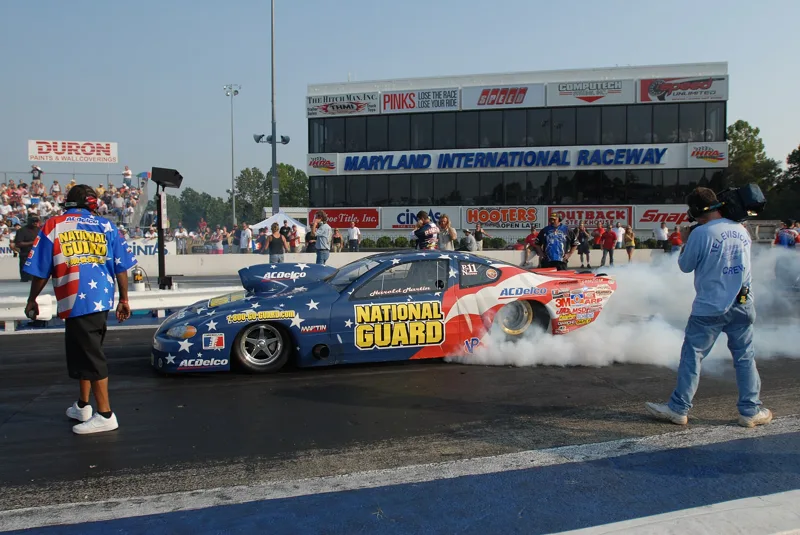
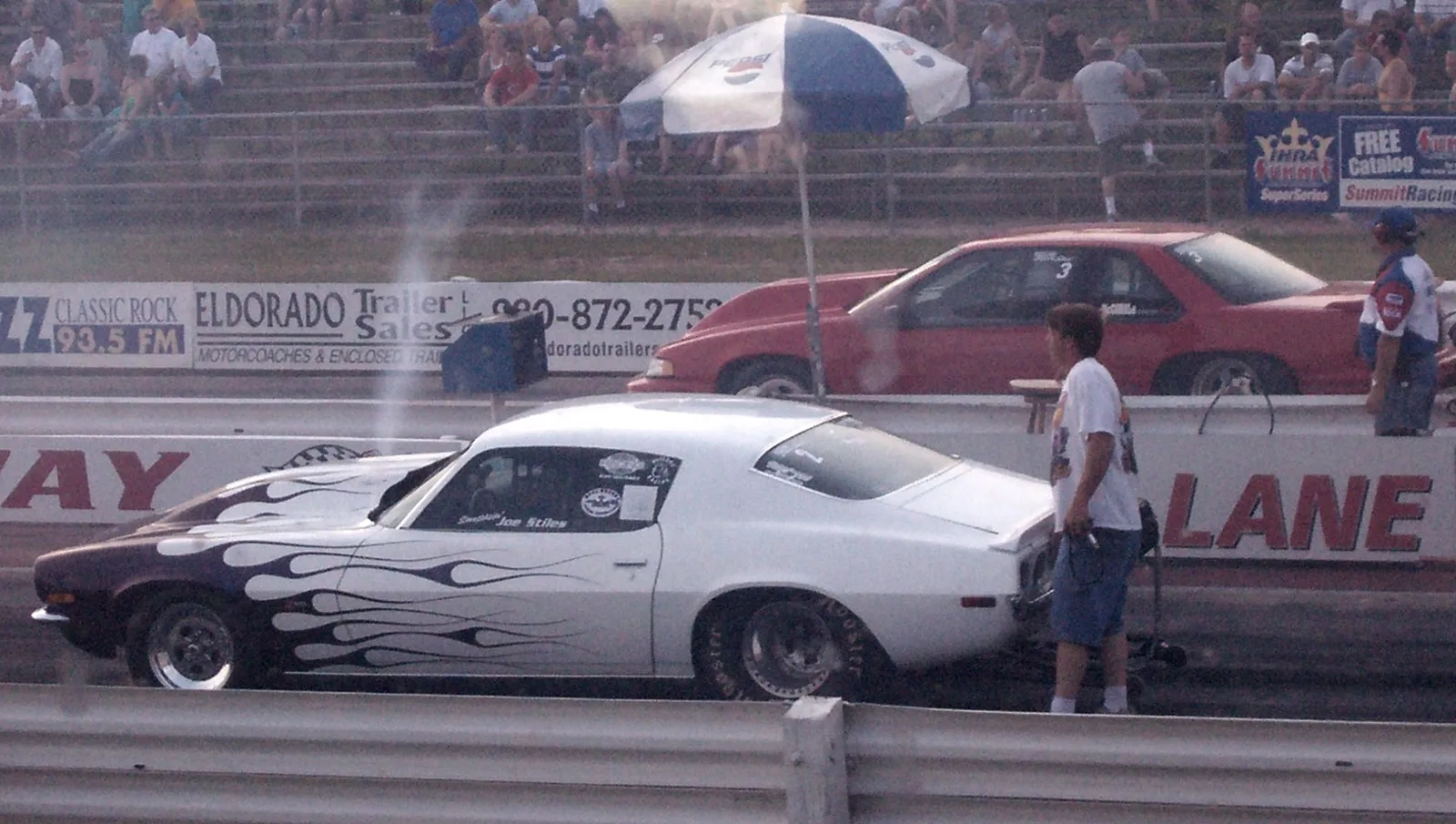
A nitrous car is often recognised by its purge. Before the start line the driver opens an electric valve to clear air and gaseous nitrous from the lines, so that liquid reaches the solenoid, and a plume of vapour is visible for a moment. It matters because vapour in the lines would make the car bog for an instant, with the mixture too rich, until liquid arrives at the nozzle.
What nitrous costs: reliability, law and racing rules
Higher cylinder pressures put the whole engine under greater stress, mainly the rotating assembly, and parts not up to it can crack or destroy pistons, connecting rods, crankshafts and blocks. Strong components and accurate fuel delivery are the keys to using nitrous without catastrophic failure. It should not be used with an automatic transmission, because the added power and torque may damage the torque converter and gearbox.
The rules differ by place. New South Wales, Australia, bans it outright: the Roads and Traffic Authority code on light vehicle modifications, applied since 1994, says in clause 3.1.5.7.3 that nitrous oxide injection may be neither used nor fitted. In Great Britain there is no restriction, but the modification must be declared to the insurer, which is likely to mean a higher premium or a refusal. Germany, despite strict TUV rules, allows a nitrous system in a street car, with technical requirements similar to those for aftermarket natural gas conversions.
In competition, most sanctioning bodies disallow it and it is strictly prohibited in the professional drag racing classes. Pro Modified once included nitrous, but as forced induction cars have taken over, groups such as PDRA and IHRA have created a nitrous-specific class called Pro Nitrous. Formula Drift allows it.
Why inject water into an engine?
Water injection, also known as anti-detonant injection, sprays water into the incoming air or mixture, or straight into the combustion chamber. The aim is cooling: it takes heat from hot points in the induction system that could cause premature ignition. In petrol engines, the cooling effect reduces knock, and that allows a higher compression ratio. Significant gains are available when it is used together with a supercharger, a turbocharger or aggressive ignition timing. Depending on the engine, power and fuel efficiency can improve from injecting water alone, and it can also cut nitrogen oxide or carbon monoxide emissions.
The fluid is often a mixture of water and alcohol, close to half and half, with a trace of water-miscible oil. Water does the cooling thanks to its high heat capacity. The alcohol burns and also stops the water freezing, while the oil protects the injection and fuel system from corrosion.
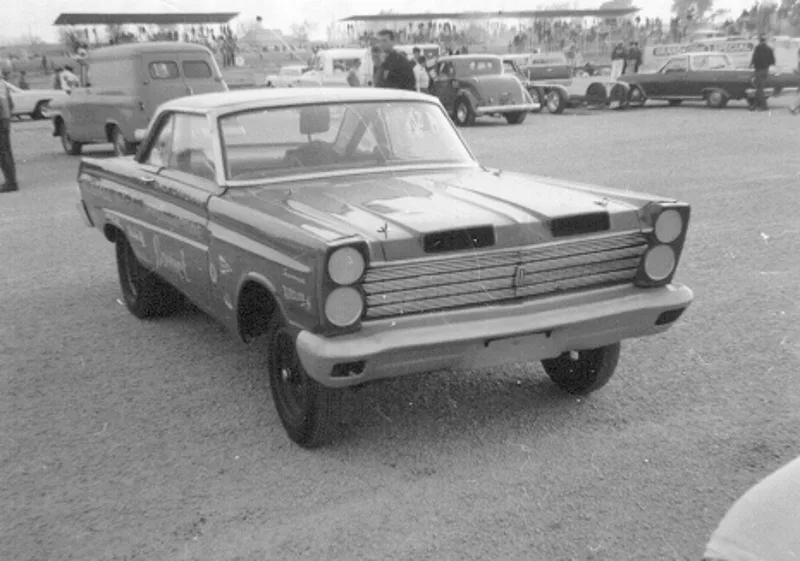
Historically it boosted military aircraft engines for short periods, such as combat or take-off, and it has been used in motorsport, notably drag racing. Among road cars, a few turbocharged or supercharged models from makers including Chrysler used it; the 1962 Oldsmobile Jetfire came with the Turbo Jetfire engine. Saab used it in the 1978 Saab 99 Turbo S for an extra 11 to 15 kW (15 to 20 hp) from its 2-litre engine, and in the 1980 Saab 900 Enduro.
BMW brought it back in 2015 on the M4 GTS, which has the turbocharged 2,979 cc straight-six S55 engine. Water injection with intercooling gave the car, by BMW's account, an extra 37 kW (50 hp), lifting output to 368 kW (493 hp), with torque of 600 Nm (443 lb ft). Three water injectors let boost rise from 17.2 to 21.6 psi (1.19 to 1.49 bar) over the N55 engine it was based on. The car was the official MotoGP safety car in 2015 and went on sale in 2016.
Bosch, which developed the system with BMW, offers water injection under the name WaterBoost to all manufacturers. It traces its heritage to the BMW 801D in 1942, which never reached production because the cylinder heads developed micro-cracks with the methanol-water mixture. Later Messerschmitt Bf 109 versions with the Daimler-Benz DB 605 engine were fitted with the system from early 1944. Today Bosch claims up to a 5 percent gain in performance, up to 4 percent less CO2 and up to 13 percent better fuel economy.
The refilling problem, and rival technologies
Water injection and cooled exhaust gas recirculation can be seen as competitors. Tests have shown that at medium load, port water injection at 40 to 50 percent of the fuel quantity does the work of an EGR rate of 10 percent, a figure regarded as fairly modest even for petrol engines.
The need to top up the tank is considered one of the main barriers to mass adoption, as surveys show limited willingness to refill an extra fluid regularly. The answer under investigation is on-board water generation in a closed loop. Three sources are being studied: humidity from the air, such as air conditioning condensate; rain water collected from the car body; and condensate from the exhaust. The first two depend on weather and driver habits, while the exhaust offers a dependable supply, since there is approximately 1 litre of water vapour in the exhaust for each litre of petrol burned. In October 2019, Hanon Systems and FEV presented an Audi TT Sport demonstrator whose water injection ran as a closed system thanks to a water harvesting unit. A 2016 diesel study that injected water into the exhaust manifold and drew it back with exhaust gas reported up to an 85 percent cut in nitrogen oxide emissions, with less soot as well.
What is a twincharger, and what does it achieve?
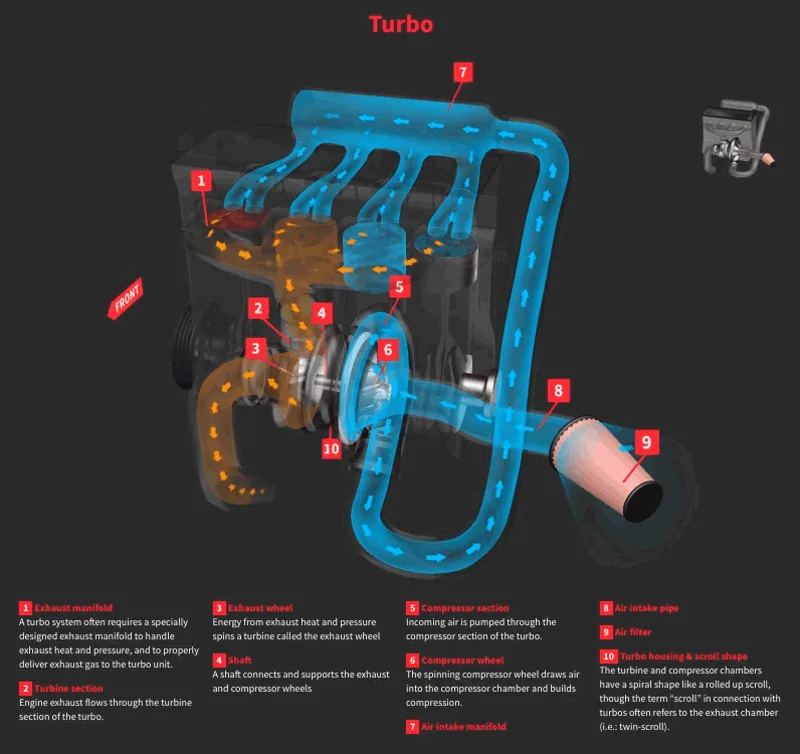
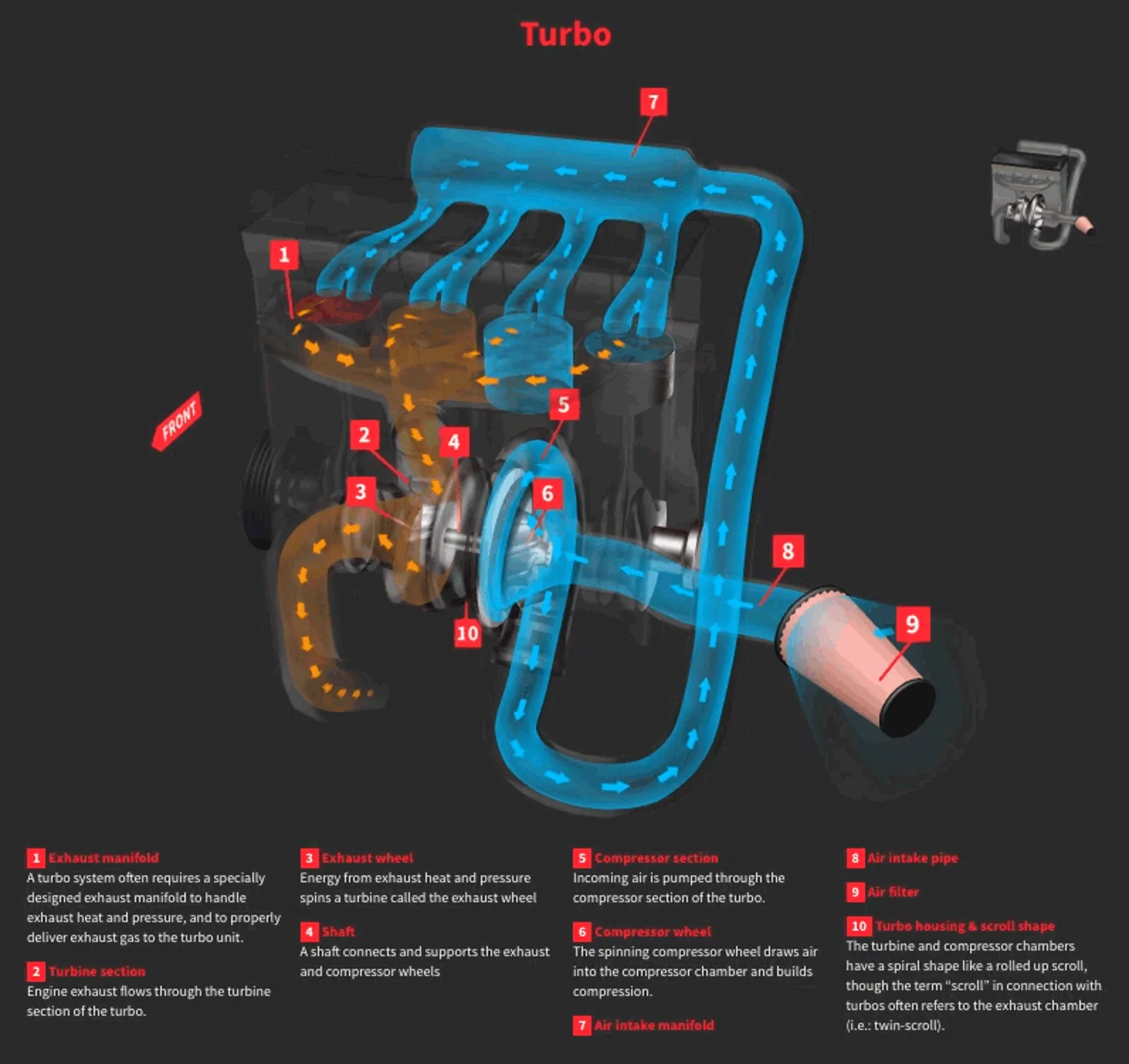
A twincharger is a compound forced induction system that uses both an exhaust-driven turbocharger and a mechanically driven supercharger, each covering the other's weakness. It is not the same as a twin-turbo, which uses two turbochargers.
The weaknesses are well known. A positive-displacement supercharger, a Roots or twin-screw design, responds sharply and gives low-rpm performance because it does not wait for exhaust pressure, but it is less efficient than a turbo because of the power it drains. A turbo big enough to move a large volume of air tends to respond slowly to the throttle, while a small, responsive one may fall short on boost at high revs. Put them together and the supercharger gives pressure quickly while the big turbo catches up, which produces a lag-free power band with strong torque low down and extra power at the top. That is why twincharging suits small engines with a wide rev range, such as Volkswagen's 1.4 TSI.
Series and parallel twincharging
In the more common series layout, one compressor feeds the inlet of the other. A supercharger is connected to a medium to large turbocharger. The supercharger supplies manifold pressure almost instantly, eliminating the turbo lag that would otherwise occur. Once the turbo has reached operating speed, the supercharger can keep compounding the pressure, or it can be bypassed and disconnected by an electromagnetic clutch and valve, which makes the induction more efficient.
Where no bypass is fitted, the pressure ratios multiply rather than add. A turbo making 10 psi (0.7 bar) on its own, feeding a supercharger that also makes 10 psi, would give 27 psi (1.9 bar) instead of 20 psi (1.4 bar). Efficiencies do not multiply, though: a 70 percent efficient turbo feeding a 60 percent efficient Roots supercharger gave a total of about 62 percent in the worked example. The Volkswagen 1.4 TSI and the Toyota 4A-GZE use an electromagnetic clutch to take the supercharger out of the loop at low load. In a series layout the turbo can also be the cheaper, more durable journal bearing type.
Parallel arrangements usually need a bypass or diverter valve. Without one, the supercharger would blow backwards through the turbo's compressor, since that is the path of least resistance, so turbo air is vented until the intake manifold reaches the right pressure.
The main drawback is complexity and cost. Acceptable response and smooth delivery usually call for expensive electronic or mechanical controls, and a spark-ignition engine needs a low compression ratio if the supercharger makes high boost, which takes back some of the efficiency of a small engine.
Twincharged cars you can name
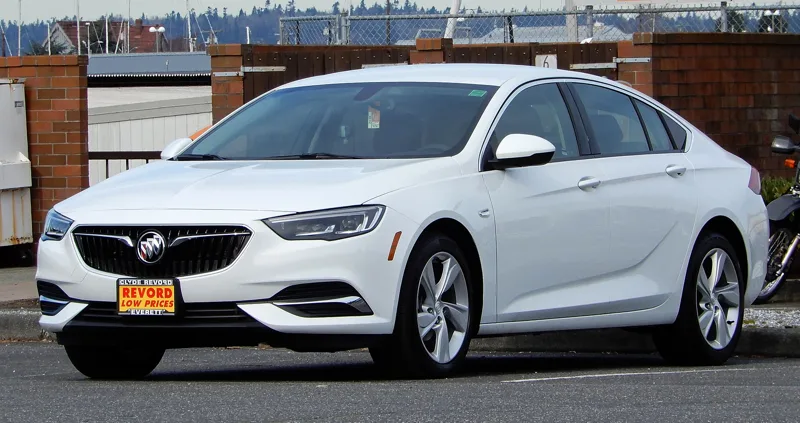
Lancia got there first, in 1985, with the Group B rally car called the Delta S4 and its road-going twin, the Delta S4 Stradale. Nissan adapted it for production with the March Super Turbo, and the Micra Superturbo R used the twincharged MA09ERT engine. The Volkswagen 1.4 TSI, a 1400 cc unit used across the VW Group, pairs both chargers and comes in eight power ratings. Volvo builds a twincharged 1969 cc four-cylinder for its T6, T8 and Polestar models, with the T8 adding a rear electric motor. Jaguar Land Rover makes a twincharged 3.0-litre six, and the Danish Zenvo ST1 supercar runs a 7.0-litre V8 with both chargers. Several companies have also made aftermarket kits for cars such as the Subaru Impreza WRX, Mini Cooper S, Ford Mustang and Toyota MR2.
Three ways to add power, side by side
| Method | What it adds or controls | Main drawback |
|---|---|---|
| Nitrous oxide | Extra oxygen from the gas, plus charge cooling | Stress on the engine; banned or restricted in many places and series |
| Water injection | Cooling that reduces knock and allows more boost or compression | The tank must be refilled unless water is made on board |
| Twincharging | Pressure from a supercharger at low revs and a turbocharger at high revs | Complexity and cost |
Twincharging also competes with other ways to cut turbo lag. Anti-lag systems burn fuel in the exhaust manifold to keep the turbo spinning, which greatly shortens the turbine's life, so twincharging's biggest advantage in race cars is reliability. Variable-geometry turbochargers, twin-scroll designs and sequential twin turbos pursue the same aim. Nitrous oxide can even help a turbo car: it burns more fuel while the turbo is slow, and the extra exhaust gas gets the turbo up to speed sooner, though the system and the gas are costly. An aftermarket water injection kit can be fitted to petrol and diesel engines to add to the benefits of forced induction.
What this means for buying or driving a car
Factory engines with water injection or twincharging are engineered around the extra stress. Aftermarket nitrous is another matter: it demands strong internals, careful fuel delivery and, in places such as New South Wales, it is not permitted on the road at all. In Great Britain, a nitrous fit must be declared to the insurer.
Where this goes next
By the mid-2020s, water injection development has turned toward fuel consumption as well as power, under pressure to reduce CO2. Bosch's claims of up to 13 percent better fuel economy point that way, and the on-board water generation demonstrated by Hanon Systems and FEV in 2019 targets the refilling barrier. In drag racing, more nitrous cars are switching to pulsed progressive technology.