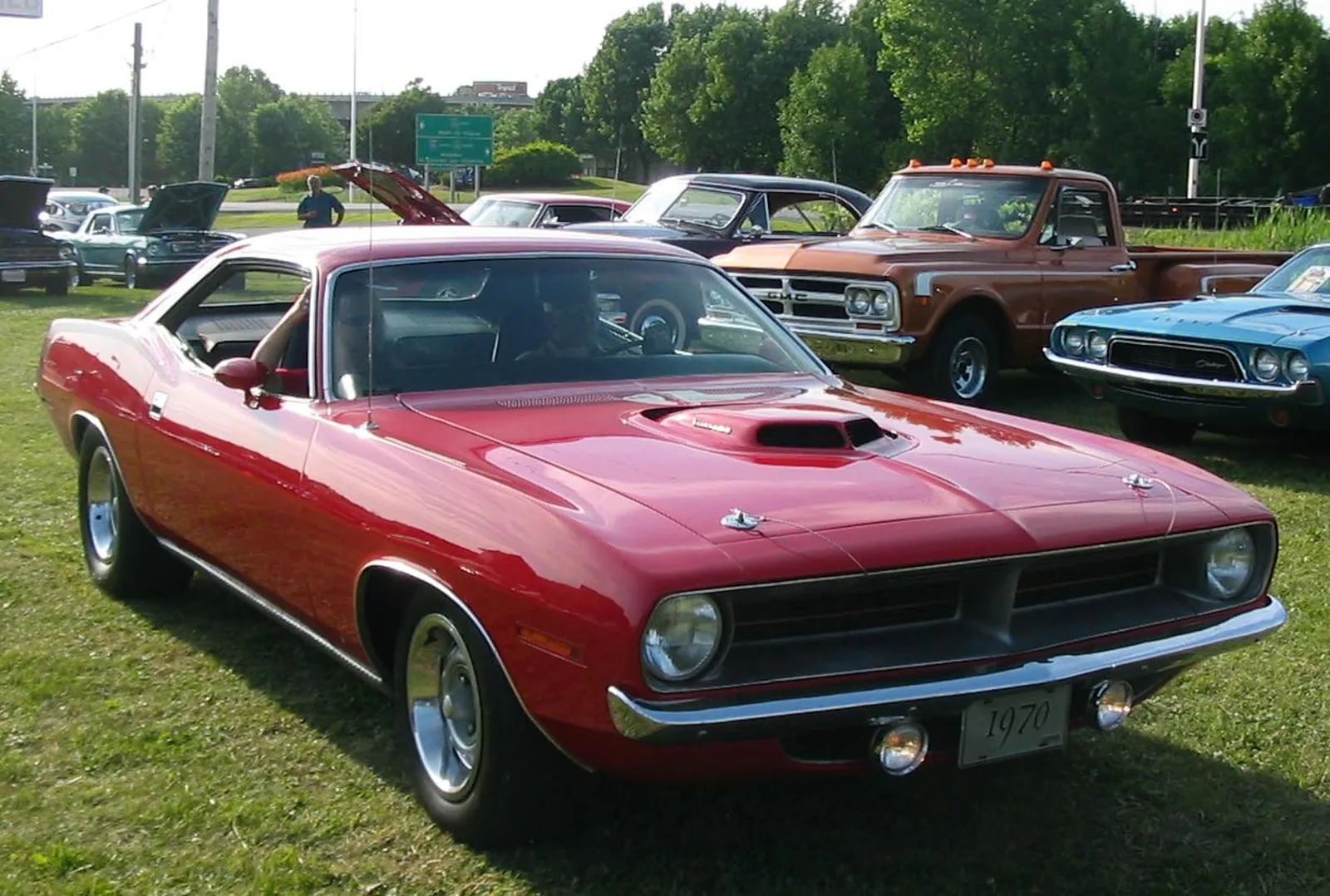
A Valiant-based fastback that grew into an E-body muscle car, with Hemi power, a racing record and a 1974 end date.
Chrysler built the Barracuda from 1964 to 1974 as a Valiant-derived fastback that became a model-specific car in 1967. Its final generation rode on the E-body platform, and Hemi options were offered on the 1970 and 1971 cars before the 426 was retired.
The Plymouth Barracuda was a two-door pony car built by Chrysler Corporation from 1964 to 1974. It began as a fastback based on the Valiant, moved to its own model-specific sheet metal in 1967, and became an E-body muscle car for its final generation. Production ended on April 1, 1974, ten years to the day after the car first appeared.
Where did the Barracuda come from?
The Barracuda was Chrysler's answer to the pony car boom that Ford had started. Ford planned a sporty compact on the Falcon chassis, which eventually became the Mustang in mid-model year 1964. Chrysler's budgets were tight because the company was also spending on the Chrysler Turbine Car, but its executives still wanted an entry in the new segment.
Chrysler stylist Irv Ritchie sketched a fastback version of the compact Valiant. The car was meant to draw some sales away from the Chevrolet Corvair Monza. Plymouth's executives wanted to call it the Panda, an idea that the designers disliked. In the end, John Samsen suggested Barracuda, and that name stuck.
A Valiant-based fastback that became an E-body muscle car, with Hemi power and a collectible final decade.
How did the first-generation Barracuda go on sale?
The first Barracuda debuted in fastback form on April 1, 1964, on Chrysler's A-body platform. It used the Valiant's 106 in (2,692 mm) wheelbase, along with the Valiant's hood, headlamp bezels, windshield, vent windows, quarter panels, doors, A-pillar and bumpers. Only the trunk and some of the glass were new.
The car's signature feature was its 14.4 sq ft (1.34 m2) rear window, the result of a collaboration between Pittsburgh Plate Glass (PPG) and Chrysler designers. It was the largest ever installed on a standard production car to that point. Plymouth had reused the Valiant's underpinnings to keep development costs and tooling time down, a similar approach to the one Ford took with the Falcon and Mustang.
The sales brochure pitched the Barracuda as a car for people of all ages and interests. Its image was that of a frugal family car with a fastback shape,. The Mustang, meanwhile, was marketed heavily to young professionals after its mid-1964 introduction, though the Barracuda had reached showrooms two weeks earlier.
How many Barracudas sold in 1964?
The abbreviated 1964 sales season totalled 23,443 Barracudas, compared with 126,538 Mustangs sold over the same period. The first car went on sale at US$2,512, which equates to about $26,000 today.
The Mustang's success overshadowed the point that Plymouth's car arrived first.
What engines did the early Barracuda offer?
The Barracuda used the same powertrains as the Valiant, including two versions of Chrysler's slant-six. The standard engine was a 170 cu in (2.8 L) unit producing 101 bhp (75 kW), and the 225 cu in (3.7 L) option raised output to 145 bhp (108 kW). The 1964 V8 was the new 273 cu in (4.5 L) LA engine, rated at 180 bhp (130 kW) with a two-barrel carburettor.
In 1965, the 225 slant-six became the base engine in the United States, while the 170 remained the base engine in Canada. A Commando version of the 273 arrived with a four-barrel carburettor, 10.5:1 compression and a more aggressive camshaft, raising output to 235 bhp (175 kW).
The Formula 'S' package bundled the Commando V8 with suspension upgrades, larger wheels and tyres, special emblems and a tachometer. Disc brakes and factory air conditioning became available after the start of the 1965 model year.
How did the 1966 model differ from the 1965?
The 1966 model year brought new taillamps, new front sheet metal and a new instrument panel. The fenders gained a more rectilinear contour, and the bumpers were made larger. The grille received a strong grid theme, and a centre console was offered for the first time.
Plymouth wanted the Barracuda to be seen as a distinct model rather than a Valiant with extra glass. The Valiant chrome script on the trunk lid was phased out at the end of the 1965 model year in the United States, and the large stylised V above the deck lid became a Barracuda fish logo for 1966. Canada and South Africa treated Valiant as a marque in its own right, so cars there carried the Valiant Barracuda name.
How was the second-generation Barracuda redesigned?
The second generation, built from 1967 through 1969, was redesigned with model-specific sheet metal, though it still shared many components with the Valiant. It rode on a 108 in (2,743 mm) A-body wheelbase and came as a convertible, a notchback coupe and the fastback. The new body was chiefly the work of John E. Herlitz and John Samsen.
The design introduced Coke-bottle side contours and heavily revised front and rear ends. Wheel openings were wider, the side glass was curved, and the hardtop had S-curved roof pillars. The fastback roofline was more streamlined and more steeply raked, and its massive wraparound rear window was replaced by a much smaller flush unit.
The overall use of chrome trim was more restrained than before. Chrysler also responded to the first US federal auto safety standards, which were being phased in at the time, and the side-marker lamps of each model year offer a way to date the cars.
How can you tell the second-generation model years apart?
The 1967 cars had no side-marker lamps or reflectors, and their backup lights sat on the rear valance by the number plate. The 1968 cars added round side-marker lamps without reflectors, with mostly white tail lamps that held the backup lights in their housings.
The 1969 cars brought small changes to the front grille, rectangular side-marker reflectors without lamps, and backup lamps moved back to the rear valance by the number plate. Those three differences make the model years easy to identify today.
What engines did the second generation offer?
In 1967 the 225 slant-six was still the base engine. Among the V8s, buyers could pick a two- or four-barrel 273 cu in (4.5 L), or a rarely ordered 383 cu in (6.3 L) B big-block rated at 280 bhp (209 kW) that came only with the Formula S package.
In 1968 the 273 was replaced as the smallest V8 by the 318 cu in (5.2 L) LA engine, and a 340 cu in (5.6 L) LA four-barrel arrived. The 383 Super Commando picked up intake, camshaft and cylinder head parts from the Road Runner and Super Bee, but restrictive A-body exhaust manifolds held its output to 300 bhp (224 kW).
The 1969 version of the 383 was upgraded to 330 bhp (246 kW). Plymouth also launched a new trim package called 'Cuda, based on the Formula S option, which could be ordered with the 340, the 383 or, new for 1969, the 440 Super Commando V8.
Were there Hemi fastbacks built for drag racing?
Yes. Chrysler built about fifty fastback Barracudas with the 426 cu in (7.0 L) Hemi for Super Stock drag racing in 1968. Hurst Performance assembled them, and they used lightweight Chemcor side glass, fibreglass front fenders, a fibreglass hood with a scoop and lightweight front seats.
Rear seats and sound deadener were omitted from the Super Stock cars. Each one carried a sticker stating that it was not for use on public roads. In 1968 these cars could run the quarter-mile in the mid-tens.
Chrysler also sold a South African high-performance version of the 225 slant-six, called the Charger Power, which produced 190 bhp (142 kW). It used a 9.3:1 compression ratio, a two-barrel carburettor and a low-restriction exhaust.
Why did the Barracuda switch to the E-body?
Styling for the all-new 1970 car came from John E. Herlitz, and the body sat on the E-body, a platform derived from Chrysler's B platform but shorter and wider. The redesign removed all commonality with the Valiant. The fastback was dropped, leaving only a coupe and a convertible, and the car shared its platform with the Dodge Challenger without sharing any outer sheet metal.
The Challenger's 110 in (2.79 m) wheelbase was 2 in (5.1 cm) longer than the Barracuda's, and its body was 5 in (12.7 cm) longer. The E-body Barracuda was able to shake off the stigma of the economy car, and it was offered in three versions for 1970 and 1971: the base Barracuda, the luxury-oriented Gran Coupe and the sport 'Cuda.
From mid-1970 until the end of 1971, the Barracuda Coupe, coded A93, offered a lower-priced entry with a 198 cu in (3.2 L) slant-six, a simpler interior and fixed rear quarter glass. The E-body's larger engine bay also made room for Chrysler's 426 cu in (7.0 L) Hemi.
Which engines did the 1970 and 1971 Barracuda offer?
For 1970 and 1971 the standard Barracuda and Gran Coupe had two slant-six engines, a new 198 cu in (3.2 L) unit and the older 225, along with a 318 V8 and several 383 choices. The 383 Magnum with a four-barrel and dual exhausts was rated at 330 hp (246 kW) SAE gross, and the 'Cuda used a 335 hp (250 kW) version as standard.
Options on the 'Cuda included the 340 cu in (5.6 L) Six Barrel, rated at 290 hp (216 kW) with three two-barrel carburettors, and a 440 cu in (7.2 L) Super Commando rated at 375 hp (280 kW). The 440 Six Barrel carried a gross rating of 390 hp (290 kW), and the top option was the 425 hp (317 kW) 426 Hemi.
The 440- and Hemi-equipped cars received upgraded suspension parts and structural reinforcements to get the power to the road. In 1971 the big-block options were the 383-2V at 275 hp (205 kW), the 383-4V at 300 hp (224 kW), the 440-6V at 385 hp (287 kW) and the 426-8V at 425 hp (317 kW).
What was the Barracuda's racing record?
Swede Savage and Dan Gurney raced identical factory-sponsored AAR Cudas in the 1970 Trans-Am Series. The cars qualified on pole three times but did not win any Trans-Am races, and their best result was second place at Road America.
Four 1970 Hemi 'Cudas were raced by Chrysler France from 1970 until 1973. The works team director, Henri Chemin, drove the first car before selling it to the privateer J. F. Mas, who raced it for another two years. That car took four French Group 1 class titles, three won on track and one in hill climbing.
Chrysler also advertised a 1971 Dodge Challenger T/A that was never built, and no 1971 Plymouth AAR Cuda was made either.
What changed in the final years from 1972 to 1974?
For 1972 the Barracuda received a new grille with single headlights, similar to the 1970 car, and four round taillights. The car was otherwise little changed through 1974, apart from new bodyside stripes and bumper changes to meet federal impact standards.
The convertible was dropped for 1972, although a few late-build 1971 convertibles were fitted with 1972 grilles and rear panels and supplied to Paramount Studios for television and film work. The Barracuda appeared on Mannix and The Brady Bunch as a result.
Big-block engines, heavy-duty suspensions and the Dana 60 rear axle were no longer offered after 1971. Power seats, power windows and leather upholstery were dropped, although heavy-duty air conditioning and a sunroof remained available.
What engines were available from 1972 onwards?
For 1972 only, three engines were offered: a 225 six, the 318 V8 that was the base engine for both the 'Cuda and the Barracuda, and a 340 detuned to meet emissions rules. All three were tuned for low-lead or no-lead fuel and were rated on the net, installed method. Transmissions were a three-speed manual, the Torqueflite automatic and a Hurst-shifted four-speed.
For 1973 the 225 six was dropped, leaving the 318 and 340 V8s as the only engine choices. For late 1973 cars and for 1974, a slightly more powerful 360 V8 replaced the 340. The 1974 360 was rated at 245 hp (183 kW) SAE net, and it powered the final model year.
Why did production end in 1974?
Production ended on April 1, 1974, after a decade of falling performance and sales. Insurance surcharges on performance cars and the rise in fuel prices after the 1973 oil crisis deterred many buyers, and the pony car market shrank.
Emissions and safety rules also cut power year by year. Big-block options were discontinued, the remaining engines were detuned to reduce exhaust emissions, and heavier bumpers and E-body side-impact beams added weight. Sales had dropped sharply after 1970, and the small 1973 uptick was not enough to save the model.
Was a Barracuda planned for 1975?
A 1975 Barracuda was planned before the end of the 1970 to 1974 cycle. Plymouth engineers sculpted two clay concepts with a Superbird-inspired aerodynamic body, and they agreed on one that could be built as a running concept car. The energy crisis changed the market so quickly that both concepts were scrapped, and no 1975 car reached production.
Has the Barracuda been revived?
In 2007 Motor Trend reported a rumour that Chrysler was considering a Barracuda revival for 2009. A new car would have been badged as a Chrysler, since the Plymouth brand had been phased out in 2001, but it was not reintroduced alongside the third-generation Dodge Challenger.
Motor Trend raised the subject again in 2012, when reports suggested a Barracuda would return in 2014 under the SRT marque and replace the Challenger. Those plans did not go ahead, and the Challenger remained in production. An all-new Barracuda under the Dodge brand was shown to FCA dealers on August 25, 2015, but it has not materialised as a production model. Dodge has since filed trademarks for the Barracuda and 'Cuda nameplates.
What is a Plymouth Barracuda worth today?
The 1970 to 1974 E-body Barracuda is now a collectible car, with high-performance versions and convertibles commanding the highest prices. Low buyer interest and low production numbers when the cars were new mean that few remain, and the surviving examples fetch high appraisal values.
The 1971 Hemi 'Cuda convertible is among the most valuable collectible muscle cars. Only thirteen were built, and seven of those were sold in the domestic market. At the June 2014 Mecum auction in Seattle, a blue-on-blue 4-speed example sold for US$3.5 million plus buyer's premium.
Replica cars that looked like Hemi 'Cudas appeared in the late-1990s police drama Nash Bridges, but none of them had a Hemi V8 under the bonnet. Surviving Hemi Super Stock Barracudas and comparable Dodge Darts now attract strong interest from collectors.
What are the Plymouth Barracuda specifications?
The Barracuda used two platforms across ten years, the A-body and the E-body, so no single set of figures describes it. The table lists the key dimensions and engines for each generation, with the 1971 and 1974 figures shown where they differ from the earlier cars.
| Specification | Detail |
|---|---|
| Production years | 1964 to 1974, Chrysler Corporation |
| First generation | A-body, 1964 to 1966, 106 in (2,692 mm) wheelbase |
| Second generation | A-body, 1967 to 1969, 108 in (2,743 mm) wheelbase |
| Third generation | E-body, 1970 to 1974, shorter and wider than the B platform |
| Challenger wheelbase | 110 in (2.79 m), 2 in (5.1 cm) longer than the Barracuda |
| 1964 base engine | 170 cu in (2.8 L) slant-six, 101 bhp (75 kW) |
| 1964 V8 | 273 cu in (4.5 L) LA V8, 180 bhp (130 kW) |
| 1965 Commando V8 | 273 cu in with four-barrel carburettor, 235 bhp (175 kW) |
| 1968 Super Commando | 383 cu in (6.3 L), 300 bhp (224 kW) |
| 1968 Hemi drag cars | 426 cu in (7.0 L) Hemi, about fifty built |
| 1970 Hemi | 426 cu in (7.0 L), 425 hp (317 kW) SAE gross |
| 1971 Hemi 'Cuda convertible | Only thirteen built |
| 1974 V8 | 360 cu in (5.9 L), 245 hp (183 kW) SAE net |
| Base price (1964) | US$2,512 ($26,000 today) |
| Production ended | April 1, 1974 |
Frequently asked questions
How many Plymouth Barracudas were built in 1964?
The abbreviated 1964 season produced 23,443 Barracudas. That figure was well below the 126,538 Mustangs sold over the same period, a gap that the Mustang's wider marketing helped create.
When did the Barracuda stop being sold?
Production stopped in April 1974, a decade after the car's debut. The 1973 energy crisis and tighter performance rules had made the car much less attractive to buyers.
What is the rarest Hemi Barracuda?
The 1971 Hemi 'Cuda convertible is the rarest, with only thirteen built. A 1971 example fetched US$3.5 million at a June 2014 auction in Seattle.
Did the Barracuda share parts with the Valiant?
Yes, the first generation shared its hood, headlamp bezels, windshield, doors and bumpers with the Valiant. The second generation kept many components, but the third generation removed all commonality with the Valiant.
.JPG)