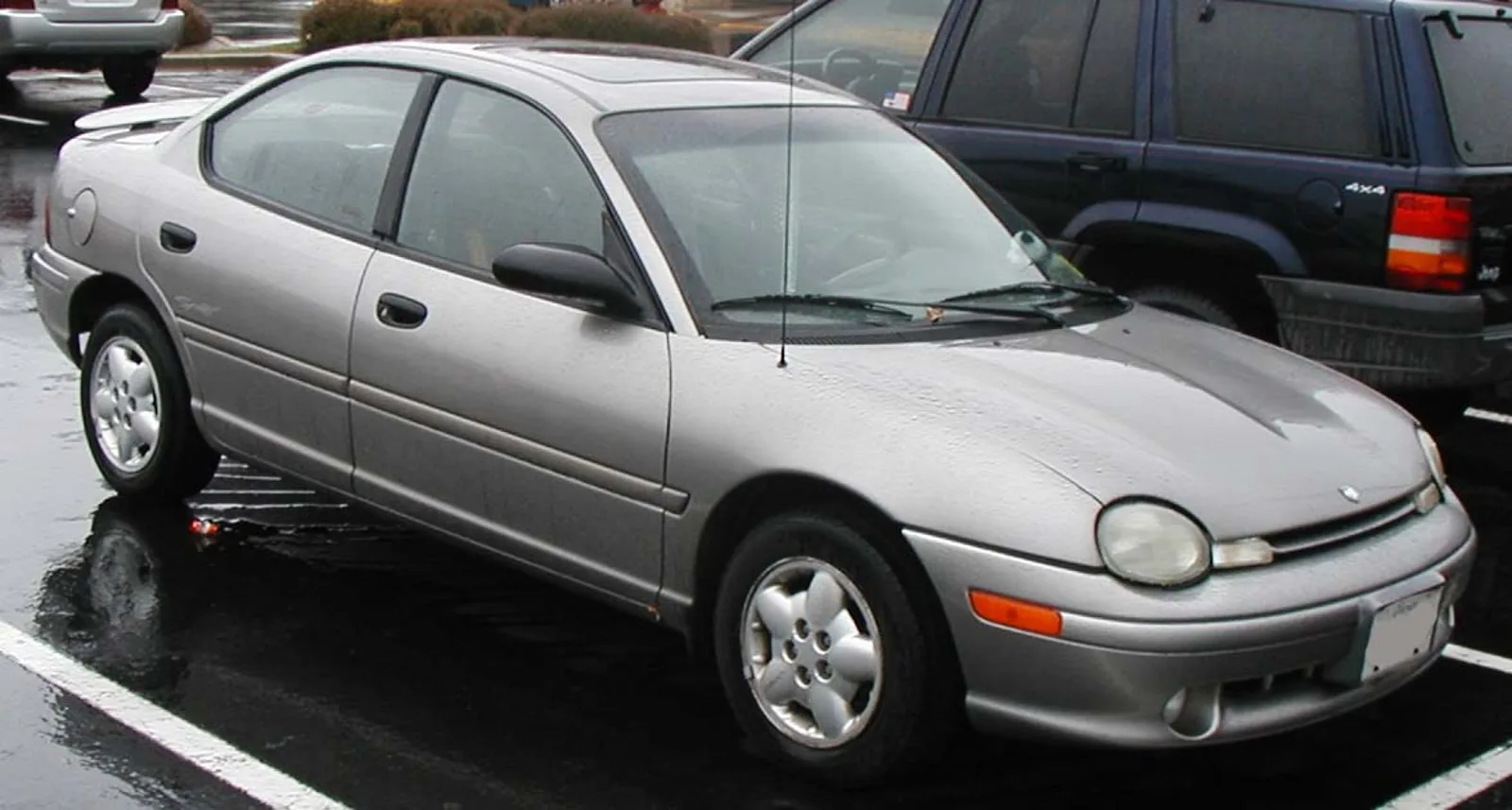
A 1995 compact built on a cost target of under $4,000, sold under three badges, and the first small car to make money for an American automaker.
Built from 1995 to 2005 on Chrysler's front-wheel drive PL platform, the Neon offered 2.0 litre engines producing up to 150 hp. The compact was sold under several badges and was the first small car from an American maker to turn a profit.
The Chrysler Neon was a compact car that Chrysler built for the 1995 to 2005 model years. It was sold under the Dodge and Plymouth badges in North America and as a Chrysler elsewhere, and it became the first compact car to turn a profit for an American automaker. Its name came from the inert gas neon, and it was built at Belvidere in Illinois and Toluca in Mexico.
Where did the Neon come from?
Development started in the mid-1980s at American Motors Corporation, where designers were working on a replacement for the Renault Alliance, the American version of the Renault R9. Chrysler acquired AMC in 1987 and combined the AMC design team with Chrysler engineers who had worked on the older L platform, which carried the Omni and Horizon.
The new car rode on the front-wheel drive Chrysler PL platform. It replaced three families of cars: the Dodge Omni and Plymouth Horizon, which had been retired in 1990, the Dodge Shadow and Plymouth Sundance, and the Mitsubishi-sourced Dodge and Plymouth Colt. Eagle did not sell a Neon to replace the Summit.
The Neon was marketed by Dodge and Plymouth in the United States and Canada, while Europe, Mexico, Japan, South Korea, Egypt, Australia, South Africa and South America received it as a Chrysler. Between 2001 and 2003 the Chrysler name also appeared in Canada.
A compact that was cheap to build, sold under three badges and remains a symbol of 1990s American small-car ambition.
What was the Counterattack project?
The new team's programme was codenamed Counterattack, a response to Lee Iacocca's public view that the Big Three could no longer match the innovation, quality and efficiency of their Japanese rivals. The goal was a car that was lightweight, economical and powerful, with American comfort.
The cost targets were demanding. The car was to cost a bit under $4,000 to build, with a retail price of no more than $8,000. Those limits shaped the engineering and the way the car was equipped.
Tom Gale led the design. The straight-edged styling kept a three-box layout, unlike the Omni and Horizon, but it looked far more modern. Its cab-forward approach was in step with contemporary concept cars, and it gave the car a clean profile for its class.
What did the 1991 Neon concept show?
Chrysler first showed the Neon as a Dodge concept at the 1991 Frankfurt Motor Show. The car was built to show environmental thinking, with recycled components and a body designed to be almost entirely recyclable. It even carried an onboard trash compactor to deal with litter inside the vehicle.
The concept was a four-door sedan whose doors all slid open from the centre, so the body had no B-pillar. Like the Citroen 2CV, it had a full-length retractable fabric roof, which made it a four-door convertible in effect.
The concept used a conventional three-speed automatic, but its engine was a 100 hp (75 kW) 1.1 litre three-cylinder two-stroke supplied by Mercury Marine. Several of its features were dropped for production, including the sliding doors, roof and two-stroke engine, but its styling shaped the production car.
The concept earned a gold IDEA91 award from the Industrial Designers Society of America. Its rounded roofline, circular headlights and minimalist grille all carried over, while the Dodge crosshair grille was dropped.
What was the first-generation Neon like?
The first-generation car debuted at the 1993 Frankfurt show and reached showrooms in January 1994 as a 1995 model. It was offered as a four-door notchback sedan and a two-door notchback coupe, with a choice of SOHC and DOHC versions of Chrysler's 2.0 litre four-cylinder engine.
The SOHC engine produced 132 hp (98 kW) at 6,000 rpm and 129 lb ft (175 N m) at 5,000 rpm. The DOHC engine offered 150 hp (112 kW) at 6,500 rpm and 133 lb ft (180 N m) at 5,600 rpm. A three-speed Torqueflite automatic or a five-speed manual could be fitted.
Equipment choices were unusual. Many base models lacked power windows in the rear doors, and some cars had bumper covers moulded in colour rather than painted, which hid scuffs better. Early Neons came in bold colours such as Nitro yellow-green and Magenta, but buyers chose more conventional tones from 1998.
The car was praised for its looks, its price and its ample power compared with rivals. Car and Driver tested the DOHC five-speed R/T and recorded 0-60 mph in 7.6 seconds and a quarter mile in 16.0 seconds.
How did the Neon sell in Japan and Europe?
In Japan, only the sedan was offered. It was the first Chrysler small car sold there, but despite attention from the press, only 994 were sold between June and December 1996. One hindrance was tax: the car fell into the larger passenger-car bracket, which meant higher yearly road taxes for owners.
The Japanese car had amber turn signals beside the tail lights to meet local rules, plus a side indicator in the fender. A width reduction of 19 mm (0.75 in) would have moved it into a much lower tax category, a change that would have mattered to buyers.
In Europe the Neon also came with a 1.8 litre engine to suit local tax regimes. The Platinum-paint CS edition arrived in February 1998 with the 131 bhp (98 kW) SOHC engine, R/T-spec suspension, a rear spoiler, leather seats and a six-CD changer.
The second generation sold on well in the Dutch market, with 2.0 LX and 2.0 SE trims. In Mexico the car competed against the Ford Escort, and in Brazil it was marketed as a luxury mid-size sedan.
Which trims and special models were offered?
The American line started as Base, Highline and Sport, and the names changed often. Other trims included Expresso, SE, ES, SXT, ACR and R/T, and the Canadian market had an EX package with alloy wheels and a power bulge hood.
The ACR, which stood for American Club Racer, was the most serious version. It came with four-wheel disc brakes, adjustable dampers from 1997, thicker anti-roll bars, heavy-duty hubs and a five-speed gearbox with a final drive ratio of 3.94 and a shorter .81 fifth gear. Its speed limiter was set at 130 mph (209 km/h) on later cars.
In 1995 the ACR was offered only to members of the SCCA, the Sports Car Club of America, but it later went on sale to the public. The name began as the internal ordering code for the Competition Package, and the American Club Racer backronym followed because the car was popular with club and grassroots racers.
The R/T debuted for 1998 in two-door and four-door bodies. It took many of the ACR's mechanical upgrades, but it was designed for the street, with more comfort and convenience features and a rear spoiler, white or coloured stripes, and a leather-wrapped wheel and shift knob.
What changed in the second generation?
Sales of the second generation began in the 2000 model year, and production ended with the 2005 model year. It was offered only as a four-door sedan. In the US the sole engine was the 2.0 litre SOHC unit with 132 hp (98 kW), although a Magnum option produced 150 hp (112 kW).
The second generation claimed more than 1,000 refinements over the original car. Its frameless windows were replaced by full-framed doors, the interior grew larger, and the weight rose. The DOHC engine was no longer available.
The R/T returned in 2000 after a one-year break, with the Magnum engine, 16-inch wheels, a spoiler, dual chrome exhaust tips, a quicker steering box and stiffer springs. It was sold as a Chrysler in the United Kingdom from 2000 to 2003.
The car's transmission changed too. A five-speed manual with the ACR's gear ratios was introduced first, but it made the car noisier on the highway and cost fuel economy, so the original ratios were restored. A four-speed automatic was offered for 2002, and a revised version arrived for 2003 to 2005.
How did the Neon fare in safety tests?
The first-generation car received a Poor rating in the offset frontal crash test from the Insurance Institute for Highway Safety. The second generation improved to Marginal in the same test, but it was rated Poor in the side impact crash test.
In 2005 the institute ran side impact tests on 14 small cars, simulating a hit from an SUV. The Neon performed worst of the group, and the institute described its structure as poor and warned that a real driver in a real crash would be unlikely to survive.
The IIHS also reported that the Neon had 161 driver deaths per million registered vehicle years, against an average of 103 for its class. Other small cars on the same list included the Acura RSX, the Kia Spectra hatchback and the Mitsubishi Eclipse.
Did the Neon race?
First-generation Neons competed in SCCA Solo autocross and showroom-stock road racing. The ACR's combination of brakes, suspension and gearing made it a favourite with grassroots racers, and its reputation grew through club events. Its strongest link to motorsport was through the ACR's popularity with club racers.
In 2001 the Neon also carried a Motorsports Edition sport package, timed to mark Dodge's return to NASCAR. It came with an R/T wing, 16-inch wheels, R/T springs, racing-style tyres and Dodge Motorsports side decals.
How did Neon production end?
The last Plymouth Neon rolled off the line on June 28, 2001, the final Plymouth ever built. Chrysler renamed the car the Dodge SX 2.0 for Canada in 2003, and the ACR was dropped that year, followed by the R/T in 2004.
DaimlerChrysler ended the Neon with final cars assembled on September 23, 2005, at Belvidere. The model was replaced in spring 2006 by the 2007 Dodge Caliber, which shared the Chrysler and Mitsubishi GS platform. The plant was retooled for the Caliber, the Jeep Compass and the Patriot.
Did the Neon return?
The Dodge Neon name came back with a third generation for the 2017 model year. It was the sedan version of Fiat's Project Aegea, built on the Fiat Tipo platform and produced by Tofas in Turkey, and it was marketed in Mexico and the Middle East.
Plans to sell it north of Mexico were dropped as General Motors and Ford trimmed their own passenger car lines. The Neon was discontinued in Mexico after the 2020 model year, and the last 70 units were sold in 2021.
Chrysler Neon specifications
The table gives the main figures for the first and second generations, with the ACR and R/T details included for comparison.
| Specification | Detail |
|---|---|
| Model years | 1995 to 2005 (first and second generations) |
| Platform | Front-wheel drive Chrysler PL |
| SOHC engine | 2.0 L, peak at 6,000 rpm, 132 hp (98 kW) |
| DOHC engine | 2.0 L, peak at 6,500 rpm, 150 hp (112 kW) |
| Torque (SOHC) | Peak at 5,000 rpm, 129 lb ft (175 N m) |
| Transmission | Three-speed Torqueflite automatic or five-speed manual |
| ACR final drive | 3.94, with a .81 fifth gear |
| ACR speed limit | 209 km/h (130 mph) on later cars |
| R/T 0-60 mph | 7.6 seconds (Car and Driver test) |
| Japan sales (1996) | 994 cars, June to December |
| Final cars | Belvidere, September 23, 2005 |
Frequently asked questions
How quick was the Neon R/T?
One Car and Driver test of the DOHC five-speed R/T produced a quarter mile of 16.0 seconds, a strong result for a mid-1990s compact.
Why did the Neon do badly in Japan?
Japanese owners paid extra yearly road taxes because of the car's size. Only 994 were sold from June to December 1996, despite press attention.
What was the Neon ACR?
The ACR was a sporting version whose name stood for American Club Racer. It had four-wheel disc brakes, thicker anti-roll bars, a 3.94 final drive and a shorter fifth gear, and it was popular with grassroots racers.
Was the Neon ever sold in Canada as a Chrysler?
Yes, but only for a short time. Between 1999 and 2002 the former Dodge and Plymouth Neon was sold under the Chrysler name in Canada, before it became the Dodge SX 2.0 for 2003.