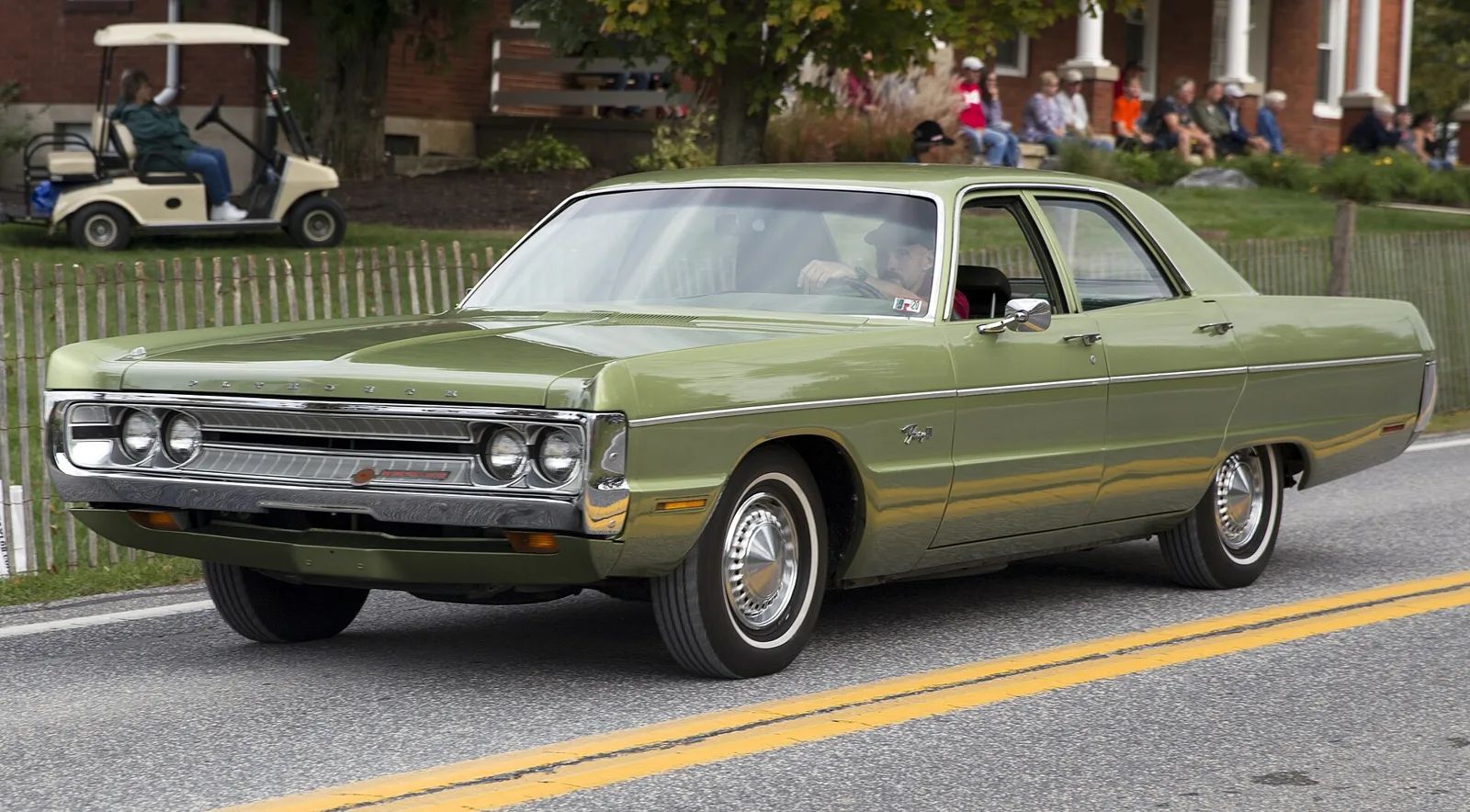
Hardtops, Torsion-Aire suspension, a 426 street wedge V8 and a Kenosha finale, through a line that changed size more than once.
Built by Plymouth from 1955 to 1989, the Fury began as a Belvedere sub-series in 1956, rose to a separate top-level series in 1959, and ended with V8 rear-drive cars made in Kenosha during 1988.
The Plymouth Fury was a model produced by Plymouth from 1955 until 1989. It began as a sub-series of the Belvedere for 1956, became a separate series above it in 1959, and switched between full-size and mid-size bodies several times. Its last V8, rear-wheel drive example left the Kenosha Main assembly plant in December 1988.
How did the Fury begin in 1956?
From 1956 to 1958 the Fury existed as a sub-series of the Belvedere. Early cars came as sandstone white two-door hardtops with gold anodised aluminium trim. For 1958 the colour changed to buckskin beige, but the gold trim stayed. Buyers got bespoke interiors, wing-guards on the bumpers and V8s with twin four-barrel carburettors.
Chrysler's products suffered from rushed development in the late 1950s, and quality control was a problem across the line. The 1957 Fury was restyled to be longer and wider, with very large vertical tailfins. It also introduced Chrysler's Torsion-Aire torsion bar front suspension, which was shared with all Chrysler products from 1957 onward.
A line that changed size more than once and ended with a V8 rear-drive finale at Kenosha in December 1988.
What engines did the 1958 Fury offer?
The 1957 and 1958 318 cu in (5.2 L) V8 produced 290 hp (216 kW), a figure it shared with the Dodge Coronet. In 1958 the optional engine became a big block of 350 cu in (5.7 L), nicknamed the Golden Commando, with two four-barrel carburettors and 305 hp (227 kW).
Buyers could also order a fuel-injected version rated at 315 hp (235 kW), but the factory recalled the Bendix electronic system and gave owners a conventional dual four-barrel setup instead. The Golden Commando was optional across Plymouth's range, and the dual four-barrel 318, known as the V-800 Dual Fury, was another choice.
How did the Fury change in 1959?
In 1959 Plymouth introduced the Sport Fury as its new top model, with the Fury as the second rung down, replacing the Belvedere at the top of the line-up. The Fury could be bought as a four-door sedan, a two-door hardtop or a four-door hardtop. The Sport Fury came as a two-door hardtop and a convertible.
The wagon went under the Sport Suburban name rather than Fury. Sport Fury disappeared after 1959, returned in mid-1962 and ended in 1971. The 350 was superseded by a 361 cu in (5.92 L) Golden Commando, available with either two or four barrels.
Was there a Fury outside the United States?
Chrysler Canada produced a one-year Dodge Viscount for 1959. It rode on the Plymouth Fury body but wore a Dodge nose, and it had no Sport Fury equivalent.
Down Under, the full-size Dodge Phoenix used Dart underpinnings with the 440 until 1965. From then it was a right-hand drive counterpart of the current Fury, and production ran until 1972.
What was the 1960 Fury like?
Unibody construction, ram induction and the new slant-six all debuted for 1960. The six displaced 225 cu in (3.69 L) and made 145 hp (108 kW) at 4,000 rpm, while the 383 V8 was rated at 330 hp (250 kW).
The styling had been formulated in 1957, at the height of the tailfin era, and by 1960 it had fallen out of fashion. Chevrolet and Ford sales increased during the year, while Plymouth barely kept its 1959 volume. Tailfins were removed for the 1961 model year, but the Fury remained Plymouth's leading volume model through the early 1960s.
How did the 1962 to 1964 Fury differ?
The 1962 Fury emerged as a downsized model on the new Chrysler B-body unibody platform. The company was dealing with several corporate controversies at the time, and sales of the new model were slow at first. That led to the Sport Fury badge coming back on a hardtop coupe and a convertible.
A Fury four-door wagon was also in the 1962 lineup, a body style that had once sold as the Sport Suburban. Chrysler began to restyle and enlarge its Plymouths and Dodges, which helped sales improve in 1963 and 1964. The 1964 two-door hardtop was the strongest seller of the three years, thanks to its new slanted roofline.
What changed in the 1965 full-size Fury?
In 1965 Chrysler returned the Fury to the full-size C-body platform. Three trims sat in the range, the Fury I, II and III, with the I as the entry point. The Sport Fury sat at the top, positioned against the Chevrolet Impala Super Sport and the Ford Galaxie 500/XL, with a sportier interior and exterior trim package.
The grille lost its chrome and gained two stacked headlights on each side. All models rode on a 119 in (3,023 mm) wheelbase, with wagons at 121 in (3,073 mm), which was 1 in (25 mm) longer than before. The 426 street wedge V8 arrived that year too, rated at 385 hp (287 kW) and finally street-legal.
The Fury II was available as a two-door hardtop only in Canada. In the United States it came as a two- or four-door sedan, or as a station wagon.
What was the VIP?
The VIP was a plush luxury edition of the Fury, introduced to compete with the Ford Galaxie 500 LTD, the Chevrolet Impala Caprice and the AMC Ambassador DPL. It first appeared in the fall of 1965 as a four-door hardtop, and a two-door hardtop followed in early 1966. Plymouth marketed it in 1966 as the very important Plymouth.
Interiors had plush upholstery, contoured door panels with woodgrain trim and a thicker grade of carpeting. The exterior carried VIP emblems and fender skirts as standard. Although it was essentially an upgraded Fury III, Plymouth sold it as a separate model. The VIP used Chrysler's 318 cu in (5.2 L) V8, and most buyers chose the TorqueFlite automatic rather than the three-speed manual.
The VIP was sold from 1966 until 1969, and it was discontinued for 1970.
How did the 1967 restyle change the Fury?
The 1967 body took on a sharper, angular shape. The stacked quad headlight bezels grew curvier and recessed further into the panels, which gave a brawnier stance, and the roof looked longer and more upmarket.
A formal two-door hardtop joined the range with slimmer rear quarter glass and a broader, swept-back C-pillar. This fast top ran beside the thinner-pillared hardtop in the VIP and Sport Fury lines. The same year regulators required dual-circuit brakes, collapsible steering columns, recessed dash controls and belt anchors for the outboard front seats on every Plymouth.
The 318 cu in (5.2 L) V8 in its old form ended with the 1967 model year, when a thin-wall LA unit took over with wedge-shaped combustion chambers. It produced more power for the same advertised figure and weighed significantly less. The 318 LA did not reach export models or cars sold in Canada until 1968.
What did the 1969 to 1973 Furys look like?
The 1969 Fury received a partial facelift and came as a two-door hardtop, a two-door convertible, a four-door hardtop, a four-door sedan and a four-door station wagon. For 1970 the VIP was discontinued, a four-door hardtop joined the Sport Fury range, and the Fury fully adopted Chrysler's round-sided Fuselage Look styling.
The 1970 and 1971 Sport Fury GT was powered by the 440 cu in (7.2 L) engine. In 1970 buyers could order it with three two-barrel carburettors, which produced 390 hp and 490 lb ft of torque. The base engine in the same range was rated at 350 hp (261 kW).
The 1969 range had the 225 cubic-inch six as standard on the Fury I, II and some Fury III models, with the 318 cu in V8 on the Sport Fury and some Fury III and VIP cars. By 1971 every full-size Plymouth had a V8. An optional Brougham package with individually adjustable split bench seats was offered on Sport Furys, and the S/23 was dropped for 1971.
The 1971 model year introduced the LA 360 cubic inch engine, the largest production smallblock V8 that Chrysler built. The 1972 facelift brought a large chrome bumper with a twin-loop design, and the Sport Suburban wagon received hidden headlamps. Two new Gran models, the Gran Coupe and Gran Sedan, appeared and later became the Gran Fury. Sport Fury and GT were axed, and the six was no longer available in big Plymouths.
What was the 1974 full-size Fury?
For 1974 the Fury shared Chrysler's all-new full-size C-body with the Imperial, the New Yorker, the Newport, the Town and Country, the Dodge Monaco and the Royal Monaco. The styling was more squared off, with lower beltlines and more glass. The unibody structure with a subframe for the engine and transmission was kept, along with torsion bar front suspension and asymmetrical multi-leaf springs at the rear.
The lineup again included the Fury I, Fury II, Fury III and Gran Fury, plus the Suburban and Sport Suburban wagons. A standard 360 cu in V8 with a two-barrel carburettor came on sedans and coupes, and a two-barrel 400 was standard on wagons. Four-barrel 400 and 440 V8s were optional on all models. TorqueFlite automatic, power steering and power front disc brakes were standard on every 1974 Fury.
Chrysler also offered a basic group and a luxury group to make ordering easier. The Brougham package on the Gran Fury had a 50/50 divided front seat with individual centre armrests and recliners. New options included a digital chronometer and a gauge alert system using light-emitting diodes to monitor engine functions.
How did the mid-size Fury work from 1975?
In 1975 Chrysler moved the Fury name to the restyled mid-size B-body, which had previously been marketed as the Satellite. The Road Runner became the top-of-the-line two-door, before it moved to the Volare line in 1976. The full-size car, now called the Plymouth Gran Fury, lasted through 1977, and the mid-size Fury line was discontinued at the end of 1978.
The 1975 to 1978 Furys shared their B-body and unibody structure with the Dodge Coronet, the Dodge Monaco and the Chrysler Cordoba and Dodge Charger SE personal-luxury coupes. The four-door models rode on a 118 in (2,997 mm) wheelbase, while the two-door models used 115 in (2,921 mm). For 1975 the mid-size Fury wheelbase was 117.5 in (2,984 mm), while earlier full-size Furys had been 120 in (3,048 mm).
Engines in 1975 included the 225 cu in (3.69 L) slant-six, which was standard on most models except the Sport, Road Runner and wagons. Those used the 318 cu in (5.21 L) V8 as base engine. Options included 360 and 400 cu in V8s, and a 440 four-barrel was offered only as a police option on four-door sedans.
In 1977 the mid-size Fury got a fresh nose, with a chrome vertical bar grille and square headlights stacked in pairs. For 1978 it was technically a mid-size car, but it was Plymouth's largest model because the full-size Gran Fury had been discontinued after 1977.
What was the Gran Fury?
For 1980 Chrysler reengineered its B-body chassis into the new R-body full-size car, a much smaller replacement for the 1974 to 1978 C-body cars. The 1980 to 1981 R-body Gran Fury did not sell widely to retail buyers, but it performed well in fleet and government and public safety sales.
After the R-body ended midway through the 1981 model year, Chrysler gave the M-body platform full-size status for 1982. The Gran Fury and Diplomat became popular choices for police cruisers. The M-body and L-body cars were withdrawn in late 1988, halfway through the 1989 model year, and Plymouth's 30-plus years with the Fury nameplate closed there.
Where did the Fury appear in popular culture?
Stephen King's 1983 bestseller Christine takes its name from a 1958 Plymouth Fury. The same year the book became a film directed by John Carpenter. Because the real Fury was not sold in red for 1958, several 1958 Plymouth Belvederes were used for filming instead.
The car returns in King's 1986 novel It. On television, Fred Rutherford's 1960 convertible Fury is prominently seen in Leave It to Beaver, in the episode Beaver and Violet, since Plymouth sponsored the show.
What are the Plymouth Fury specifications?
The table covers the main figures for each generation and engine. Where a value belongs to one year or one trim, the table names it, so the full-size and mid-size cars are not blended into one set of dimensions.
| Specification | Detail |
|---|---|
| Production span | 1955 to 1989 under the Plymouth Fury name |
| 1957-1958 V8 | 318 cu in (5.2 L), 290 hp (216 kW), shared with the Dodge Coronet |
| 1958 Golden Commando | 350 cu in (5.7 L), 305 hp (227 kW) |
| 1959 Golden Commando | 361 cu in (5.92 L), two- or four-barrel carburettor |
| 1960 slant-six | 225 cu in (3.69 L), 145 hp (108 kW) at 4,000 rpm |
| 1960 383 | 330 hp (250 kW) |
| 1965 426 street wedge | 385 hp (287 kW) |
| 1965 wheelbase | 119 in (3,023 mm); wagons 121 in (3,073 mm) |
| 1970 Sport Fury GT | 440 cu in (7.2 L), 390 hp and 490 lb ft of torque |
| 1971 LA 360 | 360 cu in, the largest production smallblock V8 Chrysler built |
| 1975 mid-size wheelbase | 117.5 in (2,984 mm) |
| 1978 | Last Plymouth Fury, the largest Plymouth that year |
| Final V8 rear-drive build | Kenosha Main assembly plant, December 23, 1988 |
Frequently asked questions
How big was the 1958 Golden Commando?
It was a 350 cu in (5.7 L) big block that made 305 hp (227 kW) from twin carburettors. A fuel-injected 315 hp (235 kW) option was also listed before the factory recalled it.
Did Plymouth build a Fury in Canada?
Chrysler Canada built the Dodge Viscount in 1959, a car based on the Plymouth Fury but using a Dodge front clip. Canadian buyers could also get the Fury II as a two-door hardtop in 1965.
When did the Fury stop being sold as a Plymouth?
The Fury name was discontinued in 1978 for the mid-size car, and Plymouth had no Fury models during the 1979 model year. The M-body Fury returned in 1982, and production of the last V8, rear-wheel drive Fury ended in December 1988.
Which novel featured a Plymouth Fury?
Stephen King's 1983 novel Christine centred on a 1958 Plymouth Fury, and John Carpenter directed the film version the same year. Several 1958 Plymouth Belvederes stood in for the car on set.
.jpg)