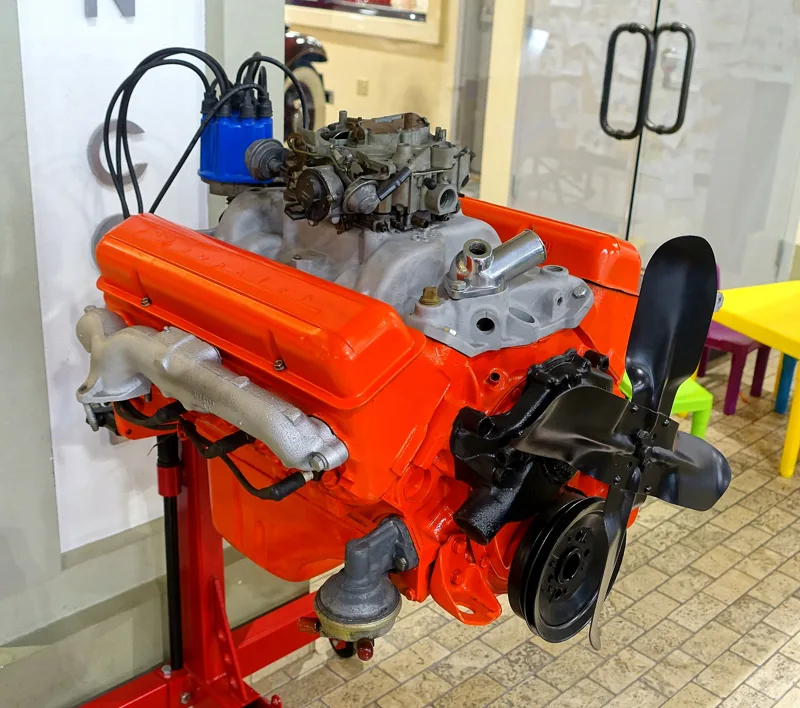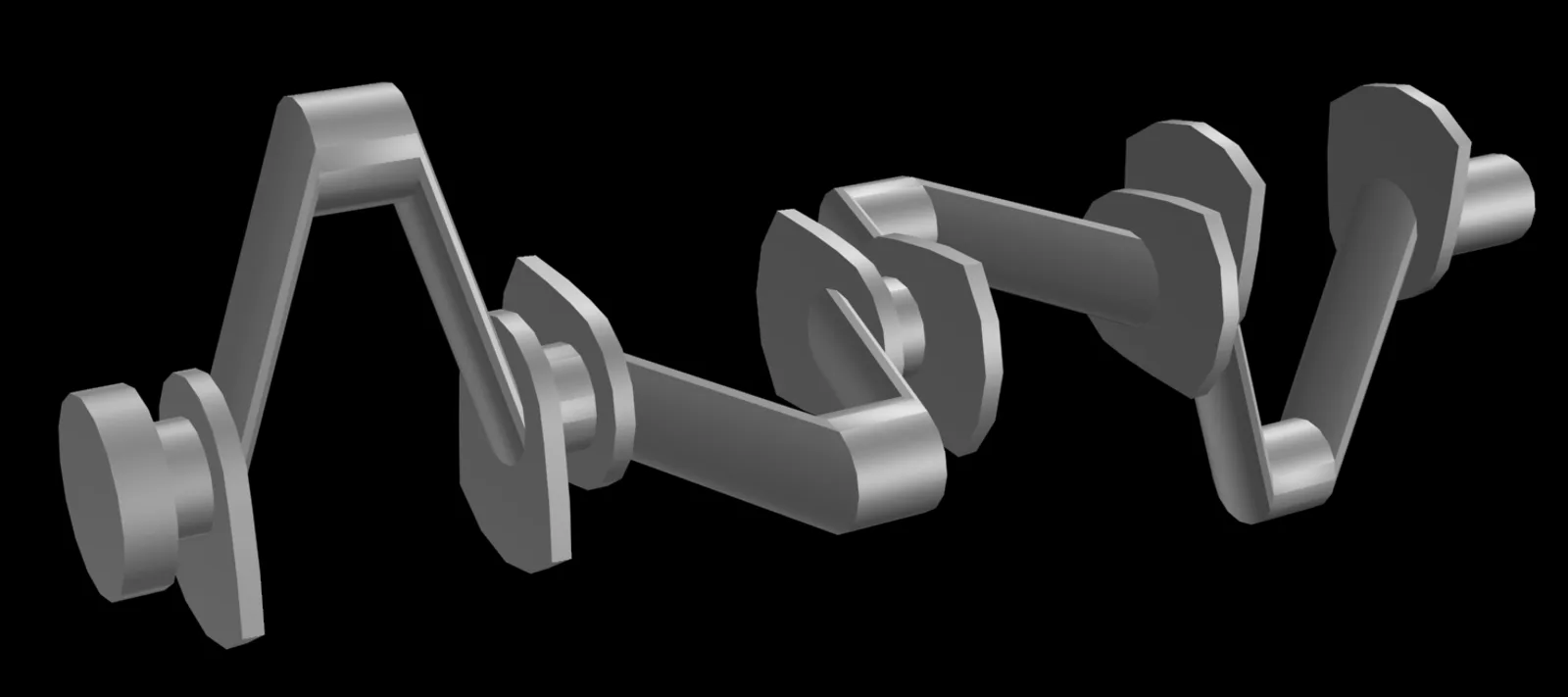
One angle on a steel shaft sets a V8's firing order, vibration, rev ceiling and exhaust note, and it is the reason a Ferrari V8 and an American one do not share a voice.
A flat-plane crank puts its throws 180 degrees apart, so a V8 behaves like two inline-fours: light, high-revving and loud. A cross-plane crank uses 90 degrees, cancelling second-order vibration and giving the classic burble, but it is heavier. Ferrari uses flat-plane; most American V8s are cross-plane.
Every four-stroke V8 fires eight times for every two turns of its crankshaft, and yet two V8s can sound and behave like entirely different machines. The difference is not the number of cylinders, the fuel or the exhaust tips. It is the angle at which the crankpins are cut on a single steel shaft, and that one decision shapes the firing order, the vibration, how high the engine will rev and the noise that reaches your ears.
What does a crankshaft actually do?
A piston moves up and down. A road wheel needs rotation. The crankshaft is the part that turns the first into the second. Pistons push on connecting rods, the rods drive crankpins, and the crankpins rotate within the big end of each rod. The shaft sits in the engine block, held by main bearings that are spread along its length rather than only at the ends, because every cylinder pushes sideways and twists the shaft as well. A flywheel on one end of the shaft evens out power delivery and calms vibration.
The loads are huge. In some engines the load per cylinder on the crankshaft exceeds 8.6 tonnes (19,000 pounds). Flex was a problem for the straight-eight engines of the 1950s, whose long shafts bent too much once designers raised compression ratios and revs, which helped end the layout. Counterweights on the shaft cancel the rotating and reciprocating masses, and because pistons and rods vary slightly in weight, the weights are tuned by removing material or adding a dense metal.
Most modern makers choose forged steel for the shaft because it is lighter, more compact and damps vibration better. Cast iron survives in cheaper engines with lower loads. Machining a shaft from a solid billet is expensive per unit, but it needs no costly tooling, so it suits small production runs.
The angle between the crank throws is closely tied to the firing order.
Two V8s can share eight cylinders and a firing cycle yet part company on every other count, all because of a single angle on the crank.
What is a flat-plane crank?
A flat-plane crank has a 180-degree angle between its throws. Inline-four engines almost all use this arrangement, which is why nobody bothers to name it there. In a V8 the effect is to make the engine behave like two inline-fours sharing one crankcase. The firing order then alternates between the banks, right, left, right, left, all the way through the cycle.
The layout is simple and light. It needs less counterweight, so the shaft weighs less and the engine can spin faster. That is why flat-plane V8s are linked with European sports cars, especially Ferrari and McLaren. The Ferrari 488 uses one. The 2023 Chevrolet Corvette Z06 has a 5.5 litre flat-plane V8, the largest ever seen in a production car.
There is a price. A flat-plane design shakes more and is inherently far louder than the alternative, which is why it is no longer widely used in mass-production V engines. In a V8, the second-order forces build up because four pistons in each bank stop and start together. In large-displacement engines that vibration becomes noticeable. Even so, a Ford GAA used the flat-plane layout in a World War II Sherman tank: an all-aluminium, 32-valve, double-overhead-cam V8 with its cylinders at 60 degrees.
What is a cross-plane crank?
A cross-plane crank sets its throws 90 degrees apart, and it is the most popular configuration in V8 road cars. A typical one carries four crankpins, and each pin feeds a pair of cylinders from opposite banks. Look at the shaft end-on and the pins form a cross: the first and last are 180 degrees apart, as are the second and third, and the two pairs sit at 90 degrees to each other. Two planes crossing at right angles gave the design its name.
Engineers proposed the idea in 1915. Cadillac and Peerless, both of which had built flat-plane V8s, developed it, with Cadillac introducing the first cross-plane engine in 1923 and Peerless following in 1924. A typical shaft has five bearings supporting four throws, though an eight-throw design could have up to nine.
The aim was smoothness. In a cross-plane engine every bank has four distinct piston phases, and they cancel the second-order free forces entirely. Only minor vibrations remain, caused by small variations in component weights during manufacture. Contrast that with the flat-plane layout, where pistons in the same plane move together and those forces add up.
Why not use the 90-degree layout everywhere? In a four-cylinder engine it does not work out so neatly. Four cylinders over 720 degrees naturally want ignitions 180 degrees apart, which is why the 180-degree flat-plane crank is so popular there. Turn the throws to 90 degrees and the firing pattern becomes uneven, and the engine needs a balance shaft to fight the rocking vibration. The cross-plane idea therefore stays confined to very high-revving engines, where less secondary imbalance outweighs the irregular firing. The V8 is different since every throw carries two pistons that are already 90 degrees apart, so the trade comes out in its favour.
Flat-plane vs cross-plane crank: the comparison
| Feature | Flat-plane | Cross-plane |
|---|---|---|
| Angle between throws | 180 degrees | 90 degrees |
| Firing order | Alternates banks: R L R L R L R L | L R L L R L R R (or the mirror) |
| Second-order forces | Add up, noticeable in large engines | Cancelled entirely |
| Crankshaft weight | Lighter, needs less counterweight | Heavy counterweights |
| Rev ceiling | Higher | Not as free-revving |
| Noise | Inherently much louder | The classic burble |
| Typical users | Ferrari, McLaren, race engines | Ford Modular, GM LS, most V8 road cars |
V8 firing order: why the sound differs
Count the ignitions in a cross-plane V8 and they arrive at even 90-degree steps. Two turns of the crank, 720 degrees, share eight ignitions equally. The unevenness shows up only when you look at one bank at a time. The usual pattern is left, right, left, left, right, left, right, right, or the mirror of it, and the gaps between firings within a bank run 180, 90, 180 and 270 degrees, in different orders depending on the engine. The precise order of the gaps depends on which way the shaft turns and which of the 360-degree pairs fires first.
That lumpy rhythm is the heart of the traditional V8 sound. Most road cars merge all four exhaust ports on each bank into one exit for convenience, which accentuates the pattern. It is sometimes described as potato-potato, mimicking the alternation of a short interval and a longer gap. Subtle variations exist because of the specific firing order and the exhaust design. Other sounds are possible by grouping the pulses carefully, but the space needed makes that impractical on a road car.
A flat-plane V8 flips between the banks in strict turns, like two four-cylinder engines taking alternate beats. Ferrari and McLaren eights are linked with the layout, and the layout is inherently louder. That is the engineering reason an Italian V8 and an American one do not sound alike.
Which crank spins faster, and why?
Weight decides it. Because of the heavy counterweights on each throw, most cross-plane V8s have very heavy crankshafts, which makes them less free-revving than flat-plane rivals. An early Chrysler Hemi V8 had heavy counterweights too, but left the middle two positions beside the centre main bearing without any. Those positions sit so close to the middle of the engine that they do little to counter rocking motion, so external balance weights, for instance in the pulley on the crank nose, achieve the same effect with less extra mass.
The 180-degree layout of the end and middle throws creates a primary rocking couple. In a 90-degree V it can be countered by weighting the crank, much as in a V-twin. Other V angles generally need a balancer shaft. Uneven firing and the 90-degree phases also put torsion into the crank, which is why cross-plane V8s have tuned mass dampers, usually on the free end of the shaft.
Racing engineers noticed the high-revving potential of the flat-plane form. The first high-rpm flat-plane engine came from Bud Winfield in Novi, Michigan, and ran at the 1941 Indianapolis 500 under the name Winfield Special. It later became known as the Novi engine and raced at Indy until 1962. In Formula One, Coventry Climax adopted a high-revving flat-plane V8 in the early 1960s, the Mk.III FWMV of 1963, and BRM changed over at roughly the same moment, taking the idea into its 1964 P261.
Exhaust tuning for a cross-plane engine
Because evenly firing pairs sit in opposite banks, a cross-plane V8 needs long, equal-length pipes to merge them and give uniform scavenging. Among the first such systems was the one bolted to Coventry Climax's small FWMV racing V8s in the early 1960s, and mechanics found it obstructed work on the engine itself. Many racing cross-plane V8s, such as Ford's 4.2L DOHC V8 for Indy racing, put the exhaust ports inside the V to shorten the pipes.
The Ford GT40 made the idea famous on production-based V8s with a tangle of long pipes nicknamed the Bundle of Snakes. Such systems are also called 180-degree headers, named for the 180-degree intervals gathered in each branch, much like a flat-plane V8. Before that, some teams, BRM included, used straight individual stack pipes, called zoomies, to avoid the harm of uneven pulse interference on scavenging, though they gave up the positive extraction effect of merging. Often the performance deficit was simply accepted and an ordinary four-into-one system was used for each bank. A four-into-two-into-one Tri-Y layout, as in NASCAR and V8 supercars, recovers some of the gap.
Who builds which?
Most production V8s use the cross-plane crank. The Ford Modular and General Motors LS engines are two examples. Some high-performance eights go the other way, with the Ferrari 488 the best-known example. Flat-plane cranks are generally linked with European sports cars and cross-plane with American manufacturers, though there are exceptions. The Lancia Thema 8.32 had a Ferrari-designed cross-plane V8, and the Ford Mustang GT350 used a flat-plane engine.
The crankshaft is not a finished story, either. In some V6 and V8 engines, designers use flying arms, direct links between neighbouring crankpins with no main bearing between them. The arrangement keeps the firing even with different V angles and reduces the number of main bearings, but it makes the crank less rigid, which can cause trouble at high revs or high power.