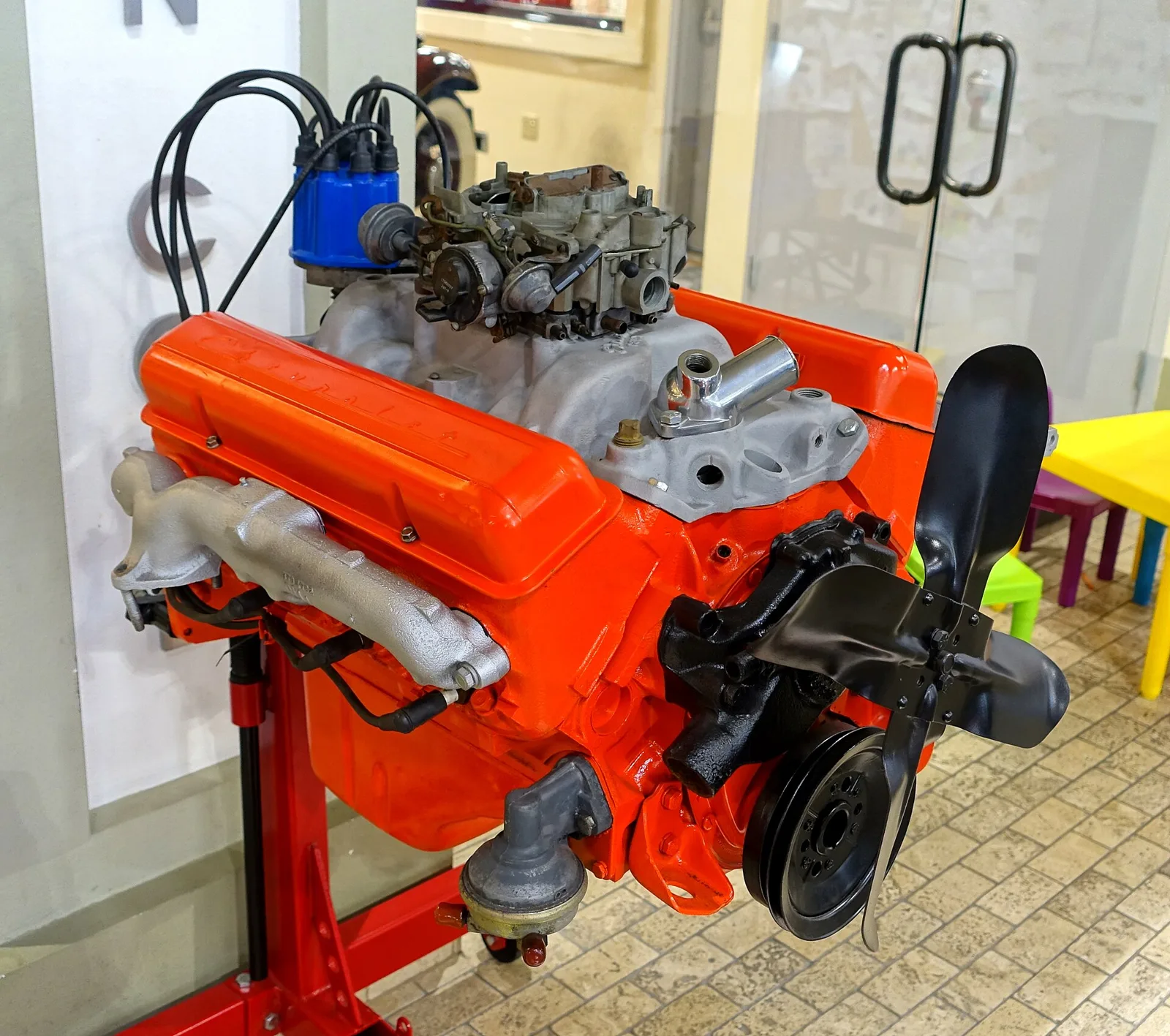
From a three-car Rolls-Royce in 1905 to the Cosworth DFV, how the crankshaft and firing order shape the rumble of a V8 and the smoothness of a V12.
The V8 and V12 both date to the early 1900s: the Antoinette 8V from 1904 and a Putney V12 in 1904. A cross-plane V8 rumbles because its exhaust pulses are unevenly spaced, while a V12 fires evenly and always has three cylinders on the power stroke.
The first V8 to power a road car was fitted to a Rolls-Royce in 1905, and it did not catch on: only three cars were made before the company returned to straight-six engines. More than a century on, the V8 and V12 are two of the best-known multi-cylinder layouts, and they behave in quite different ways.
What is a V8 engine, and what is a V12?
A V8 is an eight-cylinder piston engine with two banks of four cylinders sharing one crankshaft, set in a V. A V12 does the same with two banks of six. Of the big multi-cylinder layouts, the V12 is more common than the V10 but rarer than the V8.
At any moment three cylinders in a V12 are in their power stroke, so the push never lets up.
First V8 engine: where did it begin?
Antoinette, a French company, produced the earliest known V8 from 1904, the 8V drawn by Leon Levavasseur. It served speedboat racing first, then cars and eventually aircraft. Some accounts date Antoinette's first V8 to 1903, a year earlier. Also in 1904, Renault and Buchet started building V8s in small numbers for racing. On 24 January 1907 a Curtiss V-8 motorcycle recorded an unofficial land-speed best for two wheels: 219.45 km/h (136.36 mph).
The Rolls-Royce of 1905, with a 3.5-litre (214 cu in) V8, was the first in a road-going car. The Hewitt Touring Car of 1907 was the first American-built car with a V8. Its designer Edward R. Hewitt argued that the V8 was lighter than a six-cylinder of equal power, had a crankshaft that was easier to make, and needed little more space than a four.
The 1910 De Dion-Bouton from France is considered the first V8 produced in significant numbers. Cadillac's L-head V8 of 1914 was the first mass-produced road-going V8, with 13,000 sold in its first year, aided by electric starters, which Cadillac had pioneered. The 1932 Ford Flathead V8 did most to popularise the layout.
First V12 engine: boats, aircraft and then cars
The V12 appeared in 1904 as well, Putney Motor Works of London built it for racing boats. Known as the Craig-Dorwald after Putney's founding partners, it was a 90-degree flathead with an aluminium crankcase, a displacement of 18.4 litres (1,120 cu in) and a weight of 430 kg (950 lb). Like many marine engines it could slide its camshaft to a second set of cams that reversed the engine for astern propulsion. Larger V12s followed in the 1909 to 1910 season, among them a 25.5-litre Lamb engine and a 56.8-litre Orleans flathead quoted at nearly 298 kW (400 bhp).
Aircraft took the layout further. Renault introduced the first V12 for aircraft, a 90 hp unit, in 1912, and the Sunbeam Mohawk of 1914 produced 168 kW (225 hp), making it Britain's most powerful aero engine at the outbreak of World War I. V12 engines reached their peak during World War II, in British Rolls-Royce Merlin and Griffon units, Soviet Klimov and Mikulin designs, America's Allison V-1710 and the DB 601 and 605 from Germany's Daimler-Benz. Output rose from roughly 750 kW (1,000 hp) as the war began to more than 1,100 kW (1,500 hp) at the end, with multi-speed superchargers and high-octane fuel doing much of the work. The V12 suited light airframes because it was smooth, long and narrow. Turbojets and turboprops made it obsolete afterwards.
On the road, one of the earliest recorded V12s was a custom racing car, Toodles V, entered at Brooklands in October 1913 by Louis Coatalen, chief engineer of Sunbeam. Its 9.0-litre (549 cu in) V12 gave 150 kW (200 bhp), reached at 2,400 rpm, and the unit weighed around 340 kg (750 lb). Among the first production V12 cars, all American, were the Packard Twin Six and National of 1915 and the 1917 Weidely Pathfinder.
Why do a V8 and a V12 sound and feel different?
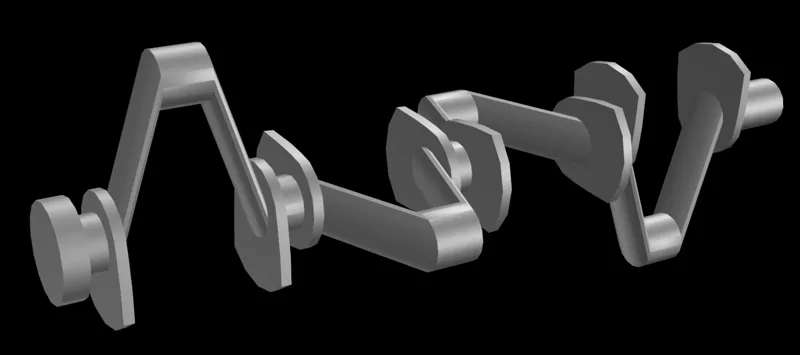
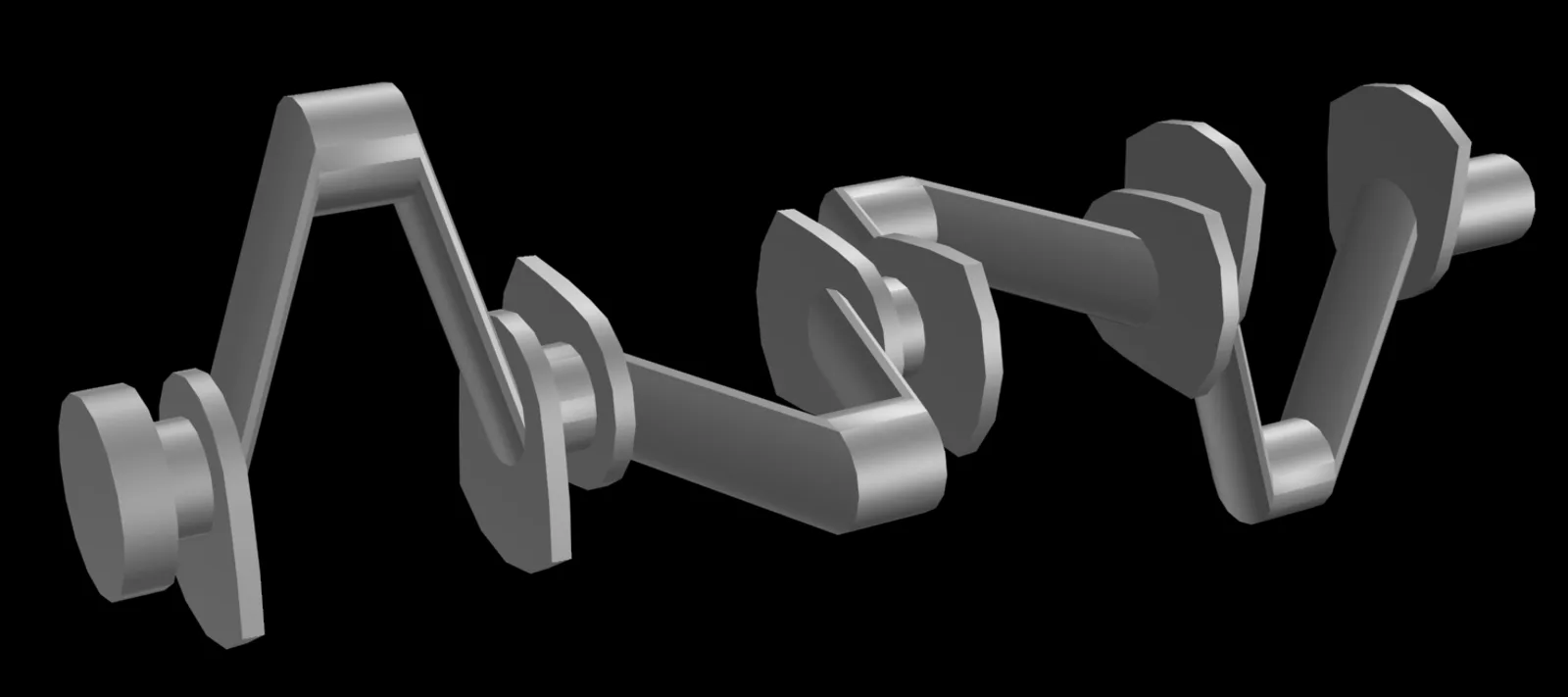
It starts with the crankshaft. Most road V8s use a cross-plane crankshaft, whose four crank pins sit at 0, 90, 270 and 180 degrees so that, seen end-on, they form a cross. That arrangement gives perfect primary and secondary balance and so little vibration, which is why most road cars use it.
The side effect is the sound. The firing order alternates between the two banks but not strictly, so some cylinders from the same bank fire back to back, and that leaves the exhaust pulses within each bank unevenly spaced. With a separate exhaust on each bank, that uneven pulsing becomes the rumble associated with V8s. Think of each pulse as a drumbeat: space them evenly and you hear a steady tone, space them unevenly and you hear a burble. Racing engineers try to avoid that, since the uneven pressure pulses cost power. In the 1960s they used long primary pipes, as on the Ford GT40, or placed the exhaust ports inside the V, as on the Lotus 38 IndyCar, to tie the two banks together and even out the pulses.
The flat-plane alternative has two merits. It is cut from a plain flat billet with no need for counterweights, so it is lighter, and it gives even exhaust pulses with a simple exhaust. Its cost is more vibration from a secondary imbalance. Early road V8s used flat-plane cranks because they were easier to build, including the 1910 De Dion-Bouton and the 1915 Peerless and Cadillac. The Coventry Climax FWMV of 1961 to 1965 and the Cosworth DFV of 1967 to 1985 spread the design through motor racing, and today every Ferrari V8, from the 1973 308 GT4 to the F8 Tributo, plus the Lotus Esprit V8, Porsche 918 Spyder and McLaren 720S, uses a flat-plane crank.
A V12 works differently. Each bank behaves like a straight-six, which on its own has perfect primary and secondary balance, and a four-stroke V12 fires evenly whether the V-angle is 60, 120 or 180 degrees. At any moment three cylinders are in their power stroke, so the push never lets up. Many V12s use a 60-degree V-angle. The price is cost, complexity, friction and size.
V8 against V12 at a glance
| Feature | V8 | V12 |
|---|---|---|
| Cylinders per bank | Four | Six |
| Common V-angle | 90 degrees | 60 degrees |
| Crankshaft | Cross-plane on most road cars; flat-plane on racing and sports cars | Each bank acts as a straight-six |
| Exhaust pulses | Uneven within each bank on a cross-plane engine | Even at 60, 120 or 180 degrees |
| Shape | Wider at 90 degrees | Slimmer than a 90-degree V8, but longer |
| Drawbacks | Width compared with smaller V-angles | Cost, complexity, friction, size and weight |
How big are V8 and V12 engines?
Modern V8s typically displace from 3.5 to 6.4 litres (214 to 391 cu in), though production sizes vary widely. The BMW M502 V8 of the 1954 BMW 502 was only 2.6 litres (2,580 cc), while the 1971 to 1978 Cadillac Eldorado had an 8.2-litre (500 cu in) engine. Motorsport V8s tend to be small and short-stroke to rev higher, such as the 3.0-litre (183 cu in) Cosworth DFV. Big and small blocks describe external dimensions, not displacement, so engines of 6.0 to 6.6 litres have been classed as both. Their size means V8s usually sit longitudinally in rear- or all-wheel-drive cars.
A 60-degree V12 is typically slimmer than a V6 or V8 with a 90-degree angle and similar displacement, but longer, which often makes it hard to fit into a passenger car and a good match for trucks, locomotives, tanks and boats, where width is limited and length is not. The Wartsila 46F V12 marine diesel displaces 1,157 litres (70,604 cu in) and produces 14,400 kW (19,300 hp).
V8 and V12 in racing
V8s have run in Formula One, IndyCar, NASCAR, DTM, V8 Supercars and Top Fuel. In Formula One the 1952 AFM and 1954 Lancia D50 were among the first, and a development of the Lancia powered Juan Manuel Fangio to the 1956 title. The 1.5-litre era of 1961 to 1965 featured V8s from Ferrari, Coventry Climax, BRM and ATS, and V8 cars won the drivers' championship every year from 1962 to 1965. The Repco-Brabham V8 won the constructors' titles of 1966 and 1967, when the limit rose to 3.0 litres. From 1968 to 1981 the Cosworth DFV dominated, with Manufacturers' Championships going to DFV cars every year except 1975, 1976, 1977 and 1979, which went to 12-cylinder Ferraris. From 2006 to 2013 the rules required 2.4-litre (146 cu in) V8s making 730 to 810 hp, and 1.6-litre turbocharged V6s replaced them in 2014. V12s were common in Formula One in the late 1960s and early 1990s but are uncommon in racing now.
V8s have dominated NASCAR since its first season in 1949, and from 1972 engines were capped at 358 cu in (5.9 L). Top Fuel dragsters run 500 cu in (8 L) V8s based on the aluminium Chrysler 426 Hemi, burning nitromethane to make over 7,000 kW (10,000 hp). The Speed Demon, powered by a V8 based on the Chevrolet small-block, reached 744.072 km/h (462.345 mph) in 2017, the fastest wheeled land vehicle that is not jet-powered.
V8s around the world
Country by country, the V8 took different routes. In Australia the first locally designed V8 car was the 1965 Chrysler Valiant, and the Holden V8 of 1969 to 2000, available as a 4.1-litre or 5.0-litre, was the first mass-produced there before the imported LS1 began replacing it in 1999. Ford Australia built the Cleveland V8 locally from 1971 to 1982, and the Falcon used imported V8s from 1991 to 2016. France went another way: after the Second World War steep tax on engines over 2 litres limited the market, though Facel Vega built Chrysler-powered cars from 1954 to 1964. The Czech 1934 to 1938 Tatra 77 had an air-cooled 3.0-litre V8, and the Chinese Hongqi CA72, of which about 200 were built, used a 5.6-litre Chrysler LA engine.
The V12 car's rise and fall
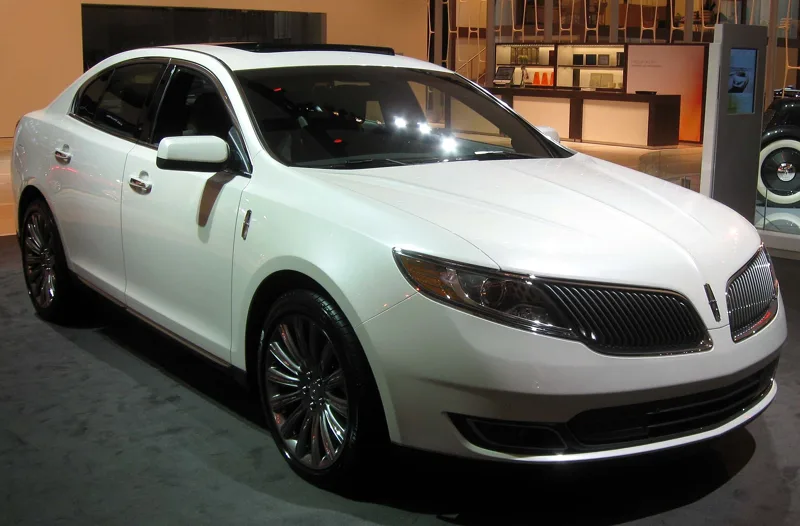
V12 car production grew in the late 1920s and peaked in the 1930s. Buyers valued the lack of vibration and noise, the smoothness and the power, and in that era petrol had a low octane rating and few passenger cars had vibration-isolating engine mounts, so extra cylinders were a way to gain performance. Europe offered cars such as the Daimler Double-Six, Hispano-Suiza J12, Maybach Zeppelin and Rolls-Royce Phantom III, and America had Cadillac, Lincoln, Packard and Pierce-Arrow.
The Great Depression ended most of it. Every American maker except Lincoln had dropped V12 production by the end of the 1930s, Lincoln stopped in 1948, and since then no American maker has produced a V12. Improvements in combustion chambers, pistons and fuel delivery let lighter, cheaper V8s overtake V12s in performance. After the war economic austerity ended European V12 luxury cars as well. Enzo Ferrari, who admired the V12s of Packard, Auto Union and Alfa Romeo, introduced the 166 Inter in 1948 with a 2.0-litre Colombo V12, and Ferruccio Lamborghini built his 350 GT with a 3.5-litre engine. Both makers have kept building V12 cars ever since.
What this means if you are buying or driving one
A V8 that rumbles is almost certainly a cross-plane engine, while a Ferrari V8 uses a flat-plane crank and a different note. A V12 will be smoother, but it is longer, so it appears mainly in large and expensive cars. Its cost, complexity and friction losses are the trade-off for smoothness and power.
Where this goes next
By the early 21st century, carmakers were using V8s less in passenger vehicles and turning to fuel-efficient lower-capacity engines, hybrids and electric drivetrains. V12s today turn up in boats and ships, on the railway, in big stationary power plants and in some European sports and luxury cars. Formula One replaced its V8s with 1.6-litre turbo V6s in 2014.