Why Audi settled on five cylinders, how a flat-four cancels its own vibration, and why the humble inline-four runs about 60% of new US vehicles.
The inline-four is simple, cheap and the most common car engine; the straight-five is smoother than a four and shorter than a six, as Audi showed; the flat-four has perfect balance and a low centre of gravity but costs more. Each layout has a famous car, from the Model T to Subaru's WRX.
Audi tried several six-cylinder layouts, could not square packaging with handling, and then its newly appointed chief designer, Ferdinand Piech, concluded that five cylinders was the only way forward. That decision gave the world the Audi five-cylinder, an engine still in use in the Audi RS3 today.
The inline-four, the straight-five and the flat-four are three ways of arranging a small number of cylinders, and each has its own strengths, weaknesses and famous cars.
What is an inline-four engine?
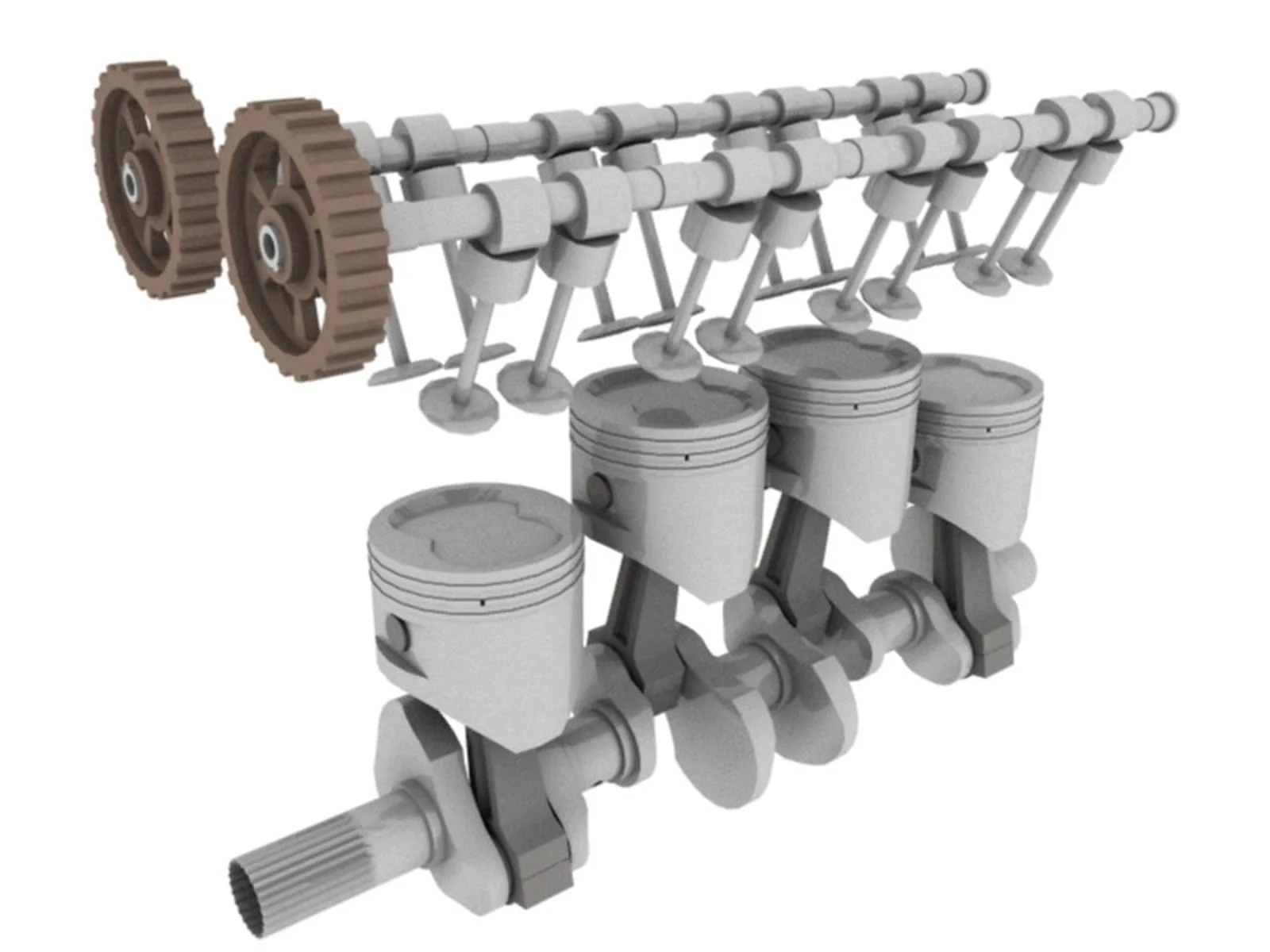
An inline-four, also called a straight-four, has four cylinders in a line along a common crankshaft. It is the layout most people mean by a four-cylinder engine, and it is the one found in most automotive fours. The flat-four, the V4 and the inclined slant-four exist too, but they are rarer. Because it needs just one cylinder head, the inline-four is simpler and cheaper to build than a V4 or flat-four.
From 2005 American buyers saw four-cylinder engines spread as makers downsized and added turbochargers to satisfy fuel economy and emissions regulations. By the 2025 model year they powered about 60% of new vehicles. Petrol fours in modern cars typically displace 1.3 to 2.5 litres (79 to 153 cu in), though the 1927 to 1931 Bentley four-and-a-half-litre was far larger and the Porsche 944 and 968 used 3.0 litres (183 cu in). At the small end, the 1963 to 1967 Honda T360 kei truck had a 356 cc (21.7 cu in) four, while the largest mass-produced four in a car is the 3.2-litre (195 cu in) Mitsubishi 4M41 diesel, used from 1999 to 2019 in the Pajero.
Audi had tested several six-cylinder layouts, and Ferdinand Piech then concluded that five cylinders was the only option.
Why does an inline-four vibrate?
Think of two pairs of children on seesaws: when one pair goes up, the other comes down. That is why a four-cylinder engine with the usual crankshaft has perfect primary balance, since one pair of pistons is always rising as the other falls. The trouble is secondary. Connecting rods are not infinitely long, so the pistons accelerate faster in the top half of the crank's rotation than in the bottom half. Two pistons always accelerate hard one way while the other two accelerate gently the other, producing an up-and-down shake at twice crankshaft speed.
The effect depends on the reciprocating mass, how long the rods are against the stroke, and how fast the pistons peak, which is why small engines with light pistons feel it little and racing engines use long rods. It also grows quadratically with revs. A four also delivers its power in pulses with gaps between them, since each cylinder finishes its power stroke before the next begins, and that adds vibration compared with engines of more cylinders.
Balance shafts and how engineers cope
A balance shaft system is sometimes fitted to fours, most often those of larger displacement. It uses two shafts with identical eccentric weights that turn in opposite directions at twice crankshaft speed, an idea dating to 1911. Mitsubishi Motors patented a version in the 1970s and introduced it in the Astron engine as Silent Shaft, and other makers have used it under licence.
Plenty of large fours have gone without. They include Citroen's 2.4-litre DS unit, Austin-Healey's 2.6-litre 100 engine, Ford's 3.3-litre Model A engine of 1927 and GM's 2.5-litre Iron Duke. Soviet and Russian GAZ Volga and UAZ engines of up to 2.9 litres were also built without them from the 1950s to the 1990s, though they were low-revving, which lessens the need.
Famous inline-four engines
The Ford Model T engine (1908 to 1941) is one of the most widely produced engines anywhere. The Alfa Romeo Twin Cam (1954 to 1994) was among the first mass-produced twin-cam engines and in 1980 was the first production engine to use variable valve timing. The BMC A-Series (1951 to 2000) was the first engine fitted to a mass-produced car that was front-wheel drive with the engine mounted across the body. The Triumph Slant-4 (1968 to 1981) was an early multi-valve engine that formed the basis of Saab's first turbocharged units, and the Honda F20C (2000 to 2009) made the highest specific output of any naturally aspirated engine of its time.
Racing carries its own list. The Peugeot that won the 1913 Indianapolis 500, designed by Ernest Henry, had double overhead camshafts and four valves per cylinder, a layout that is still standard for racing fours. The Miller engine drew on it and won through the 1920s and early 1930s, then evolved into the Offenhauser, which ran from 1933 until 1981. Before the war, voiturette Grand Prix cars including the Maserati 4CL and several ERA models used supercharged 1.5-litre fours. Aurelio Lampredi's Ferrari four began as a 2-litre Formula 2 engine for the Ferrari 500, grew to 2.5 litres for the Ferrari 625 in Formula One, and reached 3.4 litres in the Ferrari 860 Monza. The Coventry Climax four grew from a 1.5-litre Formula 2 engine to the 2,495 cc FPF, which took Cooper to the Formula One championship in 1959 and 1960. In the 1980s the BMW M12/13, with a cast iron block based on a road-car block, powered Brabham, Arrows and Benetton cars and won the 1983 world championship; the 1986 version was said to make about 950 kW (1,300 hp) when set up for qualifying, running 5.5 bar of boost.
Straight-five engine: why five cylinders?
Straight-five designs have been used since the late 1930s. They are less common than fours and sixes, and the best-known examples are the Mercedes-Benz diesels (1974 to 2006) and Audi's petrol engines (from 1977). A five is shorter than a straight-six, so it fits more easily across the engine bay, and it is narrower than V or flat engines and smoother than a four. A five-cylinder crankshaft has 72 degree angles, and with an even firing order the power strokes overlap, which a four cannot manage.
The price of an odd count is imperfect primary and secondary balance, where a straight-six is perfect. Counterweights on the crank can cancel some of the vibration. Most four-stroke fives fire in the order 1-2-4-5-3, which minimises the primary rocking couple, and Volvo, Volkswagen and Audi, General Motors and Honda have all used it. Fuelling was the other problem. A carburettor feeding an odd number of cylinders gives uneven mixture, because the inlet manifold length varies a lot between the end cylinders and those nearer the carburettor, and that is not fixed easily by adding more carburettors. Petrol fives only became practical for mass production with reliable fuel injection, whereas diesels always had injection, so large five-cylinder diesels appeared decades earlier.
Three layouts side by side
| Feature | Inline-four | Straight-five | Flat-four |
|---|---|---|---|
| Cylinder heads | One | One | Two |
| Primary balance | Perfect | Imperfect | Perfect |
| Secondary balance | Imbalance at twice crank speed | Imperfect | Perfect |
| Power delivery | Pulses with gaps | Power strokes overlap with even firing | Pulses with gaps |
| Strength | Simple and cheap | Smoother than a four, shorter than a six | Low centre of gravity, short length |
| Weakness | Vibration, strongest at high revs | Fuelling before injection | Width and cost |
The Audi five-cylinder and other famous fives
A straight-five diesel came first. The 1938 Lancia 3Ro trucks used one to replace a straight-three, and they were made for Italy's and Germany's armed forces and remained on sale until 1950. The first mass-production five in a passenger car was the Mercedes-Benz OM617 of 1974, a naturally aspirated 3.0-litre (183 cu in) in the 300D. A turbo version reached the 300SD in 1978, and Mercedes carried on making fives for 28 years until the OM647 ended production in 2006.
The Audi 2.0 R5 D diesel reached the Audi 100 in 1978, with a turbo in 1983, and Volvo used Audi fives in several cars before its own D5 turbo-diesel, built from 2001 to 2017. Other fives include the Land Rover Td5, the Fiat JTD 2.4 and the Ford Duratorq 3.2. Henry Ford had an inline-five developed in the late 1930s and early 1940s for a compact economy car but it was never built, because small cars did not sell in the United States.
Audi's 2.1 R5 of 1977, fitted to the Audi 100, was the first production straight-five petrol engine. Audi still builds them, turbocharged and naturally aspirated, and the RS3 has one. In motorsport the Audi Quattro rally car was the first to use a straight-five, and later racers included the Sport Quattro E2 of 1985 to 1986 and the Audi 90 Quattro IMSA GTO of 1989. In 1987 the factory tested a 735 kW (1,000 PS) version in the S1 Sport Quattro. Volkswagen used fives too, from the 1.9-litre 10v engine in the 1981 Passat to the 2.5-litre 20v EA855 in the North American Passat until 2014. The Volvo Modular engine, first fitted to the 1991 Volvo 850 and later to the Ford Focus ST and RS, was built in Skovde, Sweden, until 2016. Honda, Fiat and General Motors also built fives. In recent years the layout has been falling out of favour, and Volvo announced in 2012 that it would stop building them.
Scania builds a straight-five diesel for trucks and buses, in 8.9-litre and 9.3-litre forms. Fives in motorcycles are almost unknown, apart from the 125 cc Honda RC148 and RC149 racers of 1965 and 1966.
Flat-four engine: how does a boxer-four work?
A flat-four puts its two cylinder banks on either side of the crankshaft. In the usual boxer-four, opposed pistons travel in and out together in pairs. The result is perfect primary and secondary balance, a low centre of gravity and compact length. Because the forces are equal and opposed, a boxer-four needs no balance shafts, which makes it better suited to displacements above 2.0 litres (122 cu in). Some air-cooled examples have been built, though air cooling brings more noise and less power than liquid cooling, and in light aircraft it has traditionally been common.
The downsides against an inline-four are extra width, the cost of two cylinder heads and a long exhaust manifold if you want evenly spaced pulses. The typical firing order lights one bank in sequence, then the other, at 180 degree intervals. When each bank's exhausts are merged, uneven pulses produce the characteristic flat-four burble. Subaru has pursued the other approach since the mid-2000s, pairing cylinders from opposite banks with a 360 degree offset to even out the pulses, at the price of long manifolds and a less distinctive sound.
Inline-four vs flat-four: where each one won
Straight-fours are more common in cars than flat-fours, and where larger displacement is needed makers often turn to V6s. The first flat-four came from Benz and Cie in 1900: a 5.4-litre (330 cu in) engine of 15 kW (20 hp) designed by Georg Diehl for racing cars. London's Wilson-Pilcher followed in 1901 with a 2.4-litre unit of 7 kW (9 hp) whose bore and stroke were both 95 mm (3.7 in). In 1936 Tatra's T97 was first to combine a rear-mounted, air-cooled flat-four with a backbone chassis, a layout the Volkswagen Beetle later used.
The longest-lived flat-four is the Volkswagen air-cooled engine, built from 1938 until 2006 and used in the Beetle until 2003 and the Transporter until 1983. Designed by Porsche, it also powered the Porsche 356, 550, 912 and 914. A water-cooled Wasserboxer appeared in the Transporter T3 in 1984 to meet emissions rules. The 1960s and 1970s also brought flat-fours from Citroen, Alfa Romeo, Lancia and Subaru.
By 2000 most makers had replaced flat-fours with inline-fours, but Subaru stuck with its water-cooled EJ, turbocharged in the WRX and its rally-car counterpart. All-wheel drive was part of the reason: the flat-four's short length helps fit the drivetrain, and it lets Subaru build four-wheel-drive models at little extra cost over two-wheel-drive ones. In 2012 a naturally aspirated Subaru FA engine, with direct injection and 147 kW (197 hp) from 2.0 litres, went into the Toyota 86.
Flat-fours in the 2010s and beyond
The 2016 Porsche Boxster and Cayman (982) swapped a naturally aspirated flat-six for a turbocharged flat-four of 2.0 to 2.5 litres making up to 272 kW (365 hp), the first flat-four Porsche had built since the middle of the 1970s. Several reviewers criticised the engine's sound as uninspiring. In 2025 BYD introduced its first flat-four, in the Yangwang U7 luxury sedan, a water-cooled turbocharged engine with direct injection and hybrid technology making 200 kW (268 hp), reportedly inspired by Porsche's turbocharged flat-four units.
Other uses are scattered. Zundapp's K800 of 1938 to 1939 and the Honda Gold Wing of 1974 to 1987 used flat-fours, as did the BFG 1300, which used Citroen's air-cooled car engine and was built in about 450 units, a quarter of them bought by the French police. In aircraft, Lycoming and Continental flat-fours are fitted to the Cessna 172 and Piper Cherokee, and many ultralights use the Rotax 912.
What this means if you are buying or driving one
An inline-four is the default, and its vibration is managed with light pistons, long rods or balance shafts. A flat-four is rarer in cars and smooth, with a low centre of gravity, and Subaru is the main maker that kept it. An Audi five-cylinder gives smoother running than a four in a package shorter than a six. The flat-four burble comes from merged exhausts, while Subaru's pairing gives a plainer note.
Where this goes next
In the United States the trend is toward more small, turbocharged fours, while Volvo has dropped its five and Audi's is still in production. BYD's 2025 flat-four in the Yangwang U7 marks a revival of the boxer layout.