A word that once meant a coveted Italian import now means a car covered in anime characters, while the Tokyo Auto Salon fills Makuhari Messe every January with tuned and customised machines.
Itasha are cars decorated with anime, manga or game characters, mostly in paint and stickers. The Tokyo Auto Salon is an annual January show at Makuhari Messe for tuned and customised cars and aftermarket parts, which began in 1983 and drew 330,666 visitors in 2019.
Before it meant a car covered in cartoon characters, the Japanese word itasha meant the opposite of an embarrassment. In the 1980s, with Japan at the height of its economic strength and Tokyo full of luxury imports, itasha was slang for an imported Italian car, and it was the kind everybody wanted.
The word survived and changed hands. Today an itasha is a car dressed in anime, manga or video game artwork, a scene with its own conventions, racing liveries and model kits. Alongside it sits the Tokyo Auto Salon, a January show at Makuhari Messe that began in 1983 and now ranks among the top motor shows anywhere for modified and tuned cars.
What is an itasha car?
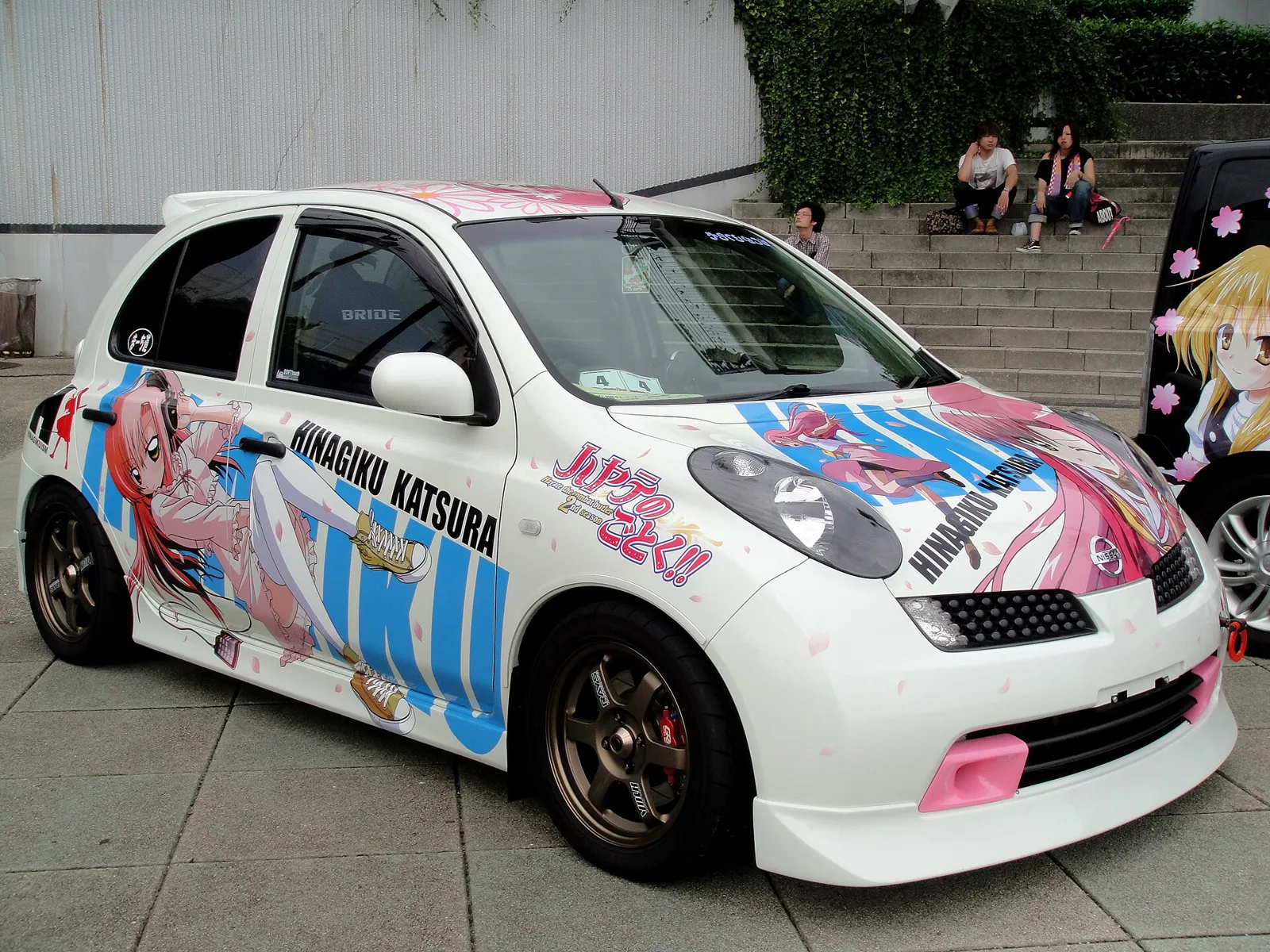
Written in Japanese, itasha means literally a painful car. It describes a car dressed in artwork of characters drawn from anime, manga or video games, with a particular link to bishojo games and eroge. The decoration is usually done with paint schemes and stickers, which in everyday terms makes it an anime car wrap.
You find these cars in hobby districts such as Akihabara in Tokyo, Nipponbashi in Osaka and Osu in Nagoya, and at events built around them, Odaiba Itasha Tengoku being one. The word applies to cars and nothing else. Other vehicles that borrow the idea have their own names. Motorcycles, bicycles, buses, trucks, trains and aircraft each get a separate term: itansha, itachari, itabasu, itatorakku, itadensha and itahikoki.
Itai can mean painful, embarrassing, painful to look at, or painful for the wallet.
Why a painful car? The word and its wordplay
The name is a double pun. The older slang itasha, short for the Japanese term for Italian cars, was clipped from Itaria-sha. The newer meaning was built by joining itai, which means painful, with sha, the word for a vehicle.
Itai stretches in several directions. It can mean painfully embarrassing, or cringeworthy. It can mean painful for the wallet, a reference to how much a fully decorated car costs. It can also mean painful to look at, an eyesore.
How the itasha scene took off
The subculture has roots in 1980s character plushies and stickers, yet it became a phenomenon only in the twenty-first century, once the Internet had made anime culture widely known. The first known report of an itasha turning up at a convention dates from August 2005, at Comiket 68.
Dedicated meetings followed quickly. In 2007 the first Autosalone, a convention aimed at itasha, was held in Ariake, close to Comiket. People use these gatherings to express themselves, to show their customisation to friends and to compete with rivals. Odaiba Itasha Tengoku was held in Odaiba, Tokyo, in 2019, and an Itasha-JDM event called Itasha Tengoku JDM Paradise took place on 27 March. Similarly decorated vehicles have also turned up in Taiwan, the Philippines and Italy.
When the owners of the characters join in
Rights holders have taken the idea seriously. Hirohiko Yoshida, executive director of ACID Co., Ltd., the parent company of game developer Age, was reported to own a Lamborghini Gallardo, a Lancia Stratos and a BMW M5, all themed on the game Muv-Luv. They were unveiled in 2008 at the Akihabara UDX Gallery.
Racing is another outlet. Since 2008 Good Smile Co. has backed cars in the GT300 class of Super GT that wear itasha-style illustrations of Hatsune Miku. In 2010 it split from its sponsored team and founded Good Smile Racing, whose cars regularly appear at conventions such as Anime Expo. In 2019 it joined forces with Type-Moon and TRIGGER, and the three entered cars at the 24 Hours of Spa wearing itasha liveries for Miku, Fate and Promare.
Not every owner is a company. Shigeyuki Nishiyama, who runs Nishiyama farm, has a Mazda3 and a motorcycle decorated with a humanised version of Seiun Sky, a character from the franchise Umamusume: Pretty Derby. The real-life Seiun Sky lived on Nishiyama Farm.
Car makers, model companies and the wider itasha look
Show floors have seen the style as well. In 2009 Nagoya Auto Trend saw the unveiling of a Phantom of Inferno Chevrolet Corvette, a Melonbooks MINI Cooper and a Chaos;Head Noah Toyota Estima.
Model makers moved in early. Aoshima Bunka Kyozai added ITASHA to its model car lines in June 2008, and since then Fujimi, Kyosho, HPI and Tamiya have all sold models with itasha decoration, in static and radio-controlled form. Increasingly the order runs the other way: models of an existing itasha get made afterwards.
The look has spread well beyond cars. It has been seen on railway cars, aircraft and computer cases. In clothing and accessories there is the ita-bag, a bag plastered with fandom badges and buttons. Ema are small wooden tablets on which visitors to Shinto shrines and Buddhist temples write a wish, and the ita-ema is the version carrying hand-drawn character illustrations. In 2008 the Maplus Portable Navi 2 satellite navigation unit began offering character voices, starting with Shuichi Ikeda as Char Aznable of the Gundam franchise, and in June 2009 the tuning shop T&E began selling a scented, semi-synthetic motor oil as the Itayu brand, its first product themed on Lucky Star and unveiled at the Shizuoka Hobby Show.
What is the Tokyo Auto Salon?
The Tokyo Auto Salon is an annual auto show for performance parts, custom aftermarket parts and tuning technology. It is held each January at Makuhari Messe in Chiba City, and NAPAC, the Nippon Auto Parts Aftermarket Committee, is the host. It started in 1983 as the Tokyo Exciting Auto Show and took its current name in 1987.
Entry on the opening Friday runs from 9 am to 7 pm. Saturday is open to the public over the same hours, and Sunday from 9 am to 6 pm. The Tokyo Auto Salon Association (TASA) is the main organiser and the Tokyo Auto Salon Committee the main promoter, with NAPAC as affiliate co-promoter. The Chiba Prefecture government, the Chiba City government, Avex Entertainment, San-Eisyobo Publishing, Idea Inc. and the Option-Land association (formally the Option-Land Global Communications Association) also back the show as affiliate sponsors.
The halls hold more than cars. Aftermarket parts makers, custom shops, car makers, other automotive businesses and automotive vocational schools all take space. There is live entertainment too, with top musicians from overseas and talk shows that put famous drivers and celebrities on stage. Show models on the stands draw loyal followings among spectators and photographers, and some are followed from show to show through the year.
The result is a show where a stand selling aftermarket accessories, a car company display and a live stage can share the same hall.
Tokyo Auto Salon by the numbers
The 2019 show featured 906 vehicles, 426 exhibitors and 4,175 booths selling aftermarket accessories. It also set a record attendance of 330,666 visitors over its three days, and a growing crowd was matched by a growing number of cars on display. Of those visitors, 1,886 came as media. Motor Trend, Car and Driver and Jalopnik were among the outlets that covered what was shown and debuted.
The venue has had to grow with the crowds. The Salon went from eight halls to 11 at Makuhari Messe, and it also uses the Makuhari Event Hall, the International Conference Hall, the Outdoor Arena and a road beside Zozo Marine Stadium. The 2012 show needed 54,000 m2 of space; the 2013 show needed 72,000 m2. The complex has parking for 6,000 vehicles, and six international hotels are within walking distance.
Tokyo Auto Salon overseas
| Edition | Details |
|---|---|
| Thailand, 2012 | First licence to a Thai enterprise to run the show under the brand; the first performance and custom parts show in Thailand, with more than 30 award-winning concept cars brought from Japan |
| Singapore, 2013 | Held at the Marina Bay Sands resort with TASA, MediaCorp and Muse Group; aimed at a culture of legal modifications |
| Kuala Lumpur, 2023 | Announced in January 2023; organised by Muse Group, joined in March by Element X; held at MITEC from 9 to 11 June 2023 |
| Hong Kong, 2025 | First time there; planned for 11 to 14 December 2025 at AsiaWorld-Expo, alongside International MotorXpo Hong Kong |
Tokyo Auto Salon through the years, and the 2026 list
In 2013 the car makers brought fresh ideas for older models. Nissan showed modified versions of its 2012 Juke, Note, Fairlady Z and GT-R, in line with a trend toward green features such as more engine output and better aerodynamics. Its headline debut was the NV350 Caravan Rider Transporter, built for the Salon as a cross between a commercial van and a leisure cruiser. Honda arrived with ten vehicles from its N-One mini family and an exhibition S2000 Modulo, a car that had not been seen since production ended in 2009. A design study of the CR-V sat beside the CR-Z Mugen RZ, which was to be limited to 300 units.
Toyota's 2015 line-up ran from a Land Cruiser on 46-inch tyres to a Gazoo Racing GT86.
The lists for recent years run longer. For 2023 they include the Renault Megane RS Trophy Limited Edition, the Mitsubishi Delica Mini and three BYD models, the Atto 3, Dolphin and Seal, along with Subaru Crosstrek and Rex concepts. The 2024 list includes the Honda Civic RS, the Lotus Eletre and Emira, the Mitsubishi Triton, Nismo versions of the Nissan Ariya, GT-R, Fairlady Z and Skyline, the Toyota GR Yaris refresh and the Toyota Century GRMN. Concepts that year ranged from a Mazda Spirit Racing pair to a Nissan Disaster Support Mobile-Hub and a Suzuki Spacia Papaboku Kitchen.
The 2024 concepts also included a pair of Mugen Civic Type R builds, one labelled Group.A and the other Group.B, the Hyundai Ioniq 5 N NPX1, and two Lexus cars, the LBX Morizo RR and the RZ450e F Sport Performance. Mitsubishi brought snow-themed versions of the Triton, Delica D:5 and Delica Mini, plus an Outlander PHEV Active Field. Nissan added an X-Trail Crawler, sports-spec Autech versions of the X-Trail and Serena, and customised Roox and March concepts. Suzuki showed the Swift Cool Yellow Rev and the Super Carry Mountain Trail, and Toyota offered a supercharged iQ GRMN and a GR Corolla Morizo Custom.
The 2025 list names the BYD Sealion 7, the Honda Prelude, the Hyundai Inster and facelifts of the Suzuki Solio and Nissan Fairlady Z. For 2026 the list has the Acura Integra, the Honda NSX Tribute by Italdesign, the Honda Passport, the Toyota GR GT and the Toyota GR GT3, plus two concepts, the Nissan Aura Nismo RS and the ID. GTI.
Where this goes next
Kuala Lumpur took the Tokyo Auto Salon brand in June 2023 under Muse Group and Element X, and Hong Kong was planned to host its first edition from 11 to 14 December 2025 at AsiaWorld-Expo, alongside International MotorXpo Hong Kong.
Itasha keeps branching into new products, from model lines and racing liveries to apparel and motor oil, and similarly decorated vehicles have already been found in Taiwan, the Philippines and Italy.