A luxury brand cancelled before launch, a rear-drive flagship, a compact saloon with a touring-car record and an SUV shared with Ford.
Mazda's Millenia, Sentia, Xedos 6 and Tribute were four models built between 1991 and 2011. The Millenia was meant to launch the cancelled Amati brand. The Sentia was a rear-drive flagship, the Xedos 6 a compact saloon and the Tribute an SUV developed with Ford. The CX-5 and Mazda6 later took their places.
Mazda once planned a $75 million advertising campaign for a luxury brand that never reached a showroom. The car meant to lead that brand became the Millenia, and its story is tied to three other discontinued Mazdas: the rear-drive Sentia, the compact Xedos 6 and the Ford-built Tribute SUV. Each was built for a different purpose, and each ended for a different reason.
Why did Mazda plan the Amati luxury brand?
Mazda wanted a rival to Lexus, Infiniti and Acura in the early 1990s. The Millenia was to be the launch model of that new brand, Amati, in 1994, wearing the name Amati 500. A logo had been produced and a $75 million marketing campaign with the Los Angeles agency Lord, Dentsu & Partners was set to begin at the end of 1993. Mazda expected 20,000 sales a year in 1994 and twice that by 1995.
Then the Japanese asset price bubble burst. Recession squeezed Mazda's finances, Amati was scrapped, and by November 1993 the company had decided to sell the car as a Mazda. Other cars were caught in the same retreat. The Xedos 6 had also been pencilled in as the Amati 300, and Best Car Magazine spotted styling cues from the unbuilt Amati 1000 on the second-generation Sentia, which was developed with the planned flagship in view.
The name Millenia has its own quirk. It is a misspelling of millennia, the plural of a thousand-year span.
Because Amati never happened, the car was rebadged to suit whichever sales channel each region had left.
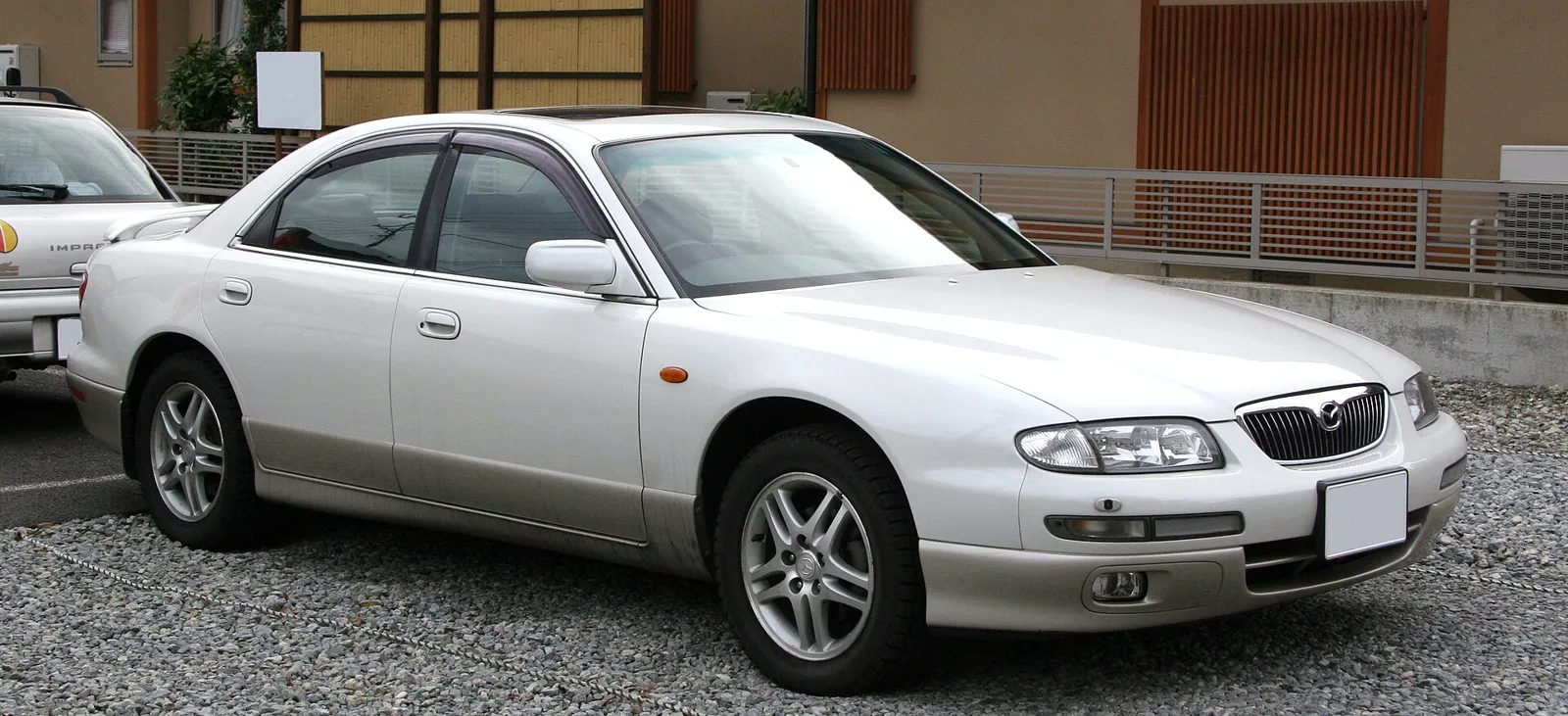
One luxury saloon, four names
Because Amati never happened, the car was rebadged to suit whichever sales channel each region had left. Mazda of Europe sold it as the Xedos 9 from 1993 to 2002, alongside the smaller Xedos 6. In right-hand-drive Japan and Australia it was the Eunos 800 from 1993 to 1998, with the Miller-cycle version known as the Eunos 800M. Neither Efini nor Autozam, Mazda's other Japanese channels, had a version of its own.
That arrangement ended in July 1997, when the Eunos brand was closed and the Eunos 800 took the Mazda Millenia name. Mazda Motorsport Australia also built a limited Eunos 800M SP with better suspension and bigger wheels.
North America got the car in 1994 as a 1995 model, where it took over from the 929 as the flagship saloon. The 929 had been the final rear-drive Japanese saloon in the US from a mainstream badge, while the Millenia drove its front wheels. There was no North American equivalent of the Xedos 6.
What made the Millenia different underneath?
At launch no other production car anywhere used a Miller-cycle engine. Mazda did not return to the idea until the second-generation Mazda2 of 2008, and it now features in the company's SKYACTIV engines. In the top Millenia S, a supercharged, dual-intercooled 2.3-litre V6 ran on that cycle instead of the more common Otto cycle.
The payoff, according to the figures given for the North American cars, was 50 per cent more power than the base 2.5-litre naturally aspirated engine and 50 per cent better fuel economy. Ward's put the engine on its 10 Best list every year from 1995 through 1998.
Because the car was aimed at buyers who would normally look elsewhere, Mazda also tried to build it to a higher standard than its mainstream models. The interior plastics were improved, the panel gaps were tighter, and the paint went on thicker and more evenly because the body was turned on a huge spindle while it was sprayed. Mazda claimed the care was meant to hold good as a benchmark for a decade or more.
Trims and equipment in North America
There were three versions. The base car was simply called Millenia, the Millenia L added leather, a power moon roof and keyless entry, and the Millenia S carried the supercharged engine. Every one had twin front airbags, ABS and traction control.
Reviewers weighed it against rivals such as the BMW 3-series, Infiniti i30, Acura TL, Lexus ES300 and Mercedes C280, and often judged it ahead on interior, engine and value. For the 2000 model year Mazda added a Millennium Edition above the S, limited to 3000 cars, with faux suede, a Bose stereo, 17-inch alloys and two special paint colours.
Japanese buyers could also order yaw-sensitive four-wheel steering. Mazda claimed it let the car pass the elk test at speeds comparable to the BMW 850i and Nissan 300ZX.
How the Millenia faded out
A small facelift in 1997 was mostly about saving money, and it swapped an aluminium bonnet for a steel one. A bigger update for the 2001 model year reworked the bumpers and grille, stiffened the body and fitted larger brakes, and leather became standard.
Production stopped in September 2002 with the last 35 cars. Dealers in the United States were still reporting new Millenia sales as late as July 2004. The car had no direct predecessor or successor in the Mazda line. The Mazda6 arrived in 2002 and also took the place of the 626, the company's other mid-size saloon of the time.
What was the Mazda Sentia?
The Sentia was Mazda's rear-wheel-drive flagship saloon, sold in Japan across two generations between 1991 and 1999. It took over from the Luce on the H platform and continued a tradition of large Mazda saloons that dated back to the late 1960s. Kia built it under licence in South Korea until October 2002, selling it as the Kia Enterprise. The name comes from the Latin sentio, to sense, feel or hear.
Its design took a winding route. Chief designer Shunji Tanaka leaned towards an unconventional theme called Prince's Coach, named for Crown Prince Akihito, but it struggled and an unusually large number of full-size models were rejected. A young American, Peter Montero, was asked to try another theme. He argued that a non-luxury brand chasing luxury buyers needed proper rear-drive proportions, so an earlier model was reworked with the front wheels pulled forward and the front overhang cut. Dori Regev, another young designer in the Hiroshima studio, produced the final design, frozen on 24 December 1988 for 1991 production. Prototype testing began in 1989.
Front midship and four-wheel steering
Mazda described the layout as front midship. The V6 sat behind the front axle and the fuel tank over the rear axle, an arrangement borrowed from the company's rotary-engined RX-7 and Cosmo. The Sentia also introduced Mazda's speed-sensitive four-wheel steering. Below 35 km/h (22 mph) the rear wheels turn against the fronts to shrink the turning circle, much as a shopping trolley pivots when you push its back sideways. Faster than that they turn with the fronts, which steadies the car.
A solar ventilation system was another piece of showpiece technology: solar cells in the sunroof ran small fans near the boot to cool the cabin while the car sat parked in the sun. The Eunos 800 and Millenia later inherited it.
Two engines were offered in Japan so that buyers could choose which annual road tax they wished to pay. The 3.0-litre JE-ZE V6, fitted with a variable-length intake manifold, made 200 PS (147 kW; 197 hp), while the 2.5-litre J5-DE made 160 PS (118 kW; 158 hp). The bigger engine came with far more equipment, and body width mattered too, since Japanese owners pay extra annual tax for larger cars. Mazda sold a better-equipped version through its short-lived Efini luxury channel as the Efini MS-9.
The 929 in export markets
Export cars wore the Mazda 929 badge, becoming the 929 Serenia in Canada. Canadian sales stopped after the 1994 model year and US sales after 1995, because buyers had lost interest in big Japanese imports from non-luxury brands, as Toyota's withdrawal of the Cressida in 1992 had already shown. The front-drive Millenia then topped Mazda's North American range.
The second-generation Sentia and its price problem
The HE generation appeared in late 1995 in Asia and in April 1996 in Australia, where it was sold as the 929. It was smaller than the car it replaced and was the last large rear-drive saloon Mazda built. Mazda expected it to serve as executive chauffeur transport, so the grille grew, the roofline rose for rear headroom and the cabin gained large areas of woodgrain. The 2.5-litre engine was dropped, leaving the 3.0-litre in two states of tune, 200 PS (147 kW; 197 hp) and 160 PS (118 kW; 158 hp).
Exports to Australia stopped in 1997 because of poor sales and a rising price: by the end the 929 cost over AUD$83,000, about what an entry-level BMW 5 Series did. Japanese television advertising starred Sean Connery.
The Kia Enterprise
The Kia Enterprise went on sale in 1998, built at Kia's Hwaseong plant. Its engines were Mazda-sourced and its suspension multilink at both ends. It followed the Kia Potentia, another Mazda-based big saloon, and it was left-hand drive where the Sentia was right-hand drive. In 2002 it gave way to the Kia Opirus, which shared a platform with the Hyundai Grandeur. The Enterprise was the last rebadged Mazda Kia produced before Hyundai took the company over following the Asian Financial Crisis of 1997.
Xedos 6 and Eunos 500, the compact executive
The Xedos 6 and its Japanese and Australian twin, the Eunos 500, were compact executive cars built from 1992 to 1999. The Eunos 500 was first shown at the 1991 Tokyo Motor Show and shared the Mazda CA platform with the Capella. Full production started in January 1992. In total 72,101 Xedos 6 and Eunos 500 cars were made, none of them for North America.
British cars carried the Xedos 6 name, while Japan, Hong Kong and Australia used Eunos 500 because they sold it through the Eunos brand. Left-hand-drive Xedos 6 cars for mainland Europe followed in 1993. Reviewers liked the shape, and Honest John likened it to a small Jaguar with Mazda dependability. The interior drew criticism for being dull.
Engines and speeds
European buyers could choose a 1.6-litre four-cylinder or a 2-litre V6. The 1.6 made 114 hp (85 kW; 116 PS) and was widely thought underpowered, while the 2-litre V6 made 144 hp (107 kW; 146 PS) and was praised for being smooth and free-revving. The V6 reached 133 mph (214 km/h) with a manual gearbox and 125 mph (201 km/h) with an automatic, and Mazda claimed 30-31 miles per gallon (imperial). The 1.6 topped out at 184 km/h (114 mph) by hand and 175 km/h (109 mph) as an automatic. It reached the UK in 1993, while the V6 was on sale everywhere from the start.
Emissions rules trimmed the output: Euro 1 updates in 1994 cost the 1.6 7 hp and the 2-litre 4 hp, with more changes in 1996. The 1.6 and the 2.0 Sport left the range in 1998, a year before the rest.
Japan received different engines. The base car was a 1.8-litre V6 with 140 PS (103 kW; 138 hp), good for 195 km/h (121 mph), and the 2-litre V6 was tuned harder than the European one, with 160 PS (118 kW; 158 hp) and 205 km/h (127 mph). When Mazda axed the Eunos brand, the car became the Mazda Eunos 500 and ran until 1999.
The Xedos 6 in the British Touring Car Championship
Mazda entered the Xedos 6 in the British Touring Car Championship in 1993 and 1994. In 1993 Roger Dowson Engineering ran the works team, with the Xedos 6 replacing the 323F of the previous season. Patrick Watts took his first pole at Snetterton, added three fourth places and ended 15th overall, two points behind former champion Tim Harvey in a works Renault 19. Mazda was eighth, and last, among the manufacturers.
The following season was harder. David Leslie and Matt Neal drove for a team run by Roger Dowson Engineering and Team Dynamics. Neal withdrew after a heavy crash at Silverstone, and Leslie left midway through with budget problems. Leslie's best finishes were two eighth places, Neal's a tenth at Snetterton, and Mazda was tenth and last. The Xedos 6 running gear later went into a 323F that Neal drove in the 1994 FIA Touring Car World Cup.
Why did Mazda build the Tribute with Ford?
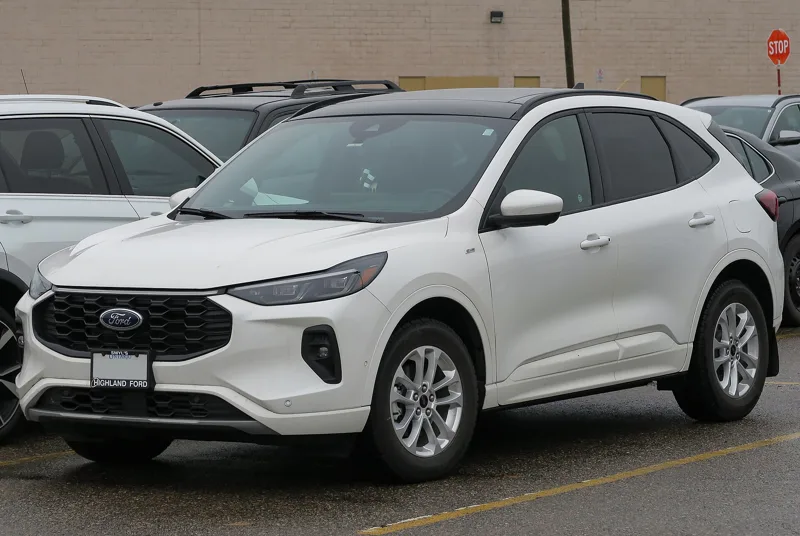
The Tribute was a compact SUV built from 2000 to 2011, developed jointly with Ford. It used the front-drive Mazda 626 platform, which also underpinned the Ford Escape on its CD2 platform, and it was priced below the Escape and the Mercury Mariner. Mazda had no SUV of its own design before it: in Japan it had been selling the Proceed Levante, a rebadged Suzuki Escudo.
It appeared at the 2000 Los Angeles Auto Show, in a segment the Toyota RAV4 had pioneered in 1994, and reached Europe at the Paris Salon in October 2000. Ford's plant at Claycomo, Missouri built North American cars, while Hofu in Japan and Lio Ho in Taiwan served other markets. Buyers chose front or all-wheel drive, with a 2.0-litre Ford four-cylinder or a 3.0-litre Ford V6. Mazda tuned the suspension firmer than the Escape's, and the Maverick sold in Europe, to fit its sporty image.
The first generation in Japan
Japanese sales began in November 2001, with only a four-speed automatic. Power was 130 PS (96 kW; 128 hp) from the 2.0-litre and 200 PS (147 kW; 197 hp) from the V6. The four-cylinder used a timing belt, while the V6 had a maintenance-free timing chain.
The refresh for the 2005 model year, in Japan from December 2003, made Mazda's own 2.3-litre four-cylinder the base engine, with the Ford V6 optional. North American cars became the Tribute i (four-cylinder) and Tribute s (V6) and gained a floor-mounted shifter. The four made 153 hp (114 kW) and the V6 200 hp (149 kW). Japanese sales stopped in March 2006, when the CX-7 replaced the Tribute.
Asia-Pacific markets received a facelift in the second half of 2006, with a bolder grille and a V6 reworked to cut fuel consumption by more than 10 per cent. Mazda Australia stopped selling the Tribute in 2008, with the CX-7 taking its place. Production for the rest of Asia-Pacific moved to Ford's plant at Jhongli in Taiwan and ended in early 2010, when imported CX-7s replaced it.
Second generation and the CX-5 that ended it
The 2008 model year brought new sheet metal and a better interior, but the car stayed on the CD2 platform with the same 2.3-litre four and 3.0-litre V6. It went on sale in March 2007 after a reveal at the Montreal show. It had been due to take the name CX-5 but kept Tribute. Unlike the first generation, it now differed from the Escape and Mariner mainly in the nose, tail lights and detailing. A hybrid joined the range, and rear drums replaced discs as a cost-saving move that drew criticism from the press.
The 2009 model year brought new engines. A 2.5-litre four-cylinder replaced the 2.3, rated at 171 bhp (128 kW; 173 PS), and the optional V6 gained 40 hp (30 kW) to reach 240 hp (180 kW). A Ford six-speed automatic became standard with the V6, and new stabilizer bars answered complaints about handling after the 2008 changes. The Tribute ended with the 2011 model year, and the more aggressively styled, Mazda-designed CX-5 took its place in 2012.
In Australia the Tribute started out popular, trailing only the Toyota RAV4, Honda CR-V, Nissan X-Trail and Subaru Forester. The Ford version dominated in other territories, but in Australia the Mazda outsold it by nearly 2 to 1, consistent with Mazda being the stronger brand there.
What replaced them
| Model | Built | Type | What followed |
|---|---|---|---|
| Millenia | 1993-2002 | Front-wheel-drive luxury saloon | No direct successor; the Mazda6 arrived in 2002 |
| Sentia | 1991-1999 | Rear-wheel-drive flagship saloon | Last large rear-drive Mazda saloon; the Kia Enterprise gave way to the Opirus in 2002 |
| Xedos 6 / Eunos 500 | 1992-1999 | Compact executive car | Production ended in 1999 after 72,101 cars |
| Tribute | 2000-2011 | Compact SUV, developed with Ford | CX-7 in Japan and Asia-Pacific; CX-5 from 2012 |
One piece of engineering outlived its car. Mazda dropped the Miller cycle after the Millenia, then brought it back in the second-generation Mazda2 in 2008 and in the SKYACTIV engines of its modern cars.