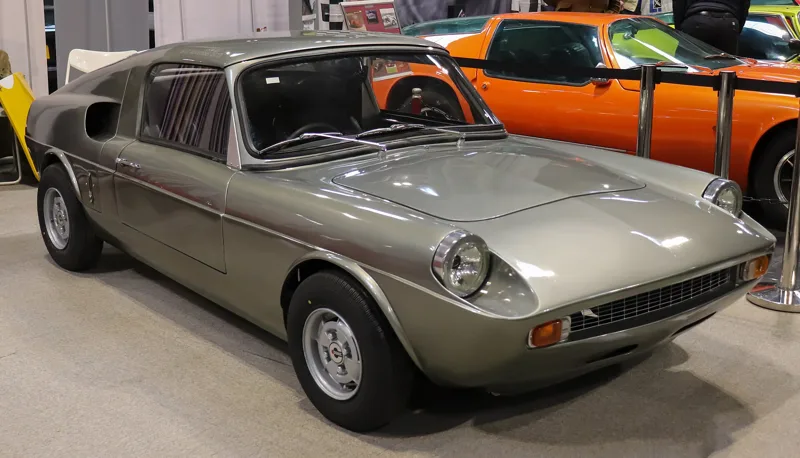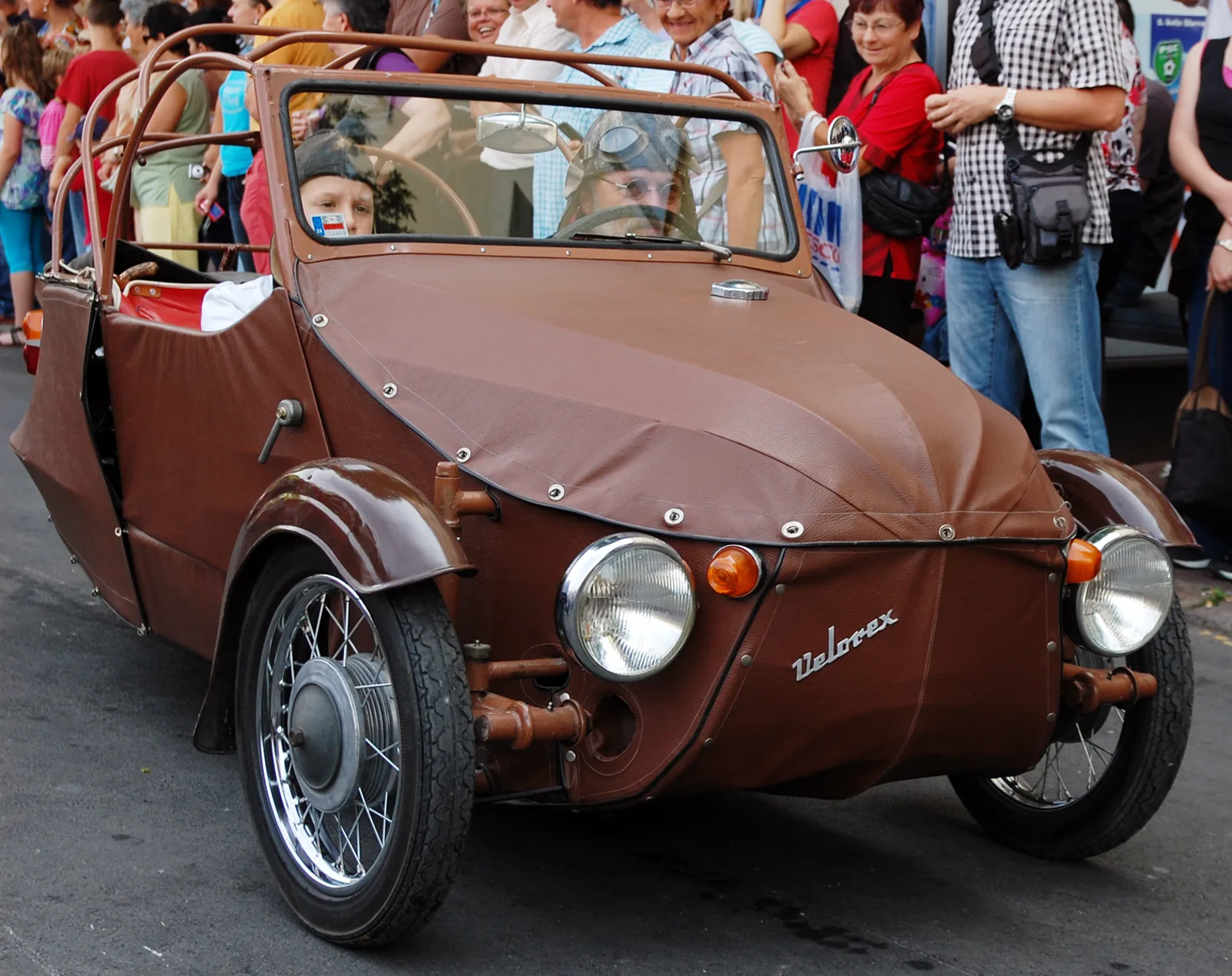
A fibreglass microcar whose idea began in Cairo, an electric commuter from a Scottish aircraft maker, and a vinyl-skinned Czech three-wheeler sold at home only to disabled drivers.
Britain's Meadows Frisky microcar was made at Wolverhampton from 1958 to 1961. Scottish Aviation drew up the electric Scamp city car as a concept in the 1960s. In Czechoslovakia, the Velorex cooperative produced a three-wheeled car, chiefly for disabled drivers, until 1971 and has kept sidecars in production.
One of these tiny cars was tested for 738 miles until its steering turned dangerously vague, another started in Cairo and ended in Kent with a spares business, and the third was sold at home only to disabled drivers. They are the Scottish Aviation Scamp, the Meadows Frisky and the Velorex.
What were the Meadows Frisky, Scottish Aviation Scamp and Velorex?
The Meadows Frisky was a British microcar made in Wolverhampton from 1958 to 1961. The Scamp was an electric commuter concept from Scottish Aviation, designed in the mid-1960s. Velorex, a Czechoslovak cooperative, built a three-wheeled car until 1971 and still has sidecars produced under its name.
The Scamp's endurance test report listed faults from buckled wheel rims at 36 miles to dangerously vague steering at 738.
Where did the Velorex come from?
From 1936 two brothers, Frantisek and Mojmir Stransky, who ran a bicycle repair shop, set out to design a small, cheap three-wheeler. Morgan three-wheelers inspired them. In 1943 they built a first prototype from steel tubing, dural sheet and bicycle parts, which they later swapped for motorcycle components. They called it Oskar, short for a Czech phrase meaning cart on axle.
The first batch followed in 1945, with bodies of leather cloth rather than metal. Three used 150 cc CZ motorcycle engines, three used 300 cc PAL engines, and six used 250 cc Jawa units. The price was around a quarter of that of a typical car, which mattered in a country where the post-war industry could not satisfy demand and customers faced long waits and quotas.
How did Velorex become a factory?
In 1950 the brothers' workshop was transferred to Velo, a small company in Hradec Kralove that was later renamed Velorex. A year later the machinery and six workers moved to a new plant in Solnice. That year 120 of the Oskar 54 were built, and 180 the year after. By 1954 eighty workers were making 40 vehicles a month.
Frantisek Stransky was killed on 21 January 1954 when a test prototype crashed, and Mojmir, who would not join the Communist Party of Czechoslovakia, lost his job. The car became Velorex - Oskar in 1956 and simply Velorex soon afterwards. Output reached 120 vehicles a month in 1959, and part of production moved in 1961 to a new plant at Rychnov nad Kneznou. The early cars had a maximum speed of 30 km/h.
How is a Velorex built?
The structure is a frame of welded steel tubing. The bodywork is vinyl, known as Igelit, stretched over the frame and held on with turnbutton fasteners. Like most three-wheelers, it has two wheels at the front and one at the back.
How do the Velorex models compare?
| Model | Engine | Power | Unladen weight | Length |
|---|---|---|---|---|
| Oskar 54 | Jawa 250 two-stroke single, 248.5 cm3 | 9 HP at 4,250 rpm | 205 kg | 3.1 m |
| Oskar 16/250 | Jawa 250 two-stroke single, 248.5 cm3 | 9 HP (later 12 HP) at 4,250 rpm | 205 kg | 3.25 m |
| Velorex 16/175 | CZ 175-505 two-stroke single | 8.5 HP at 4,500 rpm | 290 kg | 3.1 m |
| Velorex 16/350 | Jawa 350-572 two-stroke twin, 344 cm3 | 11.8 kW (16 HP) at 4,750 rpm | 310 kg | 3.1 m |
| Velorex 435-0 (four-wheeler) | Jawa 350/572 | 17 HP at 4,750 rpm | 385 kg | 2.89 m |
What did the Velorex three-wheelers offer?
All the three-wheeled models had two seats, an air-cooled two-stroke engine and a brief to serve disabled drivers. The Oskar 54 returned 3.6 L/100 km and could carry up to 395 kg in total. The 16/175 was thirstier at 5 L/100 km. The 16/350 had a cruising speed of 60 km/h and a maximum of 85 km/h.
The Model 16 arrived in 1963 and was modernised in 1968. In 1971 the company swapped to a four-wheeler, the Model 435-0, with a 17 HP Jawa engine and a top speed of 80 km/h.
Why did the Velorex four-wheeler fail?
Design and manufacturing problems hurt the 435-0, and it could not compete with cars in higher categories, including the cheap Trabants. It was a commercial failure and production stopped in 1973. Ideas for a small car in the mould of the Fiat 500, or a rickshaw-style truck, never got off the ground.
Solnice made spares at first, and Rychnov nad Kneznou took over after 1975. India tried in the mid-1980s to licence the three-wheelers, but the original tooling no longer existed and the deal collapsed.
Who could buy a Velorex?
About half of production went abroad to Eastern Bloc countries, 7,540 vehicles in all, including Hungary, Poland, Bulgaria and East Germany. At home, demand outran supply, and new cars were sold only to disabled people, after a thorough examination by an official commission. Some production was allocated to companies and organisations.
Of the three-wheelers sold in Czechoslovakia, 62.5% were still registered in 1996. The Velorex had gained cult status among owners by 2006, with several clubs in the Czech Republic and rallies at Boskovice (the last in 2007) and at Lipnice Castle in Lipnice nad Sazavou. Until 2000 a motorcycle licence (A) was all a driver needed; after that the B1 car licence, available from age 17, applied.
How do the Velorex sidecars work?
Soviet demand for motorcycle and sidecar combinations led Jawa to build the 354, a motorcycle strong enough for sidecar work, while Velorex produced the Type 560 sidecar to go with it. In 1974 Jawa built the 350cc Type 634, designed specifically for sidecars, with 28 BHP at 5,252 RPM and 38 foot pounds of torque at 3,800 RPM, the same torque as the original 750cc Triumph Bonneville. Its dynamo was rated at 75 Watt against the 354's 45 Watt.
The Type 562 sidecar was Velorex's answer: stronger than the 560 and easier to assemble, which eased the production problems the older sidecar had caused. Around 290,000 were made from 1974 to the late 1990s.
In 1986 Jawa brought in the more powerful Type 638, at first 34 BHP at 6,500 RPM, then detuned from 1988 to 25 BHP for European Union emissions rules, and to 23 BHP for the Dutch market. The Type 634 engine returned in 1990 in the 638 chassis as the Type 632, a better sidecar tug than the detuned 638, and Velorex built the Type 710 sidecar to go with it.
Why is the Type 710 the best Velorex sidecar?
The Type 710 has a more streamlined shape that resembles a jet fighter cockpit, with a big forward-opening perspex windscreen and plenty of leg room. Its full-height backrest leaves stowage behind it with three times the capacity of the Type 562, which is why it is regarded as the best sidecar Velorex made.
Both sidecars share a chassis and differ only in bodywork, with a 16 or 18 inch wheel and a 160mm drum brake linked to the motorcycle's rear brake for balanced stopping. They were also sold worldwide with fitting kits for bikes from Harley-Davidson, Honda, Triumph and others. Jawa sells the 350cc Type 640 with a Type 562 sidecar across Europe and in the UK, the one large two-stroke motorcycle that meets European Union emissions rules.
After the Velvet Revolution the cooperative collapsed. Its sidecar facilities were later privatised, and production restarted under the Velorexport name. A reseller named Motoscoot has also planned a modern three-wheeled sports car, the Velor-X-Trike, at 5 to 10 vehicles a year, which has no connection with Mojmir Stransky's designs.
Where did the Meadows Frisky start?
The Frisky was the idea of Captain Raymond Flower, a racing driver who ran the Cairo Motor Co, the Nuffield distributor in Egypt, with his brothers Derek and Neville. The family belonged to the Flower & Sons brewing dynasty of Stratford on Avon. Plans for Phoenix cars built in Egypt surfaced in the press from February 1955, but the Suez Crisis of 1956 soured relations between Britain and Egypt and little came of them.
Flower carried his idea of a cheap, mass-produced small car to British makers and struck a deal with Henry Meadows Ltd, an engine builder for road, marine and industrial use that belonged to the Associated British Engineering Company.
How did The Bug become the Frisky?
Gordon Bedson, an ex-Kieft and Vickers engineer, joined Meadows in 1954 as Export Sales Manager. With project engineer Keith Peckmore he built a prototype from about July 1956 in a back room of the factory. Nicknamed The Bug, it was a four-wheeled two-seater with a moulded fibreglass shell, gull-wing doors, a Villiers air-cooled 250 cc twin and a brazed ladder chassis.
A narrow rear track removed the need for a differential, and a roller chain drove the solid rear axle. The gearbox was a four-speed motorcycle unit, and reverse came from running the engine backwards using the Dynastart.
On 5 December 1956 The Bug started a seven-day, round-the-clock test at Oulton Park, covering 4,000 miles (6,400 km) with a fastest lap of 54.91 mph (88 km/h). Because Flower was at the circuit with his Phoenix SR150 racer, and the Meadows name was embargoed, reports wrongly called the car the Phoenix Frisky. The correct name was announced on 11 March 1957, just before the Geneva Motor Show, with a price promise of under 400 pounds.
Vignale of Turin, commissioned by Flower, gave the production body to Giovanni Michelotti. It reached Geneva without an engine, which was displayed in front of it, and the gull-wing doors drew widespread praise. Only two bodies were made, because the design was too costly for mass production, and the car was redesigned for Earls Court in October.
How did the Frisky change before production?
Meadows registered a subsidiary, Henry Meadows (Vehicles) Ltd, in June 1957. Conventional suicide doors replaced the gull wings, and a bigger Villiers engine of 324 cc (19.8 cu in) went in. The prototype had reportedly covered over 100,000 miles (160,000 km) by the time of the show.
Publicity promised a Frisky Saloon and a convertible Friskysport, but only the Friskysport appeared at Earls Court. The press liked it again, though reports noted it was not yet in full production, and production did not start until March 1958. In February that year the Flower Group took a controlling interest.
Which Frisky models were built?
The Marston Group took over Friskysport production in September 1958, and the maker became Frisky Cars Ltd, chaired by Henry R Stone. October's Earls Court show brought the Frisky Coupe, a saloon form of the Friskysport, with two other newcomers, the Family Three and the Sprint. The Coupe and Friskysport share a chassis; early Friskysports have a chrome windscreen frame from the Reliant Sabre, a detachable tail and dummy air scoops.
The Family Three was a three-wheeled coupe, fitted with the smaller Villiers 9E and MacPherson struts at the front. Three wheels cut road tax and allowed driving on a motorcycle licence. Production began around February 1959.
The Friskysprint was a sports racing prototype with an air-cooled 492 cc Excelsior three-cylinder across the frame, said to reach 90 mph (145 km/h). It was expected to sell for between 675 and 750 pounds including purchase tax, but it never reached production, and its designer Gordon Bedson left the next spring for Lightburn in Australia to produce the Zeta Sports.
What happened to Frisky Cars?
In June 1959 Frisky Cars Ltd ran into financial trouble, and Hills Fibre Glass Developments, which made the bodies, obtained an order over a debt of 3,500 pounds. Henry Stone defended it vigorously, but the creditor's insistence left the judge no alternative, and the company was wound up.
C. J. Wright, a Wolverhampton businessman, bought the stock, tooling and rights in August 1959 and formed Frisky Cars (1959) Ltd. He aimed for 30 three-wheelers a week, but a planned plant on a 30-acre site at Penkridge never happened. The Family Three Mk2 used Dubonnet front suspension, a longer chassis, a 250 cc or 328 cc Excelsior Talisman twin and an Albion gearbox with a proper reverse. It went into production in early 1960 with twin front seats.
The Frisky Prince, a Family Three given a new body and doors hinged at the front, appeared at Earls Court in October 1960, and kits arrived through Middlesbrough Motorcraft. A four-wheeled Prince announced for 1961 was never built. Petbow Ltd of Sandwich, Kent, run by R Bird, bought the company in February 1961 and production moved there.
Against the BMC Mini the Prince struggled, and chassis problems kept staff busy mending customers' cars. All work stopped towards the end of 1961. Frisky Spares and Service Ltd, formed in 1962 at Queenborough, Kent, supplied spares and kits until around 1966. Today the Frisky Register, founded in 1978 by Henry Meadows's grandson John, helps owners.
What was the Scottish Aviation Scamp?
The Scamp was a small electric city car concept that Scottish Aviation designed between 1964 and 1966. Its name joins SCottish with AMP, for electric current. The firm's Project Department had been inspired by the battery tugs at Prestwick Airport, which plugged into a charger between jobs, and it reasoned that an electric car could be charged at its owner's home.
Department head Gordon Watson watched wives waiting in a station car park for commuter trains and saw the need for a small, cheap second car dedicated to the station run. It would be recharged overnight from a 13 amp domestic socket, and the electricity cost worked out at better than 150 miles (240 km) per gallon.
What was the Scamp designed to do?
The brief asked for a full recharge from a domestic supply in 8 hours, a tiny and nimble body, and seats for a couple, or one adult plus two small children, with shopping. It had to keep up with town traffic, at 35 mph (56 km/h) flat out and 0-30 mph (48 km/h) in under 12 seconds, and set off laden up a 1 in 4 hill.
The target range was at least 25 miles (40 km). That seems modest, but the team's research said it would carry a commuter from any suburb of a big city such as Glasgow, so the plan was to make the car cheap rather than chase range or speed.
How was the Scamp developed?
In early 1965 a test vehicle appeared, barely more than a seat on a chassis, called the farm cart. It reached 36 mph (58 km/h) and did 0-30 mph in 10.5 seconds. In simulated town driving it managed 18 miles (29 km) per charge against a target of 15 miles (24 km), and 26 miles (42 km) at constant throttle.
Pleased with progress, Scottish Aviation contacted the Central Electricity Generating Board in late July 1965, hoping to sell the Scamp through the regional showrooms of the electricity boards. Senior visitors from the Electricity Council and the South West Electricity Board liked what they saw, and the farm cart was fitted with a wood, alloy and Perspex body and registered as DAG 908C. A tour ended with a press conference where Stirling Moss drove it, and almost 200 enquiries followed from around the world.
A batch of 12 pre-production Scamps came next for development and market studies, and the first left Prestwick at the end of February 1967 for the Electricity Council's stand at the Ideal Home Exhibition.
What did the Motor Industry Research Association find?
The Electricity Council submitted two Scamps to the Motor Industry Research Association, which evaluated one in 1967 and put another through an endurance test in 1968. The aim had never been to upend the motor industry, yet the unconventional little car was measured against conventional standards.
The 1967 evaluation was blunt. Internal knobs were flimsy, the demisters crude, luggage space meagre and the charging door so small that plugging in was awkward, with nothing to stop the car driving off still connected. Chains showed wear after only 200 miles (320 km), a wheel cracked at 56 miles (90 km) and two motors failed pulling away. Above 25 mph (40 km/h) the car pitched on all but the smoothest roads, and in the wet its steering let it slide and made recovery difficult.
The endurance report, dated 1 October 1968, listed faults at regular intervals. A windscreen pillar cracked after 15 miles (24 km), and both front rims were buckling by 36 miles (58 km). At 87 miles (140 km) the driver's footwell had flooded to an inch deep. A broken speedometer cable shorted out the controller at 154 miles (248 km), leaving the car stopped and smelling of burning. By 330 miles (530 km) the body had sunk 0.5 inch, and all four tyres were bald at 437 miles (703 km).
The final entry came at 738 miles (1,188 km), when the steering turned dangerously vague: several leaves of the front springs had snapped, the drag link was bent and the steering box bracket had cracked. New, stronger parts replaced them.