Volvo's 500 evolution cars, the Alfa Romeo 155 wing row and Audi's sudden exit show how production-based rules get reinvented whenever costs run away.
Touring car racing is built on production cars, and its rules keep being rewritten as costs climb. The BTCC moved from Group A to Super Touring, Super 2000 and NGTC, while the DTM ended in 1996, returned in 2000 and adopted GT3-based rules in 2021.
In 1985 Volvo built the 500 evolution cars it needed to go racing, then stripped 477 of them of their competition equipment and sold them as ordinary 240 Turbos. When the governing body went looking for an evolution car in Europe it could not find one, and Volvo had to hand over the names of all 500 owners.
What is Group A, and how did homologation work?
Group A was a set of FIA regulations for production-derived touring cars, used in racing and rallying. It arrived in 1982 to replace Group 2, with Group N taking the place of Group 1 for standard cars. Unlike the short-lived Group B and Group C, Group A limited power, weight, technology and cost, to keep plenty of privately owned cars on the grid.
Homologation was the gatekeeper. To win FIA approval a maker had to build 2,500 identical models within 12 consecutive months; before 1993 the figure was 5000. Approval ran for every later year of production and for seven years after output fell below 10 per cent of that figure in a single year. Evolutions of the road car were allowed with an ET (Evolution of the type) tag, and each needed 500 examples.
That is where the Volvo story came from. Some makers built the required cars without ever selling them as intended, stripping most to sell as normal road cars or using them as a source of competition parts. Volvo's 240 Turbo of 1985 was an evolution of a model first homologated in 1982. Once the 500 were built, 477 lost their competition equipment and went on sale as standard street cars.
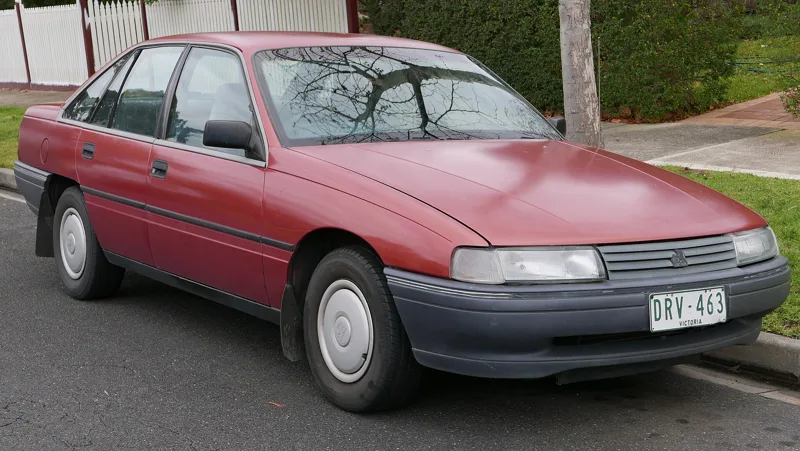
Australia and New Zealand got a special deal. Because their car markets were small, the governing body and the Confederation of Australian Motorsport agreed that local makers needed to build only 1,000 base models, although any evolution still required 500. In the end Holden was the only Australian maker to homologate a car, using its V8 Commodores. The evolutions came first from Peter Brock's HDT Special Vehicles and later from Holden Special Vehicles, which Tom Walkinshaw owned and which was set up in 1987 to replace the HDT.
Every rewrite of the touring car rulebook has followed a cost spiral.
Which cars raced in Group A touring car championships?
Group A homologated a wide spread of road cars, from big V8 coupes to small hatchbacks. They included the BMW 635 CSi and M3, the Jaguar XJS, turbocharged Ford Sierras, the V8 Ford Mustang, the turbo Volvo 240T, the Rover Vitesse and various V8 Holden Commodores.
The list went on with turbocharged Nissan Skylines, among them the four-wheel-drive twin-turbo GT-R, plus the Mitsubishi Starion Turbo, the Alfa Romeo 75 and GTV6, several Toyota Corollas and the Toyota Supra Turbo A. In the European Touring Car Championship, Group A ran in three divisions: cars over 2500cc, cars from 1600 to 2500cc, and cars under 1600cc. Because the cars had to stay close to the showroom product, makers who wanted to win had to release faster road cars first.
The formula spread across the world. Series that used it included the European Touring Car Championship (1982 to 1988), the British Touring Car Championship (1983 to 1990), the German DTM (1984 to 1992), the Australian Touring Car Championship (1985 to 1992), the All Japan Touring Car Championship (1985 to 1993) and the World Rally Championship (1987 to 1996). A one-off World Touring Car Championship ran under the rules in 1987.
How did Group A work in rallying?
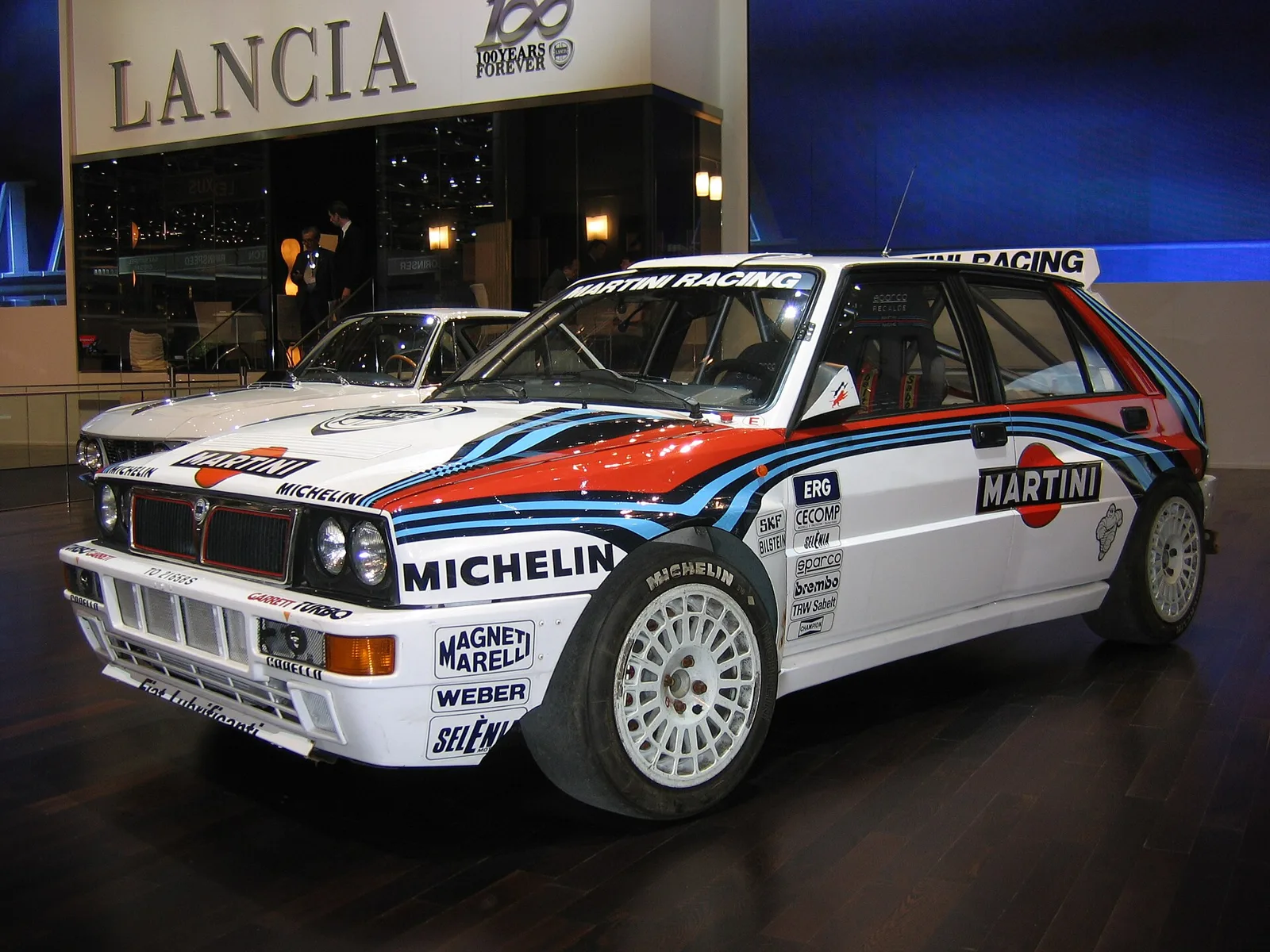
In the World Rally Championship, Group A cars were modified road cars, often turbocharged four-wheel-drive versions of small models. Examples included the Lancia Delta Integrale, Ford Escort RS Cosworth, Toyota Celica GT-Four, Subaru Impreza WRX and Mitsubishi Lancer Evolution. They were retuned for power and fitted with suspension and tyres suited to each rally.
By 1990 these cars were beating the defunct Group B machines on many events. They had far less power, but better handling and traction, and were much safer. The last car to use the old Group A homologation in the Manufacturers' championship was the Mitsubishi Lancer Evolution VI, and Group A cars could still enter World Rally Championship events until 2018. Today Group A remains the basis for most rally competition around the world.
How did British touring car racing start and change?
The British Touring Car Championship began in 1958 as the British Saloon Car Championship and took its present name for 1987. TOCA now runs it. Over the decades it has used FIA Groups 2, 5, 1 and A, then Super Touring, Super 2000 and today's Next Generation Touring Car rules.
The early years had an odd flaw. Cars of different engine sizes raced together in classes, so a driver in the right class could win the title without ever winning a race outright. Chris Hodgetts took two overall titles in a small Toyota Corolla while much bigger cars took most of the victories. Frank Sytner won a championship in a Class B BMW M3 while Ford Sierra Cosworth RS500s led at the front, and John Cleland took his first title in a small Class C Vauxhall Astra.
Super Touring changed everything. In 1990 the BTCC added a class for cars of up to 2.0 litres, which the FIA later adopted for series in Europe and elsewhere. In that first year it ran alongside a larger-engined class, still dominated by the Ford Sierra Cosworth RS500, but from 1991 the 2.0-litre cars were the only ones eligible. Six manufacturer-backed teams entered from the start: BMW, Ford, Mitsubishi, Nissan, Toyota and Vauxhall.
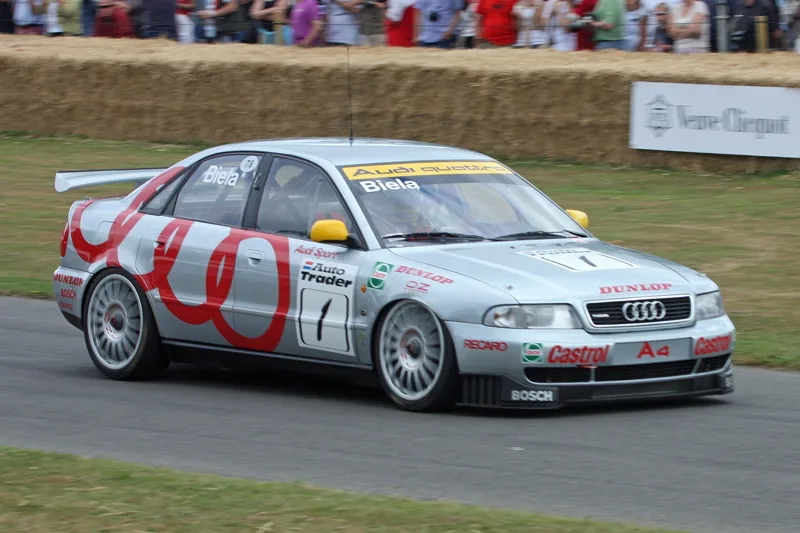
A famous row followed. Aerodynamic aids such as splitters and rear wings were banned at first, and were allowed from 1995 after Alfa Romeo caused controversy in 1994 by racing its 155 with a rear wing, a part that came with the road car but sat unfitted in the boot. Audi joined in 1996 with the four-wheel-drive A4 Quattro and won that year's title. Development then moved so quickly that costs rocketed, and by 2000 only Ford, Honda and Vauxhall were left. Even so, the 1990s remain the period most often called the most successful in BTCC history, with close racing, many manufacturers and large crowds.
Cost cutting dominated what came next. BTC Touring rules arrived in 2001 and slashed costs, but manufacturers and spectators both lost interest. Super 2000 rules were adopted for the 2007 season. The 2000s brought cheaper cars than the Super Touring years, with fewer factory teams and fewer international drivers.
The Next Generation Touring Car specification was announced in 2009 for introduction in 2011, designed to reduce the design, build and running costs of cars and engines and narrow performance gaps between them. NGTC matched Super 2000 performance until 2013, and from 2014 only NGTC cars were eligible.
How does the modern BTCC keep costs down?
Strict limits on modifications keep spending in check, and common components supplied through a contract with RML Group mean independent teams can enter without a works deal. Teams can fit an engine from their marque's wider family of cars or lease one from TOCA, built by Swindon Engines. Goodyear is the only tyre supplier.
The cars are mostly 2.0-litre saloons and hatchbacks, among them the BMW 3-Series, Infiniti Q50, Honda Civic, Toyota Corolla and Ford Focus. Manufacturer teams currently come from BMW and Toyota, alongside independents such as BTC Racing and Motorbase Performance. The cost limits have brought a rise in independent entries. In 2005 Team Dynamics became the first independent to win both the drivers and teams titles, with Matt Neal in a Honda Integra, ending a run of four Vauxhall wins from 2001 to 2004. Neal also finished all 30 races that year, a feat matched only by Adam Morgan in 2015.
Fuel has been an experimenting ground. LPG appeared in 2004, bio-ethanol in 2005 and 2006, and diesel in 2007, with SEAT Sport UK entering the first diesel manufacturer cars in 2008. Sustainable fuel was introduced full-time for the 2025 season. A race weekend runs a 30-minute qualifying session on Saturday that sets the grid for the first race on Sunday, with races of 16 to 25 laps and a draw that reverses part of the grid for race three. Fabrizio Giovanardi twice put himself on pole by drawing number 10.
How did the DTM begin, and what went wrong?
The Deutsche Tourenwagen Masters is an ADAC-sanctioned series based in Germany. The old German championship and its successor, the ITC, ended after 1996 because of high costs, and teams grumbled that too much of the income went to the FIA. When talks began on a replacement, Opel wanted cost control, Mercedes backed expensive development, BMW wanted an international series and Audi insisted on keeping its quattro four-wheel drive.
The new DTM arrived in 2000 with Mercedes and Opel using cars based on an Opel concept. Only two-door coupes were allowed, the Mercedes CLK and the Opel Astra Coupe. Abt Sportsline entered an Audi TT on short notice, but the hastily built car was outclassed until it received a stretched wheelbase and a higher rear wing, which helped the Abt-Audi TT-R win the 2002 title with Laurent Aiello. The name changed to Masters because too many races were planned outside Germany for the national authority to grant championship status.
In 2004 Audi joined as a factory entrant, and all three makers switched to saloon bodies: the Audi A4, Opel Vectra GTS and Mercedes C-Class, built with identical dimensions so the road cars' design had no influence. Mattias Ekstrom won that year. Opel quit after 2005 as General Motors cut costs in Europe, and MG Rover's plan to replace it vanished when the company collapsed. Audi and Mercedes fielded 10 cars each in 2006, though the television deal wanted three makers from 2007.
Audi dominated 2007 to 2009, with Ekstrom taking the second of his two titles and Timo Scheider winning the next two. Paul di Resta won for AMG-Mercedes in 2010. BMW came back in 2012 after 20 years away and won the drivers, teams and manufacturers titles. The Drag Reduction System from Formula One arrived in 2013, the field shrank from 24 cars to 18 in 2017, and turbocharged 2.0-litre engines replaced the 4.0-litre V8 in 2019.
Why did the DTM change identity?
The DTM lost its manufacturers. Mercedes left after 2018. R-Motorsport ran four Aston Martin-branded cars in 2019 and withdrew after one season. Audi pulled out suddenly in 2020, leaving BMW as the only maker with an eligible Class 1 car, so the series switched to GT3-based rules for 2021.
Its parent body, ITR, was dissolved in December 2022 and ADAC acquired the rights to the name. The DTM continued in name only from 2023, with a completely different organisation and rules. Earlier hopes of a North American DTM, announced in 2013 with IMSA for a start in 2015 or 2016, had not produced a race by 2019. The series has also been a launchpad: former Formula One drivers from David Coulthard to Mika Hakkinen and Robert Kubica raced in it, and Gary Paffett and Robert Wickens used it to jump-start careers.
How do the DTM and BTCC compare?
| Feature | BTCC | DTM |
|---|---|---|
| Home | United Kingdom | Germany, with rounds elsewhere in Europe |
| Organiser | TOCA | ADAC |
| Began | 1958 as the British Saloon Car Championship | 2000 as the revived DTM, after the old series and ITC ended in 1996 |
| Cars today | 2.0-litre NGTC saloons and hatchbacks | GT3-based cars since 2021 |
| Cost control | Common components, leased engines, one tyre supplier | Moved away from Class 1 cars after Audi left in 2020 |
| Race length | 16 to 25 laps | 55 minutes plus one lap |
What happened to Group A touring cars?
Group A ended in touring car racing as the Super Touring idea spread. The FIA kept issuing Group A touring rules until at least 1993, but the German DTM switched to a 2.5L Class 1 formula in 1993, and Japan followed with Supertouring-style rules in 1994. Many redundant Nissan Skylines found a new home in the Japanese GT Championship.
Australia went its own way. The Confederation of Australian Motor Sport announced in mid-1983 that Group A would replace its locally developed Group C rules, in place since 1973, from 1 January 1985. A class for Group A cars ran in selected endurance races in late 1984. From 1993 a new formula, also called Group 3A, opened the door to five-litre V8 cars and two-litre cars, which later became known as V8 Supercars and Super Touring cars.
Where this goes next
Group A has faded from championships, though it still forms the homologation base for most production-based race car formulae. European hillclimbs still use it as a touring car class, and in Australia it is a historic class open only to cars actually raced from 1985 to 1992, complete with log books.
The BTCC is now run only to NGTC rules, and sustainable fuel has been compulsory since 2025. The DTM races GT3-based cars with new pit stop rules from 2025: one mandatory stop in a set window on Saturday and two on Sunday. North America, where a DTM series was once planned, now sees IMSA and the DTM both using GT3 cars in different states of tune.