A 1914 patent nobody built, a forged alloy wheel Porsche ordered 5,000 of, and the pleated magnesium discs that Lotus raced: how each worked and what it changed.
The radial tyre, first patented in 1914 and developed by Michelin in 1946, lays its cords at 90 degrees. The Fuchs wheel is a one-piece forged alloy wheel made for the 1967 Porsche 911S. The wobbly-web wheel is a pleated disc that Lotus cast in magnesium alloy from 1957.
The radial tyre was patented in 1914 and again in 1916, and nobody built one. It took a former accountant turned researcher at Michelin, Marius Mignol, to make the first car radial in 1946. Two other ideas, the pleated magnesium wheels of Lotus and the forged alloy wheel Porsche commissioned for the 911, went after weight in the wheel itself.
Radial tyre history: from two unbuilt patents to the standard design
G. H. Hamilton and T. Sloper filed the first radial patent in London in 1914, and Arthur W. Savage, a San Diego tyre maker, followed in 1916. Neither patent led to a product. Michelin of France designed, developed, patented and commercialised the radial itself. Mignol began his experiments in 1941 with, as far as anyone can tell, no knowledge of the earlier patents, and the first Michelin X radial for cars followed in 1946.
Michelin also owned Citroen, which gave it a ready customer. The new tyre appeared on the 1948 Citroen 2CV, and in 1952 Michelin made a radial truck tyre. Because radials lasted longer and saved fuel, the design spread quickly across Europe and Asia during the 1950s and 1960s.
America took longer. In 1968 Consumer Reports, an influential magazine there, recorded the radial's longer tread life, better steering and lower rolling resistance, and radials went on to take a 100% share of the North American market. In 1970 Ford made the Continental Mark III the first American-built vehicle with radials as standard equipment, on Michelin tyres.
Goodyear faced a harder call. In 1974, after the 1973 oil crisis, its new chief executive Charles J. Pilliod Jr had to decide whether to retool for radials. He invested heavily in new factories despite criticism at the time. Of America's tyre makers, just Goodyear, Cooper, Titan and Specialty Tires of America are still independent today, and Sam Gibara, Goodyear's head between 1996 and 2003, has said the company would not have survived without Pilliod's decision.
Performance cars pushed the design further. In 1974 Pirelli built a wide radial at the request of the Lancia rally team, which needed a tyre that could cope with the power of the new Stratos. A year later it introduced a wide, low-sidewall radial that looked like a slick, for the Stratos that won the Monte Carlo Rally. Radials were standard in America by 1976, and NASCAR changed from bias-ply to radial tyres during 1991.
Porsche asked for a wheel three kilograms lighter than steel; Otto Fuchs forged one from a solid block.
Radial vs bias ply tyres: how each is built
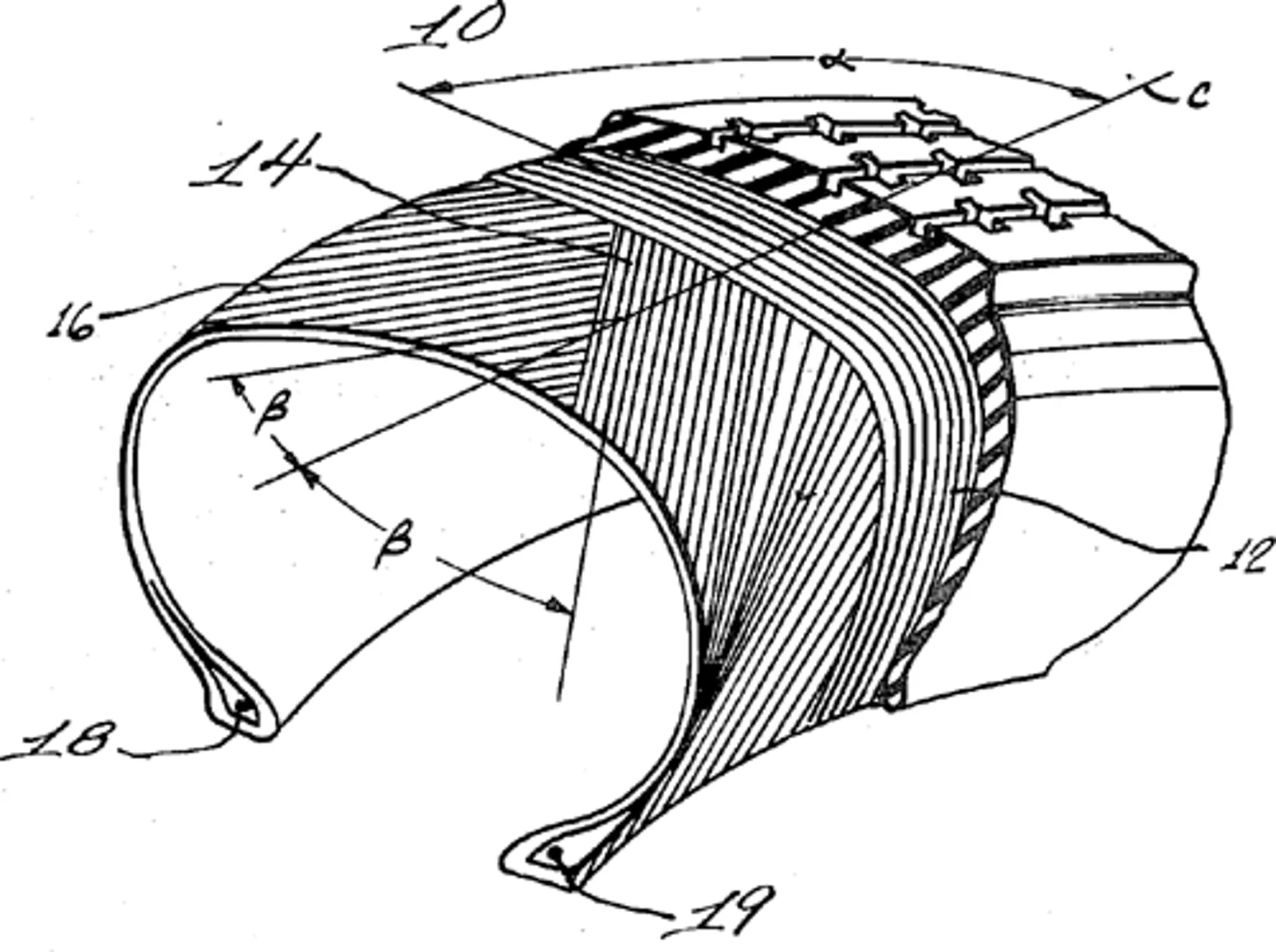
A radial tyre lays its plies of cord at a right angle to the way it rolls, 90 degrees, straight across from one bead to the other. A bias-ply tyre lays them at about plus and minus 60 degrees, criss-crossing each other. That single difference explains why radials run cooler, last longer and use less fuel.
Think of a woven basket. In a bias tyre the cords cross like the strips of the weave, and they chafe against each other every time the tyre flexes. The tyre was built flat on a drum, then shaped in the mould, which pulled the cords into an S-shape between the beads. The angle fell to about 36 degrees under the tread, stayed at 45 degrees in the sidewall and held at 60 degrees at the bead. A low crown angle made the tread rigid and a high sidewall angle gave comfort. To add strength, makers added plies, and extra plies meant more heat.
A radial avoids the rubbing, which cuts rolling friction and improves fuel economy. It also gives radial sidewalls their slightly bulging, low-on-air look. Radial cords alone would leave the tread too soft where it meets the road, so the tyre is wrapped in belts running closer to the direction of travel at a spiral angle. Those belts can be steel, which gives the steel-belted radial its name, or polyester or aramid fibres such as Twaron or Kevlar.
The result is two systems in one tyre. The radial cords in the sidewall behave like a spring, for flexibility and comfort. The stiff belts reinforce the tread for mileage and performance. Each can then be optimised on its own.
| Feature | Bias-ply tyre | Radial tyre |
|---|---|---|
| Cord angle | About plus and minus 60 degrees, criss-crossed | A right angle (90 degrees) to the rolling direction |
| Plies rubbing as it flexes | Yes | Avoided |
| Rolling friction | Higher | Lower, so better fuel economy |
| Heat build-up | Rises with extra plies | Less heat, fewer replacements |
| Tread support | Crown angle of about 36 degrees | Steel, polyester or aramid belts |
| Where it is still used | Trailers; some small aircraft | Essentially all automotive tyres |
What radials changed for drivers
Radials have a different springiness from bias tyres and a different amount of slip when steering. One benefit was weight: cars no longer had to make up for the shortcomings of bias-ply tyres and could be built lighter. The other was that drivers were not used to the feel at first, so suspensions had to be reworked. In the 1960s Ford engineer Jack Bajer tried out changes on a Falcon, giving it less tight steering, isolators on the drive shaft and extra bushings in the suspension to soak up the thump from expansion joints in concrete roads.
The gains are well documented. Radials have flexible sidewalls, a more stable contact with the road, a wider footprint and a longer tread life, and they do less damage to the ground they run on. At lower speeds they can feel sharper over ridges in the road, expansion joints included. Bias tyres survive on trailers, which they suit because they carry heavy loads well and resist swaying behind the tow vehicle. In aircraft the switch is slower, because tyres are certified along with the airframe, though radials carry less sidewall material and so are lighter, cooler-running and longer-lived.
Fuchs wheel: why Porsche asked for forged alloy
The Fuchs wheel, or Fuchsfelge, was made for the Porsche 911 and arrived on the 1967 model year 911S. It was designed with Otto Fuchs KG by Porsche modeller Heinrich Klie and Ferdinand Porsche Jr, and it was the first lightweight forged wheel fitted to a production car. In the early 1960s several sports car makers were still using steel wheels or even wire ones. Porsche knew from racing that lighter wheels paid off in speed and handling.
The reason lies in unsprung mass. The wheel and tyre are the part of the car that is not carried by the springs, so every kilogram has to be shoved up and down by the road rather than cushioned. The lighter that mass, the more easily the suspension keeps the tyre on the tarmac. Porsche asked for a mass-produced wheel lighter by three kilograms or more than the steel wheels then in wide use.
The firm had a head start of sorts, since it had made lightweight aluminium tank parts for the German Army before 1960. It struggled to carry that skill over to cars, so it went looking for a partner and found Otto Fuchs, whose background was casting light materials for aerospace. Cast aluminium wheels from several makers met the weight target, but in testing all of them proved fragile and could not take the load.
Otto Fuchs solved it with a method never before used on a road car: a one-piece forged aluminium wheel, made by pressing solid blocks under extreme pressure. Each wheel weighed five kilograms, three less than the steel 911 wheel of the day. The first design sketch is dated 13 February 1965, with details added on 4 May 1965 and final approval from Klie and Ferdinand Porsche. The wheel measured 15 inches across and 4.5 inches wide. A 911 Targa wearing the first set was shown at the 1965 IAA show to test interest, and the response was positive enough for Porsche to order 5,000 wheels for the 911S.
The look changed late. Fuchs presented tapered spokes in the five webs between hub and rim. Ferdinand Porsche Jr reshaped them as flat spokes, on grounds of style, and minutes of the meeting record that he found his version more harmonious with the new car. He based it on a kleeblatt, a four-leaf clover, which is why the Fuchs is known as the cloverleaf wheel.
How a Fuchs wheel is made, and where it went
Fuchsfelge is credited with the first forged wheel for Porsche and with the first series-production aluminium wheel, on the 1972 Mercedes S-class. Its process has six steps. A cast aluminium block is forged under a force of 4,000 tonnes into a rotationally symmetrical piece, then a second forging at 7,000 tonnes gives each disc its styling, and ventilation holes are stamped out. A lightweight barrel is fused to the disc to the width required. Turning, drilling, deburring and painting complete the job.
The alloy is 97% pure aluminium. Of the remaining 3%, magnesium makes up about 1.3% and silicon about 1%, a pairing that raises strength greatly. Chromium, titanium and manganese, between 0.1% and 1% by weight, add strength and resilience against recrystallisation.
Early 911S wheels came in three widths by model year. The 4.5 inch wheel of 1967 is the rarest, and by 1969 the width had grown to 6 inches. A 6 inch deep-dish version, the 6R, started out on the front of the very limited 1967 911R race car, and a 7R followed for its rear, distinguished from later 7 inch wheels by a 49 mm offset. The 7R stayed on road-going 911s through 1971, and collectors want it because its width and diameter suit many modern tyres. A 15 by 8 inch wheel was fitted only to the 1973 Carrera RS during six months of production, and now commands a large price premium. The 911RSR race car of 1973 and 1974 used 15 by 9 and 15 by 11 inch versions.
Otto Fuchs went on to make wheels for other German manufacturers. Mercedes-Benz used its baroque style wheels until the late 1980s, and the first BMW M5 wore a multi-spoke design. The company claims its wheels have, at some point, been fitted to almost every premium brand, among them Rolls-Royce, Lamborghini, Audi, BMW, Porsche and Mercedes.
The Fuchs is still made. Otto Fuchs now produces over 2.5 million forged wheels a year for makers including Porsche, Ferrari, Alfa Romeo, Volkswagen, Rolls-Royce, BMW and Mercedes-Benz, with over 400 tooling options. Vintage-specification Fuchs wheels come in limited batches through the Porsche Classic programme, to fit most 911s built between 1965 and the early 2000s. The 2010 Porsche Sport Classic, limited to 250 cars, wore a 19 inch recreation, and those wheels are in demand among owners of other modern 911s. From August 2014, forged Fuchs wheels in 19 by 9 inch front and 20 by 11 inch rear sizes were an option on the Mercedes-AMG GT, in brushed aluminium or matte black.
Wobbly-web wheel: Lotus and the pleated disc
A wobbly-web wheel is a metal disc whose surface is folded, or wobbled, into the effect of spokes. It makes a stiffer, lighter wheel, and it is best known from racing Lotuses of the late 1950s and into the 1960s.
The idea comes from how thin sheets behave. A flat disc is strong for loads in its own plane, including twisting, but flexible against loads that push on its face and against axle wobble. Cone the disc and it becomes stiff against those side loads, though the wheel gets wider along its axis. Folding the cone into pleats makes it narrow again while keeping the stiffness, much as a sheet of paper that flops when flat stands up once folded into a fan. Architects use the same principle in a serpentine wall, which corrugation strengthens against sideways forces so it can be thinner and lighter.
The wobbly web has a long history. The first, around 1884, was the centre of a pulley, made by J & E Hall of Dartford from a steel strip folded in corrugations and fanned into a circle. The first road wheel of this type was fitted by Roy Fedden to his Cosmos car of 1919, a pressed steel disc carrying six spokes, set alternately to either side, and held on by three bolts. Aircraft wheels of cast light alloy appeared in the 1930s and were fitted to the Spitfire, among others. The first distinctly wobbled web came on the Convair CV-240 of 1948, a cast wheel with nine narrow spokes formed from a curved disc.
Lotus used the idea on a Formula 2 car, the Twelve of 1957, and Vanwall adopted a similar wheel in 1958. The designer was Lotus's Gilbert McIntosh, known as Mac, though the wheels were often credited to Colin Chapman. Lotus wanted the lightest wheel possible, since wheels are unsprung weight and the cars were extremely light.
The wobbles were deliberate. Wall thickness stayed constant because foundries find a uniform casting easier to control, and the folding supplied the stiffness that varies across the radius. Stiffness had to be highest around the hub, so the folds are deep and steep there and ease into a gentle wave towards the rim. The wheels were cast in Elektron magnesium-aluminium alloy by Stone Foundries of Charlton. Cooper already ran magnesium wheels, and Charles Cooper had found it profitable to sell drivers the many spares racing needs. Chapman wanted the same business, and McIntosh obtained failed wheels from the Cooper foundry's scrap to study how magnesium racing wheels broke.
With the new wheels came a new colour scheme. Lotus had raced in green and yellow with bare aluminium bodywork, and now painted the wheels yellow and the bodies green. The glossy yellow went on well over the zinc chromate primer, itself a greenish yellow, that protected the wheels from corrosion.
The Le Mans stud dispute and the end of the disc wheel
Chapman's famous maxim was to simplify and add more lightness. The Formula Junior Lotus 20 and 22 followed it by using 4-stud front wheels while the driven rear wheels kept 6 studs. At the 1963 Le Mans, Lotus entered a new and somewhat unfinished two-seater, the Lotus 23, with 6-stud wheels at the rear and 4-stud wheels at the front. Its rear rims were wider, and so were its tyres. The rules still called for a spare wheel, and the car's spare could not fit both ends. Scrutineers refused it, and even when matching 4-stud rear hubs were flown from England they objected that 4 studs must be too weak if 6 had been needed. The car did not run.
Chapman answered that Lotus would never again race at Le Mans. The company kept that promise until 1997, long after his death in 1982. The following year's Can-Am car, the Lotus 30, switched to centre-lock wheels, mainly because of its V8's far greater torque, though it also avoided a repeat of the dispute.
A disc wheel blocks the airflow that brake discs need, particularly at the front. From the Lotus 26 onwards, later Lotus designs ran spoked wheels, though the shrinking diameter of racing tyres was the bigger reason.
What this means for someone buying or driving a classic
Magnesium corrosion was always a problem, and Lotus used these wheels only on racing cars. Original wobbly-web wheels have a limited service life, and they are no longer accepted at historic racing scrutineering, however good they look, so reproductions are available instead. For a Porsche 911 owner, the 15 by 8 inch wheel is the only historically correct one for a 1973 Carrera RS, which is why it carries a premium. Modern recreations are also on sale through Porsche Classic.
On the road, radials are now the normal design for practically every car tyre. A car designed around bias-ply tyres feels different on radials, which is why Ford's 1960s Falcon experiment needed changes to its steering and suspension.