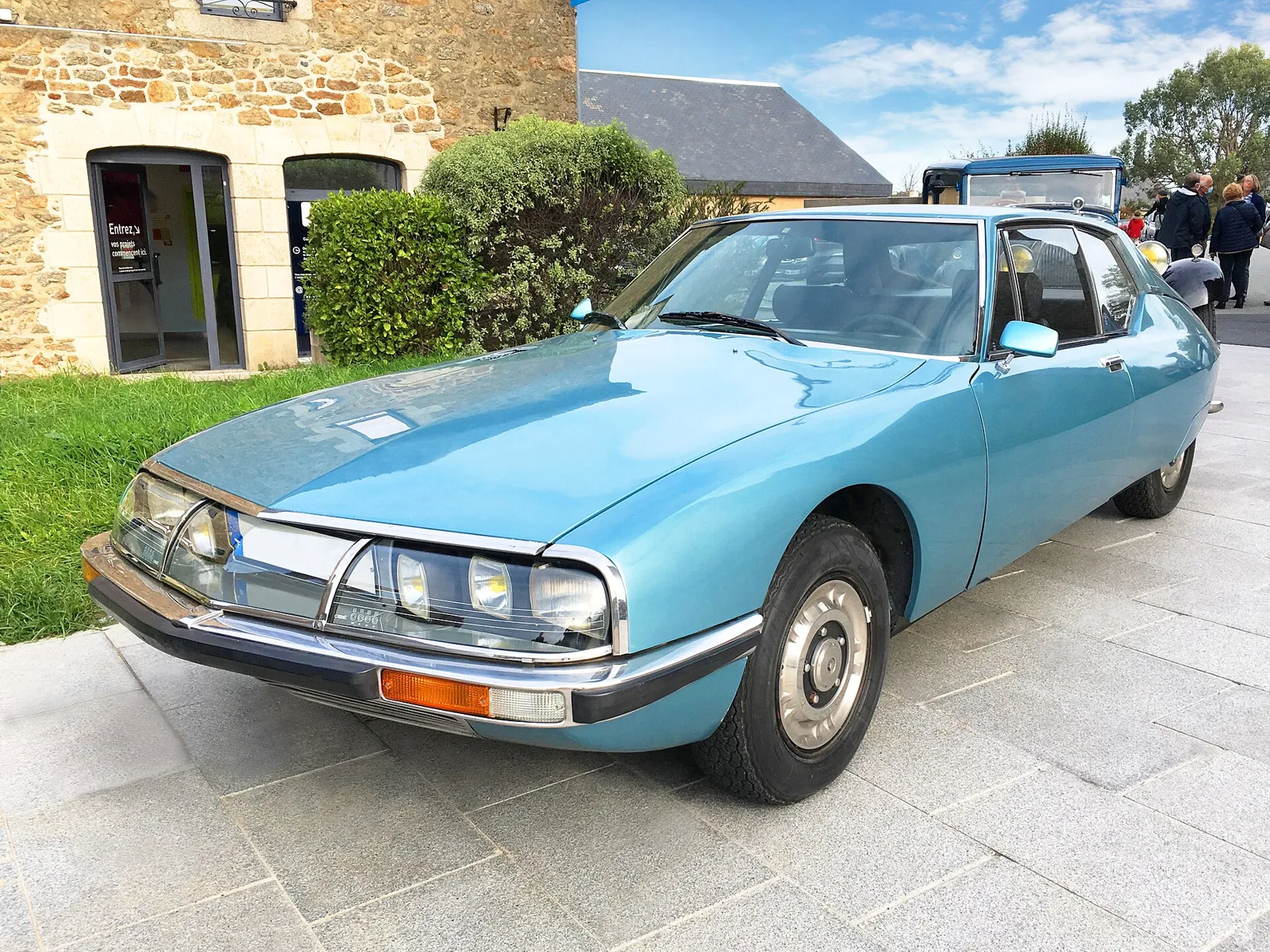
Citroen's 1970 fastback coupe, built around a 2.7 litre Maserati-designed V6, with DIRAVI steering, self-levelling hydraulics and a short production life.
Built by Citroen from 1970 to 1975, the SM paired a 2.7 litre Maserati-designed V6 with hydropneumatic suspension. Some 12,920 were produced. Third place in the 1971 European Car of the Year vote came before a Motor Trend award in 1972.
The Citroen SM was a high-performance coupe that Citroen built from 1970 to 1975, using a Maserati-designed V6 and a set of hydraulic systems borrowed from the DS. It placed third in the 1971 European Car of the Year contest and won the 1972 Motor Trend Car of the Year award in the United States. Its technical ambition was far ahead of its sales, which is why it became a cult classic.
What is the Citroen SM?
The SM is a two-door fastback coupe, the only body style the factory ever produced. It was designed as a fast grand tourer, and its name is still debated, with some linking the S to Project S and the M to Maserati. Citroen first showed it at the Geneva Motor Show in March 1970, and it went on sale in France that September.
Factory cars were left-hand drive only. Right-hand drive conversions were carried out in the UK and Australia, and the car competed with grand tourers from Jaguar, Ferrari, Aston Martin and Porsche. Citroen had hoped it would fill a gap in a French market where big luxury cars had been held back by tax.
A grand tourer that carried French hydraulics, a Maserati-built heart and a steering system that confused its own drivers.
How did the SM's engine come about?
Citroen bought Maserati in 1968 to use its high-performance engine technology in a true grand tourer. The SM's engine was designed from scratch by Giulio Alfieri, yet it could be assembled on the existing tooling for the Maserati V8. Its 90 degree cylinder banks were unusual, and they were shared later with the Buick and Jeep V6 engines.
French tax rules had a direct effect on the design. The puissance fiscale system penalised large engines heavily, so the SM was limited to 2.7 litres. The aluminium engine weighed 140 kg (309 lb) and sat behind the front axle, while producing 170 PS (125 kW) in standard form.
Owners often fit the Maserati Merak SS engine, which produces 220 PS (162 kW) and transforms the driving experience. Many contemporary tests found that the stock car was adequate rather than exceptional in acceleration, though its fuel use compared well with rivals.
How did DIRAVI steering and hydraulics work?
The SM borrowed hydropneumatic self-levelling suspension from the DS and added speed-sensitive steering called DIRAVI. The system changed the assistance according to road speed, so parking required little effort while motorway driving kept feedback. The steering was self-centring and fully powered, rather than hydraulically assisted.
Two turns from lock to lock made the car feel go-kart quick at low speed. Reviewers said it took about 80 km (50 mi) of driving to become familiar with it. The steering was controversial, and the lead actress in The Protectors refused to drive the SM because of it.
The braking system took the DS as a starting point but used disc brakes at all four corners. The front brakes were inboard and cooled by large ducts beneath the car. Braking balance adjusted itself to the weight carried at the rear, so the whole car dropped evenly under hard braking. Standard wheels were steel with stainless trims, but Michelin also offered factory lightweight glass-fibre wheels that weighed less than half as much. The steering column adjusted for height and reach.
Why was the SM so aerodynamic?
The SM used a Kamm tail and a low drag coefficient, which was unusual for a car of its era. Citroen first claimed a figure of 0.26, then published a revised value of 0.339. The bonnet vent sat in a neutral area, so the ventilation fan worked at all road speeds.
The design was penned by chief designer Robert Opron, who gave the SM a family resemblance to the CX and GS. Like the CX, it kept rear fender skirts, and seen from above it tapered like a teardrop, with a wide front track narrowing toward the rear. The bonnet was aircraft grade aluminium, and the brightwork was stainless steel rather than chrome.
How did the SM sell in the United States?
The United States was the main export market, where the personal luxury car sector was much larger than in Europe. The SM won Motor Trend's Car of the Year award in 1972, which was unusual for a non-American car. Around 2,400 cars were sold in the US in 1972 and 1973 combined.
The SM's six composite halogen headlamps, with swivelling high beams, were illegal in the US. American cars had to use four round sealed-beam lamps on fixed mounts. The US-spec SM therefore carried four exposed round lamps that did not swivel.
US sales ended abruptly when Citroen did not get an exemption from the 5 mph bumper regulation for the 1974 model year. The integral variable-height suspension made compliance impossible. The 134 SMs built for the 1974 US market could not be supplied there, so they were sold in Japan instead.
Why did production of the SM end?
Production totalled 12,920 cars, and sales fell steeply after the first full year. In 1974 Citroen went bankrupt, and Peugeot took ownership of the company. Peugeot divested from Maserati in May 1975 and quickly moved to end SM production.
Output had dropped to 294 cars in 1974 and 115 in the final year. The last 135 examples were built by Ligier, because the Quai Andre-Citroen factory closed in 1974. Observers often blame the oil crisis, yet maintenance demands and the complex engine also hurt sales badly.
The SM needed specialist care from two sources: a Citroen specialist, and a rarer Maserati specialist to keep the engine in tune. Once buyers understood that, sales dropped sharply. Carburettor adjustment and the 90 degree timing were unfamiliar to many workshops of the era.
How did the SM perform in motorsport?
The SM won its first competitive outing, the 1971 Rallye du Maroc, which was a tough test of the car's durability. Citroen then developed a short-wheelbase breadvan racing variant, with squared-off rear sections and highly tuned engines.
A turbocharged SM built by SM World in Los Angeles set a production-class speed record at the Bonneville Salt Flats in 1987. It reached 325 km/h (202 mph), which remains a notable result for a car built on an old platform.
What special SM variants were built?
The factory produced only one body style, but several derivatives were built. Coachbuilder Henri Chapron of Levallois-Perret produced the most collectible versions, including the presidential cars and the rare convertibles.
The SM presidentielle was a four-door convertible stretched by 52 cm to 5.60 m. These cars travelled at 6-7 km/h for parades and had a small rearward-facing seat for a translator. Presidents from Georges Pompidou to Jacques Chirac used them, and they served for 37 years.
Chapron also built five SM Mylord convertibles and seven SM Opera sedans. A Mylord sold for 548,320 euros in February 2014, which shows how valuable the originals have become. Heuliez made two pillarless targa versions in 1971, and Maserati's Quattroporte II was a four-door SM relative built in only twelve examples.
Who owned the SM?
The SM attracted celebrity buyers, much as the DS had. Leonid Brezhnev, Idi Amin, who had seven of them, and Emperor Haile Selassie drove SMs, along with Rolling Stones members and actors. Pompidou and Queen Elizabeth II took a presidential SM for a drive in May 1972.
The SM's engine and transmission lived on in Maserati's Merak, which sold 1,800 units, and the later Biturbo, which sold 40,000. The CX carried forward the speed-sensitive power steering. Components of the SM also lived on in the Lotus Esprit transmission and were mirrored in the Maserati Merak. Even Jay Leno's SM has become a familiar sight in his garage videos. Croatian singer Misho Kovac owned a golden SM, and as of 2019 Guy Berryman of Coldplay was driving one.
Where were right-hand drive SMs converted?
The factory built left-hand drive cars only, so right-hand drive examples were converted after production. In the UK, three official right-hand drive prototypes were built by Middleton Motors, a Citroen dealer in Hertfordshire, and at least one survives today.
In Australia, Chappel Engineering in Melbourne converted 12 cars for Dutton's, the Citroen importer of the time. Right-hand drive is mandatory in that market, and cars are still modified there with right-hand controls and dashboards.
The United States received its own modification. About 100 cars were fitted with an electric sliding steel sunroof built by ASC. American bumper and lighting rules were among the reasons the SM struggled to stay on sale there.
What engine experiments did Maserati carry out on the SM?
Maserati created a special V8 for test purposes in 1974, which it installed in a standard SM and ran over a long distance. The engine was then removed and preserved, and the rest of the car was destroyed. The SM Club of France later built an exact replica of the car around the original engine.
One SM carried a heavily used Maserati V8 test bed developed for the Quattroporte II, and the car needed only modest adjustments to run it. The result turned the car into a true sporting machine, which surprised many who had known the SM as a comfort-first grand tourer.
Specialist Jerry Hathaway of SM World fitted a turbocharged V6 to another SM for land speed record testing at Bonneville, reaching 325 km/h (202 mph). That result showed how far the basic engine could be pushed when properly tuned.
Specification overview
The table below sets out the key figures for the SM as built by the factory. Figures that depend on a particular version are labelled, so the presidential and racing variants do not change the standard numbers.
| Specification | Detail |
|---|---|
| Launch | Geneva Motor Show, March 1970 |
| Engine | 2.7 litre V6, 90 degree banks, aluminium |
| Output | 170 PS (125 kW) |
| Engine weight | 140 kg (309 lb) |
| Top speed (factory) | 220 km/h (137 mph) |
| Top speed (tested) | 235 km/h (146 mph) |
| Fuel tank | 90 L (20 imp gal; 24 US gal) |
| Drag coefficient | 0.26 claimed, later 0.339 |
| Production total | 12,920 cars |
| Final production | 135 built by Ligier |
Frequently asked questions
Was the SM quick for its time?
It was fast rather than exceptional. Its 170 PS (125 kW) V6 was less powerful than some rivals, but it could travel for hours at 200 km/h in comfort, and its factory top speed was 220 km/h (137 mph).
Did the SM have a convertible?
Not from the factory. Citroen felt the roof was integral to the structure, so the roof and rear quarter panels were welded on. Chapron later produced five SM Mylord convertibles.
How many SMs were made?
A total of 12,920 SMs were produced. North America took 2,400 cars in 1972 and 1973, and the final 135 were built by Ligier at its Vichy factory.
What is DIRAVI?
DIRAVI was the SM's speed-sensitive power steering. It gave strong assistance for parking and firmer feedback at motorway speeds, and the CX later used the same idea.