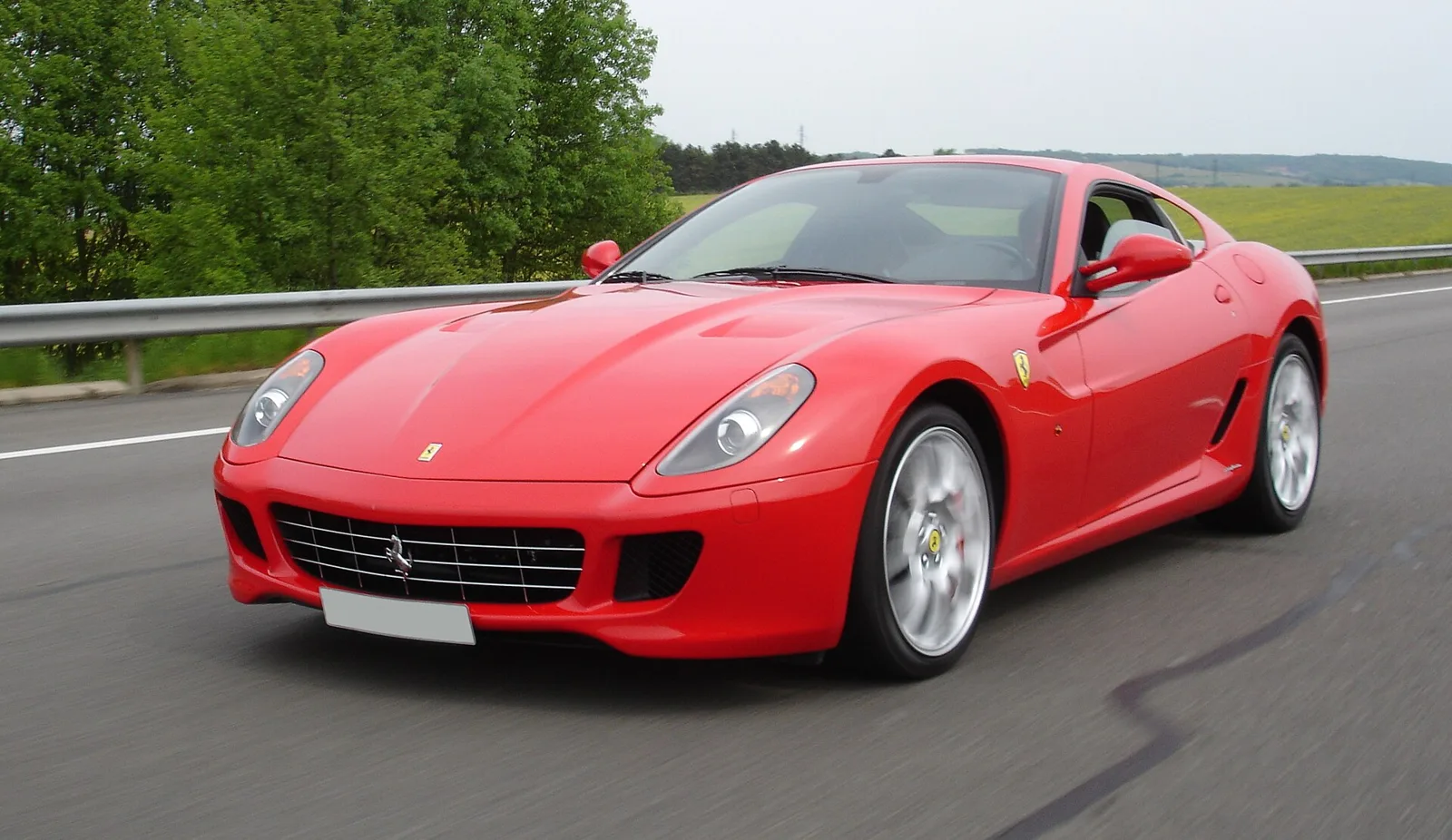
A 6.0-litre V12 on an aluminium chassis, a manual gearbox most buyers passed over, and the GTO and 599XX variants that followed.
The Ferrari 599 GTB Fiorano was a front-engined two-seat grand tourer introduced at the 2006 Geneva Motor Show. It used a 6.0-litre V12 producing 610 hp (620 PS) on an aluminium chassis, and it was replaced by the F12berlinetta for the 2013 model year.
Ferrari's 599 GTB Fiorano took the company's front-engined grand touring formula to a new peak when it arrived in 2006. Its 6.0-litre V12 was the most powerful series production Ferrari road car at the time of its introduction, and the chassis was the first aluminium one Ferrari had used in a GT. Pininfarina styled the body with sail panels and flying buttress pillars that did much of the work a rear wing would normally do.
Where did the 599 come from?
The 599 replaced the 575M Maranello, arriving in 2006 as a 2007 model. Ferrari revealed it at the Geneva Motor Show in February 2006, and the name combined its 5,999 cc displacement, its Gran Turismo Berlinetta character and the Fiorano test track Ferrari used for development. Jason Castriota directed the exterior styling for Pininfarina.
The car had a longer wheelbase than the model it replaced, and its fuel tank moved to a rear, mid-mounted position to improve weight distribution. Ferrari described it as its front-engined, two-seat model, and the F12berlinetta eventually took over the role for the 2013 model year.
A front-engined V12 on an aluminium chassis, with a manual gearbox fitted to only 30 cars.
How did the chassis and engine work together?
The aluminium chassis added rigidity and helped hold the dry weight at 1,690 kg (3,726 lb), and Ferrari claimed a power-to-weight ratio of 367 PS per tonne. The engine, the Tipo F140 C, was reworked to fit the engine bay because the Enzo unit stood taller and would have blocked forward vision.
The V12 produced 610 hp (620 PS) between 7,600 and 8,400 rpm, and its output per litre went past 100 PS without forced induction, which was rare at the time. Torque reached 608 N m (448 lbf ft) at 5,600 rpm, a record for a Ferrari GT, and the car debuted F1-Trac traction control.
How fast was the 599?
Ferrari claimed 0-100 km/h (62 mph) in 3.7 seconds and 0-200 km/h (124 mph) in 11.1 seconds, with a top speed of 330 km/h (205.05 mph). Motor Trend's January 2007 test recorded 0-60 mph in 3.2 seconds and 0-100 mph in 7.1 seconds.
The magazine measured the quarter mile in 11.3 seconds at 126.4 mph, and its 60-0 mph stop took 105 feet. Those figures came from a car running standard cast iron brakes, while carbon-ceramic discs were available as an option.
Was a manual gearbox offered?
Yes, a six-speed manual was available, but the great majority of buyers chose the F1 SuperFast automated manual. That paddle-shift gearbox changed gear in 100 milliseconds on the standard car and in 85 milliseconds when the HGTE package was fitted, and it became the car's defining transmission.
Only 30 examples left the factory with a manual gearbox. Of those, 20 went to the United States and 10 stayed in Europe, which made the 599 GTB Fiorano the last V12 Ferrari fitted with a manual. Ferrari then dropped the manual from its future GT cars.
What did the HGTE and GTO change?
The HGTE package, short for Handling Gran Turismo Evoluzione, was an upgrade aimed at handling. It stiffened the springs and rear anti-roll bar, lowered the ride height, and recalibrated the Delphi MagneRide dampers for the sportier settings. It also brought faster gear changes and new engine software.
Ferrari announced the 599 GTO on 8 April 2010 as a road-legal relative of the 599XX track car. It produced 490 kW; 660 hp (670 PS) at 8,250 rpm, weighed 1,605 kg (3,538 lb), and had its production capped at 599 cars, roughly 125 of which were bound for the United States.
Ferrari said the GTO could lap Fiorano in 1 minute 24 seconds, one second faster than the Enzo, and that it reached 100 km/h in under 3.3 seconds. Its top speed was put above 335 km/h (208 mph), and it weighed almost 100 kg (220 lb) less than the standard GTB.
How did the body create downforce?
Pininfarina's body used an underbody spoiler and venturi tunnels to add downforce, while the arched flying buttress pillars channelled air around the rear and removed the need for a rear wing. Luca Caldirola confirmed the buttresses' effect in wind tunnel testing, and the car was credited with 160 kg (353 lb) of downforce at 300 km/h (186 mph).
The steering wheel houses electronic controls and a starter button, and the shift paddles could be ordered in aluminium or carbon fibre. Brake cooling ducts sit in the front and rear panels, and the leather trimmed cabin offered storage in the door panels and a rear shelf behind the seats.
How did the 599XX perform on track?
The 599XX appeared at the 2009 Geneva Motor Show as a track-only car built by Ferrari's Formula One engineers. It gained winglets on the C-pillars, a carbon fibre ducktail, a roll cage and an LCD in place of the analogue gauges, and the nine traction and stability modes were selected from the manettino dial.
Ferrari's figures put downforce at 280 kg (617 lb) at 200 km/h (124 mph) and 630 kg (1,389 lb) at 300 km/h (186 mph). Output reached 540 kW; 720 hp (730 PS) at 9,000 rpm, and the car accelerated from 0-100 km/h in 2.9 seconds.
At the 2010 Beijing International Auto Show, Ferrari announced a Nordschleife lap of 6 minutes and 58.16 seconds, which it called the fastest for a production-derived sports car. Pagani's Zonda R beat that time in June 2010 with 6 minutes and 47.50 seconds.
The 599XX Evoluzione arrived in 2011 with restyled aero, a new exhaust package, electronic upgrades and Pirelli racing slicks. It weighed 35 kg (77 lb) less than the standard 599XX, its active rear wing adjusted itself for cornering, and output rose to 540 kW; 730 hp (740 PS) with 700 N m (516 lb ft) of torque.
Which special editions were built?
Ferrari built several special editions and one-offs on the 599 platform. The SA Aperta, shown at the 2010 Paris Motor Show, was a limited roadster of 80 examples, and the 60F1 marked 60 years of Formula One wins. Private clients commissioned several of the one-offs.
The SA Aperta honoured designers Sergio and Andrea Pininfarina, and its name marked the 80th anniversary of Pininfarina. It used the GTO's engine and gearbox, sat 10 mm lower and was sold out before the public reveal. The 599 GTB 60F1 arrived in December 2011 with the HGTE chassis, three paint finishes and bucket seats that differed by market.
Edward Walson commissioned the P540 Superfast Aperta in 2008, a modern interpretation of a gold-covered 330 LMB from the 1968 film Spirits of the Dead. It was revealed on 11 December 2009. The Superamerica 45, built for Peter Kalikow to celebrate 45 years as a client, featured a rotating targa hardtop and first appeared at Villa d'Este on 20 May 2011.
Zagato's GTZ Nibbio arrived in 2007 with a run of nine cars, while the SP30 was a 2013 one-off based on the GTO and the fifth project from Ferrari's special projects division.
Did the 599 win awards?
Evo magazine named the 599 GTB its Car of the Year for 2006, and Top Gear made it Supercar of the Year the same year. Ferrari also used a 599 as a test mule for KERS, the energy recovery system that later fed development of the LaFerrari.
What replaced the 599?
The F12berlinetta replaced the 599 for the 2013 model year. Ferrari announced the successor on 29 February 2012, shortly before the Geneva Motor Show where it was unveiled on 6 March 2012, and promotional footage showed Fernando Alonso and Felipe Massa driving it at Pista di Fiorano.
How did the 599 differ from the 575M?
The 599 replaced a car built on a tubular steel chassis, and its aluminium structure was a first for a Ferrari GT. Together with a longer wheelbase and a rear-mounted fuel tank, the change left the newer car lighter than the 575M it succeeded.
Ferrari's engineers also worked on packaging, moving the fuel tank to the rear so that weight balanced from front to back. The company said that output per tonne put the car at the top of its GT range.
The 575M had been the brand's front-engined grand tourer before the 599 took over, so the new car marked a clear generational step rather than a restyle.
What electronics did the 599 introduce?
The 599 debuted F1-Trac traction control, and its F1 SuperFast automated manual shifted in 100 milliseconds on the standard car. A manettino dial on the steering wheel selected the stability and damper settings, so the driver could change the car's character without leaving the wheel.
Magnetorheological dampers changed viscosity with a magnetic field, and the same knob governed their reaction and the stability control. The driver therefore had one control for three systems.
The stability settings worked alongside F1-Trac, so traction and yaw control could be tuned for a dry road or a fast circuit without changing the chassis.
What did Motor Trend's testing add?
Motor Trend's January 2007 test is a useful cross-check on Ferrari's claimed figures. Independent timing of this kind shows how a car performs outside the manufacturer's own numbers, which is why the magazine results sit alongside the official values here.
Ferrari's official figures remain the reference point for the 599's performance, and the test results add context rather than replacing them. Readers comparing the two sets should note which measure each one uses.
For context, the standard car's claimed 3.7-second sprint to 100 km/h compares with the GTO's claimed time of under 3.3 seconds, which shows how far the track-focused version moved on.
Why did Ferrari drop the manual from its GT range?
Ferrari decided after the 599 that its future GT cars would not offer a manual transmission. The choice reflected the 599's own sales pattern, in which only 30 cars left the factory with a manual and most buyers chose the automated gearbox.
That decision set the direction for Ferrari's grand tourers from this point, and the 599 remains the last V12 Ferrari offered with a manual.
What were the key specifications?
The table lists the standard coupe figures for the 599 GTB Fiorano and marks the GTO value where it applies. Figures are Ferrari's claims unless the row says otherwise, and the Motor Trend results appear in the text above.
| Specification | Detail |
|---|---|
| Type | F141 front-engined two-seat grand tourer |
| Engine | Tipo F140 C V12, 6.0 L (5,999 cc) |
| Output | 460 kW; 610 hp (620 PS) at 7,600-8,400 rpm |
| Torque | 608 N m (448 lbf ft) at 5,600 rpm |
| Chassis | Aluminium, first in a Ferrari GT |
| Dry weight | 1,690 kg (3,726 lb) |
| 0-100 km/h | 3.7 seconds (claimed) |
| Top speed | 330 km/h (205.05 mph) (claimed) |
| Transmission | 6-speed manual or F1 SuperFast automated manual |
| Brakes | Cast iron standard; carbon-ceramic optional |
| GTO output | 490 kW; 660 hp (670 PS) at 8,250 rpm |
| Successor | F12berlinetta, 2013 model year |