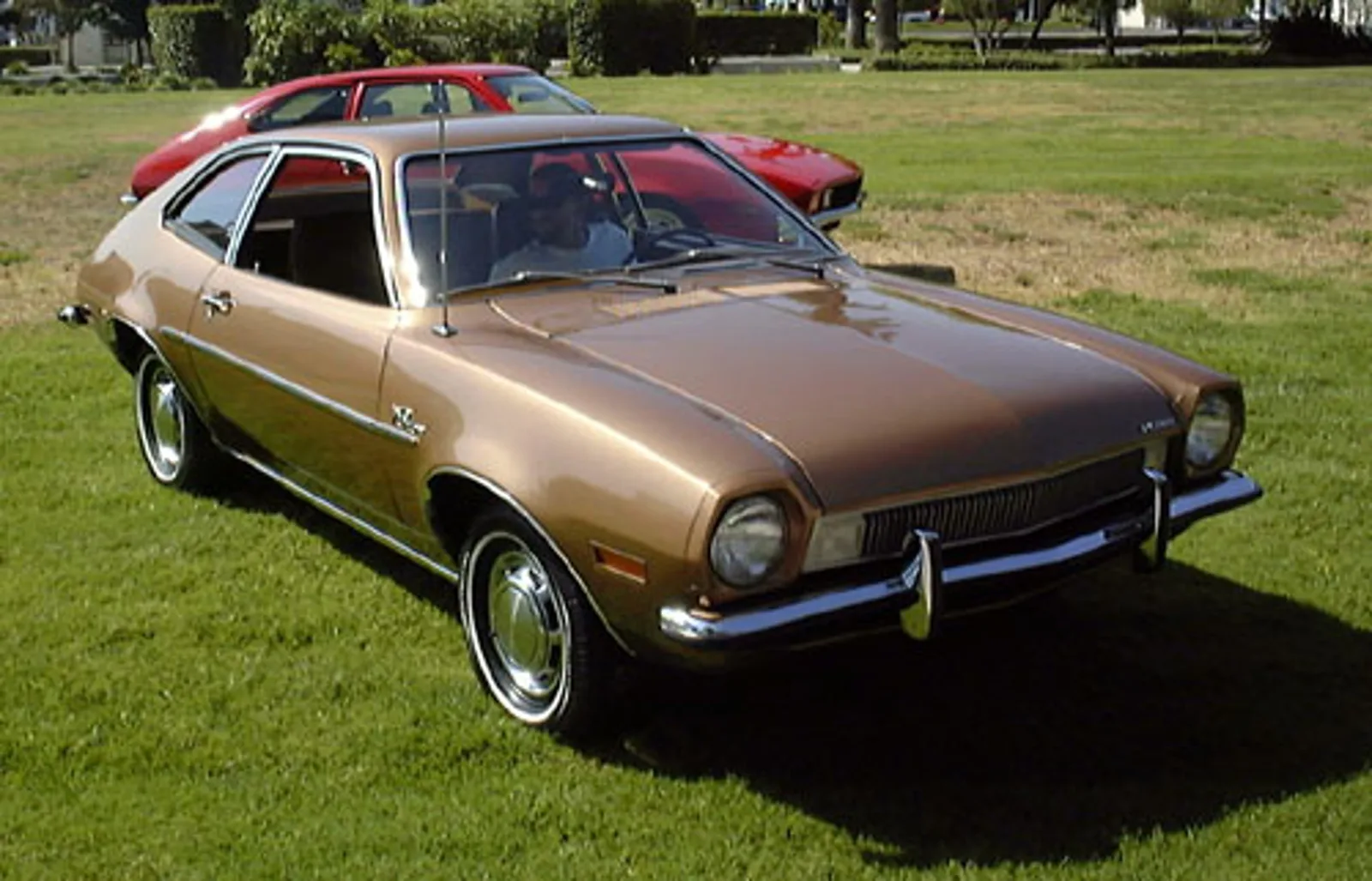
Ford's first North American subcompact sold more than three million units in a decade, then became the centre of one of the most debated safety stories in motoring.
The Ford Pinto was a North American subcompact built by Ford from 1970 to 1980. It came as a sedan, hatchback and station wagon, and more than three million were built. Its fuel tank design later led to a 1978 recall of 1.5 million cars and a long debate over its safety.
The Ford Pinto was a subcompact car built by Ford in North America from 1970 to 1980. Over three million left the line, making it more popular than the Chevrolet Vega and the AMC Gremlin combined, but its fuel tank design became one of the most debated safety stories in automotive history.
What was the Ford Pinto?
The Pinto was Ford's first subcompact in North America. It went on sale on 11 September 1970 in a fastback sedan body, with a three-door Runabout hatchback following in 1971 and a two-door station wagon in 1972. Each body style used the same basic platform and mechanical layout.
The name came from a type of horse with a distinctive coat. Ford's launch tagline called it The Little Carefree Car, and the marketing positioned it as a small and easy car at a time when imports were taking a larger share of the market.
Mercury offered a rebadged version called the Bobcat. It first appeared in Canada for 1974 and in the United States for 1975, and about 224,000 were built from 1975 to 1980 at plants in New Jersey, Ontario and California.
A subcompact that sold more than three million units in a decade and then became one of the most debated safety stories in motoring.
Why did Ford develop the Pinto so quickly?
Work on the project started in the summer of 1967. Ford's internal committee backed the idea in December 1968, and the company's directors signed it off a month later. The brief from Lee Iacocca was clear: a 1971 model below 2,000 lb (900 kg) that would cost less than US$2,000.
The development programme took 25 months from concept to delivery, against an industry average of 43 months. Some processes that usually ran in sequence were run in parallel, and tooling overlapped with development. The team's rush gave the car its internal nickname, Lee's car, and the body was styled by Robert Eidschun.
Speed had a cost. Engineers had less time to test alternatives, and the design was frozen before some questions were settled. That schedule pressure later became central to the criticism of the car.
What engines and running gear did the Pinto use?
The Pinto used a unibody structure with a longitudinally mounted engine at the front driving the rear wheels. The suspension used unequal-length control arms with front coil springs, while the rear axle was a live axle on leaf springs. Steering was rack and pinion, with power assistance optional.
Ford's North American range had gone without a four-cylinder unit since the Model A engine was dropped in 1934. The first Pinto engine was the Kent unit, a 1.6 L borrowed from Ford of England, alongside a from Germany 2.0 L engine. The 2.0 L could reach 60 mph (97 km/h) from rest in 10.8 seconds, which was lively for a car that weighed very little.
Tougher emissions and safety requirements later forced engineers to rethink the early engines. Under the revised SAE standards of 1972, the 1.6 L was rated at 54 bhp (40 kW) and the 2.0 L at 86 hp (64 kW). In 1974 the 2.3 L OHC four arrived, and it stayed in production into 1997. A 2.8 L V6 from Cologne was offered from 1975.
How well did the Pinto sell?
The Pinto sold more than 100,000 units by January 1971, and 352,402 were built in the 1971 model year. The peak came in 1974, when 544,209 units were produced in a single model year. Over three million Pintos were built during the decade.
Its success owed much to price and timing, as buyers shopping for small cars in the early 1970s had few domestic options. Entry-level models began at $1,850 in 1970, undercutting the Chevrolet Vega and targeting imports such as the Mazda 1200, the Subaru DL and the Honda Civic. The hatchback Runabout arrived in 1971 at $2,062, which made it a practical alternative to the sedan.
Total production reached 3,150,943 cars before the line ended in July 1980. The Ford Escort, a front-wheel-drive car, replaced it. The production run covered a decade of changing rules for American carmakers.
What changed as the Pinto aged?
The Pinto was updated regularly. In 1974 it gained large 5 mph bumpers to meet federal rules, and in 1976 it received an egg-crate grille and new headlamp bezels. The 1979 restyle brought rectangular headlamps and a taller grille, and the ESS European Sports Sedan trim arrived the same year.
Ford's chairman, Henry Ford II, bought a 1971 Runabout as one of his personal cars. Options and trims multiplied, from the basic Pinto Pony to sporty appearance packages. The Cruising Wagon for 1977 was a sedan delivery version styled to look like a small conversion van, complete with bubble windows.
Changes like these reflected the wider pressure on American carmakers to meet new rules while keeping prices low, a balance that makes the Pinto a useful case study. The V6 was dropped for 1980, leaving the 2.3 L as the only engine. By then the Fiesta had arrived in the US, and it was nearly two feet shorter than the Pinto, which made the older car look dated.
How was the Pinto received by critics?
Reviewers were divided when the Pinto arrived. Consumer Reports placed it among the runners-up in a six-car subcompact test, while Road and Track criticised the suspension and the standard drum brakes. Later commentary has been far harsher, with Forbes and Time naming the car among the worst ever built.
Car and Driver found the car nimble and powerful as a commuter when fitted with the larger 2.0 L engine and front disc brakes, while Super Stock Magazine rated its fit and finish as superior. Those early reviews show a car that many testers liked, even though its later reputation became far more negative.
Was the Pinto a safety failure?
The Pinto's fuel tank sat between the rear axle and the bumper, a common arrangement for American subcompacts at the time. After rear-end collisions, some tanks were damaged and fires followed, and the case against the car centred on those fires and on how Ford responded.
Beginning in 1973, field reports of fires after low-speed rear impacts reached Ford's recall office. The company's internal group reviewed the reports and found no actionable issue on two occasions. A 1973 cost-benefit report, the so-called Pinto Memo, later became a symbol of the controversy.
The NHTSA found 27 deaths in rear-impact fires between 1970 and mid-1977. Subsequent analyses have questioned how those numbers were framed, and the safety record of the car in comparison with other subcompacts remains a point of debate.
The debate has never fully settled. Supporters point to the car's record within its class, while critics focus on the decision to keep the tank placement after early warnings arrived from the field.
What was the Pinto Memo?
The Pinto Memo was a 1973 cost-benefit analysis prepared for submission to the NHTSA, which Ford used to oppose a tougher fuel system rule. It estimated a fix at $11 per car across 12.5 million cars, a cost of $137 million, against a benefit of $49.5 million from fewer burn deaths and injuries.
The memo estimated that the changes would save 180 burn deaths and 180 serious injuries a year. Later writers argued that it was widely misunderstood, since it covered all manufacturers and all cars, rather than only Ford's tort liability.
In August 1977 Mark Dowie's article Pinto Madness appeared in Mother Jones, and it used the memo to argue that Ford had traded lives for profit. Time magazine later called the memo one of the industry's most notorious paper trails.
Critics later noted that the cost figures were built on values applied across the whole market, which made the calculation look more callous than its authors may have intended.
How did the recall and lawsuits unfold?
The NHTSA opened an investigation in August 1977 and found the fuel system defective in May 1978. Days before a formal recall order, Ford agreed to a voluntary recall of 1.5 million Pintos and Mercury Bobcats on 9 June 1978, the largest in automotive history at that time.
The fix placed a polyethylene shield between the tank and likely puncture points, lengthened the filler tube and improved the filler seal. Ford said the recall was meant to end public concern, while disagreeing with the finding of a defect. The episode became a reference point for how fuel system defects were handled in later years.
Around 117 lawsuits were brought over rear-end accidents. The best-known case, Grimshaw v. Ford Motor Co., produced a jury award of $127.8 million, including $125 million in punitive damages, and the judge later reduced the punitive figure to $3.5 million.
What was the Indiana case?
Prosecutors in Indiana charged Ford with reckless homicide after three teenage girls died in a 1973 Pinto in August 1978. The indictment was the first time a corporation faced criminal charges for a defective product, and Ford was found not guilty in 1980.
Ford's defence was far more ambitious than the one in the Grimshaw case. A civil suit linked to the same crash was settled for $7,500 to each plaintiff. Commentators have since described the indictment as a low point for the company's reputation.
Lawyers and legal scholars still cite these cases in business ethics and product liability courses. They show how a single design choice can become a symbol, whatever the wider statistics say.
What are the Ford Pinto specifications?
The table below gives the main body styles, engines and production figures. Each row names the year or model it applies to, because power ratings changed almost every year. Imperial and metric figures are shown together where the original numbers were published.
| Specification | Detail |
|---|---|
| Launch | 11 September 1970 |
| Body styles | Two-door fastback sedan; three-door Runabout hatchback; two-door station wagon |
| Engines, 1970 to 1974 | 1.6 L Kent; 2.0 L from Germany; 2.0 L cut to 86 hp (64 kW) in 1972 |
| Engines, from 1974 | 2.3 L OHC four; 2.8 L V6 from 1975 (dropped for 1980) |
| 0 to 60 mph (97 km/h) | 10.8 seconds, 2.0 L model |
| Peak production | 544,209 units in 1974 |
| Total production | 3,150,943 cars until July 1980 |
| Mercury Bobcat | About 224,000 built, 1975 to 1980 |
| Replacement | Ford Escort, front-wheel drive |
Frequently asked questions
How many Pintos were built?
Total production reached 3,150,943 cars between 1970 and July 1980. Most of them were sold in North America, where the car was built.
What was the Pinto's largest recall?
The June 1978 recall covered 1.5 million Pintos and Mercury Bobcats, and it was the largest in automotive history at that point.
Did the Pinto have a station wagon?
Yes. The two-door station wagon debuted on 24 February 1972, and it was the first two-door Ford wagon since the 1965 Falcon.
What replaced the Pinto?
The Ford Escort replaced the Pinto. It was a front-wheel-drive car, which marked a clear change in Ford's small-car engineering.