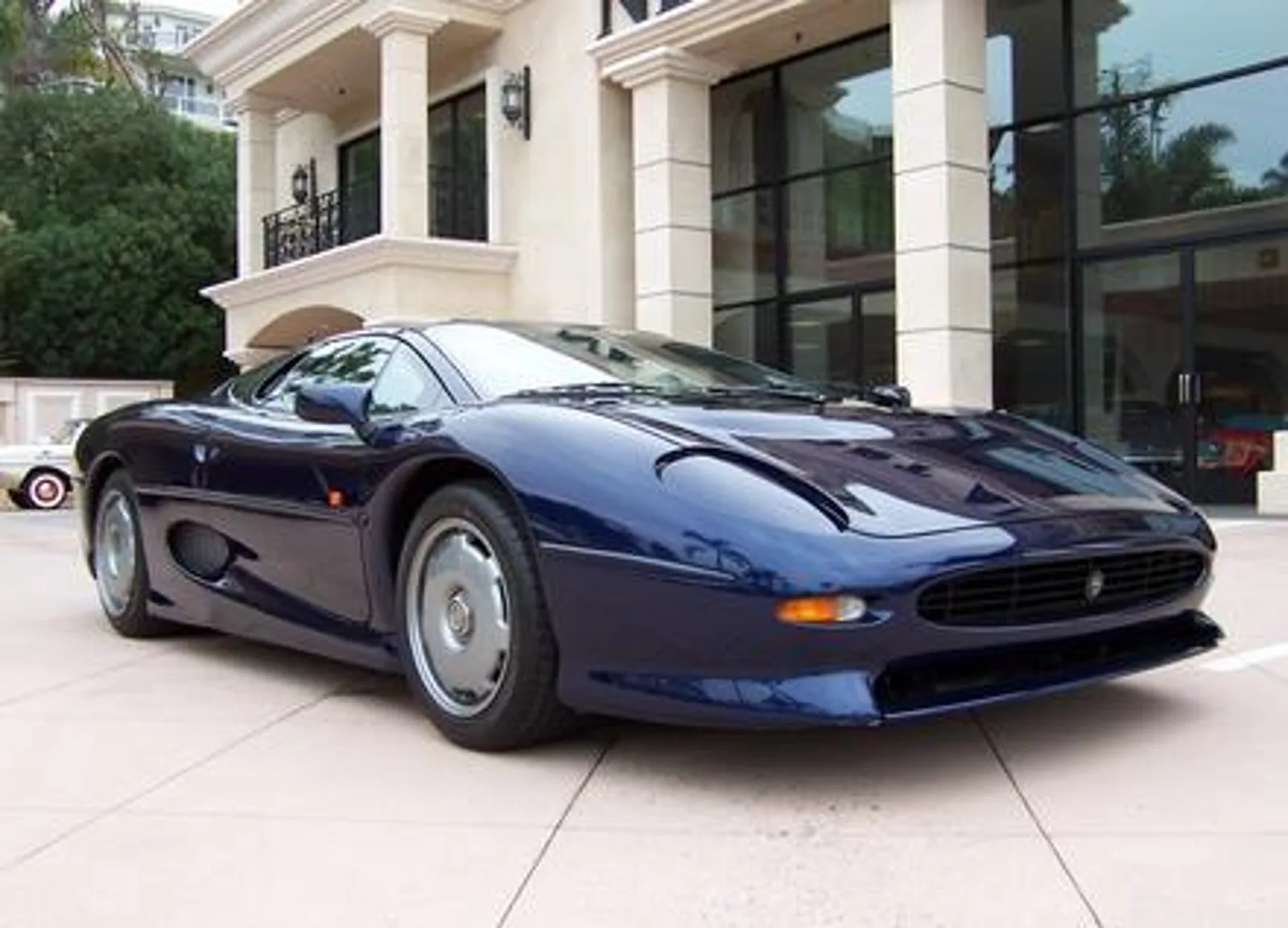
A volunteer concept with a V12 and four-wheel drive became a rear-drive twin-turbo V6 that still held a headline speed record.
The Jaguar XJ220 was a two-seat supercar that Jaguar built with Tom Walkinshaw Racing from 1992 to 1994. It began as a V12 concept, but production cars used a 3,498 cc twin-turbo V6 producing 550 PS (405 kW; 542 hp), and about 275 were built.
Few supercars have a story as tangled as the Jaguar XJ220. Born as a spare-time project inside Jaguar, it was meant to carry a V12 and four-wheel drive, but the production car arrived as a rear-drive twin-turbo V6 that still delivered a headline speed record.
Where did the Jaguar XJ220 come from?
The XJ220 started life as a V12-engined concept. Its production form was delivered between 1992 and 1994 by Jaguar in partnership with TWR, and the finished car ran a 3,498 cc twin-turbo V6 with 550 PS (405 kW; 542 hp). Roughly 275 were completed before production ended.
The concept grew out of a V12-engined four-wheel-drive car designed by an informal group of Jaguar employees who worked on it in their spare time. Their goal was a modern successor to the company's 1950s and 1960s Le Mans cars that could enter FIA Group B competition, and the XJ220 drew on engineering already done for Jaguar's racing family.
The concept was shown to the public at the 1988 British International Motor Show in Birmingham. Its reception was so positive that Jaguar decided to put the car into production, and the company took deposits of 50,000 pounds from around 281 customers before deliveries were planned for 1992.
A volunteer concept with a V12 and four-wheel drive became a rear-drive twin-turbo V6 that still set a speed record.
How did the XJ220 concept come together?
Jim Randle, Jaguar's director of engineering, drove the project from the start. He built a 1:4 scale cardboard model of a potential Group B racer over Christmas 1987, and the design was then taken into the styling studio, where Keith Helfet's proposal was chosen from two mock-ups.
The project had no official backing, so Randle assembled a team of volunteers who worked evenings and weekends. The group was known as the Saturday Club and numbered twelve people. The car had to produce useful data on handling, high-speed aerodynamics and aluminium structures, and FIA racing rules and government safety rules shaped the final design.
The Group B rules pointed the concept toward a mid-engined, all-wheel-drive layout with a Jaguar V12. Randle called in favours from suppliers and engineering firms that he and Jaguar had worked with before, offering public recognition and the hope of future contracts in return. That is how a car of this ambition was built at very little cost to the company.
The name came from the XK120, whose name referred to its top speed in miles per hour. The concept was targeted at 220 mph (350 km/h), so the car became the XJ220.
Why did the XJ220 switch from a V12 to a V6?
The XJ220 swapped its V12 for a turbocharged V6 because of engine weight, dimensions and emissions rules. A shorter V6 allowed a shorter wheelbase and a lower weight, and the V12 was ruled out when it became clear it would struggle to meet emissions legislation.
The V6 came from a racing story of its own. Jaguar's racing cars had moved away from the V12 after fuel consumption and refuelling rules forced changes in the XJR-10 and XJR-11. Meanwhile the Austin Rover V64V, designed for the MG Metro 6R4, was left without a home when the Group B rally ban arrived in 1987, and TWR bought its design rights in 1989.
Engineers reworked the V64V for forced induction. They enlarged it to 3.5 litres, strengthened the internals and fitted two Garrett TO3 turbochargers. The new JV6 was first used in the XJR-10 and XJR-11, and its compact size and low weight made it a natural fit for the production car.
What was under the XJ220's skin?
The chassis was an aluminium structure using Alcan's bonded honeycomb technology, with two box-section rails that served as suspension mounts and a crash structure. An integral roll cage formed part of the chassis and monocoque, and the car passed stringent crash tests.
Rear-wheel steering, height-adjustable suspension and active aerodynamics were dropped from the production car to save weight. The suspension used double unequal-length wishbones, inboard coil springs and Bilstein gas-filled dampers, while AP Racing designed brakes with ventilated, cross-drilled discs.
Anti-lock braking was removed after feedback from enthusiasts and racing drivers, and the brakes had no servo, which some owners found hard to use when cold. Steering was rack and pinion with power assistance, and the wheels were 17 inches at the front and 18 inches at the rear, shod with Bridgestone tyres developed specially for the car.
Jaguar had little experience with four-wheel drive, so the concept's all-wheel-drive system was designed by FF Developments, the firm run by Tony Rolt's son, Stuart. That system was later simplified for the production car into a rear-wheel-drive transaxle with a viscous limited-slip differential, and the gearbox was given triple-cone synchromesh on the lower gears.
How fast was the XJ220 really?
Jaguar claimed a top speed of 212.3 mph (341.7 km/h) for the standard car and a 0-60 mph time of 3.6 seconds. Road & Track measured 210.5 mph (338.8 km/h), 4.8 seconds to 60 mph and a quarter mile in 12.4 seconds, so independent figures sat below the factory claims.
The record run was made at the Nardo test track in Italy in June 1992. Martin Brundle drove a pre-production car with its catalytic converters removed, and the rev limit was raised to 7,900 rpm. Those changes added about 51 hp, and the car reached 217.1 mph (349.4 km/h), a figure that stood as the fastest standard production car speed in the Guinness Book of Records editions of the period.
The record did not last. Guinness later recognised the McLaren F1 at 240.1 mph (386.4 km/h) in March 1998 as the fastest standard production car. Even so, the XJ220 remained an important early marker in the race to build the fastest road car.
When did the XJ220 go on sale?
Production was approved in late 1989, when the limited run was announced at between 220 and 350 cars. The list price on 1 January 1990 was 290,000 pounds before VAT, but indexation pushed it up to 470,000 pounds by 1992, which made it one of the most expensive cars of its day.
Jaguar could not develop the car in-house because its engineers were busy with the XJ and XJS. The job went to JaguarSport Ltd., a joint venture with TWR formed in 1987, and a new company called Project XJ220 Ltd. was set up for the work. Mike Moreton, formerly of Ford Motorsport, led the engineering team, and Richard Owen became chief designer.
The car was assembled at a purpose-built factory at Wykham Mill, Bloxham, near Banbury. Diana, Princess of Wales opened the plant and unveiled the first production car in October 1991, and the first customer delivery came in June 1992 with output averaging about one car a day.
The reception was not kind to every buyer's plans. The recession, the changed specification and the effects of indexation led many depositors to walk away, and the buyers who went to court in 1995 lost after Jaguar showed the delivered car matched the contract. The last unsold car went for 127,550 pounds plus VAT in 1997.
How did critics judge the XJ220?
Reviewers were impressed by the car's pace, though they were less kind about its manners. Autocar's Andrew Frankel praised the performance, and Gavin Green of Car praised the ergonomics and the ride, with the driving position and the forward view both singled out.
Other testers were harsher. A 1994 comparison test in Car criticised the car's size, its handling and its engine noise, and it found the XJ220 disappointing against the Bugatti EB 110 in that test. Testers also complained about heavy steering, weak brakes without ABS and poor visibility.
Years later, Evo compared the XJ220 with the Lamborghini Murcielago in 2009. The magazine accepted that the switch from a V12 to a turbocharged V6 would be easier to accept in the present day, but it judged the Lamborghini the far more exciting and accessible car to drive.
What racing versions did the XJ220 spawn?
A racing version, the XJ220-C, was shown at the 1993 Autosport International show. Win Percy drove one to victory on its debut outing, a round of the BRDC National Sports GT Challenge at Silverstone.
Jaguar fielded three factory XJ220-Cs at the 1993 24 Hours of Le Mans, in the Grand Touring class, and John Nielsen, David Brabham and David Coulthard won the class by two laps over Porsche. The win was revoked after the cars were disqualified over catalytic converters. Jaguar won its appeal, which the FIA supported, but the disqualification stood because the appeal had not been lodged in time.
TWR also developed six road-going XJ220-S cars with one-piece carbon fibre reinforced polymer bodywork and an engine tuned to 700 PS (515 kW; 690 hp). Colin Goodwin of Autocar set a lap record with one of them at Millbrook in June 1995, averaging 180.4 mph (290.3 km/h).
What are the Jaguar XJ220 specifications?
The production car combined a twin-turbo V6 with a rear-wheel-drive transaxle and a lightweight aluminium chassis. The table sets out the main production figures alongside the concept and record-run numbers.
| Specification | Detail |
|---|---|
| Production | 1992 to 1994; about 275 cars |
| Engine | 3,498 cc twin-turbo V6, dry sump |
| Bore and stroke | 94 mm x 84 mm (3.70 in x 3.31 in) |
| Power | 550 PS (405 kW; 542 hp) at 7,200 rpm |
| Torque | 475 lb ft (644 N m) at 4,500 rpm |
| 0-60 mph | 3.6 seconds (Jaguar figure) |
| Top speed, claimed | 212.3 mph (341.7 km/h) |
| Record run | 217.1 mph (349.4 km/h), June 1992 |
| Price, 1992 | 470,000 pounds |
| Concept wheelbase | 2,845 mm (112 in) |
| Concept length and width | 5,140 mm (202 in); 2,000 mm (79 in) |
| Concept weight | 1,560 kg (3,439 lb) |
| Drag coefficient, production | Cd=0.36 |
| Downforce | 1,361 kg (3,000 lb) at 200 mph (322 km/h) |
What was the concept's interior like?
The 1988 concept's interior was trimmed in Connolly leather by Callow and Maddox. Its equipment list covered heated glass at both ends, power windows, climate control, heated seats that could be adjusted electrically and a CD player from Alpine, while the dashboard came from Veglia.
Its exterior was built from aluminium by Park Sheet Metal and finished in silver, which gave the concept a cleaner look than the production car would have. The production interior was simpler, with leather sports seats, electric windows and a curved dashboard that carried a secondary binnacle of four analogue gauges.
Did the XJ220 race in other series?
The XJ220-C also appeared in the 1993 Fast Masters series, a made-for-television contest that aired on ESPN in the summer. Invited drivers over 50 raced in an elimination format at Indianapolis Raceway Park, and the event proved a farce for the cars.
The problem was the car's viscous limited-slip differentials, which were poorly suited to the oval chosen by the organisers. They produced odd handling and led to several crashes, which damaged the car's reputation as a racer on that surface.
Was there a special XJ220 built for royalty?
Yes. A special XJ220 was built in 1995 for the Sultan of Brunei and his brother, Prince Jefri, both of whom ordered custom cars based on expensive luxury models. The Pininfarina car had a redesigned body built by the coachbuilder Coggiola.
Its changes ran to fixed headlamps, reworked rear lamps, a double-vane rear wing and a fresh cabin. The paint was dark green, a clear break from the silver finish of the concept.
Frequently asked questions
How many Jaguar XJ220s were made?
Production ended in April 1994 after about 275 cars. The limited run had been announced at 220 to 350 cars, and deposits came from around 281 customers.
Did the XJ220 have a V12 engine?
The concept did, with a 6.2-litre V12 and titanium connecting rods. The production car replaced it with a 3,498 cc twin-turbo V6 because of weight, size and emissions considerations.
Who built the XJ220's all-wheel-drive system?
FF Developments designed the four-wheel-drive system for the concept. The production car used a simpler rear-wheel-drive transaxle that FF Developments also built.
Was the XJ220 sold in the United States?
It was never officially approved for sale there, but it was admitted under the Show or Display exemption by 2001.