Launched in Paris in 1969, the Renault 12 built a worldwide following through Gordini and Alpine models, licensed factories and an electric experiment.
Renault introduced the 12 as a small front-wheel-drive family car in Paris in October 1969 and built it in France until 1980. It came as a saloon and an estate, and licensed factories in other countries kept it in production for decades, with 2.5 million sold.
The Renault 12 was a small family car that Renault introduced at the Paris Motor Show in October 1969. French production ran until 1980, and licensed factories kept building versions for decades afterwards. Renault sold 2.5 million of them, a commercially successful result for a car designed to be built almost anywhere.
European reviewers praised its roomy interior, styling, performance and low fuel use in the early years. North American critics were harsher, and Road and Track complained about the engine noise and heavy steering of a 1974 model.
What was the Renault 12?
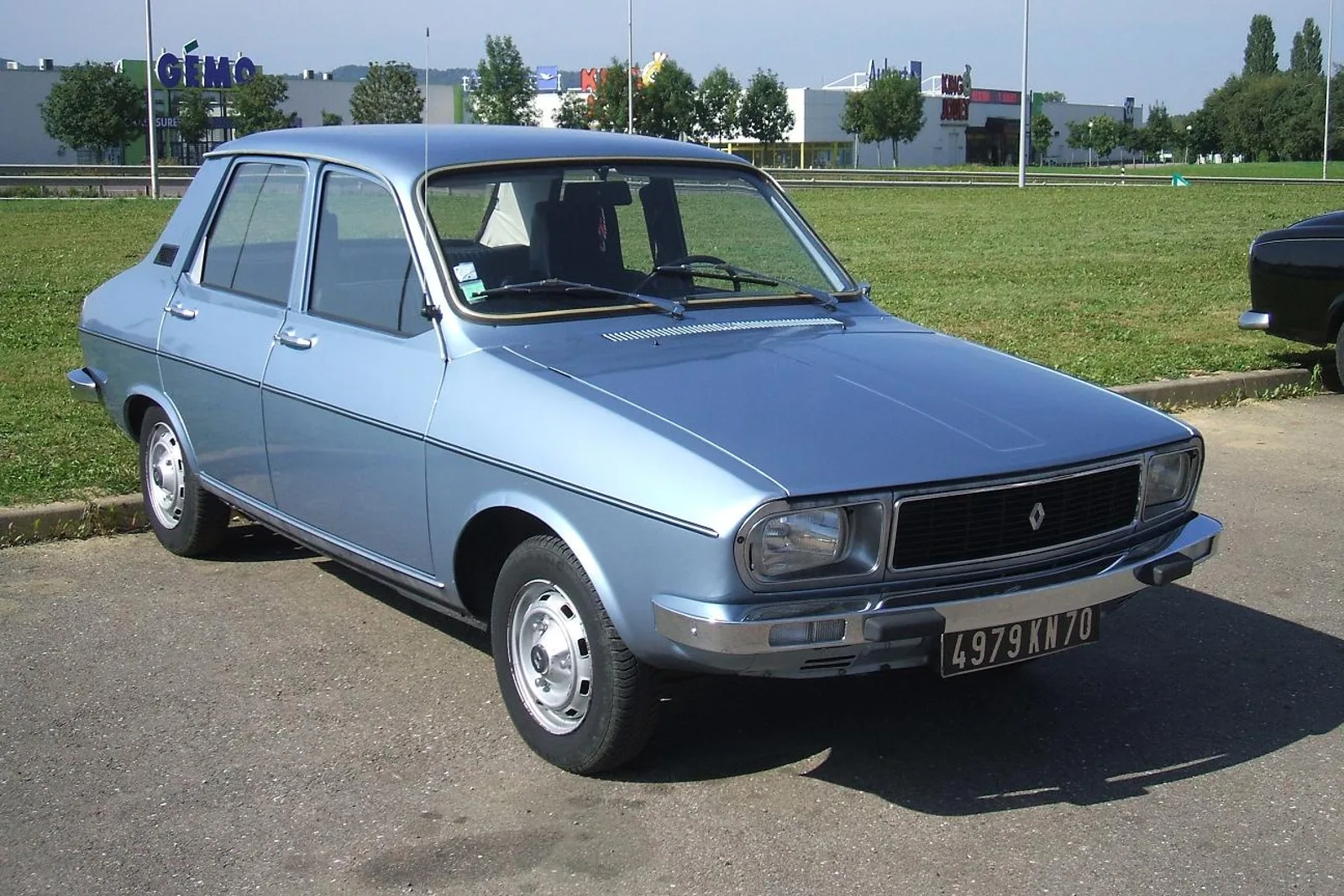
The Renault 12 was a front-wheel-drive small family car sold as a saloon, called the Berline, and as an estate, called the Break. Renault positioned it between the Renault 8 and the Renault 16, and it was produced in France until 1980.
The launch cars were four-door saloons in L and TL specifications. The TL was the pricier option, with two individual reclining front seats, door armrests, interior lamps in the boot and glovebox, heated rear glass and additional warning lamps.
The estate arrived in 1970 with the same trim levels and engines as the saloon. That gave the range a practical body for families and fleet buyers across Europe.
A family car designed to be built almost anywhere, which turned into a global model with a sporting edge.
Why did Renault design the 12?
The Styling Center began work on the 117 project in January 1964. Its job was to fill the gap between the Renault 8 and the Renault 16 with a car that was economical, roomy and simple to build.
The brief also asked for reliability in export markets, enough comfort for France, and a platform that could support several variations. That final requirement explains why the car spawned so many national versions.
The Renault 16 engine was a lighter option, but its aluminium block was rejected on cost grounds. Renault wanted a price that could challenge the Peugeot 304, which targeted buyers willing to pay a premium in the 1300 class.
How was the Renault 12 engineered?
The 12 was front-wheel drive, with its engine placed longitudinally ahead of the front wheels. The Renault 4 and 16 had their engines behind the wheels, so the 12 was a different layout from Renault's other front-drive cars.
That layout let the gear selector sit on the floor rather than on the dashboard or steering column. Early cars had the handbrake under the dashboard, and it later moved to a floor-mounted position.
The rear suspension used a rigid axle rather than independent suspension. Many commentators saw that as a retrograde step for a manufacturer that had championed independent suspension for decades.
What engines did the Renault 12 use?
The launch engine was an enlarged version of the iron Cleon unit that had been used in the Renault 8 and 10 since 1962. It displaced 1,289 cc and produced 60 PS (44 kW; 59 hp) SAE, which gave a top speed of 145 km/h (90 mph).
Renault kept the removable cylinder liners it favoured, and it avoided the oversquare dimensions that were fashionable elsewhere in Europe. The cylinder bore grew to 73 mm, and the cylinders were equally spaced to leave room for coolant.
Power varied by market and by specification. The TS used a single double-barrel Weber carburettor for 64 PS (47 kW; 63 hp) and 150 km/h (93 mph). In the United States the engine grew to 1,647 cc in 1973, but emissions rules cut its output to 69 hp.
What made the Gordini special?
The Gordini was the high-performance model added in 1970. It used the all-aluminium 1,565 cc block from the R16 TS, two double-barrel Weber carburettors, a reinforced crankshaft and a five-speed gearbox, with ventilated front discs and a tuned suspension.
Buyers could choose a solid pastel colour finished with double white stripes. French Blue with stripes became the best-known combination, and it remains the look most associated with the model.
Sales peaked at 2,225 units in 1971 before falling sharply. Renault stopped building the Gordini in 1974 after 5,188 had been sold, compared with 11,607 Renault 8 Gordinis.
How did the TS, TR and facelift change the range?
The TS arrived in October 1972 with Gordini-style wheels, a chrome strip along the side and integrated headrests. It also added a tachometer and a cooling-fluid temperature gauge, which gave it a more driver-focused dashboard than the base cars.
The TR appeared at the Paris Motor Show in October 1973 with automatic transmission as standard. Its three-speed torque converter was developed by Renault and was controlled electronically rather than hydraulically.
A 1975 update across the whole range simplified the grille, refreshed the rear lamps and reworked the dashboard. French production continued for two more years after the Renault 18 arrived in 1978, despite the successor's quick popularity.
Where was the Renault 12 built outside France?
The 12 was built in at least a dozen countries and sold across every continent. It also formed the base of the GNW Duiker, a sporting convertible with a fibreglass body that never reached production as a Rhodesian national car project.
In Romania, Dacia acquired the tooling and basic designs and built the car in several body styles as the Dacia 1300. Its successor, the Dacia 1310, started production in 1979 and stopped in 2004, and Romanian output totalled 1,959,730 vehicles over 35 years.
In Turkey, Oyak-Renault built a 12-based car from 1971 to 2000. After a 1989 facelift it was marketed as the Renault Toros, and it was the first Turkish-built automobile to be exported abroad, starting with shipments to Lebanon in 1973.
In 1972 Renault also formed a strategic partnership with the Yugoslav manufacturer IMV of Novo Mesto, Slovenia. IMV began producing the Renault 12 alongside the Renault 4, 16, 18 and 5 for the Yugoslav market, extending the car's production footprint in eastern Europe.
How was the Renault 12 sold in Australia?
The 12 won Wheels magazine's Car of the Year award in Australia in 1970. It was assembled at Renault Australia's plant in Heidelberg, a Melbourne suburb, from CKD kits, with seats and other components sourced locally.
The Australian range generally followed the UK models, and its facelift arrived there in 1976. From about 1971 the local wiper mechanism had to suit a right-hand drive pattern under new Australian Design Rules.
In October 1976 the 1,289 cc engine was replaced by a 1,397 cc version, and the model was marketed as the Renault 1.4 Litre. In May 1978 it became the Renault Virage, identical in mechanics but with twin round headlamps.
What was the Renault 12 in North America?
In Canada, the 12 was assembled locally in Quebec from CKD kits from 1970 until 1973, and fully built cars were imported from France after that. A total of 25,662 cars were sold in Canada across the model's life there.
The United States version was presented in May 1971, and it came as a TL saloon or a station wagon before a base model and the 12 L were added. Its quad headlamps, side marker lights and a bonnet bulge to clear the larger engine set it apart from European cars.
Canada received a 1.4-litre engine in late 1977, the same unit used in Sweden. The Nordic special edition of 1978 and 1979 highlighted that shared Scandinavian link.
Did the Renault 12 compete in rallies or races?
Yes, most notably in South America. Jorge Recalde won the class up to 1,600 cc in the 1978 South American Marathon, and Renault 12s took the first six places in that category.
The Renault 12 Alpine was built to improve the marque's image in local rallying. It used the 1,397 cc engine from the R5 Alpine, a bulbous fibreglass bonnet and competition-tuned suspension, and only 493 units were made between 1977 and 1980.
Hand building and imported components pushed the Alpine's price about 40% above the basic TL, which limited its appeal to enthusiasts.
Was the Renault 12 ever electric?
Yes, as an experiment. In the mid-1970s NASA used Renault 12s as electric vehicle testbeds, working with the Energy Research and Development Administration and Electric Vehicle Associates of Parma, Ohio. The converted car was rebadged the EVA Metro.
The EVA Metro kept the original drivetrain but ran on lead-acid battery packs taken from golf carts, which sat in the engine bay and the boot. Only 12 were converted, and seven were sold to the government of Manitoba, Canada.
One EVA Metro resurfaced in Georgia in 2020 and was restored to running order.
Renault 12 specifications
The table lists the core figures for the launch car and the main variants. Where a figure belongs to one trim or market, the table says so.
| Specification | Detail |
|---|---|
| Launch engine | 1,289 cc, 60 PS (44 kW; 59 hp) SAE |
| Top speed at launch | 145 km/h (90 mph) |
| Gordini | 1,565 cc, 113 PS (83 kW; 111 hp), 185 km/h (115 mph) |
| TS | 64 PS (47 kW; 63 hp), 150 km/h (93 mph) |
| Australian 1.4 Litre | 1,397 cc, 49 kW (66 hp), 150 km/h |
| Alpine | 1,397 cc, 110 PS (81 kW; 108 hp), around 175 km/h (109 mph) |
| Total sales | 2.5 million units |
How did the Gordini and Alpine compare?
Both sporting models shared the 12's basic body but used very different engines. The Gordini's 1,565 cc all-aluminium unit gave 113 PS (83 kW; 111 hp), while the Alpine's 1,397 cc engine made 110 PS (81 kW; 108 hp) and was built in Argentina from local and imported parts.
The Alpine was aimed at rallying and used a bulbous fibreglass bonnet, competition suspension and custom paint schemes. Its top speed of around 175 km/h (109 mph) fell short of the Gordini's 185 km/h (115 mph), and the Gordini sold 5,188 units to the Alpine's 493.
Why did Renault end European production of the 12?
French production ended in 1980, two years after the Renault 18 launched in 1978 as its successor. Manufacturing continued in partner countries for much longer, and the last R12 was built in Turkey in 2000, closing the car's long production story.
Dacia's 1310 saloon and the R12-based Dacia Pick-Up kept the design alive in Romania until 2004 and December 2006 respectively, long after the car had left western European showrooms. Those extra years gave the model a long global tail.
Frequently asked questions
When did French production of the Renault 12 end?
Production in France stopped in 1980, roughly two years after the Renault 18 arrived.
How many Renault 12s were sold?
Renault sold 2.5 million units overall. Argentine production alone ran from 1971 to 1994, and the saloon and estate totalled around 450,000 units there.
What did Road and Track make of the Renault 12?
The magazine criticised engine noise on a 1974 model and called its heavy, non-power steering a serious design flaw. It also gave the car poor marks for ventilation.
What was the Renault 12 Gordini's top speed?
The Gordini reached 185 km/h (115 mph), making it the quickest version of the family car that Renault offered in its early years.