Airship, bomber and seaplane engines went under the bonnet to chase land speed records, and Count Louis Zborowski's homemade monsters inspired a famous flying car.
An aero-engined car is powered by an engine designed for aircraft, mostly built for racing and land speed records. Louis Zborowski's homemade Chitty Bang Bang cars of the early 1920s, with Maybach and Benz aircraft engines, inspired Ian Fleming's novel about the flying car.
The last land speed record ever set on public roads belonged to a car with a 21.7-litre Fiat aircraft engine. Ernest Eldridge drove his Mefistofele at Arpajon in France on 12 July 1924 and reached 234.980 km/h (146.010 mph). The press had named the car for the noise and smoke from its engine, and after that day record-breakers moved to beaches and salt flats.
Eldridge was one of a small band of builders who dropped aircraft engines into car chassis, chasing speed that ordinary car engines could not reach. Their cars ran from Brooklands to Daytona and Bonneville, and one family of them, Count Louis Zborowski's Chitty Bang Bang machines, ended up as a children's story about a flying car.
What is an aero-engined car?
An aero-engined car is a vehicle powered by an engine designed for aircraft. Most were built for racing, and many tried to set land speed records. The practice began a few years before the First World War but peaked in the interwar period, when military-surplus aircraft engines were readily available. Later cars used aviation turbine and jet engines, and piston, turbine and jet cars have all set land speed records.
There were also non-racing uses, among them the production Tucker 48 and prototypes such as the Chrysler Turbine Car, the Fiat Turbina and the General Motors Firebirds. In the late 20th century and into the 21st, interest in piston-powered aero-engined racers has revived.
Why bolt in an aircraft engine?
In the early 20th century car engines struggled past about 3,000 rpm, so the easiest way to find more power was a bigger displacement. During the 1900s, engines needed enormous capacity just to reach 100 horsepower (75 kW). Fitting such a lump into a car was hard but possible, and since most aircraft engines of the period were liquid-cooled, they were easier to adapt for car use.
The last land speed record ever set on public roads was driven by a car with a 21.7-litre Fiat aircraft engine.
Before the First World War
Hispano-Suiza, Renault and Rolls-Royce all experimented, but Fiat created perhaps the first true aero-engined car in 1910. The Tipo S76, nicknamed "The Beast of Turin", mated a 1907-08 Fiat production chassis to a four-cylinder airship engine of 28.4 litres (1,730 cu in) that developed 300 hp (220 kW) at 1,500 rpm. Daryl Murphy speculates it was built to take the world land speed record, which stood at 125.95 mph (202.70 km/h) after the Blitzen Benz set it at Brooklands in 1909. The S76 raced at Brooklands but never topped about 140 km/h (90 mph), and it vanished during the war.
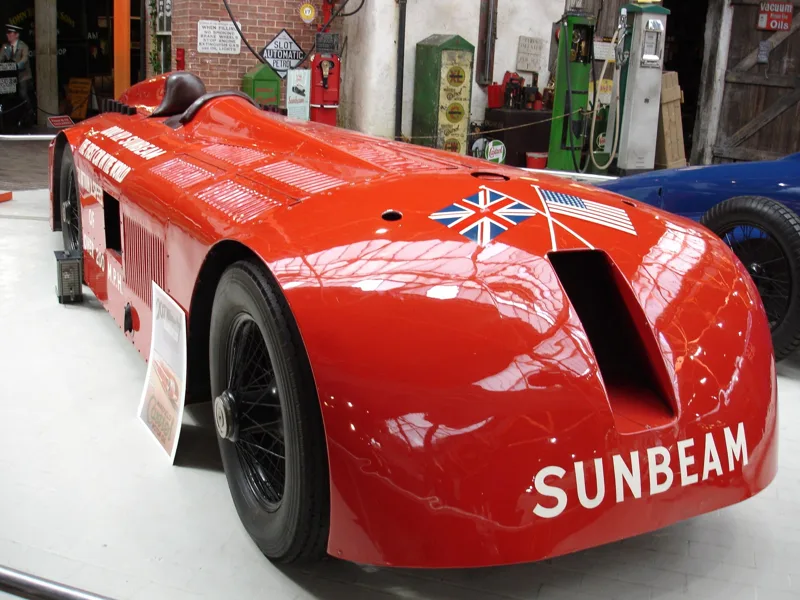
Sunbeam, at the suggestion of chief designer Louis Coatalen, put a nine-litre flathead V12 aircraft engine into a chassis in 1913. Nicknamed "Toodles", it reached 184.25 km/h (114.49 mph) at Brooklands before going to the United States for Ralph DePalma to race. He sold it to Packard, which used its engine as inspiration for the seven-litre Twin Six, the first production 12-cylinder engine, in 1916, and for a 14.8-litre V12 aircraft engine in 1917. A second Sunbeam, an Indianapolis 500 car fitted by Warwick Wright with a V8 Sirdar airship engine, made 200 brake horsepower (150 kW) at 2,200 rpm and about 100 mph (160 km/h). By 1923 it was listed for sale at 1,000 pounds.
The 1920s: Mefistofele, Blue Bird and Babs
After the war, interest rose to a new level. Coatalen built the Sunbeam 350HP around a Manitou engine designed for Royal Naval Air Service flying boats: 18.32 litres (1,118 cubic inches), 355 hp (265 kW) at 2,100 rpm, and a top speed of 216 km/h (134 mph) in 1922. Malcolm Campbell bought it in 1923, reworked the bodywork and engine, and renamed it Blue Bird. On 25 September 1924 it set the official world land speed record of 235.22 km/h (146.16 mph) at Pendine Sands in Wales. On 21 July 1925 he became the first person past 240 km/h (150 mph), recording 242.634 km/h (150.766 mph).
Eldridge's Mefistofele, begun in 1923, combined a Fiat SB4 chassis with a 21.7-litre Fiat A.12 bis engine that produced 320 hp (240 kW) at 1,800 rpm. Argentine racer Adolfo Scandroglio copied the idea in his Fiat Botafogo Special, built on a 1917 Fiat chassis with the same A.12 engine and named after a racehorse. Scandroglio died racing it in 1949, and the car was presumed lost until its engine was rediscovered in the 1990s. The Argentine firm Pur Sang, known for replicas of Alfa Romeo 8C 2300s and Bugatti Type 35s, rebuilt it, and Jay Leno bought it in 2011.
The real Chitty Bang Bang cars
The best known interwar aero-engined cars were the amateur, chain-driven creations of Louis Zborowski, each called Chitty Bang Bang. They later lent their name to Ian Fleming's children's book and to the film and musical. No one knows where the name came from; it may derive from a lewd soldiers' song of the First World War, or simply from the sound of the engines.
Chitty 1, 2 and 3
Chitty 1 put a customised pre-war Mercedes chassis together with a 23-litre (1,400 cu in) six-cylinder Maybach aircraft engine that had powered a Gotha G.V bomber until Germany surrendered it as a war reparation. It made 300 hp (220 kW) at a modest 1,500 rpm. At Brooklands in 1921 it won races at over 160 km/h (100 mph), and in 1922 Zborowski's best run was 182.58 km/h (113.45 mph). That autumn it was destroyed in a racing accident. The engine's origin is disputed, since the original Chitty is also said to have used a Zeppelin engine.
Chitty 2, started in 1921, used an older Mercedes chassis and an 18.8-litre (1,150 cu in) Benz Bz.IV engine of 230 hp (170 kW). It finished second in its only Brooklands race and recorded over 174 km/h (108 mph). In 1922 Zborowski and his wife drove it across France and Algeria to the edge of the Sahara, where a lack of radiator water badly damaged the engine and ended its racing career. After Zborowski was killed at Monza in the 1924 Italian Grand Prix, the car passed through a series of owners, Arthur Conan Doyle among them, and ended up in the Crawford Auto-Aviation Collection in Cleveland.
Chitty 3 had another modified Mercedes chassis and a six-cylinder Mercedes aircraft engine, rated at 160 hp (120 kW) and tuned to 180 hp (130 kW). It reached 181.34 km/h (112.68 mph) at Brooklands.
The Higham Special becomes Babs
Zborowski's fourth and last car, the Higham Special, named after his manor, came in 1924. A First World War Liberty L-12 V12 of 27 litres (1,648 cu in) powered it, the largest engine ever to race at Brooklands, producing 450 hp (340 kW) through the gearbox and chain drive of a pre-war Blitzen Benz. With Zborowski at the wheel it reached 187 km/h (116 mph).
J. G. Parry-Thomas bought it after Monza, streamlined the body, modified the engine and renamed it "Babs". In 1926 he took it back to Brooklands for a new world record of 208 km/h (129 mph), then to Pendine, where he reached 272 km/h (169 mph). Campbell retook the record at 280 km/h (174 mph) in Blue Bird, and Parry-Thomas returned in 1927 with a more streamlined Babs. On his first run he was killed in a crash. His crew buried the car in the sand, where it stayed until Owen Wyn Owen began excavating it in 1969. He restored it to working order by 1985, and in 2013 it went on display at the National Waterfront Museum in Swansea.
Daytona, Bonneville and the biggest engines
Records then moved to Daytona Beach. In 1927 Henry Segrave became the first to pass 320 km/h (200 mph), at 326.66 km/h (202.98 mph) in the Sunbeam 1000 hp, which used two Matabele V12 aircraft engines. The following year Campbell took the record at 333.05 km/h (206.95 mph), only for Ray Keech to beat it two months later in the Triplex Special, which had three Liberty V12 engines. On 11 March 1929 Segrave got it back with 372.476 km/h (231.446 mph) in the Golden Arrow, powered by a 23,944 cc Napier Lion W12 giving 925 bhp (690 kW) at 3,300 rpm. The next day, Lee Bible died attempting to retake it in the Triplex Special, in a crash that also killed a film cameraman.
Campbell returned in 1931 with a sleeker Blue Bird and a 1,450 hp (1,080 kW) Napier Lion, setting 396.04 km/h (246.09 mph). By 1933 a new Blue Bird had the Rolls-Royce R engine that had helped the Supermarine S.6B seaplane win the Schneider Trophy: 2,500 hp (1,900 kW) from 36.7 litres (2,240 cu in), and over 438 km/h (272 mph) at Daytona. Daytona's limited length was by then holding cars back, so in September 1935 Campbell took Blue Bird to Bonneville, where it exceeded 480 km/h (300 mph).
Mormon Meteor and the rivals of 1937
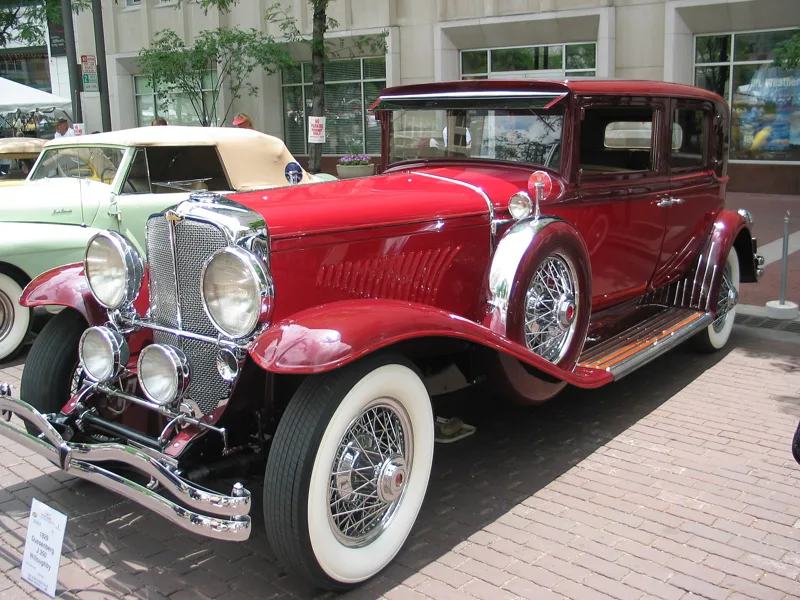
Ab Jenkins had set one-hour and 24-hour records in a modified Duesenberg SJ at Bonneville in October 1935, but concluded that production-based cars could no longer compete with aero-engined ones. He fitted a 25.73-litre Curtiss Conqueror, and the car, named "Mormon Meteor" in a Deseret News contest, set the 500-kilometre record at 264.69 km/h (164.47 mph) in 1936, plus 24-hour and 48-hour records. August Duesenberg built a sturdier chassis for the Mormon Meteor III, which set a 24-hour record of 259.39 km/h (161.18 mph) in 1940.
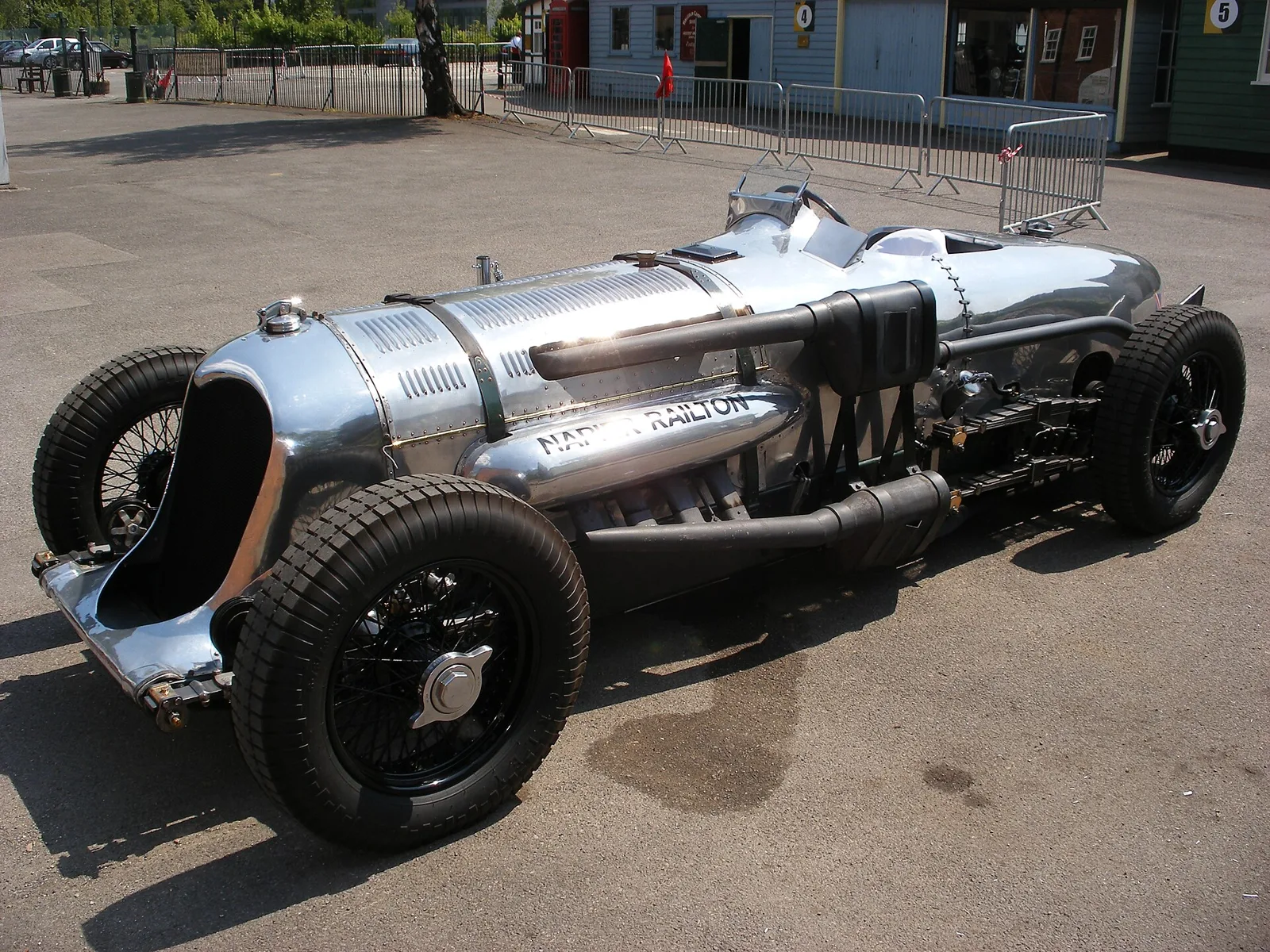
In 1937 George Eyston's Thunderbolt, with twin Rolls-Royce R engines, set 502 km/h (312 mph). A rivalry with John Cobb followed, whose Railton Special was teardrop-shaped with four-wheel drive and two Napier Lion engines. Eyston reached 556.01 km/h (345.49 mph), Cobb answered with just over 560 km/h (350 mph), and Eyston retook the title at 575.3 km/h (357.5 mph). Cobb returned in 1938 to set 369.7 mph.
Aero-engined speed records at a glance
| Year | Driver and car | Engine | Speed |
|---|---|---|---|
| 1924 | Eldridge, Mefistofele | Fiat A.12 bis, 21.7 L | 234.980 km/h (146.010 mph) |
| 1924 | Campbell, Blue Bird | Sunbeam Manitou | 235.22 km/h (146.16 mph) |
| 1927 | Segrave, Sunbeam 1000 hp | Two Sunbeam Matabele V12s | 326.66 km/h (202.98 mph) |
| 1929 | Segrave, Golden Arrow | Napier Lion W12 | 372.476 km/h (231.446 mph) |
| 1931 | Campbell, Blue Bird | Napier Lion, 1,450 hp | 396.04 km/h (246.09 mph) |
| 1937 | Eyston, Thunderbolt | Twin Rolls-Royce R | 575.3 km/h (357.5 mph) |
From Zborowski to Hollywood: the Chitty Chitty Bang Bang car
Ian Fleming took his inspiration from Zborowski's cars. According to Fleming, the original was built in 1920 on a pre-war Mercedes chassis with a six-cylinder Maybach military aero engine of the type fitted to Zeppelins, with four overhead valves per cylinder and twin Zenith carburettors. It weighed over 4.5 tonnes (5 short tons), had a bonnet 2.4 m (8 ft) long and was finished in grey. In the novel the car is described differently, as a twelve-cylinder, eight-litre supercharged Paragon Panther of which only one was made. The Pott family buy it as a wreck with the registration "GEN 11", read by the children as "genii", and Caractacus Pott restores it over three months.
For the 1968 film, several cars were built, with at least eight listed, two of them as the Paragon Panther racer seen before its crash. The main road-going car, called Chitty Prime, was designed by production designer Ken Adam and sculptor Frederick Rowland Emett and built by Alan Mann Racing in Hertfordshire in 1967. Its engine was a contemporary Ford 3000 Essex V6 with automatic transmission, in a wooden body made by shipbuilders. It is about 5.3 m (17 and a half feet) long and weighs 1.8 tonnes (2 short tons). Dick van Dyke, who drove it, said it had the turning radius of a battleship.
The other film cars
Chitty Beta, the second road version, was used as a stand-in and for publicity, and can be told apart by darker wood on a higher-set steering wheel and vertical bars behind the grille. A trailer-mounted, engineless Chitty (GEM 11) was built for close-ups of the actors while driving. One car got wings with folding propellers for the flying scenes, and an aluminium version was made for the tidal scenes, since the sea air was thought likely to corrode the brass radiator surround. The hovering Chitty was a shell on a speedboat, destroyed after filming. The ex-Racer No. 3 was rebuilt as a replica by Gordon Grant and displayed at the Brooklands Museum in 2014. The stage version holds the record for the most expensive stage prop ever used.
What the cars have fetched
Prices tell their own story. Chitty Prime, owned by Pierre Picton from the early 1970s, went to auction in Los Angeles on 22 May 2011. It was expected to reach US$1-2 million but was capped at $805,000 (495,415 pounds), with the winning bid from Sir Peter Jackson. The flying Chitty sold for US$37,000 in 1973 and US$505,000 in 2007. A licensed replica, GEN 22, was built by Tony Green from the original plans over three years from 2000.
Is anyone still building aero-engined cars?
The record chasers have moved on to turbine and jet power, but the idea has not died. The late 20th century and the 21st have seen a revival of interest in piston-powered aero-engined racing cars. Babs is back on display in Swansea, the Botafogo Special has been rebuilt by Pur Sang, and several replicas of Chitty have been built since the film.